Michael D.Heath-Caldwell M.Arch.


Michael Heath-Caldwell M.Arch
Brisbane, Queensland
ph: 0412-78-70-74
alt: m_heath_caldwell@hotmail.com
- Home
- Architectural Projects 0
- Architectural projects 1
- Architectural Projects 2
- Architectural Projects 3
- Architectural Projects 4

- The Crystal Palace
- Timeline
- 1693
- 1745
- 1770
- 1783
- 1784
- 1785
- 1786
- 1788
- 1789
- 1791
- 1792
- 1793
- 1794
- 1795
- 1796
- 1797
- 1798
- 1799
- 1800
- 1801
- 1802
- 1803
- 1804
- 1805
- 1806
- 1807
- 1808
- 1809
- 1810
- 1811
- 1812
- 1813
- 1814
- 1815
- 1816
- 1817
- 1818
- 1819
- 1820
- 1821
- 1822
- 1823
- 1824
- 1825
- 1826
- 1827
- 1828
- 1829
- 1830
- 1831
- 1832
- 1833
- 1834
- 1835
- 1836
- 1837
- 1838
- 1839
- 1840
- 1841
- 1842
- 1843
- 1844
- 1845
- 1845-46 Oxford
- 1846
- 1847
- 1848
- 1849
- 1850
- 1851
- 1852
- 1853
- 1854
- 1854/55 Appendix
- 1855
- 1856
- 1857
- 1858
- 1859
- 1860
- 1861
- 1862
- 1863
- 1864
- 1865
- 1866
- 1867
- 1868
- 1869
- 1870
- 1871
- 1872
- 1873
- 1874
- 1875
- 1876
- 1877
- 1878
- 1879
- 1880
- 1881-1
- 1881
- 1882
- 1883
- 1884
- 1885
- 1886
- 1887
- 1888
- 1889
- 1890
- 1891
- 1892
- 1893
- 1894
- 1895
- 1896
- 1897
- 1899
- 1900
- 1901
- 1902
- 1903
- 1904
- 1905
- 1906
- 1907
- 1908
- 1909
- 1910
- 1911
- 1912
- 1913
- 1914
- 1915
- 1916
- 1917
- 1918
- 1919
- 1920
- 1921
- 1922
- 1923
- 1924
- 1925
- 1926
- 1927
- 1928
- 1929
- 1930
- 1931
- 1932
- 1933
- 1934
- 1935
- 1936
- 1937
- 1938
- 1939
- 1940
- 1941
- 1942
- 1943
- 1944
- 1945
- 1946
- 1947
- 1948
- 1949
- 1950
- 1951
- 1952
- 1953
- 1954
- 1955
- 1956
- 1957
- 1958
- 1959
- 1960
- 1961
- 1962
- 1963
- 1964
- 1965
- 1966
- 1967
- 1969
- 1971
- 1974
- 1975
- 1976
- 1979
- 1983
- 1990
- 1991
- 1998
- 2001
- 2002
- 2004
- 2005
- 2006
- 2007
- 2008
- 2009
- 2010
- 2011
- 2012
- 2013
- 2014
- 2015
- 2016
- 2017
- 2018
- 2019
- 2020
- F.C. Heath-Caldwell
- C.H.Heath-Caldwell Memoirs
- Palmer Family
- Palmer Timeline
- 1912 - Palmer
- 1914 - Palmer
- 1916 - Palmer
- 1918 - Palmer
- 1919 - Palmer
- 1924 - Palmer
- 1925 - Palmer
- 1926 - Palmer
- 1929 - Palmer
- 1932 - Palmer
- 1934 - Palmer
- 1936 - Palmer
- 1938 - Palmer
- 1939 - Palmer
- 1944 - Palmer
- 1946 - Palmer
- 1961 - Palmer
- 1967 - Palmer
- 1970 - Diary - Joe Palmer
- 1971 - Diary - Joe Palmer
- 1972 - Diary - Joe Palmer
- 1991 - Diary - Joe Palmer
- 1992 - Diary - Joe Palmer
- 2010 - Diary - Joe Palmer
- Venice Earthquake 1873
- Old Letters 1
- Old Letters 2
- Old Letters 3
- Old Letters 4
- Old letters - Mid 1800
- More Old Letters
- Eaton Hall, 1943
- Marsh Family Timeline
- James Caldwell papers 1
- James Caldwell papers 2
- James caldwell papers 3
- Old letters 1800s
- Old Letters 1800s 2
- HH Sultan Taimur bin Turki 1913
- Frank Featherstone Wright 1921-2014
- Frank F. Wright 1
- Frank Featherstone Wright early
- Frank F. Wright 2
- Frank F. Wright Videos
- Old Featherstone album 1
- Old Featherstone album 2
- Old Featherstone album 3
- Old Featherstone album 4
- Old Featherstone album 5
- Arthur Eversfield Featherstone Album 1
- Arthur Eversfield Featherstone Album 2
- Arthur Eversfield Feartherstone Album 3
- Grasmere
- Frank E Wright Album 1a
- Frank E Wright Album 1b
- Frank E Wright Album 1c
- Frank E Wright Album 1d
- Frank E Wright Album 1e
- Frank E Wright Album 1f
- Frank E Wright Album 1g
- Frank E Wright Album 2a
- Frank E Wright Album 2b
- Frank E Wright Album 2c
- Frank E Wright Album 2d
- Frank E Wright Album 2e
- Frank E Wright album 2f
- Frank E Wright Album 2g
- Frank E Wright Album 2h
- Frank E Wright Album 2i
- Frank Edward Wright drawings
- Cathy Featherstone 1910a
- Cathie Featherstone 1910b
- Norma Featherstone 1913
- Norma Featherstone Part2
- Norma Featherstone Part3
- Norma Featherstone Part4
- Norma Featherstone Part5
- Kitlands House
- Moorhurst Manor
- Redlands House
- Milland House
- Anstie Grange
- Ebernoe House
- West Ham House
- Vigo House
- Linley Wood
- Crimean War
- James Caldwell letters 4
- James Caldwell letters 5
- James Caldwell letters 6
- James Caldwell letters 7
- James Caldwell letters 8
- James Caldwell letters 9
- Eton & Oxford 1830/40s A
- Eton & Oxford 1830/40s B
- Eton & Oxford 1830/40 C
- Eton & Oxford 1830/40 D
- Eton & Oxford 1830/40 E
- Eton & Oxford 1830/40 F
- Back in England. Early 1800s
- Arthur Heath 1872-4
- Sicily 1800
- Naples - 1830
- Trentham Hall
- Paris 1810
- Cromptons on the Lusitania
- HMS Illustrious 1948
- The Minoans
- Henry Crompton 1836-1904
- Orongorongo 1957
- Another Page
- Gertie Wheeler 1909
- The Ahsan Manzil
- More old letters 1800s
1817 - 1818 - 1819
James Heath R.A. 60/61 - Engraver
Mary Heath (ne Phillipson) 60/61
George Heath 38/39 - Attorney
Anne Raymond Heath (ne Dunbar) 30/31
Julia Anna Harrison (ne Heath) aged 10/11
John Moore Heath aged 9/10
Douglas Denon Heath aged 6/7
Dunbar Isidore Heath 2/3
Leopold G. Heath 0/1
Charles Heath 32/33 - Engraver/Publisher - Half-brother of George Heath - Attorney
Elizabeth Heath (ne Petch) - 28'ish
The Heath Family Engravers 1779-1878, Volume 1. James Heath A.R.A. by John Heath
Cooke's British Theatre - engraved by James Heath after various artists. - published by C.Cooke. Although first published in 1818, the plates here are all dated '1820' except for No.6. which is undated. The proofs of these engravings were re-published under the title 'Theatrical Prints,' with 54 plates varoiusly dated from 1816-1820
1. - Alzira: Act 3, Sc.1 - plate sizes 14 x 10.
2. - The Grecian Daughter. Act 2, Sc.1
3. - The Mourning Bridem. Act 2, Sc.2
4. - Chances. Act 4. - 'James Heath A.E.R.A.'
5. - The Suspicious Husband
6. - The Miser. Act 5, Sc.1 'James Heath R.A.'
----------------------------------------------
Milton's Lycidas - engraved by James Heath after J.Thurston. Published by J.Bumpus. Another part of Milton's works.
1. - Vol.III. 'Nothing invites us more...' 'Publ. 30 May 1818' - plate size 10 x 8cm.
----------------------------------------------
The Lady's Magazine - published by S.Robinson. See 1804 for the original plate. A re-engraving for the Lady's Magazine, with a different publisher.
1. - Thomas Morton -
after 1817
Letter, James Heath to Dawson Turner.
My dear Sir,
I thank you for two braces of pheasants.
I fear your friendly desire of gratifying me may have been inconvenient to yourself.
I beg your acceptance of an etching of the Pilgrims and a proof in the medium state of the Plate. As this was the only Proof taken in that state, it will I hope be better worth your acceptance Dear Sir,
Yours truly,
James Heath
Wednesday 14 January 1818
Morning Post
Distressed Seamen. At a Committee held at the King's Head Tavern in the Poultry, January, Simon Cock Esq. in the Chair. - Amount of Subscriptions already advertised - £1,759
Among the Subscriptions already advertised - - - Sir Graham Moore - £5.5.0 - - Messrs Heath, Son, and Furse (?) £10.10.0 - - -
Tuesday 20 January 1818
Star (London)
Insolvent Debtors' Court, January 19
The Insolvent Debtors' Court met at ten o'clock this morning. There were 32 cases on the day's list, 17 or which were opposed.
The application of Francis Brisco was opposed by Mr.Heath under the following circumstances: The Learned Counsel said, that the Insolvent acted as sub-officer to a regular officer for the hundred of Ossulton: and while so acting, had converted to his own use a sum of money which he received on account of Plaintiffs, whose warrants he had served. The sum, so far as the opposing creditor (Mr.Henley) knew, amounted to £31/. He was called on to pay it, and he had done so. Perhaps some further sums would be called for, which the Plaintiff at present knew nothing about. - - -
In his cross-examination by Mr.Pollock, he said that he had repeatedly called on Mr.Henley for a settlement of his accounts, and the latter put him off from time to time. His own understanding of his engagement was, that he should have seven shillings a week for his trouble, besides the understood fees he received. - - -
The Court remanded the Insolvent, under the 34th clause of the Act, which makes it penal for a servant to convert to his own use the property entrusted to him on the account of his master.
[Friday 20 March 1818]
Globe
Sussex Lent Assizes - Horsham, March 18.
Brighton Murder
The Grand Jury having yesterday ignored the Bill of indictment against James day, a private soldier in the 21st regiment of Royal Scotch Fusilliers, and James White and John Williams, two respectable inhabitants of Brighton, the former charged as a principal in the wilful murder of Thomas Rowles, in the parish of Brightelmsone, on the 5th of November last, and the two latter as accessories thereto, they were this morning severally arraigned upon the Coroner's Inquest, in order to take their trials. They severally pleaded Not Guilty. The Prisoners had all be admitted to bail, and surrendered this morning. Day was placed within the dock, and the others (who were men of respectable appearance) were exampled from this ignominious ceremony, and stood in the place allotted to Attornies.
Owing to the frequent discussion of this case, and the universal interest excited thereby, the Court was crowded to excess, although it was generally reported last night that no evidence would be offered in support of the prosecution. - - -
Mr.Baron Graham said, he was justified in stating, that as far as he could collect the circumstances of the case, as well from the depositions as from the statements elsewhere, the Defendants were wholly free from blame, the misfortune having arisen, as appeared to him, from accident.
The Defendants were all found - Not Guilty and immediately discharged.
Mr.Ballantyne was Counsel for Day, and Mr.Heath for Mr.White
Thursday 5 February 1818
Morning Herald (London)
Artists General Benevolent Institution, for the Relief of Decayed Artists in the United Kingdom, and their Widows and Orphans. Joint Patrons - His Royal Highness the Duke of Kent, and his Royal Highness the Duke of Sussex. Fourth Public Anniversary Dinner. His Royal Highness the Duke of Sussex in the Chair. Directors -
J.M.W.Turner Esq., R.A. Chairman and Treasurer. - - -Charles Heath Esq. - - - -
The Dinner will take place on Thursday March 5th at the Albion House, Aldersgate St.
Stewards - W.Alston Esq. J.Backler Esq. - - - Henry Corbould Esq. - - - Charles Heath Esq. - - - G.B.Lonsdale Esq. - - -
Tickets may be had of the Stewards, and at the Bar of the Albion House, at £1.1s each.
Thursday 5 February 1818
British Press
Shenstone.
The personal property in the possession of Mr.William Spencer of Hurcott, Worcestershire, lately deceased, belonging to the Bard of the Leasowes, was given to him by his relative, the late Mr.Hodgetts, of Hagley, and consisted of his portrait, gold watch, gold-headed walking cane, and a blank pocket volume of paper. The portrait is a half-length front-face,in the finest preservation, and bears evident marks of being a very striking likeness to Mr.Shepstone, when rather at an advanced period of his life. I was led to hope, when Mr.Spencer first shewed me the MS. at Hurcott, that it contained such relics of Shenstone's muse, as would have enabled me to have laid a new edition of his poetry (which, with materials communicated to me by my father-in-law and my mother, respecting the Poet, and Miss Mary Ashton, the lady of exquisite beauty he so much admired, who resided at Hayborough, between Kidderminster and Hagley), as would have been interesting to the public: but the volume did not contain a page of novelty to rescue it from that oblivion to which it seems to be consigned.
The portrait ornaments the parlour at Hurcott, a beautiful and cozy spot, long the residence of his family, which his own hands had, in a great measure, erected; and he always evinced, when he shewed them to me, the highest pleasure in being the possessor of them; they will long continue steadfast memorials of the genius of the Leosowes; and, as connected with him, I thought the communication thus far interesting.
Mr. Wm. Spencer was one of eleven children, nine of whom are now living to lament the sudden separation of the best of brothers - for he was an eminently honest man; and the peaceful tenor of his life rendered him greatly esteemed throughout the whole of the surrounding neighbourhood.
Charles Heath.
Friday 13 February 1818
Statesman (London)
Court of King's Bench Feb.12
The King v James Heath
The Defendant had been ordered to be fined for not attending as a Juryman on the trial of Arthur Thistlewood, Watson, and others, and the Attorney-General now replied to an affadavit filed by the Defendant, as the ground on which he claimed to be relieved from the penalties, stating that he had received a summons to attend as a Juryman, but not being a freeholder he expected to be challenged, and therefore did not attend; and that he was ignorant of any fine having been imposed upon him by the Court until the present month of February. The Attorney-General said, it was not his wish to press the enforcement of the fine, if their Lordships thought that, under the circumstances stated by Mr.Heath, he ought to be excused. It was his business to have attended on receiving the summons, and then to have stated his disqualification.
Lord Ellenborough said, it certainly was the duty of the Defendant to have attended according to the summons; but, inasmuch as it appeared from his affidavit, that he had been led into error, and as he would have been discharged if he had attended, the Court was disposed to view his neglect as a venial matter, and would therefore now discharge the order made against him.
Saturday 14 February 1818
Morning Post
The Arts
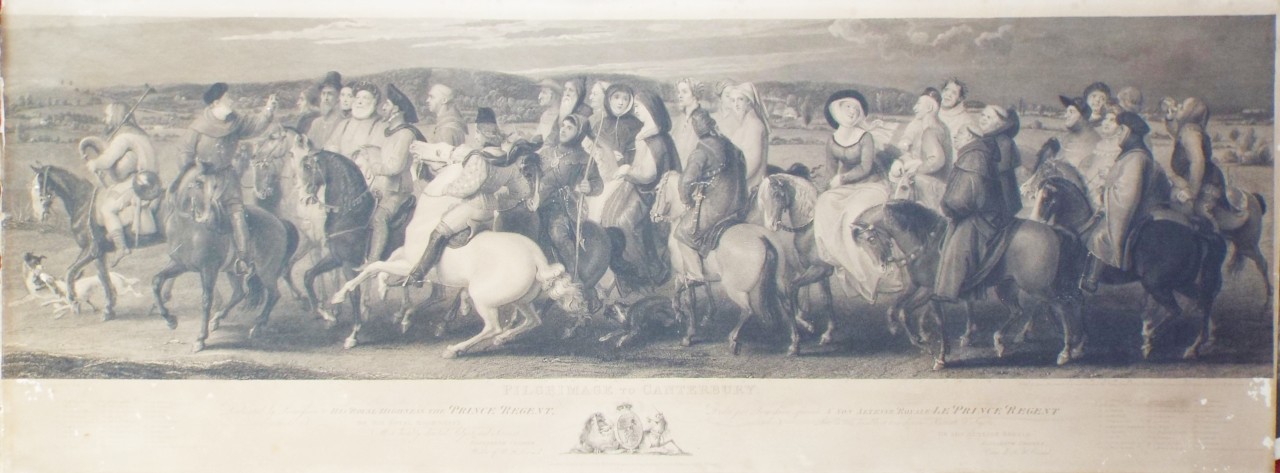
Procession of Chaucer's Pilgrims to Canterbury
The Print (which is just published) is one of the finest pieces of Engraving we have ever witnessed. It is from the celebrated Cabinet Picture painted from this subject by Thomas Stothard Esq., R.A., etched by the late Louis Schiavonetti Esq., V.A., engraved in the Line manner by James Heath Esq., A.R.A. Of the original painting it has been justly observed that it would have done honour to any School at any period; it was a subject worthy of the highest qualifications in the Graphic Art, and the Engraver has done most ample justice to it in all its numerous parts.
The scene of the Picture is laid in that part of the road to Canterbury which commands a view of the Dulwich hills - the time, a beautiful and serene May morning - -- -
Tuesday 24 February 1818
Morning Post
Artists' General Benevolent Institution, for the Relief of Decayed Artists in the United Kingdom and their Widows and Orphans. Joint Patrons - His Royal Highness the Duke of Kent, and his Royal Highness the Duke of Sussex - Fourth Public Anniversary Dinner. His Royal Highness the Duke of Sussex in the Chair. Directors:- J.M.W. Turner Esq, R.A. Chairman and Treasurer, - - Charles Heath Esq., James Lonsdale Esq., Sir Thomas Lawrence R.A., - - - Tickets may be had of the Stewards; and at the Bar of the Albion House, at One Guinea each.
Saturday 28 February 1818
Sun (London)
Sixth Edition of Lalla Rookh. This day published in 8vo. price 14s. Lalla Rookh, an Oriental Romance, - By Thomas Moore Esq., - - Also just published,in 8vo. price 12s. Illustrations to the Poem, engraved by Charles Heath, from Paintings by R.Westall R.A., A few of each may be had in Quarto.
Sunday 22 March 1818
Windsor and Eton Express
In order to lessen, if not prevent, the frequency of forgeries, the following certificate ofthe efficacy of a plan was offered to the Directors so far back as the year 1797.
"London, 5 April 1797.
Mr Alexander Tilloch, of Carey St, London, having submitted to our inspection a specimen of an art invented by him, for the purpose of producing checks to prevent the forgery of bank notes, bills of exchange, drafts, &c. we have examined the same with care and attention, and we declare each of us for ourselves that we could not make a copy of it, nor do we believe that it can be copied by any of the known arts of engraving. It, therefore, appears to us highly deserving of the notice of the Bank of England and private Bankers, as an art of great merit and ingenuity, calculated, not merely to detect, but to prevent the possibility of forging bank and other circulating bills (signed)
Francis Bartolozzi R.A. Engrave to the King.
James Heath, Engraver to His Majesty and to the Prince of Wales.
James Fittler, Engraver to his Majesty.
J. Landseer, Engraver to His Majesty.
J.R.Smith, Engraver to the Prince of Wales
Francis Harward, Engraver to the Prince of Wales.
James Basire, Engraver to the Royal Society, and to the Society of Antiquarians.
William Sharp.
etc.
Wednesday 25 March 1818
Morning Post
Italy - On the 1st of April will be published the First Number of Italian Scenery; or Views of the most remarkable, celebrated, or admired Points of Italy: from Drawings taken in the Year 1817, by E.F.Batty.
The Plates will be engraved in the very best style by Mr. Charles Heath, and other artists; and the Work will be published in Numbers, in Imperial Octavo; each Number to contain Five Plates, with Letter-press illustrative of the Views, and with reference to the most popular ancient and modern Authors upon Italy, Foreign as well as English. The Work will not exceed 12 Numbers, to be published regularly every Two Months till complete. The price of each Number will be Half a Guinea. A Small number of Copies will be printed in Royal Quarto, price Sixteen Shillings. Also the Seventh Number of Pompeiana: or, the Topography, Edifices, and Ornaments of Pompeii: by Sir W.Gell F.R.S., &c. and J.P.Gandy, Architect.
Printed for Rodwell and Martin, New Bond St; sold also by J. and A. Arch, Cornhill.
Tuesday 31 March 1818
Morning Post
A few days ago we laid before our Readers a Copy of a Certificate, dated 5th April, 1797, signed by the First Engravers in London, stating that a specimen of an art, invented by Mr. Alexander Tilloch, calculated greatly to lessen, if not prevent entirely, the forgery of Bank Notes, Bills of Exchange, &c., had been exhibited to them;that they had examined the same and declared each of them for themselves, that they could not make a copy of it, nor did they believe that it could be copied by any of the known Arts of Engraving; and they they thought it highly deserving of the attention of the Bank of England, as calculated to answer the purpose for which it was offered. The Certificate alluded to was signed by Bartolozzi, Heath, Fittler, Landseer, Lowry, Sharp, Bryne, Holloway &c.
Since that time we have learnt that some people connected with the Bank have stated, that the proposed plan was rejected by the Bank, because their Engraver had made a perfect copy of the Specimen offered to the Bank; and because Mr.Tillock himself had admitted that his Art was not perfectly applicable to their system.
The latter assertion, we are well assured, is untrue, Mr. Tilloch having always maintained that his invention was perfectly applicable to the business of the Bank. As the most decisive answer to the former statement, we insert the following certificates:-
"London 6th July 1797
We whose names are heretofore subscribed do hereby certify, that we were called, on the 4th July, instant, to examine an attempt, made at the Bank of England, to produce a facsimilae of Mr.Tilloch's Specimen of an Art invented by him to prevent Forgery; that two imitations, the one from a Woodcut, the other from a Copperplate, were then produced by Mr.Terry, the Bank Engraver; that the one from the wood-cut was so totally unlike Mr.Tilloch's Specimen that Mr.Terry did not endeavour to make it be received as a likeness, but withdrew it; and that the copperplate which was produced as a Copy, was so far from being an exact Copy, that it was not even executed in the same manner; Mr. Tilloch's being printed from the surface of his work, by means of the letter-press; but Mr.Terry's from the bottom ofhis, by means of the rolling-press.
We declare besides, that , in other respects, the Imitation was so unlike the Original, that we believe it by no means probable that any person in the habit of taking Bank Notes, would ever take the one for the other. We believe that one of Mr.Terry's Imitations would be easily detected among the thousand of Mr.Tilloch's Specimens; and that one the latter, put among the same number of the former, might, from its singularly peculiar effect, and very superior execution, with equal facility be taken from among them by any person of common discernment. Mr Terry's being not more like to the Specimen than a brass counter with the King's head upon it, to guinea.
"We think it but justice to Mr.Tilloch's Invention to add, that if once the public eye were habituated to Bank Notes executed by his Art, the security against forgery would be infinitely greater than the Bank Directors, with whom we were at the examination, seemed to have any idea of.
This declaration we make, not from any personal acquaintance with Mr.Tilloch, or from that bias which may sometimes be supposed to result from habits of intimacy (for the greater part of us never were in his company, or knew any thing of him, till the moment we were desired to give our opinion of his Art, but we do it as a duty which we believe in our conscience we owe the to the Community who ought to be secured as far as possible against the losses to which they are subjected by the facility with which all the Bank Notes now in circulation may be, and, as the Directors themselves confessed are frequently forged.
James Heath James Fittler `William Byrne
William Sharp Wilson Lowey - - - continues
Tomorrow, we shall lay something further before our Readers on this interesting subject.
Wednesday 1 April 1818
New Times (London)
Forgeries of Bank of England Notes.
The following is the certificate of the efficacy of a plan to lessen, if not prevent, the frequency of forgeries, which was offered to the Directors so far back as the year 1797.
ditto.
It was afterwards stated, that the proposed was rejected by the Bank, because their engraver had made a perfect copy of the specimen offered to the Bank; and because Mr.Tilloch himself had admitted that his art was not perfectly applicable to their system.the latter assertion is absolutely false. Mr.Tilloch has always maintained that his invention was perfectly applicable to the business of the Bank, and the most decisive answer to the former statement is given in the following certificates:-
James Heath, Engraver to his Majesty and to the Prince of Wales. - -
Saturday 4 April 1818
Morning Herald (London)
William Marshall and Thomas Duffin were tried under Lord Ellenborough's Act, for having violently assaulted and wounded John Sharp, in the churchyard of Lambeth, on the night of the 30th of November.
John Seager, sexton of the parish of Lambeth, had employed the two prisoners to assist him in watching the church-yard for a fortnight, to the 30th of November. Marshall had been so employed the previous winter. There were four or five burials on Sunday, the 30th of November, at three o'clock. Witness and his sons had repeatedly gone round the church-yard to see that all was safe. In the evening, after having locked the church, he went into the burial-ground to set man-traps, unknown to Marshall, but Marshall followed him, and saw him set them. He demanded the key of Marshal; but he refused it, saying he wished to look in the ground afterwards.
Between eleven and twelve o'clock, when witness and his sons came into the house, the saw two men, and heard them conversing about the graves, going first to the ground where the poor were buried, next to the ground for the burial of children, and then to the bone-house, and took two shovels, with which they went to the poor-grave. He knew them to be the prisoners at the bar. Marshall pulled off his coat and set a digging in the poor-grave, till he came to the coffin. Duffin was with him at the foot of the grave. Witness heard the clearing of the mould from the top of the coffin; he came forward to the head of the grave, about twelve paces from it, and said, "You scoundrels, don't you want som' assistance there."
Duffin, using very bad language said, "We are took to." Marshall struck him with the shovel, but missed. Witness said, "Will, don't you know me?" He replied, with a bitter oath, "I know nobody." Witness parried a second blow with a fowling-piece he had in his hand, and struck Marshall, so as to set him a-reeling. Marshall then shifted the shovel into his left hand, and swore he would do for him now. Witness called for assistance, being unprotected: his son Joseph came forward, and asked, "Will you shoot your master?" He replied, "Yes, and you too." His son fired with a pistol over his head, and he surrendered himself immediately.
Marshall was secured with much struggling and difficulty. Witness did not see Sharp or Duffin; he was occupied only with his own preservation. The shovel was produced, and identified. On his cross-examination, he said that the second time he spoke to the prisoner, he said, "Surrender or I'll shoot you." He had a fowling-piece in his hand. Marshall had made the first blow at him before he said so. - - -
Mr. Heath replied. - Whatever might have been the intention of Mr.Seager and his party, it was not made known to the prisoners before the made the assault. This was particularly the case as to Duffin's conduct, which was the ground of the indictmen.
Mr.Baron Wood said he would reserve the points of law for the Judges, if the Jury found the prisoners guilty. - - -
Saturday 18 April 1818
Mirror of the Times
Insolvent Debtors' Court
There were nearly 200 cases fixed for examination at the present Sessions, which commenced on Thursday, and continued until this day, but they chiefly related to matters devoid of public interest.
Conduct of an Agent
This day an occurrence took place which shews the necessity of the utmost circumspection in the appointments of agents to practise in this Court. Many frauds had been practised upon unfortunate insolvents by persons who acted as their agents, and were entrusted with the management of their causes. It is but justice to Mr.Serjeant Runnington, the Chief Commissioner under the Acts for the Relief of Insolvent Debtors, to state that he had invariably suspended the parties on proof of misconduct, and also taken the utmost pains that responsible situations of this kind shall be filled by proper individuals.
Just before the Court rose, Mrs.Cecilia White, a female of respectable appearance, who had applied for her discharge, was put into the witnesses' box for examination.
Mr.Heath opposed her application on the part of one of her creditors.
The insolvent expressed her astonishment, and said, that her friends had employed Mr.Day, one of the agents who acted in that Court, to assist in effecting the legal formalities necessary to support her application. He had been instructed to engage Mr.Andrews and Mr.Heath as her counsel, and five guineas and half a crown had been paid him for the fee of the former, and three guineas and half a crown for that of the latter. She was ready to prove this fact, and was therefore astonished to find Mr.Heath, instead of assisting her, prepared to oppose her discharge.
Mr.Heath said he had received no instructions to defend the insolvent, and his clerk confirmed this declaration.
The agent, Day, who was in Court, said it was all a mistake, which could be soon rectified.
The insolvent, after examination, was discharged, and Rogers, an attorney, expressed himself ready to draw up an affidavit of the charge against the agent, which the insolvent was ready to prepare for the Court at its next meeting.
Wednesday 6 May 1818
The Engraving of the large plate of the "Healing of the Sick in the Temple," after Mr.West's Picture, purchased of hom by the Directors of the British Institution,is now in a very forward state, under the masterly graver of Charles Heath
Friday 22 May 1818
Liverpool Mercury
Chaucer's Pilgrimage to Canterbury.
(Dedicated, by permission of His Royal Highness the Prince Regent, from the original celebrated Cabinet Picture by Thomas Stothard Esq., R.A., Etched by Schiavonetti, and finished in the best manner by James Heath Esq., A.R.A.
Mrs.E.Cromek, widow of the late R.H.Cromek, the projector and proprietor of the work, has the pleasure to announce to the Subscribers and Amateurs of the Fine Arts, that the Engraving is now finished in as stile so splendid and masterly as in the opinion of the most competent judges, to reach their warmest approbation.
Mrs.C. also begs to say, that she will remain in town for a few days, for the purpose of delivering the Impressions to the Subscribers.
The Print may be inspected at Messrs Robinson and Sons, Castle Street, and any commands addressed there, or Mrs.Cromek, 16 Basnett Street, will meet with immediate attention.
The Print is exactly the size of the Picture. The price of the Print is Three Guineas, Proof Impressions, Five Guineas, and on India Paper, Six Guineas. The Price of the Proofs on India Paper will be shortly advanced to Non-Subscribers.
Thursday 28 May 1818
Morning Advertiser
Insolvent Debtors' Court, May 27
Alleged Concealment of Property and Charges of Gross Fraud.
Several Creditors v Thomas Carter.
The insolvent, Thomas Carter, a coach-master and dealer in horses, late of Ipswich, was opposed by Mr.Pollock on behalf of the creditors, and supported in his application to the Court for relief under the Act by Mr.Heath.
This case occupied the Court and the interest of a large audience for a very considerable time.
The insolvent being examined, stated that the debt amounted to £236/. He was a coach-master and dealer in horses at Ipswich; he received the sum of £350/. a short time before he went to prison; he paid it to his creditors, except the sum which he had expended in his confinement. The £350/. he received for horses sold at Mr.Aldridge's stables. He had given up all his property; he had not concealed any thing, he was positive; he had been doing business since his imprisonment in the King's Bench; he had day rules.
The insolvent was re-examined by his Counsel, Mr.Heath, pointed out to the Court the persons to whom he had paid the different sums to.
Mr.Pollock called the following witness to prove the charges against the insolvent.
Israel Alexander being sworn, said - -- - The insolvent has had horses since his confinement, and now has a house in the London Road. I went with him to take it, and to purchase furniture. The remainder of the goods came from Ipswich in a wagon. The insolvent told me they were removed by night from his premises at Ipswich. I was at Aldredge's the day after the sale of the insolvent's horses, and I know he received £370/. for them.
Witness being cross-examined by Mr.Heath, said, I know the insolvent received £370/. because the clerk of Mr.Aldridge told me so. I was at Aldridge's the day after the sale. I believe the sale was about the 25th of December last. I and the insolvent were good friends, but are not now. We quarrelled; he assaulted me - knocked me down, and bit off half my ear.
Mr.Heath. - I advise you now to be careful how you answer my questions.
Witness. - I shall. I know the insolvent has property concealed. I took the act about four months ago. I swore at the time I had been in prison three months prior to the time I took the benefit of the act.
Mr.Heath. - The Insolvent came to you, to learn how he could cheat his creditors?
Witness. - Yes; but I did not advise him to cheat them.
Mr.Heath. - Very well; but you have sworn that you were at Mr.Aldridge's the day after the sale of the horses?
Witness. - So I was.
Mr.Heath. - This is an account of the sale, dated the 24th of December last year,.
Witness. - Yes, it is; I know the hand-writing.
Mr.Heath. - Now, Mr.Alexander; pray, how came you to swear you had been in prison three months, when you had been at Aldridge's several times within three months?
Witness. - I must be mistaken.
Mr.Joseph Basely, Inspector to the Commissioners of Stamps, being sworn stated, that he knew the last witness, and he knew that he was not to be believed on his oath. He was now in prison for money he owed Government, and every person in the Stamp Office who knew Alexander, he believed, was of his opinion.
The Court interposed, and said that he believed the evidence of Alexander was totally false, and ordered the Insolvent to be discharged.
Saturday 30 May 1818
Morning Advertiser
Insolvent Debtors' Court, May 29.
Ackland v Horton.
The defendant, Mr.Horton, an inspector of hides in Leadenhall Market, was opposed in his discharge by Mr.Heath, on the part of Mr.Ackland, an extensive carcase butcher in Leadenhall Market; on the ground of concealment of his property, an putting the creditor to expence by pleading to an action, which afterwards he did not defend, but suffered judgment to go by default.
The insolvent denied that he had any knowledge that his Attorney put in a plea to the action brought by Mr.Ackland.
Mr.Pollock addressed the Court on the part of the defendant upon that point of objection; and -
Mr.Serjeant Runnington over-ruled the same.
Mr.Heath then proved by witnesses that the Insolvent held a situation as inspector of hides, which brought him in £150/. per annum; he hoped the Court would apportion some part of that income towards paying his debts.
Mr.Pollock resisted the proposition, and stated that unless the insolvent was elected next Monday to the situation of Inspector of Hides he would not have a shilling income.
The Court ordered that the insolvent be discharged upon his agreeing to pay £20/. per annum out of his income arising from the situation of Inspector of Hides, towards the payment of debts.
Tuesday 23 June 1818
Morning Advertiser
Yolland v Clements
This was an action brought by the plaintiff, steward to the Ear of Morley, to recover from the defendant, proprietor of the Newspaper called the Observer, a compensation for a false and malicious libel inserted in that paper, reflecting on his character, and tending to injure his reputation. The libel complained of was contained in a publication inserted in the Observer of the 28th of April last, purporting to be a report of the proceedings which took place in the Insolvent Debtor's Court on the day previous, in the case of an Insolvent named Kerswell. The Insolvent's discharge was opposed by the plaintiff, who was steward to Lord Moreley, and a brief was given to Mr.Bassett, one of the Counsel practising in that Court.
Mr.Heath, another Counsel, was retained by the Insolvent. In the Report of the proceedings, as published in the Observer, the examination in chief to the Insolvent by Mr.Bassett was omitted, whilst the speech of Mr.Heath was reported to have said, "I am satisfied no Peer of England would ever have been concerned in such infamous conduct. It must have been the act of the Steward Yolland;" and in another part of his speech he was made to say, "It was Mr.Yolland's constant practice to distrain for rent, then to buy the stock himself - it was that Yolland, for whom his Lordship had to pay £1,000/. for his conduct at the Exeter Sessions." - These were the libellous paragraphs complained of.
A person named Edmonds, was called, who stated, that he gave the report of the proceedings to the "Observer" newspaper. He was certain he had given the substance of Mr.Heath's speech correct, if not his very words.
Several people were called to prove the contrary.
Mr.Bassett stated, that he considered the report of the proceedings as most incorrect; the whole of his examination in chief was omitted, and he was certain Mr.Heath did not in the course of his speech, use the expressions as applicable to Mr.Yolland, which was stated in the Report.
The Jury, after a charge from his Lordship, found a verdict for the plaintiff - Damages £100/. - Costs 40s.
Wednesday 24 June 1818
Evening Mail
Court of King's Bench, Monday, June 22
Sittings for Middlesex before Lord Ellenborough and a Special Jury
John Yolland v W.J.Clements
An action on the case for a libel published in the Observer newspaper of the 27th of April. The pleas were not guilty, and a justification, that the alleged libel was a true and faithful account of what passed in the Insolvent Debtors' Court on the 21st of April.
Mr.Scarlett in opening the plaintiff's case observed that the libel in question was one of the most false and malicious attacks that had ever been made upon the character of a private individual. It purported to be a correct account of what had passed in one of our public Courts, and this pretence rendered it infinitely more injurious. - - -
Lord Ellenborough recommended, instead of wandering into these extraneous matters, that the plaintiff should proceed shortly to falsify the plea of the defendant. - - -
Mr.James Boys deposed, that he had attended the Insolvent Debtors' Court on the occasion in question, as attorney for one of the parties: he did not consider the libel as a faithful report of what passed by any means: it did not contain the whole of what occurred; a great deal was omitted, and it seemed entirely an exparte statement.
He did not hear Mr.Heath, counsel for Curswell, say any thing to the effect that Lord Moreley had been obliged to pay £1,000/. at Exeter for Yolland; had it been said, he must have heard it; nor did he hear Mr.Heath state that it was the plaintiff's constant practice to distrain for rent and buy the stock himself. Many other things were put much more strongly than they had been stated by Mr.Heath: the whole was exaggerated. Something was said about Yolland purchasing stock, but not that it was his constant practice to do so. The examination in chief of Curswell, by Mr.Bassett for Lord Morley was entirely omitted. - - -
Lord Ellenborough here intimated a very strong opinion that the justification had been falsified. The proprietors of newspapers were at least bound to be impartial; but here it seemed clear, that important points had been omitted, and others inserted merely as volunteers. - - -
Mr.Chitty, who was with Mr.Gurney, here suggested that one of the allegations on the part of the plaintiff had not been proved, viz. that the Christian name of Mr.Heath was George. Lord Ellenborough was upon the point of deciding that the objection was fatal, when Mr.Scarlett fortunately found that in one of the counts it was stated as "one Mr.Heath" without the avermath of any Christian name. The following was then produced for the defendants.
Mr.Edward Edmonds swore, that he was in the Insolvent Debtors' Court on the day in question, and attended particularly to the proceedings. He afterwards gave a report of it to the editor of the Observer; the alleged libel was printed from his statement; it was a true and faithful account: the words attributed to Mr.Heath were nearly those he used, and certainly the sense he said: "I am satisfied that no peer of England would be concerned in such infamous conduct; it must be the act of his steward, Yolland." Mr.Bassett made no speech at all, but merely applied to have the case postponed to the next sitting, that he might bring up other witnesses. Mr.Heath also said that it was Yolland's constant practice to purchase stock, sold under distress.
Cross-examined. - The witness was a reporter for the Observer, and sometimes for other newspapers. He had never said he would give the steward a good trimming. Mr.Bassett never gave him a caution as to what he published about Lord Morley. While in Court, some of the counsel might say, "I hope you mean to give this to the papers, as it deserves to be published."
He could not state who had said so, whether Mr.Heath, Mr.Pollock, or Mr.Bassett - probably not the latter, though he had since admitted that the report was fair but in one or two particulars. Some part of this proceeding the witness had taken in short-hand - not the whole. He might have seen Mr.Heath's brief before he wrote the account of the proceedings: it was not uncommon for gentlemen in the Insolvent Court to show their brief to persons attending to take notes: most likely he had had possession of Mr.Heath's brief - he could not state positively - he did not take it home with him - he certainly never took the brief out of Court - he might possibly have had it in Court - he had had it in Court, and read some of it - it might be when it was before Mr.Heath. He did not get Mr.Bassett's brief. He could not recollect the terms Mr.Bassett used when he "endeavoured to work upon the mind of the Court, against the prisoner." He was not the author of the introductory paragraphs on the Monday; but between the Sunday morning and the Monday afternoon he had seen the defendant. He did not know whether Mr.Heath's name was or was not George. He did not recollect to have seen it on the back of the brief.
Samual Emery had been present, and saw the Observer soon afterwards. He believed that the substance of the statement was correct.
Cross-examined - He was an agent to the Insolvent Court. Mr.Heath always signed his name "G.Heath." The witness gave the brief to the last witness, who asked him to allow him to look it over; he lent it him for two minutes, and when the witness returned into Court he could not find Edmonds, and did not get the brief back for a week afterwards. - - -
Lord Ellenborough remarked, that Mr.Bassett was the defendant's witness, and what he said must therefore be taken most strongly against him.
Mr.Scarlett replied and -
Lord Ellenborough charged the Jury, repeating the opinion he had previously expressed; that a party publishing what passed in a court of justice did not discharge himself from liability by showing that the report was faithful and contained only what in fact occurred.
The Jury consulted for a few minutes, and found a verdict for the plaintiff, damages £100/.
Friday 24 July 1818.
The Heath Family Engravers 1779-1878, Volume 3. by John Heath
Letter to John Murray from Charles Heath)
Dear Sir,
Your Plates for Lord Byron's Poems are most of them very forward and shall be proceeded with immediately till out of Hand - They would have nearly been finished by this time, but I have been very unwell for the last Six Weeks, so much so, as to prevent my doing a line of Engraving.
I am getting better, and will do all I can to oblige you respecting the Plates. Perhaps as you are in haste for them you will give me Leave to put some of the Plates in other Hands, such as Mr.Finden, Engleheart, Robinson, etc to bear their names and to have the same power with myself, which to save you trouble I will pay - and you can settle with me as if I did them all.
If you oblige me in this they can soon be done, and I will undertake they shall be all beautiful Plates. I would send you Proofs of them fit to prove according to your request but have not time, having only received your letter yesterday.
You may rely on my doing all I can to get the work out - it will much oblige me to be favoured with an answer to this by return of Post, and I will make the arrangements necessary. Shall you have any more drawings made for the last Poems published to complete the set?
With best respects believe me, my Dear Sir, Yours truly and Obliged.
Charles Heath
6 Seymour Place.
Euston Square.
Monday 17 August 1818
Champion (London)
Trial of Chennel and Chalcraft for the Murder of Mr.Chennel and his Housekeeper.
Wednesday Aug.12. - At a very early hour this morning, the Court, and all the avenues leading to it, were filled up, so great was the public anxiety to hear the trial of these prisoners.
At eight o'clock Mr.Serjeant Lens proceeded to the Court, when the prisoners, George Chennel and J.Chalcraft were arraigned for the wilful murder of O.Chennel, at Godalming, on the 10th of Novmeber last; and on a second indictment, for the murder of Eliz. Wilson by fracturing her scull with a hammer and cutting their throats.
Mr.Gurney then, as leading counsel for the Crown, stated the case to the jury, he said, that even the horrid crime of murder had its gradations of atrocity. It was aggravated when committed by the strong upon the feeble and unresisting - when by the servant against his master - and above all, when by the son against his aged father. The last was the dreadful charge which was imputed to the prisoners - the one was the son, and the other the servant of the deceased. - - -
The Jury almost immediately returned a verdict of Guilty against both the prisoners. We observed very little change in the appearance or countenance either of Chalcraft or Chennel when the verdict was pronounced,
The learned Judge then proceeded to pass the awful sentence of the law, apparently much affected. He told the prisoners that they had been found guilty by a jury of their countrymen, after a most mature and patient investigation of their case; and he might now mention what he had studiously abstained from hinting before, that he thought the conclusion they had come to, the only one to which any reasonable man could come on the evidence against them. He had now only to pronounce the awful sentence of the law, which was, that they be taken hence to the prison from whence they came, and on Friday next carried to the place of execution, there to be hung by the neck till dead, and their bodies afterwards to be given to a anatomised and dissected according to the statute. This being the sentence of the law, the Lord have mercy on the soul. - - -
The Counsel for the prosecution were Mr.Gurney, Mr.Bolland and Mr.Heath - - -
Chennel and Chaldraft of the murders at Godalming, were executed on Friday, and persisted in their innocence to the last. The meadow where Chennel was executed was in sight of his own farm, and not more than a gun shot from his father's house.
Saturday 22 August 1818
Mirror of the Times
Insolvent Debtors' Court
Saturday the discharge of Samuel Richardson was opposed by Mr.Heath on the part of Messrs.Husband and Sims, curriers. It appeared that the insolvent was a boot and shoemaker, and had dealt with the opposing creditors, who put an execution into his shop for a balance of £50/. which he owed them. They now charged him with having concealed a part of his stock in trade which the opposing creditors positively declared amounted to about 28 pairs of boots, 12 pair of shoes, and some unmanufactured leather, at the time he went into prison, but which the insolvent as positively declared did not consist of half that quantity. After a long hearing the debt of the opposing creditors was excepted from his discharge.
- - - - -
Job Burgoyne, who had, at a former period, been remanded for a concealment of property, was again re-heard. It was, on the one side, contended that the insolvent had concealed from his creditors a quantity of table-linen, to the value of £20/. and upwards, contained in a trunk or box which he had deposited with a Mrs.Garrard, at Clapton,and afterwards taken away, leaving another in its place, as a security for a small loan he obtained from this lady, while on the other, a variety of witnesses proved that the trunk merely contained wearing apparel belonging to some of the insolvent's family.
When the insolvent was heard in this Court on the former occasion, Mr.Heath was his Counel, and Mr.Adolphus opposed him with success. On the present occasion the Learned Gentlemen changed sides - the former opposed the insolvent, and the latter defended him with more than usual earnestness. In the course of the investigation, which lasted for several hours. though the facts lay in a very small compass, the learned gentlemen became amazingly warm. When Mr.Heath intimated a desire to put one particular question to a witness, Mr.Adolphus expressed his astonishment that a gentleman of ten years' standing at the bar could have thought of doing so in this manner; and the former retorted with the expression of his amazement, that a gentleman of nine years' standing at the bar could have objected to it. The Court did not interpose by expressing an opinion either way between the Learned Gentlemen, and the insolvent was, in the end, discharged.
- - - - -
The discharge of Isaac Bird, of Harrow, fruiterer, was opposed by Messrs.Bassett and Heath, on behalf of several creditors. The former Counsel took a preliminary objection to the insolvent's schedule, which did not contain a description of the paraphernalia of his wife and family's apparel, which were very costly. The schedule was of the profits of the insolvent's business, which was conducted by his wife during his imprisonment. Mr.Pollock contended, in reply, that the description of the apparel was set forth in the schedule, and referred to the words "sundry wearing apparel" as a proof of that fact. The Court held that this description was insufficient, and dismissed the insolvent's petition.
Sunday 30 August 1818
Champion (London)
Law
Insolvent Debtors' Court, Tuesday, August 25
Mr.Heath appeared in support of a rule obtained on a former day for allowing Mr.Thomas Hall to be re-heard as to certain creditors, at whose suit he was detained.
This insolvent, who was generally known at the west end of the town as Captain Hall, applied for his discharge on the 21st last January, and was opposed by Colonel Corry (the brother of the late Right Honourable Isaac Corry), Thomas Foster Esq. of Berkshire, and a number of other creditors, whose debts he agreed on that occasion to except from his discharge. But the Court, after hearing Mr.Foster's statement that the insolvent obtained from him valuable pictures at a price payable by bond of £3,500/. which he immediately afterwards sold at a picture gallery for less than a forth of that sum, and had represented himself as a legitimate son of a gentleman of large landed property near Manchester, whereas, on the contrary, it afterwards appeared he was only the illegitimate son of that gentleman, who merely allowed him a small weekly stipend, ordered that the insolvent should be remanded for gross injustice to his creditors.
The insolvent's debts amount to £48,900/. is effects, nothing.
Mr.Heath this day explained to the Court, that the insolvent did not want to get rid of the excepted debts, which nearly amounted to the whole of his incumbrances, but merely to get his discharge from others where no opposition was intended.
Colonel Corry addressed the Court, and stated, that he came from the country to see what the insolvent intended by his present application; and he desired to know whether the gentleman who had with him opposed the insolvent, were not entitled to the expenses they had been obliged to incur in feeing Counsel, and appearing in Court upon the present occasion.
The Court - How does the insolvent come up here this day?
Mr.Heath - By a rule Nisi, to be heard so far as appertains to debts not excepted.
Mr.Foster - My debt is £500/. more than the insolvent stated it to be in his former schedule. Here is his own bill for £500/. to established this fact.
It was then agreed by the insolvent's counsel that Mr.Foster's claim should be recorded as excepted to the amount be now desired.
The Court said, that the insolvent's remand must still stand, for gross injustice to his creditors, notwithstanding these arrangements.
It was, however, finally agreed upon, that he should be discharged from certain debts in his schedule, on which no opposition was intended, but that he should still remain detained for the excepted debts.
By this application of this day the insolvent got rid of several smaller debts; but the large ones, of which by far the greater part of the amount of £48,000/. consists, still remain in full force against him
8 October 1818
James Heath to Dawson Turner
Many thanks for your kind present. It is pleasing to know that you live in the remembrance of your friends. I have often lamented that you live at such a distance for I can assure you without flattering that I never was so attached to anyone as to yourself from so short an acquaintance.
Respecting the Print of the Pilgrim. I believe that is hardly one to be got that has not been repaired and spoil'd, but it gives me pleasure to be able to request your acceptance of one of my own Proofs from the earliest state of the Plate before half a dozen were struck off.
I thank you for your friendly invitation to your House and if ever I could be induced to leave my family and travel such a distance it would give me the greatest pleasure to accept it.
I am engraving another Portrait of the Irish Characters and when it is finished will send you a proof to add to your collection. If there are any of my Works that are worth your acceptance I beg you will favour me by letting me know as it will give me the greatest pleasure to be able to prove how much you are esteem'd by -
Your most truly,
James Heath
Saturday 14 November 1818
Morning Post
This day is published, handsomely printed in two vols. royal 4to. with a Map of Arrowsmith, and twenty-two Plates by Charles Heath, price 8/.8s.
The History of Persia from the most early Period to the present Time. With an Account of the Religion, Government, Usages, and Character of the Inhabitants of that Kingdom. by Colonel Sir John Malcolm K.C.B., and K.L.S., late Minister of the Court of Persia from the Supreme Government of India. A few copies on large paper, 12/.12s.
Printed for John Murray; and Longman and Co. London
27 November 1818
James Heath - to Dawson Turner
My dear Sir,
I have received a barrel of Herrings and thank you for this kind remembrance of me. They are the finest I ever saw and I shall have the pleasure of obliging some friends who are particularly fond of them. I am sorry you should so overrate the value of the trifle I shall have the pleasure of sending you from time to time and to make your mind easy on that score I am willing to turn beggar for a little game if in the course of the season you should have any to spare.
My friend Mr.Leigh Phillips of Manchester and Mr.Ben Thompson of Nottingham who are my best friends in that way being dead, has made that article very scarce with me. It would give me the greatest pleasure to avail myself of your kind invitation next summer but I fear it will be impracticable. I am quite a family man and make it a rule to spend6 months in town and 6 months at a House I have a few miles in the country. If, however, I ever break through that rule it certainly shall be to have the pleasure of seeing you at Yarmouth.
James Heath
(sent by franked free post of J.L.Drinkwater)
Thursday 24 December 1818
The Heath Family Engravers 1779-1878, Volume 3. by John Heath
Letter - John Murray to Charles Heath
Sir,
The cause of my suffering myself to be persuaded by you to engage in a new set of plates for Lord Byron's works which I neither wanted nor contemplated - was your dwelling upon the cheapness, dispatch, ability and absence of all trouble even as to payment - with which they would be executed.
The Drawings were to be done for 10 or Guineas and the engravings in no instance to exceed 20 or Guins. I was not to be asked for a shilling until the whole should be completed and put into my hands for publication and then you were to take a long Bill which at the least would extend to Six months - of this I pledge my honour and could make affidavit as to my full conviction - you ought to know best, because the proposals originated with yourself.
I pledge my honour to my own understanding of what you said - you may have meant differently - but if so it is the last transaction I ever will enter into with you. The whole of these engravings were to be executed at least Eight Months ago - and you now send me home only six that are finished and asked me to give you £300.
The inducement to give the whole to ou was their being compleated at once and you know perfectly well - that they are of no use ot me unless they are all done - and upon what principle of common justice do you expect your demand to be attended to the moment it is made when you set the example of such shameless deviation from all punctuality yourself - to say nothing of the gross indelicacy of making so instantaneous a Demand at a period of the year when every man of business is doing his Books.
I want no long letters - if my statement agrees with yours - write - if it is your intention to demand any thing, further let me know it specifically and send me in an account for the plates that are finished.
I am Sir,
John Murray.
Saturday 26 December 1818
This day is published, in foolscap 8vo. with a beautiful Frontispiece, engraved by Charles Heath, price 5s. boards.
Rasselys, Prince of Abyssinia; a Tale. By Samuel Johnson LL.D. London: Printed for F.C. and J. Rivington; G.Wilkie; Scatchard and Letterman; Longman, Hurst, Rees, Orme and Brown; J.Mawman; Walker and Edwards; and B.Reynolds.
Sunday 27 December 1818
The Heath Family Engravers 1779-1878, Volume 3. by John Heath
Letter - From Charles Heath to John Murray
Dear Sir,
With feelings much hurt by certain expressions you have thought it proper to address to me in your last Letter, and being perfectly unconscious of ever having written, or done anything that could justly call for such language I write this, not by way of Justification, as that is needless, but to prevent any future discussion. I shall therefore be as brief as possible.
The price of the Plates was to be 20 and 25 Guineas each according to the quantity of work. Disputes are useless, if you are dissatisfied and wish to be off your engagement, as I was the first Proposer of the Scheme, I will take the whole on myself on the sole condition of having 12 Months credit for the Drawings and will accept a Bill at that date payable to my Bankers for the amount which is, I believe, 200 Guineas.
This will avoid all further argumens - I shall only add, my notes were not intended to offend and that I could not pay the other artists for their Plates without drawing on you, which was not asking for money but a Bill at your own date - if there was any offence in this I am very sorry and remain etc.
Your obedient servant.
Charles Heath
P.S. That we may quite understand each other beyond possibility of mistake I beg to mention the 20 Guineas subjects do not amount to more than Six - to avoid giving any further trouble I will send for an answer by 1.0 o'clock tomorrow morning when I will thank you to return the Drawing for the [illegible] - the Portfolio and Proofs.
[page missing]
Charles Heath
6 Seymour Place,
Euston Square
1817-1818
The Heath Family Engravers 1779-1878, Volume 3. by John Heath
Letter to George Lackington from Charles Heath.
Lackington was joint publisher with Longmans of the History of St.Pauls Cathedral published in 1818.
Dear Sir,
I send you the finished Proof of large Plate for 5th part of Cheshire. The Etchings of the other one are taken and the Plate will be done in a fortnight.
With respect to the St.Paul's - Mr.Corbould had been out of Town this last week and I cannot put the ruling till he had carefully revised them. You shall have in a few days complete Proofs of all the Plates I have now bitten in and you may depend on my keeping my word.
Three weeks after I receive the last drawing the whole will be finished.
Yours very truly,
Charles Heath