Michael D.Heath-Caldwell M.Arch.


Michael Heath-Caldwell M.Arch
Brisbane, Queensland
ph: 0412-78-70-74
alt: m_heath_caldwell@hotmail.com
- Home
- Architectural Projects 0
- Architectural projects 1
- Architectural Projects 2
- Architectural Projects 3
- Architectural Projects 4

- The Crystal Palace
- Timeline
- 1693
- 1745
- 1770
- 1783
- 1784
- 1785
- 1786
- 1788
- 1789
- 1791
- 1792
- 1793
- 1794
- 1795
- 1796
- 1797
- 1798
- 1799
- 1800
- 1801
- 1802
- 1803
- 1804
- 1805
- 1806
- 1807
- 1808
- 1809
- 1810
- 1811
- 1812
- 1813
- 1814
- 1815
- 1816
- 1817
- 1818
- 1819
- 1820
- 1821
- 1822
- 1823
- 1824
- 1825
- 1826
- 1827
- 1828
- 1829
- 1830
- 1831
- 1832
- 1833
- 1834
- 1835
- 1836
- 1837
- 1838
- 1839
- 1840
- 1841
- 1842
- 1843
- 1844
- 1845
- 1845-46 Oxford
- 1846
- 1847
- 1848
- 1849
- 1850
- 1851
- 1852
- 1853
- 1854
- 1854/55 Appendix
- 1855
- 1856
- 1857
- 1858
- 1859
- 1860
- 1861
- 1862
- 1863
- 1864
- 1865
- 1866
- 1867
- 1868
- 1869
- 1870
- 1871
- 1872
- 1873
- 1874
- 1875
- 1876
- 1877
- 1878
- 1879
- 1880
- 1881-1
- 1881
- 1882
- 1883
- 1884
- 1885
- 1886
- 1887
- 1888
- 1889
- 1890
- 1891
- 1892
- 1893
- 1894
- 1895
- 1896
- 1897
- 1899
- 1900
- 1901
- 1902
- 1903
- 1904
- 1905
- 1906
- 1907
- 1908
- 1909
- 1910
- 1911
- 1912
- 1913
- 1914
- 1915
- 1916
- 1917
- 1918
- 1919
- 1920
- 1921
- 1922
- 1923
- 1924
- 1925
- 1926
- 1927
- 1928
- 1929
- 1930
- 1931
- 1932
- 1933
- 1934
- 1935
- 1936
- 1937
- 1938
- 1939
- 1940
- 1941
- 1942
- 1943
- 1944
- 1945
- 1946
- 1947
- 1948
- 1949
- 1950
- 1951
- 1952
- 1953
- 1954
- 1955
- 1956
- 1957
- 1958
- 1959
- 1960
- 1961
- 1962
- 1963
- 1964
- 1965
- 1966
- 1967
- 1969
- 1971
- 1974
- 1975
- 1976
- 1979
- 1983
- 1990
- 1991
- 1998
- 2001
- 2002
- 2004
- 2005
- 2006
- 2007
- 2008
- 2009
- 2010
- 2011
- 2012
- 2013
- 2014
- 2015
- 2016
- 2017
- 2018
- 2019
- 2020
- F.C. Heath-Caldwell
- C.H.Heath-Caldwell Memoirs
- Palmer Family
- Palmer Timeline
- 1912 - Palmer
- 1914 - Palmer
- 1916 - Palmer
- 1918 - Palmer
- 1919 - Palmer
- 1924 - Palmer
- 1925 - Palmer
- 1926 - Palmer
- 1929 - Palmer
- 1932 - Palmer
- 1934 - Palmer
- 1936 - Palmer
- 1938 - Palmer
- 1939 - Palmer
- 1944 - Palmer
- 1946 - Palmer
- 1961 - Palmer
- 1967 - Palmer
- 1970 - Diary - Joe Palmer
- 1971 - Diary - Joe Palmer
- 1972 - Diary - Joe Palmer
- 1991 - Diary - Joe Palmer
- 1992 - Diary - Joe Palmer
- 2010 - Diary - Joe Palmer
- Venice Earthquake 1873
- Old Letters 1
- Old Letters 2
- Old Letters 3
- Old Letters 4
- Old letters - Mid 1800
- More Old Letters
- Eaton Hall, 1943
- Marsh Family Timeline
- James Caldwell papers 1
- James Caldwell papers 2
- James caldwell papers 3
- Old letters 1800s
- Old Letters 1800s 2
- HH Sultan Taimur bin Turki 1913
- Frank Featherstone Wright 1921-2014
- Frank F. Wright 1
- Frank Featherstone Wright early
- Frank F. Wright 2
- Frank F. Wright Videos
- Old Featherstone album 1
- Old Featherstone album 2
- Old Featherstone album 3
- Old Featherstone album 4
- Old Featherstone album 5
- Arthur Eversfield Featherstone Album 1
- Arthur Eversfield Featherstone Album 2
- Arthur Eversfield Feartherstone Album 3
- Grasmere
- Frank E Wright Album 1a
- Frank E Wright Album 1b
- Frank E Wright Album 1c
- Frank E Wright Album 1d
- Frank E Wright Album 1e
- Frank E Wright Album 1f
- Frank E Wright Album 1g
- Frank E Wright Album 2a
- Frank E Wright Album 2b
- Frank E Wright Album 2c
- Frank E Wright Album 2d
- Frank E Wright Album 2e
- Frank E Wright album 2f
- Frank E Wright Album 2g
- Frank E Wright Album 2h
- Frank E Wright Album 2i
- Frank Edward Wright drawings
- Cathy Featherstone 1910a
- Cathie Featherstone 1910b
- Norma Featherstone 1913
- Norma Featherstone Part2
- Norma Featherstone Part3
- Norma Featherstone Part4
- Norma Featherstone Part5
- Kitlands House
- Moorhurst Manor
- Redlands House
- Milland House
- Anstie Grange
- Ebernoe House
- West Ham House
- Vigo House
- Linley Wood
- Crimean War
- James Caldwell letters 4
- James Caldwell letters 5
- James Caldwell letters 6
- James Caldwell letters 7
- James Caldwell letters 8
- James Caldwell letters 9
- Eton & Oxford 1830/40s A
- Eton & Oxford 1830/40s B
- Eton & Oxford 1830/40 C
- Eton & Oxford 1830/40 D
- Eton & Oxford 1830/40 E
- Eton & Oxford 1830/40 F
- Back in England. Early 1800s
- Arthur Heath 1872-4
- Sicily 1800
- Naples - 1830
- Trentham Hall
- Paris 1810
- Cromptons on the Lusitania
- HMS Illustrious 1948
- The Minoans
- Henry Crompton 1836-1904
- Orongorongo 1957
- Another Page
- Gertie Wheeler 1909
- The Ahsan Manzil
- More old letters 1800s
1833 - 1834 - 1835
James Heath R.A. - aged 75/76
George Heath Serjeant-at-Law - aged 54/55
Anne Raymond Heath (ne Dunbar) - aged 46/47
Julia Anna Harrison (ne Heath) - aged 26/27
John Moore Heath - aged 25/26
Douglas Denon Heath - aged 22/25
Dunbar Isidore Heath - age 18/19
Leopold G. Heath R.N. - age 16/17
Emma Jane Heath (later Whatman) - aged 12/13
Thursday 9 January 1834
Charles Heath to Dawson Turner
My Dear Sir,
I have received your kind and friendly letter and likewise a fine turkey for which many thanks, as I am still confined to my room though able to hobble about with the aid of a stick.
By tomorrow's coach I shall have the pleasure of forwarding you the "Turner's Tour" and "Book of Beauty" both of which I am sure you will approve. I feel much gratified at the interest you take in works and likewise with the offer of Hechtin[?]. But I have engaged Mr.Catterole for next year's "Picturesque" as I intend it to be something quite new - I am, however, equally obliged.
There is one part of your letter my Dear Sir which calls for some explanation from me. When I wrote to you requesting you to do my long Bills and stated that I would place 10 per cent of Messrs in Messrs Barclay's to your account Messrs.Jennings and Chaplain were my publishers, who always settle by long Bills, - some of which you were so kind as to cash for me.
But for the last two years Messrs.Longman & Co. have published and they never give me any Bills. They always pay me in cash - deducting discount, I therefore have very few Bills, merely for those books I send to America, France and Germany and Messrs.Moon & Co. for Proofs which that firm published.
It is true that Messrs.Overend & Gurney have cashed as far as my memory goes 6 or7 Bills for me in the two years - 3 were from abroad on "Hodgeson & Co." Liverpool at 60 & 90 days sight - which of course any one would be glad to cash, the others were Jennings & Chaplin but they were for them, as I had quarrelled with them and wished of course to settle anything in that quarter.
I was induced by Mr.Chaplins calling on me to renew either two or three which I am not certain, therefore the money went to them. I do not recollect that I have ever cashed any others with Messrs.Overend and [Gurney]. I hope this explanation will exonerate me from having taken any advantage of your kind introduction.
I enclose two Bills on a firm you will know who send 1000 Keepsakes every year to America if you will be so kind as to cash them I will place £40 to our credit at Barclays.
I beg assure you that will never feel happy until you are paid in full.
If you could return to me an answer by first Pols I should be glad. With respects to yourself and family.
I remain, Dear Sir, Most truly yours,
Charles Heath
Wednesday 22 January 1834
Sun (London)
Common Pleas - (This Day).
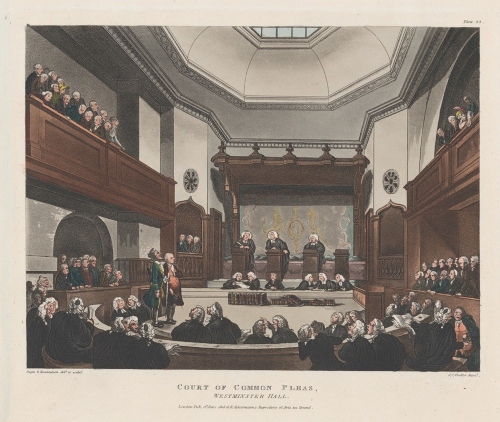
(Sittings at Nisi Prius before Mr. Justice Gaselee and a Middlesex Jury.)
Forrester v Laporte.
This was an action brought by Mr.Forrester, late of the Theatre Royal, Covent Garden, against Mr.Laporte, the late lessee, to recover the balance of an arrear of salary, and compensation in damages for a breach of the terms of an engagement.
Mr.Sergeant Talfourd, with whom was Mr.Thessiger, stated the case on behalf of the plaintiff, and Mr.Sergeant Heath appeared for the defendant.
Mr.Bartley, examined by Mr.Sergeant Talfourd, deposed, that he was stage manager at Covent garden theatre during the last three years of Mr.C.Kemble's management, and that Mr.C.Kemble was succeeded in 1832 by Mr.Laporte, under whom the witness continued stage manager.
The note produced was in the hand writing of Mr.Laporte. The note was addressed by the defendant to the plaintiff, and was an invitation to join the Covent garden theatre. An interview was had pursuant to this invitation, and it was ultimately agreed between witness, as the agent of Mr.Laporte and the plaintiff, that the latter should be engaged for three years, at a weekly salary of £6 for the first, £8 for the second and £9 for the third year.
A letter to this effect, dated 10th Sept 1832, was admitted and put in as evidence. The witness further deposed, that the season succeeding that engagement commenced on the 1st of October, 1832, and that the plaintiff played in the play and farce on the first night, and continued during the season as any other person. Witness is now stage-manger to Mr.Bunn, but the defendant is not engaged, and though witness had been thirty-three years connected with the theatres, he never till the present instance knew a case of a party succeeding another in the management ever questioning an engagement of an actor previously engaged.
Cross-examined by Mr.Sergeant Heath - Mr.Bunn has succeeded Mr.Laporte in the management. Mr.Laport loast £7,000 during his management.
Mr.William Abbott,examined by Mr.Thessiger - Deposed that for many years (twenty) he had been a member of the Covent garden Company, but this his engagement expired last year. The season of 1832 commenced on the 1st of October, and the house was opened nightly till the 19th of November, about which time Mr.Laporte called a meeting of the company, and stated that in consequence of the ruinous state of the season in was impossible to go on, and he therefore proposed that the company should play only three nights a week until Christmas, but that the performers should not lose by it, as he would make up the number of nights at the termination of the usual season.This arrangement was ultimately agreed to by the performers, who were consequently paid half salaries till the pantomime came out, and the theatre was then opened every night till the 18th April 1833, when it was closed in consequence of the prevalence of the influenza.
Another meeting of the performers was called by Mr.Laporte, and a proposition made by him that instead of 54 nights they should only be paid for 34 nights. A committee of performers was appointed to consider the proposition. Witness was one of the committee, who on deliberation declined the offer.
After this witness suggested to Mr.Laporte that as the company were reduced to a most destitute condition, they should go on their own resources to the Olympic Theatre. Mr.Laporte made no objection, but seemed much astonished at the proposition, but subsequently he granted the performers the assistance of books, music, properties, and dresses. It occurred to the company that their acting at the Olympic would invalidate their engagements with Mr.Laporte, and, at an interview, Mr.Meadows asked him if, in the event of their going to the Olympic Theater, it would invalidate the engagements of those performers who were under articles. Mr.Laporte replied, "Certainly not, so far as I am concerned."
On a subsequent occasion, Mr.Laporte suggested some alteration in the bills, announcing the first night of the performance at the Olympic Theatre, which was kept open in this arrangement until the 9th of June, the performers sharing the receipts according to the salaries of each performer. Mr.Forrester acted during the whole time, and is now engaged at the Victoria Theatre.
Cross-examined by Mr.Sergeant Heath - The plaintiff was paid like the rest of the performers, up to the close of the theatre, by Mr.Laporte. The plaintiff is now paid by the witness a salary of £3.10s.per week.
Mr.Meadows examined by Mr.Sergeant Talfourd - Witness has been engaged thirteen years at Covent garden Theatre, and the season generally averages two hundred nights.
Mr.Andrew Sutherland proved that the plaintiff presented himself as the opening of the present season, at Covent garden, as one of the company, but witness refused him admission, by the orders of the present lessee, Mr.Bunn.
It was admitted by Mr.Sergeant Heath on the part of the defendant, that the plaintiff received £36 as his share of the profits realised by the performers at the Olympic Theatre.
Mr.Sergeant Heath, for the defendant, addressed the Jury, and admitted that the plaintiff was entitled to a verdict, but expressed his regret that the amount had not been settled out of Court. His clients had been anxious to have referred the subject, and not thus to have been dragged before the public.
Mr.Justice Gaselee summed up the case to the Jury.
The Jury, after a short deliberation, returned a verdict for the plaintiff - Damages, £180
Friday 7 February 1834
Charles Heath to Dawson Turner
I regret that you are not likely to be in London as I could so much more easily explain than by writing. However, I will be as brief as possible and I beg that you will not hesitate one moment if the proposal does not appear to you satisfactory.
You are aware that Messrs.Longman & Co. supply me with all the money I require for my four Annuals on the security of the Works. Now my most beautiful and most splendid work, the "England and Wales" as you know proceeds but very slowly. The reason is wont of capital. Could I get the numbers out 3 and 4 a year I should sell half a many more, get the work completed in three years when it would be a most valuable property.
Now I propose for you to lend me on my own Bills payable with interest £1,500 or should it be required which I do not think it will £2,000 , the first Bill to be payable in 15 months and another every six months.
As your security I propose to make over to you the whole of the Plates & Stock amounting in Value if sold tomorrow to at least £4,000. And besides the security on the loan the work shall be your security for all the money there may be deficient on the Bills you hold. Until they are paid by me.
This is briefly what I had to propose and I shall be obliged by your answer at your convenience. I ought perhaps to have stated that no money will be required for six or eight Weeks.
I have received from Mr.Asher the bookseller of Berlin to whom Messrs.Longman & Co. sold all my back stock of books and whom they consider a very safe man several Bills of £363 each. I have had two Bills for the last two years for the amount of Books sent each year and they have always been most regular. Could you cash me two due Nov. and Dec.next. If so I could place £40 more to your credit at Barclays and would much oblige.
Dear Sir, Yours most truly obliged,
Charles Heath.
The picture of your Daughters would have [been] too much work for a line plate or I should have accepted it when at Yarmouth.
I forgot to mention the Bill[s]are accepted by his agent in London and payable at Williams & Co. Bankers.
[note on outside of letter. "most satisfactory."]
Tuesday 25 March 1834
Charles Heath to Dawson Turner
My dear Sir,
I enclose the two Bill[s]of Mr.Ashes endorsed by Messrs."Perkins & Co." Your observation respecting that firm rather surprises me - knowing as I do and as I suppose you do that Mr.Serjeant Heath is the principal Partner with Mr.Drinkwater and my Mother in Law, Mrs.Petch - all person of considerable property. If you had Bills for £10,000 they would be good.
I trust when you come to London I shall have e pleasure of seeing you. With many thanks believe me my Dear Sir,
Your most obliged
Charles Heath
Tuesday 29 April 1834
Morning Herald (London)
Parliament of the United Kingdom. - House of Lords - Monday
In the absence of the Lord Chancellor, at the sitting of the House, the Earl of Shaftesbury presided on the woolsack. - - - continues
The Earl of Rosslyn observed that the Counsel for the petitioners might be presumed to be prepared, but it was not to be expected that the Counsel in support of the Bill should be ready to go on without notice.
The Lord Chancellor said it would save time if Counsel were, at least, called in, and an arrangement made with them as to the time at which they should be in attendance.
The Earl of Durham said he had a list of witnesses whom it would be necessary to examine in support of the Bill, and he apprehended it was not possible to proceed now.
The Lord Chancellor asked, in a loud voice, whether there were any Counsel in attendance in support of the Bill?
Several Learned Gentlemen who had been in waiting made their way to the bar.
The Lord Chancellor - "Mr.Harrison, for whom do you attend?"
Mr.Harrison - "My Lord, I cannot exactly answer that question." - (a laugh).
The Lord Chancellor - "Mr.Sergeant Merewether, for whom do you appear?"
Mr.Sergeant Merewether - "For the petitioners against the Bill, my Lord."
The Lord Chancellor then put the same question to Mr.Sergeant Heath.
Mr.Sergeant Heath - "My Lord, I am with Mr.Harrison" - (great laughter).
The Lord Chancellor -"Why do you come forward when Counsel are called in if you do not know whom you represent?"
Mr.Harrison explained, that having been Counsel in the House of Commons for the petitioners against the return, with his Learned Friend Mr.Sergeant Heath,it had been intimated to him that he might be called upon to examine witnesses at their Lordship's bar, and he had consequently attended, but without meaning to present himself at the bar; but as yet, he had no authority to act, and he must wait until he received such authority.
The Lord Chancellor again asked, in a loud voice, whether there were any Counsel in support of the Bill?
Mr.Harrison, after a pause, said, "My Lord, I am ready to undertake that duty.
Earl Grey here observed tyhat he did not apprehend there could be any Counsel until it had been decided that Counsel should be heard. He thought the best course would be to appoint a day for the second reading, on which day an order should be made for witnesses to attend, and for Counsel to appear and examine them against the Bill, and also Counsel to examine witnesses on the part of the House in support of the Bill.
The Lord Chancellor said he was aware this was the course that had been pursued on the East Retford Bill. According to the precedent the House should make an order for Counsel to attend on Thursday, but upon such an order all Westminster Hall might come to their Lordship's bar. But was the House to make no selection of th Counsel whom it should choose to assist it in the examination of evidence;if that were the case, any Learned Gentleman, who happened to have nothing to do, might come cruising, or, he might say, on the look out. If some selection or appointment were not made, a more absurd or inconvenient precedent could not be followed. He could not conceive how such a precedent had been set, but the sooner it was got rid of the better. Under cover of such an order that Counsel should be heard without naming whom, any Learned Gentleman, or any score of Learned Gentlemen, might come trooping into their Lordship's House, and say that they came in pursuance of the order. He, therefore thought that the order ought to be confined or limited in some shape.
- - - Continues - - -
After some further conversation Mr.Harrison, Mr.Sergeant Heath and Mr.Whittacre were called to the bar as Counsel in support of the Bill, and Mr.Sergeant Merewether against it.
Mr.Harrison stated that he was not then prepared to proceed, and it was ordered that the Counsel and witnesses should be in attendance at half-past three o'clock on Friday, at which time the examination is to be proceeded in.
Tuesday 29 April 1834
Albion and the Star.
- -- - The Lord Chancellor asked whether any Counsel was in attendance for the Bill?
Mr.Harrison said that, in consequence of having been Counsel with his Learned Friend (Mr.Sergeant Heath) in support of the Petition against the return of the Members for the borough of Warwick, it was intimated to them that they might be called in to appear at their Lordship's bar. They appeared there in consequence, but they had no authority to state that they appeared in support of the Bill.
- - --
The Duke of Cumberland had no wish to offer any opposition to the suggestion of the Noble and Learned Lord, but thought that the difficulties in the case could at once be got rid of. The Noble Earl who had undertaken to manage the Bill should consult those persons whose case he was defending as to the Counsel they desired. - (Hear.) - This might be done without delay. He considered that it would not be fair for their Lordships, who were Judges on the case, to name the Counsel. He wished to ask the Noble Earl (Durham) whether he objected to the suggestion?
The Earl of Durham was quite prepared to follow the course suggested by the Illustrious Duke. He would at once name Counsel, and give in the list of witnesses which he wished to have summoned. The Noble Earl then moved that Mr.Harrison, Mr.W.Harrison, Mr.Sergeant Heath, and Mr.Whitcomb be directed to appear at their Lordship's Bar in support of the Bill.
After a few words from the Marquise of Salisbury, Lord Wynford, and the Lord Chancellor, the motion was agreed to.
Wednesday 7 May 1834
Wolverhampton Chronicle and Staffordshire Advertiser.
Death of Mr. Stothard.
Died, on the 27th ult. at his house in Newman St, Oxford St, Thomas Stothard Esq., R.A. Mr.Stothard was born in Long Acre in August 1755, consequently in his 79th year. - - - Mr.Stothard has made more drawings than any other man who ever lived - Chedowiecki, perhaps, excepted. His invention was only equalled by his taste and delicacy. On every subject he was completely at home. No person could be more a moderate admirer of Stothard. is admirers were enthusiastically so. The collectors of his drawings and engravings are numerous. Many of our most distinguished engravers have obtained their chief reputation by engraving after Stothard, and we may instance the late James Heath. - - -
Sunday 11 May 1834
The Examiner
Now selling for Twenty Guineas by the Proprietors, Messrs Baldwin and Cradock, London, In Imperial folio, half round, Russia back.
The Works of William Hogarth, from the Original Plates restored by James Heath R.A. with the addition of many subjects never before collected. To which are prefixed, a Biographical Essay on the Genius and Production of Hogarth, and Explanations of the Subjects of the Plates. By John Nichols Esq., F.A.
In addition to this valuable collection, late the property of Messrs Boydell, fac-similes have been engraved of several curious plates, not now to be found, and perhaps no long in existence; and further to enrich the work; the publishers have purchased many very interesting and valuable plates; thus adding twenty-eight subjects to what constituted the collection of Messrs Boydell.
Thursday 15 May 1834
Morning Post
Warwick Disfranchisement Bill.
Counsel were then called in, and the examination of witnesses on this Bill resumed.
The examination was interrupted by a Message from the House of Commons bringing up the London and Southampton Railway Bill and several Private Bills, which were read a first time.
The examination of witnesses was again resumed.
Four other witnesses, namely, Henry Townsend, his wife, Wm. Powell, and George Wall, having been examined, the further hearing of evidence was adjourned until tomorrow.
The Lord Chancellor having resumed his seat on the Woolsack.
Mr. Sergeant Heath said that he felt it his duty to call the attention of their Lordships to a paragraph which appeared in a Morning Paper of that day, and which was calculated to excite a strong prejudice in the public mind against the case which he had the honour to advocate, inasmuch so as to prevent witnesses from coming forward and tendering their evidence in such a manner as would give effect to the Bill now pending before their Lordships' House. He would say nothing further on the subject, but merely confine himself to reading the paragraph, leaving it to their Lordships to take steps on the matter as to them should seem meet. The Learned Gentleman then read from the morning's number of this Journal as follows:-
"Certain it is that since the conclusion of the examination of the first two or three witnesses he (meaning the Lord Chancellor) appears to have entertained a conviction that the Bill must not pass; that it is based on the foulest conspiracy and supported by the foulest perjury. We must say that in the defeat of this conspiracy, and the detection of this perjury, he has exhibited both acuteness and perception and integrity of purpose."
The Lord Chancellor said that so far as he was concerned, so far as the paragraph which the Learned Counsel had read alluded to him, he must say that nothing could possibly be more unfounded than the statement therein set forth. Not only was it not true that he had expressed any opinion, but up to that time he had formed no opinion on the subject; for how could he, when he had only partially heard both sides before he made up his mid on any case,and from that rule he should not depart on the present occasion. He repeated that he had not formed, and could not form, for the reasons he had stated,any opinion; and a single word had not escaped him which could justify any such erroneous inference.
Mr.Sergeant Heath said that he would at present make no further applications to their Lordships on the subject; but he at the same time deemed it right to say that in future he should feel it his duty to apply to their Lordships to protect the persons who came forward as witnesses in the cause from such attacks.
The Earl of Durham said that his name had also been used in the Newspaper alluded to, and that all that was stated respecting him was neither more nor less than a gross and impudent fabrication. Words were put into his mouth that he had never uttered; but at present he would not deign to notice such conduct further than to repeat that it was not only a gross and impudent, but he would add, a willful, fabrication.
The Lord Chancellor had only a word or two to add to the observations he had already made. He wished to tender it as his advice that their Lordships should abstain from taking notice of publications of the description of that alluded to until they were so often repeated that they could not shut their eyes to them. He concurred with his Noble Friend that it was better not to notice the matter this time. The Noble and Learned Lord then said that as the examination of the witnesses in support of the Bill was likely to occupy a considerable time, they should commence sitting each day at four o'clock rather than begin at an earlier hour.
The Sale of Fish Bill was, on the motion of the Earl of Shaftesbury, read a second time, and ordered to be committed.
Their Lordships then adjourned.
Thursday 15 May 1834
Albion and the Star
The Warwick Borough Case - Lord Brougham and Lord Althorp.
(From the Morning Post)
Mr.Sergeant Heath, as Counsel in support of the Warwick Disfranchisement Bill, called the attention of the House of Lords last night to a paragraph which appeared in this Journal yesterday. Lord Brougham there-upon declared that, "so far as he was concerned, so far as the paragraph which the Learned Counsel had read alluded to him, he must say that nothing could be more unfounded than the statements therein set forth."
So far as Lord Brougham was concerned the "statements there set forth" were two -
Our first statement was that his Lordship "appears to have entertained a conviction that the Bill must not pass." We assure his Lordship that this statement is no "unfounded." We have rightly stated that which "appeared" not only to ourselves but to others, and to more impartial observers. What conviction his Lordship has entertained his Lordship best knows; but what conviction his Lordship has "appeared" to entertain we know a great deal better than his Lordship.
Our second statement was that his Lordship "has exhibited both acuteness and perception and integrity of purpose." And must we, reluctantly, admit that "nothing can be more unfounded;" must we, upon his Lordship's authority, assure the world that his Lordship has exhibited neither acuteness of perception nor integrity of purpose?
Having, for once had occasion to praise Lord Brougham, we will not thus peevishly retract our praise. His demeanour during the investigation has been that of an honest man, and of an able man. And, whatever he may say upon the matter, we do not think we overrated the impression produced upon his mind by the perjury and prevarication of some of the witnesses.
Turn we now to the Earl of Durham. His Lordship is angry, of course. "Ira furor brevis est," says the poet: but his Lordship is born to express the error: anger is with him a long madness. The Earl of Durham therefore, being angry thus speaks:-
"His name has also been used in the Newspaper alluded to, and all that was stated respecting him was neither more nor less than a gross and impudent fabrication. Words were put into his mouth that he never uttered; but at present he would not deign to notice such conduct further than to repeat that it was not only a gross and impudent, but, he would add, a willful fabrication."
The two words we have italicized look ominous. Dignified disregard at present implies a criminal information in Trinity Term. No matter. The Earl of Durham is unlucky in Westminster Hall, and therefore we will venture to speak the truth.
We solemnly and deliberately assert that the statements we made of Lord Durham's conduct in the House of Lords on Monday last was substantially on record.
We perceive that our account, so far as it relates to his Lordship's examination of Mr.Butt, the notice-server, is entirely borne out by the report of the True Sun, an Journal not very likely to publish concerning Lord Durham "not only a gross impudent, but a willful, fabrication."
The Lord Chancellor "concurred with his Noble Friend that it was better not to notice the matter this time."
We concur with the Lord Chancellor.
Friday 16 May 1834
Imperial Parliament - House of Lords - Thursday 15 May 1834
Several petitions were presented by Lord Cawdor and others, for redress of grievances affecting Dissenters.
Warwick Bill.
Counsel as usual were called to the Bar.
Margaret McKew was then examined by Mr.Serjeant Heath.
She was the wife of a voter at Warwick. In consequence of some persons coming to her, she went to the Castle, and received money, that her husband might not say any thing about his being bribed.
William Braunston voted for Tomes and King; Ayres canvassed him for Sir Charles Greville; found four sovereigns in his tea-pot; had been canvassed three times by Ayres before he found his money.
Cross-examined by Mr.Follett. - Paid rates for the poor at that time, but is not now a voter.
John Hammond voted for Tomes and King; was canvassed by Smith, an attorney, who promised him a pound to vote for Sir Charles; the Monday before the election lived and slept at the Rose and Crown, an orange public-house; did not pay anything; met Smith the next morning, who said that money was very plentiful, and that he would give him £25 to vote for Sir Charles.
Cross-examined by Mr.Follett. - Would not swear that he had not said that he had received money to vote for Tomes and King; cannot tell whether he stated to any body that Mr.Heath had given him a sovereign; would not swear that he had not said he was ready to come up and give evidence against Messrs. Tome and King; never went to Lapworth Smith or Tibbits to offer to give evidence of bribery by the other parties; was drunk all the time of the election; signed a paper (which was put in) to the effect that he received a guinea from Heath and £3 from Redburn; signed the paper at Mr.Smith's; was certain the paper was not read over to him before he signed it.
Re-examined by Mr.Sergeant Heath. - After the election lived for several weeks at the Star and Raven, and received five shillings a day; had plenty to eat and drink; was drunk all the time; never paid for anything; was several times examined by Lawyer Smith; could not read writing; signed two or three papers; 40 other voters were living at the Star and Raven.
Sunday 18 May 1834
Age (London)
The proceedings of the Warwick Disfranchisement Bill are pregnant with instruction. We find in them full indications of what is to be the rule in England, if certain persons of the ultra-Whig persuasion - the bilious bill-men - should come into power. It was first attempted that the borough should be disfranchised without deigning to hear a witness whether any corrupt acts had taken place or not. "We go on the notoriety of the case," said the impartial Earl of Durham. However, as there are lawyers in the House of Lords, (whatever may be the case among the active portion of the House of Commons) this summary mode of proceeding was not to be listened to, and Lord Durham was reduced to the hard necessity of being obliged to prove deliquency before he inflicted punishment. Baffled in this, he next did his best to establish new rules of evidence and practice.
He was particularly indignant when the person on the woolsack (who, whatever may be the amount of his legal knowledge, is at all events aware of what is legal practice) prevented him from examining a witness as to what his belief on a certain circumstance of which he could not by any possibility have known any thing but by conjecture. Lord Melbourne ought to have ordered his bilious friend to consult Mr.Under-secretary Phillips on the propriety of such a mode of examination. Durham persisted, but at last was obliged to give way - grumbling and growling,however, at the hard case to which he was compelled to submit, and the vile degradation of being called upon not to substitute fancy and hearsay for fact and eyesight.
An understrapper of his, one Sergeant Heath, took an opportunity of giving his opinion as to the manner in which the press is to speak of him and his proceedings. Heaven help the dull fellow! Little does the press care for such small beer as Mr.Sergeant Heath. We confess that we are often considerably annoyed at the impertinent interference with us and our affairs which some people very often permit themselves to make.
We do not see what there is in writing an article for a newspaper, which is to set the man who makes a speech on any side of any case he is retained in for a guinea or two over those who support a consistent and honourable side of politics with a pen. Sorry should we be indeed to offer this Sergeant Heath a single shilling for the best paper he could write on any subject he chose; and yet he has the assurance to think that he towers in abilities and station above us. There must be an end put to this humbug pretension.
To recur to the Warwick case we are happy to be able to give it as our opinion that the meditated act of injustice will be baffled, and that Warwick will not be disfranchised or swamped by an influx of voters from Leamington - a place in which every person of sense and respectability is eagerly desirous of rejecting the fatal boon of becoming a seat of electoral disturbance and bickering
The House of Lords will thus have done it duty - and we hope that the lesson will not be lost on the family of Warwick. We have a great deal to say about mismanagement and want of common sense in certain persons who shall be nameless for the present; but we shall not lose sight of the subject.
Sunday 18 May 1834
Atlas.
The Press and the Bar.
Standard - The proceedings of the House of Lords last Thursday gave warning, by infallible indications, that a new attack upon the public press is in preparation; and if those proceedings were not sufficiently instructive upon the point, we have complete assurance of our danger in the conduct of a particular journal, this morning, which has uniformly played the part of a jackall upon every recent case of persecution; we mean the Morning Chronicle.
As the observations of the Morning Post have been contradicted from the proper quarter, we very readily believe that these observations were founded upon an erroneous view - but still we have to learn upon what ground a hired lawyer, permitted to stand below the bar of the House of Lords, for a special purpose, presumes to the right of denouncing the conduct of public journals?
Hitherto we have been taught to believe that the Houses of Parliament are the guardians of their own privileges and honour, and that they are about to execute the duty without any intruded partnership of gentlemen, tolerated below their respective bars, to earn a few guinea fees.
As to Mr.Sergeant Heath's pretence that the remarks of the Morning Post could deter witnesses, that pretence must appear ludicrously absurd after the explanation, we believe, only the night before, of the stringent power which the house possesses to compel the attendance of all whose testimony it considers as of any value.
Perhaps we attach too much importance to the learned sergeant's foolish interference; but if we do so, it is because we feel that a war of bitter hostility has long been waged by lawyers against the press. The never omit an opportunity of oppressing us - never let slip an occasion of flinging out an impertinent sarcasm against journalists.
The reason is plain enough. They see us as a class rising into a degree of respect and consideration, which, in their present descent from the rank they once held, they regard with envy - and they are apt to conclude that "our rise has been their fall."
The conclusion is unjust; the press has risen simply by the improved character of its conductors; - the bar has sunk by the opposite road - by its greediness, by superstition which, however, like other superstitions, plausibly maintains itself, that a certain degree of ignorance as to whatever invigorates and polishes the mind, aided by an intuitive indifference to the attributes of genius, is necessary to constitute a successful lawyer. - - -continues.
Thursday 22 May 1834
Mr Barlas and others expressed a wish to be informed what was the real point in the onnus clause upon which the Committee divided, and also the arguments used for having it altered from the original form. Mr.H.Ballingal still thought this a most important clause, although held to be a trivial matter now.
The Dean of the Guild said, that none but Counsel argued, and it might take hours to state the substance of their pleadings. As to the clause itself, Mr.Sergeant Heath, and their other counsel, assured them it was of no material importance: Indeed they thought its present form was rather an advantage, as it would afford to the Commissioners means and opportunity of reply, which under the other form they would not have enjoyed.
Some member here asked what were the arguments of the members of the Committee?
Friday 23 May 1834
Morning Advertiser
Law Intelligence.
Court of King's Bench, Westminster, May 22.
This being the first day of Trinity Term, the Judges came into Court at half-past one o'clock.
The Lord Chief Justice said the Court proposed to take new trials immediately, and go on with them from day to day, including Tuesday and Wednesday. - - - -
Sergeant Heath, having been appointed one of his Majesty's Counsel, learned in the law, was invited by the Lord Chief Justice to take his seat within the Bar.
The proceedings during the day were not important.
Friday 23 May 1834
London Packet and New Lloyd's Evening Post.
The House of Lords met yesterday at four o'clock, after the recess. Mr.Sergeant Heath was heard as to the further evidence he had to adduce in support of the Warwick Disfranchisement Bill. Witnesses were subsequently heard upon this matter. -- - -
Monday 26 May 1834
True Sun
Trades Union Chronicle
Sherwin v. Balcombe. - We gave the particulars of this case, as they came out in the Middlesex county court some days since. Our readers will recollect that the Deputy Chairman deferred the case, much to the injury of the plaintiffs.
On Thursday last Mr.Serjeant Heath heard it, and having said that the court should never be used for party purposes, but that every case should be decided on its merits, and impartial justice be administered to all, he proceeded to give it as his opinion that Sherwin was entitled to be paid for the day which he had worked, and also one day's pay for walking to London, because he would not be able to work after travelling that distance (fourteen miles).
The these observations he left the case to the jury, who instantly gave for the plaintiff. This decides fourteen similar cases, in which Balcombe is defendant.
Tuesday 27 May 1834
Globe
Warwick Bill.
Their Lordships having resumed the proceedings on the Warwick borough bill.
Mr.W.Trepess was called in, and stated that he took part in the last election at Warwick, on behalf of Sir.C. Greville.
Mr.Sergeant Heath asked the witness if he had not given orders to certain of the voters for silk handkerchiefs, hats, and articles of that description?
Mr.Sergeant Merewether objected to the question, and contended that, under the cockade act, the distribution of of such articles might take place without any imputation of bribery.
The Lord Chancellor said the learned sergeant was mistaken. The cockade act had nothing whatever to do with the giving the goods, wares, and merchandise, under which description silk handkerchiefs and hats were convertible into money at any moment, and therefore such gifts amounted to bribery. At the Liverpool election £48,000 were spent on beer, and they all knew what that meant. The question was a proper one, and the witness was bound to answer it.
The question was then repeated, and the witness admitted that he had given orders for hats and handkerchiefs to different voters who had asked for them.
The witness was further examined with a view to show that money had been given for votes.
Wednesday 18 June 1834
Morning Advertiser
The house then resumed the examination of witnesses in support of the Warwick Bribery Bill.
Lucy Goods, John Wright, Thomas Box, and Catherine Phillip, were examined as to the amount of the bills incurred at their respective houses for treating previous to, and during, the election. At the conclusion of their evidence.
The Lord Chancellor, addressing the counsel in support of the Bill, said, "Really something ought, to be done to bring this inquiry to a close. In the name of common sense, what can be the use of such a protracted examination? Let me beg of you, said his Lordship emphatically, in mercy to the House - in mercy to the country, to go at once to prove acts of bribery. You may go on for weeks in this manner, and lead to nothing conclusive. You say that you have witnesses to prove bribery, whey then not call them? The expense is ruinous."
Mr. Sergeant Heath hoped the House would allow him to prove the extent of treating.
The Lord Chancellor. - We want you to prove acts of bribery. Treating will not serve you. If the Lord Chief Justice of the King's Bench had been here he would have stopped this course of examination before now. The House is not disposed to shut out evidence, but the doors have been open long enough. It cannot be expected that time is to be allowed for the proclaimed witnesses to come in.
Mr.Sergeant Heath said, treating was an essential part of his case; but he would be content if his Learned Friends on the other side would allow the amount to be taken from the books and bills delivered in.
A discussion took place between Counsel on the proposition, which was suddenly stopped by the Lord Chancellor moving,"That this House do now adjourn." His Lordship said the further consideration must be postponed until Thursday.
The House adjourned at Half-past Nine o'clock.
Thursday 19 June 1834
Morning Post
The King's Levee
Their Majesties arrived at St.James's Palace about half-past one o'clock yesterday afternoon from Windsow Castle. The King held a Levee soon after two o'clock, at which his Serene Highness the Duke of Saxe Meiningen, attended by Baron Spesadt, was present. - - - - Mr.Sergeant Heath, on his promotion. - - - -
Friday 20 June 1834
Leicester Journal
Warwick Borough Bill - Further evidence was then heard on the Warwick Borough Bill. William Parr, Lucy Good, John Wright, Thomas Box and Catherine Phillips were examined.
The Lord Chancellor said that common sense and common justice to the House, and to the country dictated the propriety of bringing the case to a speedy termination. According as they were going on it was hard to say, whether it would be closed in 1836 or 1837, for they were already approaching 1835. - - -
Sergeant Heath said he hoped to close his case shortly. Bribery and treating were so mixed up together that the proof of one should grow out of the proof of the other.
The Lord Chancellor asked what did he mean by shortly? Was it in 1837? The House required proof of bribery and of that there was no appearance yet. The opposite party were on their defence, bound to follow the course prescribed to them, and no blame for delay could be attributed to them.
The House then adjourned at half past nine, until ten o'clock tomorrow (Wednesday).
Friday 20 June 1834
Sun (London)
Warwick Disfranchisement Bill.
Counsel and witnesses were then called in on this bill.
Lord Denman and Lord Wynford sat at the table for the Lord Chancellor.
Several witnesses were examined.
On the conclusion of the examination of a witness named Thomas Satan, a beershop-keeper, residing in Warwick.
Mr.Sergeant Heath applied to have him committed on the ground that he had sworn no beer was served out to the Orange party after the 30th of November, or during the days of the election, although on reference to his books it appeared that, up to the 11th of December and during the days of the election, not only was beer served to the Orange party, but that the greater portion of the items in the account was for the beer supplied between the 30th of November and the 11th of December.
Lord Wynford expressed the regret that an application of the same kind had not been made with reference to several preceding witnesses. He believed that if such an application had been made much of their Lordship's time would have been saved and a great deal of perjury prevented. Before their Lordships entertained the application, it would be necessary to have the short-hand writer's notes of the witness's evidence read over to him.
The witness was then called in and the notes of his evidence read over to him.
On its appearing from the short-hand writer's notes that the witness had not positively sworn, although he had said sufficient to raise the impression, that no beer was served from his shop after the 30th of November.
After a short conversation, in which Lord Wynford, the Duke of Wellington, the Duke of Cumberland, and Duke of Richmond, the Earl of Radnor, and Lord Denman took part, the application for the witness's committal was refused. - - - -
At a quarter-past nine, the further hearing of the case was postponed until Monday next, at four o'clock, and the house adjourned.
Friday 20 June 1834
Public Ledger and Daily Advertiser.
Warwick Disfranchisement Bill.
Counsel and evidence were now called in this case.
Thomas Seyton, an innkeeper, was charged with prevarication by Mr.Sergeant Heath, who called on their lordships to exercise their authority and commit the witness.
The Duke of Wellington, Lord Wynford, the Duke of Cumberland, and Lord Wharncliffe were against such a course.
The Earl of Radnor and Earl Mulgrave were of opinion that the witness had prevaricated.
Lord Denman was of opinion that this was not exactly a question their lordships should entertain; it was, in his opinion one of separate enquiry. In any case, before they should commit the witness, he ought to be given an opportunity of explaining and defending himself.
The witness, being re-examined, said the prevarication was all a mistake. - (Laugh.)
Lord Denman after some pause, said, it appeared that no motion on the committal of this person was about to be put by any noble lord - the effect on the evidence was another question.
The witness was then ordered to withdraw.
Joseph Sachell, John Stanley, William Pickering, Anne Maunder, and William Julian were examined, after which their lordships' adjourned at a quarter part nine to 10 o'clock tomorrow (this day).
Friday 11 July 1834
Lincolnshire Chronicle
Skegness - The following have been amongst the arrivals at Enderby's Hotel at this retired and delightful spot during the last and present month. - - - John Heath Esq., Fellow and Tutor, of Trinity College, Cambridge; Douglas Heath Esq., Senior Wrangler, Fellow, and Tutor, of Trinity College, Cambridge. - - -
Friday 18 July 1834
Morning Advertiser
Yesterday at the Kingsgate St Court of Requests, another batch of debtors was sued by Licensed Victuallers, for having been aswerable for refreshments supplied to workmen while they were in their employ, but who refused to discharge the amount thereof, they not having any means of stopping the same from their wages as formerly.
Mr.Sergeant Heath, the senior Commissioner, and Mr.Dubois, the deputy, sat in different Courts, in order to expedite the accumulated business, and both of them decided that the masters, or foremen, who became answerable for the payment of publicans and others, for goods sold and delivered to those under them, would continue liable to such payments for an indefinite period, if they neglected to inform the tradesmen when the men for whom they became responsible left their situations, and cautioned them against giving any further credit to the same parties upon the same responsibility.
Thursday 11 September 1834
James Heath, 23 Great Coram St, London to Dawson Turner
Dear Sir,
Sir Jonah Barrington's death gives me the opportunity of again disposing of his Valuable Drawings.
In consequence of your having formerly been the purchaser I again make you the first offer at the same price you had before. You are the best judge of their value,
I remain, dear sir, Your truly,
James Heath
Wednesday 24 September 1834
Charles Heath, 6 Seymour Place, Euston Square, London, to Dawson Turner.
My Dear Sir,
Be assured I shall not [forget], nor have I forgotten your Proofs, but it has gone over so long that I will not wait till all the Plates are complete for the ensuing year and make one parcel of them. I am on the wing for Paris tomorrow - shall return the middle of next month, when you may calculate on hearing from,
Dear Sir, Yours most truly obliged,
Charles Heath
Monday 27 October 1834
Sussex Advertiser
Brighthelstone.
Their Majesties arrived in town in the afternoon of Saturday se'nnight from Windsor Castle, and went to view the scene of the late calamitous fire, and Westminster Hall. After remaining about an hour, the King and Queen returned to Windsor. - - -
Mr.Serjeant Heath, with Mrs. and the Misses Heath, have apartments at the Marine Hotel.
21 November 1834
Morning Chronicle
James Heath Esq., a member of the Royal Academy, and for more than half a century one of the most eminent engravers in Europe, died a few days ago at his house in Coram Street, aged seventy-eight years.
He had long retired from the profession, which he resigned to his son Mr. Charles Heath, whose almost numberless illustrated works, and other exquisite productions of the graphic art, do so much honour to the country.
The late Mr.Heath was the early associate and friend of Stothard, the artist: they may be said to have commenced their career of popularity and distinction at the same time. The old Novelists' Magazine, published by Harrison, which extends to twenty-two royal-octave volume, is adorned by the delicately finished engravings of James Heath, from the exquisite and imperishable drawings of Thomas Stothard. This work remains, at the present moment, a monument of the supremacy of the genius and skill of Heath and of Stothard.
Heath's fame as an engraver extended all over the Continent , and was by no one more highly appreciated than by that distinguished artist, Raphael Morghen, at Florence. During many years he confined himself to book illustrations; but it was impossible that an artist of such high capabilities should fail to strike out a more enlarged sphere for the display and exercise of his art, and with equal success.
The "Death of Major Peirson" from a painting by West, and, as a companion to it, the "Death of Lord Nelson," from a painting by the same artist; the "Dead Soldier, " from a picture by Wright of Derby; a whole-length of General Washington, engraved from American Stuart's well-known portrait in the possession of the Marquess of Landsdowne; and the portrait of Pitt, form the statue at Cambridge University are a very few of the many lasting specimens of Heath's graphic excellence.
In private life, Heath was esteemed and loved by the large circle in which he was known. He was a delightful companion, abounding with entertaining anecdotes and stories, relating to the eminent persons with whom he had associated. Sir Joshua Reynolds, Sir Thomas Lawrence, West, Stothard, F.Reynolds, Morton, John Kemble, Miles, Peter Andrews, Wroughton the actor, and to the end of his life Jack Bannister, (who we rejoice to say, survives him in excellent health), were his attached friends.
Although his engravings were highly prized in all the principal cities in Europe, we question if his visit to the Continent extended beyond Calais, on an occasion when Jack Bannister was his companion, and who often tells a humerous story of an occurrence that happened to them at Dessein's Hotel. Heath was a widower when he died. He has left behind him three children - George, serjeant-at-law; Charles, the eminent engraver; and Mrs.Hamilton, who is understood to be almost equal to her brother as a professor of the graphic art.
Godefroy, of Paris, who engraved the celebrated Battle of Austerlitz, from the splendid painting by Gerard, was a pupil of Mr.Heath.
Thursday 11 December 1834
Charles Heath to Dawson Turner.
My Dear Sir,
By the time you receive this letter I trust the Large and small paper Books of my four Annuals for 1835 will have reached you and likewise in a separate parcel the Sets of Proofs for this and last year.
I likewise hope they will meet your approbation. I am compelled on a very particular business relating to a republication of my back plates in France to run over to Paris but shall return before Xmas day - early in January I shall have the pleasure of sending you a number of Proofs of the England & Wales about that subject I wrote to you some time back - if you would cash my own Bills, say 4 at 250 each I could get them backed by what you would consider good security or I would lodge the Plates with any person you chose till the Bills were paid.
I am very anxious to get that work to a close when it will be a property worth six or seven thousand pounds at least. I do not wish you to write me any answer to this but when I send the Proofs on my return you can then tell me what you think - - -
Believe me,
Charles Heath