Michael D.Heath-Caldwell M.Arch.


Michael Heath-Caldwell M.Arch
Brisbane, Queensland
ph: 0412-78-70-74
alt: m_heath_caldwell@hotmail.com
- Home
- Architectural Projects 0
- Architectural projects 1
- Architectural Projects 2
- Architectural Projects 3
- Architectural Projects 4

- The Crystal Palace
- Timeline
- 1693
- 1745
- 1770
- 1783
- 1784
- 1785
- 1786
- 1788
- 1789
- 1791
- 1792
- 1793
- 1794
- 1795
- 1796
- 1797
- 1798
- 1799
- 1800
- 1801
- 1802
- 1803
- 1804
- 1805
- 1806
- 1807
- 1808
- 1809
- 1810
- 1811
- 1812
- 1813
- 1814
- 1815
- 1816
- 1817
- 1818
- 1819
- 1820
- 1821
- 1822
- 1823
- 1824
- 1825
- 1826
- 1827
- 1828
- 1829
- 1830
- 1831
- 1832
- 1833
- 1834
- 1835
- 1836
- 1837
- 1838
- 1839
- 1840
- 1841
- 1842
- 1843
- 1844
- 1845
- 1845-46 Oxford
- 1846
- 1847
- 1848
- 1849
- 1850
- 1851
- 1852
- 1853
- 1854
- 1854/55 Appendix
- 1855
- 1856
- 1857
- 1858
- 1859
- 1860
- 1861
- 1862
- 1863
- 1864
- 1865
- 1866
- 1867
- 1868
- 1869
- 1870
- 1871
- 1872
- 1873
- 1874
- 1875
- 1876
- 1877
- 1878
- 1879
- 1880
- 1881-1
- 1881
- 1882
- 1883
- 1884
- 1885
- 1886
- 1887
- 1888
- 1889
- 1890
- 1891
- 1892
- 1893
- 1894
- 1895
- 1896
- 1897
- 1899
- 1900
- 1901
- 1902
- 1903
- 1904
- 1905
- 1906
- 1907
- 1908
- 1909
- 1910
- 1911
- 1912
- 1913
- 1914
- 1915
- 1916
- 1917
- 1918
- 1919
- 1920
- 1921
- 1922
- 1923
- 1924
- 1925
- 1926
- 1927
- 1928
- 1929
- 1930
- 1931
- 1932
- 1933
- 1934
- 1935
- 1936
- 1937
- 1938
- 1939
- 1940
- 1941
- 1942
- 1943
- 1944
- 1945
- 1946
- 1947
- 1948
- 1949
- 1950
- 1951
- 1952
- 1953
- 1954
- 1955
- 1956
- 1957
- 1958
- 1959
- 1960
- 1961
- 1962
- 1963
- 1964
- 1965
- 1966
- 1967
- 1969
- 1971
- 1974
- 1975
- 1976
- 1979
- 1983
- 1990
- 1991
- 1998
- 2001
- 2002
- 2004
- 2005
- 2006
- 2007
- 2008
- 2009
- 2010
- 2011
- 2012
- 2013
- 2014
- 2015
- 2016
- 2017
- 2018
- 2019
- 2020
- F.C. Heath-Caldwell
- C.H.Heath-Caldwell Memoirs
- Palmer Family
- Palmer Timeline
- 1912 - Palmer
- 1914 - Palmer
- 1916 - Palmer
- 1918 - Palmer
- 1919 - Palmer
- 1924 - Palmer
- 1925 - Palmer
- 1926 - Palmer
- 1929 - Palmer
- 1932 - Palmer
- 1934 - Palmer
- 1936 - Palmer
- 1938 - Palmer
- 1939 - Palmer
- 1944 - Palmer
- 1946 - Palmer
- 1961 - Palmer
- 1967 - Palmer
- 1970 - Diary - Joe Palmer
- 1971 - Diary - Joe Palmer
- 1972 - Diary - Joe Palmer
- 1991 - Diary - Joe Palmer
- 1992 - Diary - Joe Palmer
- 2010 - Diary - Joe Palmer
- Venice Earthquake 1873
- Old Letters 1
- Old Letters 2
- Old Letters 3
- Old Letters 4
- Old letters - Mid 1800
- More Old Letters
- Eaton Hall, 1943
- Marsh Family Timeline
- James Caldwell papers 1
- James Caldwell papers 2
- James caldwell papers 3
- Old letters 1800s
- Old Letters 1800s 2
- HH Sultan Taimur bin Turki 1913
- Frank Featherstone Wright 1921-2014
- Frank F. Wright 1
- Frank Featherstone Wright early
- Frank F. Wright 2
- Frank F. Wright Videos
- Old Featherstone album 1
- Old Featherstone album 2
- Old Featherstone album 3
- Old Featherstone album 4
- Old Featherstone album 5
- Arthur Eversfield Featherstone Album 1
- Arthur Eversfield Featherstone Album 2
- Arthur Eversfield Feartherstone Album 3
- Grasmere
- Frank E Wright Album 1a
- Frank E Wright Album 1b
- Frank E Wright Album 1c
- Frank E Wright Album 1d
- Frank E Wright Album 1e
- Frank E Wright Album 1f
- Frank E Wright Album 1g
- Frank E Wright Album 2a
- Frank E Wright Album 2b
- Frank E Wright Album 2c
- Frank E Wright Album 2d
- Frank E Wright Album 2e
- Frank E Wright album 2f
- Frank E Wright Album 2g
- Frank E Wright Album 2h
- Frank E Wright Album 2i
- Frank Edward Wright drawings
- Cathy Featherstone 1910a
- Cathie Featherstone 1910b
- Norma Featherstone 1913
- Norma Featherstone Part2
- Norma Featherstone Part3
- Norma Featherstone Part4
- Norma Featherstone Part5
- Kitlands House
- Moorhurst Manor
- Redlands House
- Milland House
- Anstie Grange
- Ebernoe House
- West Ham House
- Vigo House
- Linley Wood
- Crimean War
- James Caldwell letters 4
- James Caldwell letters 5
- James Caldwell letters 6
- James Caldwell letters 7
- James Caldwell letters 8
- James Caldwell letters 9
- Eton & Oxford 1830/40s A
- Eton & Oxford 1830/40s B
- Eton & Oxford 1830/40 C
- Eton & Oxford 1830/40 D
- Eton & Oxford 1830/40 E
- Eton & Oxford 1830/40 F
- Back in England. Early 1800s
- Arthur Heath 1872-4
- Sicily 1800
- Naples - 1830
- Trentham Hall
- Paris 1810
- Cromptons on the Lusitania
- HMS Illustrious 1948
- The Minoans
- Henry Crompton 1836-1904
- Orongorongo 1957
- Another Page
- Gertie Wheeler 1909
- The Ahsan Manzil
- More old letters 1800s
1846 - 1847 - 1848
George Heath Serjeant-at-Law - age 67/68 1779-1852
Julia Anna Harrison (ne Heath) - age 39/40 1807-1879
Rev. John Moore Heath - aged 38/39 1808-1882
Douglas Denon Heath - aged 35/36 1811-1897
Dunbar Isidore Heath - age 30/31 1816-1888
Leopold G. Heath R.N. - age 29/30 1817-1907
Emma Jane Heath (later Whatman) - age 25/26 1821-1884
4 January 1847
Charles Heath, 6 Seymour Place, London to Dawson Turner (Banker)
My Dear Sir,
I beg to acknowledge the receipt of a Barrel of beautiful Yarmouth Herring which are very delicious and I assure you a very great treat to us Londoners. I hope your son is better and I am particularly rejoiced to find that you are in good health yourself or you could not [have] travelled the distance you mention.
The year my two Books return to my hands - and I shall make considerable alterations in then both. You will [have] something quite new next year - I think I told you I am illustrating the "New Testament" with beautiful borders to every page and numerous vignettes forming the most complete illustration to the Testament ever published. I shall bring out the first number the end of February or March by which time I shall have six Numbers printed and four or five others forward to prevent the possibility of being stopped in the publication. The moment I publish [I] shall forward you a copy. And I feel sure that many or your friends will like to take it. It is only two shillings a month, a larger Edition 3 shillings. Everyone says it must succeed. "Nous Verrons."
With my best wishes believe me Dear Sir,
Yours very sincerely,
Charles Heath
Saturday 9 January 1847
Salisbury and Winchester Journal
The Rev. Dunbar Isadore Heath M.A., has been presented by the Master, Fellows and Scholars of Trinity College, Cambridge, to the Vicarage of Brading, in the Isle of Wight (£250/.) vacant on the death of Rev. Miles Popple
Monday 11 January 1847
London Evening Standard
British Association for the Relief of Extreme Distress in the Remote Parishes of Ireland and Scotland. - - -
Information has been received of the most distressing character, and of undoubted credibility, of the rapid progress of famine and utter destitution in many remote parishes of Ireland and Scotland, in which there are but few families who can be considered as the resident gentry, and who are therefore, exposed to urgent and overpowering demands for the smallest supplies of the necessities of life, by the famishing population, to an extent far exceeding any means within their power - it has been determined, in the dependence upon God's blessing, to form a Committee in London for the purpose of aiding the efforts made to relieve the multitudes who are suffering under the present calamity. H.Holland Esq., £10.0.0, - - - D.D.Heath,£5.0.0
Wednesday 13 January 1847
Daily News (London)
Perferments
Rev.D.I.Heath to Brading V., Hants dio., Winchester; value XX250.; patron W.Thomas Esq.
Saturday 16 January 1847
Bell's Weekly Messenger
Ecclesiastical Intelligence
Rev.D.I.Heath M.A., Fellow of Trinity College, Cambridge, to the Vicarage of Brading, Isle of Wight.
Saturday 16 January 1847
Bucks Herald
The Rev. D.J. Heath M.A. Fellow of Trinity College, Cambridge, and late Curate at Uxbridge Moor Church, was last week indented to the Vicarage of Brading, Isle of Wight.
25. - 2 February 1847 - Captain Mundy to Leopold Heath regretting his withdrawal from H.M.S. Iris
Letter -
From - The Iris, Penang, 2 February 1847
My dear Heath,
I was much annoyed on arriving at Singapore on the 18th ult. to hear that the Admiral had received peremptory orders to send the 'Iris' immediately to England and I consequently received a (message?) directing me to join the Flag at Penang.
Poor Mr.Airey's illness and subsequent death on the 22nd inst. detained me at Singapore till the 23rd on which morning I sailed and arrived here on the 28th.
The Admiral desired me to be ready to sail for Portsmouth via the Cape on the 6th (?) and Commander Little is now working hard refitting and provisioning and he goes long by the Admiral's order dong duty.
I asked the Admiral to allow me to go back to Borneo in order to pick you up but of course the Admiralty orders being so positive prevented his listening to such a proposal and he is now at a loss what to do with you. He positively refuses to allow you to go home as Super(nucicrery) Lieutenant in 'Wolf.' Nor indeed would that be desirous.
I have fully explained your great anxiety to get to England. He has offered Captain Mc(lace?) to have you as first of the ('Dadelus'), but I believe it must end your becoming a Supernumerary for the disposal of the new Commander in ((Chesy?)
I can assure you this unlooked for contratems has been a source of much annoyance to me as you would readily believe and indeed I told you at the time that I had nominated you to the Acting Command of the "Wolf" solely on the public ground of your constant service on the Coast of Borneo and or your personal acquaintance with the Sultan and the Ministers and your knowledge of the language and I fully expected to take you on board the "Iris" again on any return to Labuan in a couple of months.
I now (not?) only remained for me to tell you what I have done publickly with the view of bringing your zest and good conduct before the Lords of the Admiralty. I found Sir Thomas Cochrane considerably surprised at the smallness of the promotion for the capture of Bruni and you will be prepared to hear that I was equally astonished as I remember (having, hearing, Leony?) information of the very strong and flattering terms in which the first Lord and Secretary of the Admiralty had written on receiving intelligence of the operation and which naturally led me to believe that adequate rewards would have been gazetted.
This not having been the case the two death vacancies here given to mates whom the Admiral expected (tried?) have got it from the Board and Josling loses his chance.
Mr. Robinson of the "Fox" whose Father is an Old Post Captain and great friend of Sir Thomas being the fortunate person selected. Mr Sullivan is confirmed appointed to the "Vulture" and Mr Harries gets (Second?) Master of Minden leaving "Iris" to go home no one to navigate her.
The Admiral in his Official acknowledgement of my despatches detailing the proceedings connected with the conclusion of the Treaty of Brune and the taking possession of Labuan expresses his "entire Approbation" of every part, and he (informs?) me that he intended to forward the despatch to the Admiralty which gave the detail of our operation and which contained the following paragraph relative to yourself "(no serval?) hundreds of the native followers (bire?) also present I took the opportunity of explaining our new position amongst them Lieutenant Heath translated my remarks into the Malay language in a manner very creditable to him and I think it due to represent the assistance I have received on all occasions from that talented officer and I hope on an event of such public importance as that of adding a new settlement to the Queen's Dominions that I may be permitted to request your Excellency to bring this deserving young Officer before the special notice of their Lordships."
I subsequently asked the Admiral to do me the favour and you the justice to mention your name in his own despatch forwarding mine but he appears on principle to have an objection, though he did not say that he would not do so.
I ascertain that my despatches detailing the operations at Mambacoot were duly forwarded to the Admiralty and went from Singapore by the November 7th steamer.
You will of course receive a paper which gives in (extenco?) the whole of the despatches relative to the operation in the Borneo River. Your sketch of Labuan goes home in the box with the treaty.
You may conceive the astonishment and I believe the delight of all on board at the order for our return home. I alone am much chagrined at such an arrangement as I had fully expected to remain six months longer and the Admiral intended to have kept me in command of the Straits Station.
I shall hope to hear from you. My address is always United Service Club and you may rest assured that whatever little interest or influence I may at any time (present or future) possess with those in authority at the Admiralty that I shall ever be anxious to excercise it to advance your professional interests and I beg you will write to me without hesitation if you imagine I can in any particular be useful.
I have received a letter of thanks from the Hydrographic Office for my 'Headlands' of China &c &c which are to be forthwith published. You will of course hear from your messmates who cannot be more sorry than I am that the ship goes home without her Gunnery Lieutenant.
- - -yours very truly.
G. Rodney Mundy
Envelope
From - Penang - 17 February 1847. (no keys?)
To - Acting Commander Heath, H.M.S. Wolf. Labuan
(Iris)
Admiralty
25 May.
My dear Douglas,
You will probably see in tomorrow's Times and Chronicle an interesting letter from Leo to Brooke.
I believe it will be brought to the notice of Lord Palmeston so L.G.Heath's name will allow him (celebrity) - this maybe (turned to account?)
Yours sincerely,
Charles Bethune.
Saturday 20 February 1847
Bucks Herald
Uxbridge
Testimonial of Respect to the Rev.D.I.Heath.
On Monday evening last a numerous meeting took place at the newly-elected National School Rooms at Uxbridge Moor, for the purpose of acknowledging the valuable services of the Rev.Dunbar Isadore Heath, while curate of that and the neighbouring parish of Denham.
The pains-taking self-denying, indefatigable labours of this excellent parish priest prove of what invaluable advantage is our establishment, when its Catholic spirit is imbibed by those who are appointed its ministers.
Although distinguished as a scholar, and in manners a perfect gentleman, his duty and his pleasure united to make him the friend of the poor. At the bedside of the sick, and comfortable sympathy of sincere Christian fellowship, made reproof when needed to be received with meekness. While the day was short for his errands of mercy, his simple style of living gave him the means of aiding liberally the wants of the sick and destitute.
An address, chiefly from the poor, and a present of Patrick's Commentary from the same, were introduced by Mr.Woolls, in the names of the subscribers, about 150 in number. Several clergymen were present.
The next day Mr.Heath proceeded to his living, Brading, Isle of Wight. The following is a copy of the testimonial, and which we understand was signed by above one hundred and fifty-three individuals:-
"To the Reverend Dunbar Isidore Heath M.A., now Vicar of Brading, late Curate of Denham, then of Uxbridge Moor, whom we have esteemed as a faithful pastor, or a valued friend, from whom we part in sorrow, yet in hope that where he shall be called to labour, there his work will be blessed. Whose unaffected simplicity of life, and Christian plainness of speech, have fitted him the better to minister to the poor of Christ. This testimony of affectionate remembrance from parishioners, whom by his life and teaching he has instructed; from friends, whom by private virtues he has attached to him, is offered, in the hope that it will be valued, not according to its costliness (for it is the simple offering chiefly of the poor), but according to the esteem and regard which it is intended to express, with the earnest desire that they may live in his remembrance, and the humble prayer that the traces of his ministry among them may never be effaced."
Thursday 18 March 1847
Daily News (London)
Bloomsbury County Court of Middelesex
Before Mr.D. Heath Esq., Deputy Judge.
Today this court was opened at the new premises in Berners Street. Middlesex Hospital, before Mr.Serjeant Heath, the judge, and his deputy, for the appointment of officers under the new act, 9th and 10th Vic. c. 95. The high bailiff and other officers were named. And some business had been transacted, the court adjourned to the 13th of April.
Thursday 18 March 1847
Morning Advertiser
Bloomsbury County Court.
Yesterday this Court was opened at the new premises in Berners Street, Middlesex Hospital, before Mr.Sergeant Heath, the Judge, and his Deputy, for the appointment of officers under the new Act. 9 and 10 Vict. , cap 95. The High Bailiff and other officers were named; some business of no importance was transacted.
Friday 19 March 1847
Morning Post.
Bloomsbury District County Court.
The office of this Court of which Mr.Sergeant Heath is the judge, and his son, Mr.D. Heath, the deputy, will be opened for plaints on Monday next, according to a notification made on Wednesday, at the New Court House, in Berners Street, Oxford Street, when the Court was formerly opened under the provisions Act 9 and 10 Vic., cap. 95, as already mentioned in the Morning Post. Mr.John Galsworthy, solicitor, has been appointed High Bailiff, and on the day stated the 129th section of the Act constituting County Courts will come into operation.
It is provided by the section, that if any of the superior Courts, for any cause for which a plaint might have been entered in any Court holden under this Act, and a verdict shall be found for the plaintiff, for a sum less than £20, if the said action is founded or lost, the said plaintiff shall have judgment to recover such sum only, and no costs;and if a verdict shall not be found for the plaintiff, the defendant shall be entitled to his costs as between attorney and client, unless in either case the Judge who shall try the cause shall certify on the back of the record that the action was fit to be brought in such superior Court.
Kingsgate Street Court of Requests - This Court, which has existed for years (created in the reign of George II) is now closed, and the premises have been vacated. All books and the causes have been removed to the Bloomsbury District Court, in Berners Street, where all proceedings commenced in the County Court, before it abolition, will be continued under the new Act now in force in the county of Middlesex.
Wednesday 24 March 1847
Evening Mail
Bloomsbury County Court of Middlesex.
On Monday the office of this court was opened in Berners Street, Oxford Street, for entering plaints and granting summonses. The judge of the court, Mr.D.D.Heath has appointed the 13th, 14th and 15th of April for hearing cases; and, according to the present arrangements, cases under £2 will be taken on the first day, from £2 to £5 on the second day, and from £5 to £20 on the third day.
Mr.John Galsworthy had been named the high bailiff, and, under the 12th section of the act, the registrar of the late County Court of Middlesex (Mr.Wright) has been appointed the chief clerk. The Bloomsbury district having been selected by the county clerk of Middlesex, Mr.D.D.Heath, who succeeded Mr.Serjeant Heath, some years back, in the office, he has, by virtue of the act, become the first judge in Middlesex. Mr.Dubois is the deputy Judge.
Saturday 27 March 1847
Hampshire Telegraph
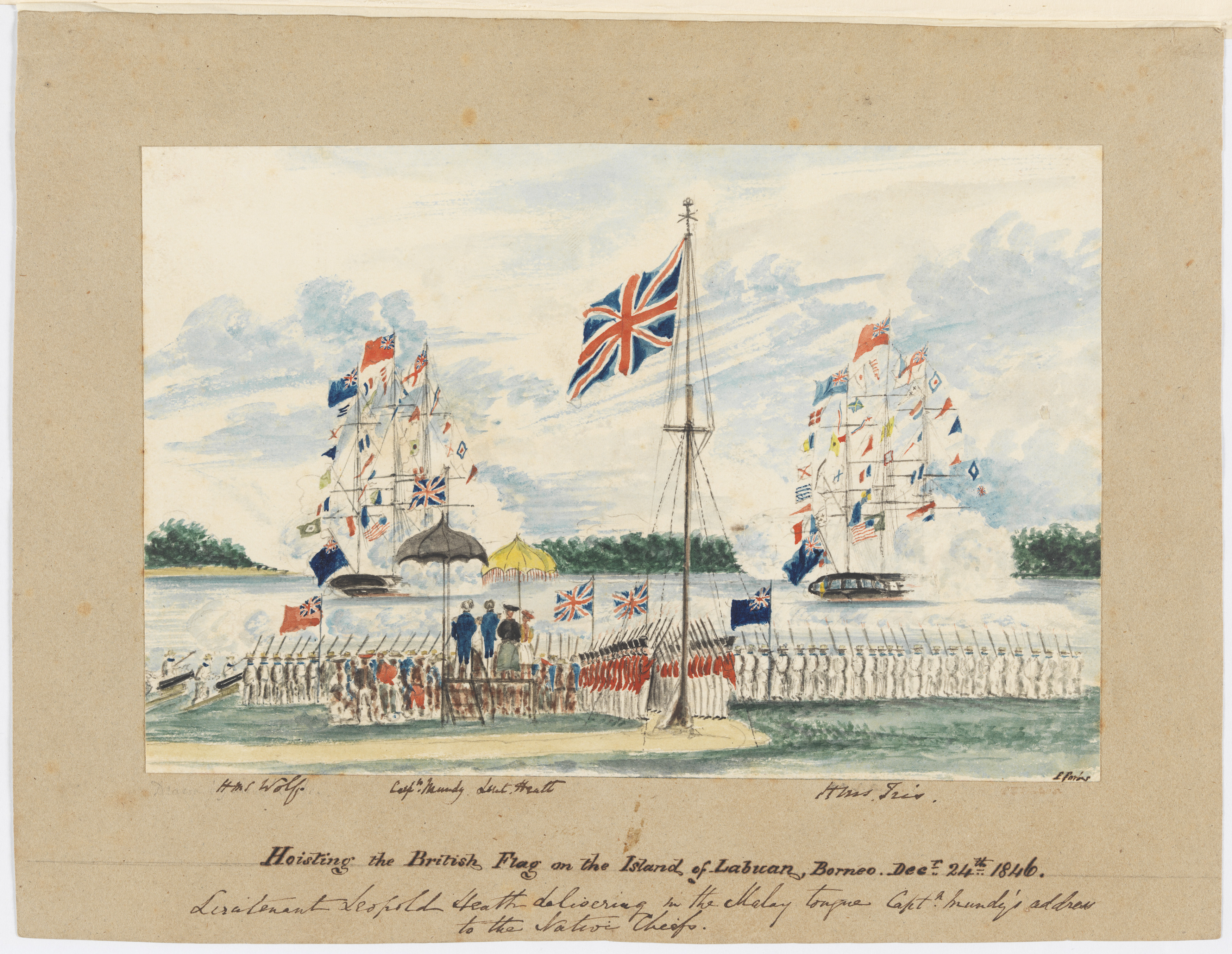
- - On the 14th of the same month, the island of Labuan was taken possession of in the name of the Queen of England with due form and ceremony. The Iris and Wolf dressed ship, royal salutes were fired, marines and small armed men landed, and Pangeran Mourmea, the prime minister, with all the Chief Rajahs, nobles, and several hundreds of Borneans, attended on shore, and their picturesque proas, anchored close to the beach, with flags and banners, had a beautiful effect.
Captain Mundy addressed the assembled natives in a short speech, explanatory of the English and Borneo governments, which Lieut. Heath put into Malay, and which seemed to give universal satisfaction, the great majority declaring their anxiety for protection from the ferocious pirates, and wishing for peaceful trade.
A sumptuous repast was afterwards given to the natives, princes, and people, under tents, erected on Point Pasley, and conviviality was kept up till sunset when the Musalmen returned to their fleet. Pangaren Mourmen and all the nobles visited the Iris the following day, and afterwards returned to Brune. - - The Iris was a Labuan on the 12th of January with the Wolf.
Monday 29 March 1847
Daily News (London)
Judges under the Small Debts Act.
The Observer puts forth the following as a correct list of the judges under the new Small Debts' Act, as far as the appointments have taken place. - - - Bloomsbury, D.D.Heath; - - -
Thursday 1 April 1847
Shipping and Mercantile Gazette
Mr Airey, master of the Iris, 26, Captain Munday, died at Singapore on the 22nd of January, from dysentery contracted at Labuan. A number of crews of the Iris and Wolf were also attacked with fever while at that station. Lieut. Heath, of the Iris, has been placed in temporary command of the Wolf, vic Gordon, deceased, and Mr Josling, mid-shipman, has been made acting Lieutenant.
Friday 9 April 1847
Lincolnshire Chronicle
After remaining here a week we set sail for this river (Borneo), into which I brought the Iris in safety, for the third time, on the 17th. The next day a deputation arrived from the Sultan to compliment me on my return, and begging to offer me presents of bullocks, stock &c., which I declined accepting, and my return compliments to his Highness, with the information that I proposed paying him a visit on the 19th.
Early on that morning I dispatched all the boats, armed, under Lieut. Heath, taking with him the detachment of marines, and gave him orders to moor the force in line of battle in front of the Sultan's new palace, and land the marines on the platform commanding the entrance of the small audience and there wait my arrival.
To James Brooke, Esq., Her Majesty's Agent
Saturday 10 April 1847
Hampshire Advertiser
Brading, April 10.
Vestry Meeting - The annual Vestry was held in the parish church, on Tuesday last, the Rev. D.J.Heath, the vicar, in the chair, when Messrs. James Perkins and Barnabas Barton were elected churchwardens, and Messrs. R. Loe, H.Hawkins and H.Pocock overseers for the ensuing year. A church rate was proposed by Mr.G.Stone, and seconded by Mr.G.Kemp, of 1½d in the pound; when Mr.S.Birch moved an amendment, seconded by the Rev. - Smith, Independent minister, to adjourn the meeting for six months. The amendment was lost by a show of hands, and the original motion was passed by a considerable majority. A vote of thanks was passed on the chairman for his able conduct in the chair, and a large party adjourned to the Wheat Sheaf Inn, and partook of an excellent dinner provided by the worthy host, Mr.Wales. - - -
Wednesday 14 April 1847
Sun (London)
Bloomsbury County Court.
(This day)
Before D.D.Heath Esq, Judge
Carle v Peplow.
The plaintiff, Susan Jane Carle, south the of the sum of 1/.6s. 8d., the balance of a bill due for dressmaking, millinery, &c. On behalf of the defendant (Dr.Peplow) attended the husband of the plaintiff, for a severe illness with which he had been attacked, and for which he charge 1/.10s.6d. To liquidate this debt, the plaintiff was engaged as dressmaker, &c. by Mrs.Peplow. From that time (Christmas 1846) to the 6th of March last, the plaintiff had made, altered and repaired various articles of wearing apparel, for which she demanded 2/.17s.2d., leaving after the deduction of Dr.Peplow's bill a balance of 1/.6s.8d. the sum sued for.
Mr.Edwards, on the part of the defendant (who was not present), stated that in consequence of a separation having been made between the defendant and his wife, the former inserted an advertisement in The Morning Sun, and other daily journals to the effect that after that notice, he would not be answerable for any debts contracted by his wife. As corroborative evidence, Mr.Edwards handed the Learned Judge The Morning Sun and another paper, bearing the date of January 26, 1846, containing the advertisement alluded to. He, therefore, on behalf of his client, objected to the items inserted in the plaintiff's bill on the 6th of March.
The Learned Judge explained that if the items named were necessities for the maintainance of the wife, the defendant would be liable, notwithstanding the public notice to the contrary. An advertisement inserted in any of the London daily journals would render the husband in a position to dispute the debt, if the articles incurring it, were not proved to be positive necessaries. After the appearance of the advertisement, the husband would not be liable for any jewellery, silks, or other articles of an expensive nature, not usually worn by the wife previous to separation.
Mrs.Peplow was called, and said she had been separated from her husband since the 20th of January without any allowance. She had had all the articles named in the plaintiff's bill - mostly to her husband's personal knowledge.
The Judge then questioned the plaintiff and the last witness as to the nature of the articles supplied on the 6th of March, and, considering them all to be necessaries with the exception of some ribbons, returned for the plaintiff, for 1/.5.4d.
Saturday 17 April 1847
Hampshire Advertiser
Ryde Literary Institution.
The Rev.D.I.Heath M.A., vicar of Brading, Isle of Wight, delivered a lecture to a very numerous and respectable audience on the "Body, Soul and Spirit." The rev.lecturer possessed a thorough knowledge of the abstruse and sublime matter on which he treated.
26. - 20 April 1847 - Sergt. Heath to Admiralty, draft letter appealing for Leopold's promotion.
F
Letter - draft
34 Mardagan Place, Bedford Square,
28 April 1847
Sir,
I take the liberty of guiding you, lay before the Lords Commissioners of the Admiralty a Statement of the Service of my Son, Lieutenant Leopold George Heath late of the M.S.Iris and at the date of the last letter acting Commander of H.M.S. Wolf and in charge of the new settlement at Labuan until supeseded by Commander Vansittart who is made with the death vacancy by the Admiral on the Station and I hope their Lordships will be disposed to entertain favourably this Application for his Promotion.
Their Lordships will find that while serving in the Iris he has been engaged in all the late operations and negotiations at Brunei and on the Coast of Borneo. He was in fact the senior Gunnery Lieutenant of the Squadron and was on board the Phyleillion in the Action at Bruni, though Lieutenant, now Commander Paly (Paynter), his junior was by sight of the Flag made his commanding officer and obtained his Promotion on that occasion.
In the subsequent - - - pursuit on Land of the Sultan their Lordships will see by Captain Mundy's Report, published in the Gazette, that Lieutenant Heath as commanding the Rockets and the (Pioneers? Provisions?) had the heaviest part of the Duty and received the public Commendations of his commanding officer and I believe they will find mention of him in whatever Accounts may have reached the Admiralty of the (subsequent?) operations to the (Eastwards?) and of the recent proceedings at Bruni and Labuan, where his Acquirement of the Malay Language has caused him to be employed in all the Negotiations with the Sultan and his Chiefs, and it was (crossed out - have the authority of) Captain Mundy stated when he (cross out - 'saying that he') appointed him to the Wolf and to the (entire?) charge of the new settlement, that he did so - (crossed out - 'where more than 200 people had already located themselves at the end of January and numbers daily flocking in without any direct encouragement on the part of the English and where a Trade is already sprung up') because he considered him to the person best fitted (cross out - 'of those on the ship') from his knowledge of the Language and political relations of the Country.
I now beg leave to refer their Lordships to his previous professional life. He was placed in the old Royal Naval College by his relative Sir Graham Moore in 1830, and at the end of 14 months gained the first medal, he was selected by Sir John Gore from the College and served with him in the Melville, and for his opinion and that of Sir Henry Hart,the Flag Captain, I beg to refer to the letters and Documents sent herewith.
He then served in H.M.S. Harrier - Commissioner Carew (since dead).
On his return he entered the new Naval College and again passed out first at the Public Examination and Mundy gained his commission as Lieutenant. I believe he is the only officer who has gained the first Prize in both the Colleges.
He then served as Gunnery Lieutenant in H.M.S. Impregnable (crossed out - 'where he had a crew almost entirely Landsmen to get into Order').
Captain (Tovred?) and Commissioner Philpott are both dead, but I am confident I may appeal to Admiral Sir Edward Owen and Captain Hervey of the Queen as to the efficiency of the Impregnable in Gunnery and as to my son's general merits as an Officer.
Considering that but for the Preference in command given by the Flag, to his junior officer, he would have been the Party promoted for the Burni Affair, that no promotion took place for the subsequent Proceedings in which he took a prominent part, that he has been actively employed on Land and on board ever since in the same Country and that he has now had command of the Wolf and of Labuan for more than two months, and considering how very few Opportunities are afforded in these Times to Officers, however zealous and capable they may be, to make themselves known.
I trust that I am not presuming too much in bringing forward his present Services and responsible position, his 17 years of active Service, his uniform good conduct and zealous performance of his Duties and his scientific acquirements which he loses no occasion to keep up and improving, as will appear from tables published in the nautical Magazine and in hoping their Lordships will consider his case entitled to a favourable consideration.
I am, Sir, your obedient servant, - George Heath
(thicker ink hand writing at bottom of page)
Tho' not strictly coming within the description of 'Service" I may add that he has twice nearly lost his life from his efforts to save his shipmates from drowning - Once on the memorable occasion when the son of Sir J.Gore perished, he being in the surviving boat and once in the Impregnable when he and his Boat Crew were given over as lost.
Note - referring to letter above
I have criticised freely - Above all things have the letter written plainly so that it may be read without a check. -
Yours very truly
Charles R. Bethune (?)
Tuesday 20 April 1847
Sun (London)
Bloomsbury County Court.
(Before D.D.Heath Esq., Judge)
Gredland v Bounds
This was an application for a writ against the body of Thomas Bounds, the defendant.
It appeared that during the time the old Small Debts Act was in force the defendant was summoned at the Middlesex County Court for the recovery of 1/.18s., and in consequence of his not appearing a verdict was given for the plaintiff, ordering immediate payment. Subsequently, an execution was issued against his goods. The landlord of defendant, upon the officer making his appearance, would not permit the seizure, alleging that he had a prior claim upon the goods for rent. The house was in Marylebone Lane.
The Judge did not understand how the law stood upon that point at present; but he thought it only laid in his power to grant a certificate of his application to this court, the plaintiff then could take out another execution from the Marylebone district.
The plaintiff stated that he had also taken out a judgment summons for the committal of the defendant, but that had also proved ineffectual.
The Judge directed Mr.Wright, the clerk of the court, to draw up a certificate of this application. Plaintiff would then be enabled to take out a new judgment summons at the Marylebone County Court for an immediate execution upon his body, but would not be enabled to recover costs of the first judgment summons.
Monday 26 April 1847
London Evening Standard
Bloomsbury County Court, (April 24)
(Before D.D.Heath Esq., Judge)
This morning, upon a case of debt being called on for hearing, a young man named Spencer Robert Lain, a clerk to a solicitor of extensive practice in the Inner Temple, appeared to sustain the case of the defendant. Before commencing, however, the learned Judge inquired if he (the clerk) could give the Court any proof of his being authorised to appear by the solicitor by whom he was engaged.
Mr.Lain, in reply, stated that he was articled to the gentleman in question, and he submitted that, in accordance with the usual custom, that was a significant authority.
In this opinion, however, the Court did not agree; the Judge consequently refused to allow the case to proceed.
(Evening Mail continues. . . )
The clerk expressed his astonishment at the court adopting such a rule, and inquired the judge's reason for so doing. The learned Judge explained that this was the first case of that description which had come under his notice since the enforcement of the new Small Debts Act, and with its commencement he had determined to abolish, as far as it lay in his power, a system both injurious to the legal profession and to the public generally. The practice of permitting clerks to conduct cases, under the names of the gentlemen to whom they may be employed, without their producing and satisfactory authority for so doing, was a great and growing evil, and the sooner it was checked the better it would be for all parties. He (the learned Judge) knew it to be a very common case of solicitors' or attorney's clerk to carry on a little business of their own, under the name of, and wholly unknown to, the gentlemen to whom they were articled, who were thus not only injured, but to a considerable degree defrauded.
Therefore, unless Mr.Lain could produce any letter, or some other proof satisfactory to the court, of his presence being authorised, he certainly would not go on with the case. A solicitor (whose name did not transpire) stated that the system alluded to by the learned Judge was rapidly increasing.
Mr.G.Clive, the judge of the Southwark County Court, had informed him that he also would do his utmost to suppress it, and he hoped the public press would notice the observations which had fallen from the learned Judge, for the subject was of equal importance to the public at large as to the profession itself.
In discussing the case the case the Judge said that his observations in relation to the general practices of attorneys' and solicitors' clerks did not in the slightest degree apply to this particular case; but, for the more effectual abolition of the system, he was determined for the future not to allow any plaint or other proceedings to be entered into unless he was well and perfectly satisfied of the clerk's authority for acting under the name of the solicitor or attorney by whom he may be engaged.
Friday 21 May 1847
Morning Advertiser.
Bloomsbury County Court - May 20
Before D.D.Heath Esq., Judge.
Leggett v Barton
In this case, in which Mr.Duncombe, the solicitor, appeared for the plaintiff, a plaint had been entered under the 122d section of the New County Courts Act (9th and 10th Vic.. C.95) to obtain possession of a small tenement rented by the defendant, in Eve Place, Old St.Pancras Road.
Mr.Duncombe stated that the defendant had rented the tenement, of which possession was not sought, at a weekly rental of 4s.6d. He had conducted himself in a very improper manner and had been served with notice to quit, which had not been complied with, and hence the present proceedings to obtain possession of the property.
The defendant, as soon as the case began, used his tongue in a very free manner, applying abusive epithets to all the parties engaged in the case except himself. He alleged he took the house monthly, although he was to pay the rent weekly.
Mrs.Leggatt, who is a licensed victualler, her collector, and a broker employed by him, were called. Their evidence proved that the house was let at 4s.6d. a week, and was taken not monthly, but weekly.
The defendant declared that they would swear anything, and made some further remarks, which he seemed to relish as witticisms.
The Learned Judge (D.D.Heath) advised him to be sparing in his epithets, and to conduct himself with common decency.
Mr.Duncombe stated that Mrs.Leggatt was a respectable licensed victualler, and by the present proceedings merely sought to obtain her own property.
The defendant, on being sworn, stated that he had taken the tenement monthly, and it was agreed between him and Mrs.Leggatt that he was to have a month's notice.
The Learned Judge asked him if he had any witnesses to call?
The defendant replied that unfortunately for him, this being "Epsom time," his witnesses were not in attendance.
The Learned Judge told him he could have compelled their attendance, or they could have been fined for non-attendance.
The defendant said they would not have attended. They would have preferred Epsom to the Court.
The Learned Judge (D.D.Heath) gave his opinion that the evidence showed that the house had been taken weekly, and not monthly, and he should issue a warrant for possession to be given. If the defendant was dissatisfied, he could enter into a bond with sureties to try the question before another tribunal.
Monday 24 May 1847
Morning Advertiser.
Bloomsbury County Court, May 22.
Before D.D.Heath Esq., Judge.
On the case of Smith v Ward being called for hearing, the defendant was found to be absent; and the action being founded upon an unsatisfied judgment, the plaintiff applied for a warrant of imprisonment.
The personal service of the summons having been fully proved, the defendant was committed, by the order of the Learned Judge, to the House of Correction for a period of 30 days.
In several other cases the defendants, who had failed to appear to the summons, were ordered to be imprisoned for different periods.
The Judges of the County Courts are empowered, under the 98th and 99th clauses of the New Small Debts Act, to imprison, for a period not exceeding 40 days, any individual who may be summoned to appear after an unsatisfactory excuse for non-attendance. The personal service of the summons must in each case be proved before the Judge can made an order of committal.
Envelope
From - Penang - 17 February 1847. (no keys?)
To - Acting Commander Heath, H.M.S. Wolf. Labuan
(Iris)
Admiralty 25 May.
My dear Douglas,
You will probably see in tomorrow's Times and Chronicle an interesting letter from Leo to Brooke. I believe it will be brought to the notice of Lord Palmeston so L.G.Heath's name will allow him (celebrity) - this maybe (turned to account?)
Yours sincerely,
Charles Bethune.
Tuesday 25 May 1847
Express (London)
Labuan. - Coal. - Intelligence from this settlement down to the 20th of March, has been received via Singapore. Whilst H.M.S. Wolf (relieved by the Columbine taken by her commander Lieut. Heath R.N.) and Lieut. F.E.Forbes R.N.,to ascertain something relative to the products of the island. Their researches have been successful in discovering a large seam of coal, commencing at what may be termed Captain Bethune's out-crop, and extending across the island in the directions E.N.E. and W.S.W.
The thickness of the seam was ascertained to be ten feet one inch; the dip 22 deg. N.N.W., and the extent about one and three quarter mile.
A path has been cut to the nearest portion of the seam, which is stated to be 334 yards from the beach, and distant 8 miles from Point Pasley. But what is not a little satisfactory is the circumstances of the seam being found near a bay, where there is good anchorage. - - - continues. - - - During the time the Wolf was stationed at Lebuan the sickness on board did not exceed the average of a sea voyage, and in some cases was a little below it.
Friday 28 May 1847
Express (London)
The following letter, addressed by Commander Heath, late of her Majesty's ship Wolf, to James Brook, Esq., furnishes some particulars of that gentleman's estimate of the state and prospects of the island of Labuan, our newly-acquired possession off the coast of Borneo:
H.M.S. Iris, Pule, Penang, April 6 1847.
Sir - Having on the 18th of March been superseded in the command of H.M.S. Wolf, and in the charge of the station of Labuan, I think an account of the present state of affairs at Brune will not be uninteresting to you.
I enclose you a copy of a letter which I addressed to the senior officer relative to the discovery of a fine seam of coal at the north end of Labuan. Specimens are on their way to England for the purpose of being properly analysed; in the meantime the report of the ship's blacksmith and of the cook is highly favourable.
Numerous examinations of the interior of the island show that the soil, or the greater portion of it, is a light yellow clay.
I was at Labuan during a dry season, and although many of the streams had ceased running, our wells never failed us, nor did their supply decrease. I therefore conclude that by increasing the number of wells an unlimited supply of good water may be obtained. Native information leads me to believe that there are but two steams which never fail - one being the waterfall near the north point, and the other a steam on the west side of the island.
Bullocks, poultry, fish and vegetables were always abundant at moderate prices, the average cost of beef being 2d. a pound. The inhabitants of the Kallias river are the purveyors, and I thought it right to visit them, and cement the friendly feeling which had begun between us. It is a fine river, and abounds with the Nepa palm (which does not grow in Labuan), but of which the greater portions of a Malay's house is built; the towns on the banks contain 7,000 or 8,000 inhabitants.
After passing the town of Kallias, the river flows on under the name of Kapala Panger, and enters the sea opposite Palo Tiga, thus making the land which forms the east side of the Labuan Channel an island; this passage is much used by the natives during the north-east monsoon.
The first English vessel was cleared and loaded with Borneo produce in a very short time, realising a large profit to her owners. One more had arrived at Labuan, and three were on their way from Singapore at the time of my leaving. The competition among them will, of course, soon lessen their profits, but will, on the other hand, encourage the Borneans, and the trade will soon find its level.
Until Labuan is colonized this trade will be carried on at Borneo, it being the residence of the Makhodas. But as I have known of native vessels being wind-bound ten days at Muarra, Labuan will, evidently, eventually have great advantages.
During my stay at Labuan I made a point of conversing as much as possible with the natives, especially the Nakhokas and traders. Their gratitude for the protection afforded by our presence is unbounded; they now have no hesitation in sailing singly, whereas in previous years they have been obliged to go in large squadrons for mutual support.
Since Sir Thomas Cochrane's operations,last year, piracy has been unknown on the coast; it is certain that the Illanoons have retired to Toongkoo on the east coast: some few who have intermarried with Badjows still remain, and have begged our forgiveness.
In the middle of February I heard from the Sultan that Hadji Saman was in Brune and creating disturbances, and the Sultan said he was not strong enough to bring him to justice. I immediately went up with all the force could muster, and finding the Sultan would be satisfied, I obtained the signature of Nakhoda Rashid to a document making him responsible for the good behaviour of Hadji Samen and his followers. This Nakhoda is a rich man, and supports the Hadji. It was clear to me that the Sultan was more afraid of offending you and Sir T. Cochrane by allowing the Hadji's residence than of any personal injury from him.
Upon being relieved by Commander Grary, who has but recently arrived on the station, I left letters with him, detailing with minuteness all that had occurred since last autumn, and upon your arrival at Labuan, I have no doubt he will show them to you, although there will probably be little in them that you are not already acquainted with.
Wishing you every success and support in your philanthropic undertaking.
I have the honour to be, sir, your obedient servant.
(signed) L.G. Heath.
Friday 28 May 1847
Sun (London)
By the last Indian mail we have been furnished with the important intelligence, tending further to stimulate the expectations entertained of the growing importance and prosperity of our new acquisition, the island of Labuan. On the adjoining coast of Borneo extensive coal mines were known to exist, and as that part of the country is within the territory of Sarawak, and under the sway of Mr.Brooke as Raja, there was every reason to rely that they would aid in no slight degree the future commerce of the archipeligo.
Fortunately, however, this advantage now promises to be superseded by another of greater magnitude, since we are informed of the discovery of a large seam of coal on the island of Lebuan, and consequently in our own possession. An opportunity has just been taken by Lieutenant Heath, Commander of the Wolf, to ascertain as far as possible the general products of the island, and among other results of his researches is the discovery in question. The seam commences at a distance of not more than 334 yards from the beach, and, what is of the utmost importance, in the neighbourhood of a bay where there is good anchorage, and a sufficient depth of water to allow steamers of moderate draught to proceed close in shore.
Much care was bestowed in ascertaining its direction, and it was observed at seven different places, the thickness being mostly ten feet. In trials made of the combustion of this coal it was estimated as about equal to Newscastle as regards heat and flame, but its consumption was more rapid. Situated near the same bay were a great number of camphor trees, which are described to be of the finest kind. There was also found large quantities of iron in its native state.
27. - 29 May 1847 - H.Wise to Sergeant Heath re Leopold's promotion
File 884
Letter
Private
To Mr. Serjeant G. Heath, 11 Chancery Lane.
From Henry Wise, 13 Austin Friars,
29 May 1847
Sir,
I have much pleasure in acquainting you, that on the arrival of the last overland Mail, I transmitted copies of your Son's able and intelligent Report on the Island of Labuan to the Foreign Office - Admiralty, and Colonial Office. I also caused the highly interesting and important communication in question to be inserted in the Morning Chronicle of yesterday's date - hoping by these means to call attention in the proper quarter to Lieutenant Heath's zealous discharge of his duty whilst in command of the Station at Labuan.
I have not been disappointed. The accompanying Note from Lord Auckland's Private Secretary to myself, will convey to you his Lordships opinion of your Son's Report, and I have stated to my friend Captain Drinkwater Bethune that I confidently hope this matter may prove useful in advancing Lieut. Heath's prospects for promotion.
Oblige me by returning Captain Eden's Note to my address, when read, and as the subject of this communication will be a sufficient exercise for my freedom in addressing you to whom I am personally unknown.
I beg to remain, Sir, Your obedient Servant,
Henry Wise.
Agent for James Brooke Esq., H.M.Commissioners, Borneo.
Tuesday 1 June 1847
County Courts Chronicle
Middlesex - Bloomsbury, Thursday May 13.
Before D.D.Heath Esq.,, Judge.
Newte v Helme
Practice as to set off - Security for costs - Plaintiff our of Jurisdiction - Assumplit - Money paid.
Money paid at the plaintiff's request. On the cause being called on, on the 5th inst.,
G.Becke, attorney for the defendant, applied for leave to postpone the cause, and for liberty for defendant to give plaintiff notice of set-off, which he had neglected to give five clear days before hearing, according to the rule. (No.17, Rules of Practice.)
The Judge (D.D.Heath) referred to the printed notice at the back of the summons, and asked if the defendant could read; which being answered in the affirmative, he permitted the cause to be postponed, on the defendant depositing two pounds for costs of adjournment, and on giving notice of set-off forthwith.
Becke then moved for security for costs, on the ground that the plaintiff was out of jurisdiction, being then at Paris.
The Judge ordered the plaintiff to deposit two pounds with the officer of the court, for security of the defendant's costs.
On the hearing of the cause on the 13th,
Hodgson stated plaintiff's case. The plaintiff rented rooms of defendant;and a pianoforte which the plaintiff's wife had hired, and which was on the premises, had been seized under a distress for rent, alleged to be due from defendant to one Dowson. The distress and the payment were not disputed.
Becke submitted that the plaintiff's case did not go far enough,and that he must be called. In order to recover money paid, a request, express or implied, must be proved; a mere voluntary payment was not sufficient. The plaintiff had not proved any legal liability on defendant's part to pay the rent, and it was not proved that any was due. Neither did it appear that the money was paid by plaintiff under compulsion; for the pianoforte distrained was not plaintiff's property, but another party's, who might properly have paid the money and recovered it had rent been due.
Hodgson then called the plaintiff's wife, who admitted that the defendant had stated he did not owe the rent distrained for, and was quite astonished at the demand being made; and also said she was a fool for paying the money, but although the defendant made some general admission of owing the rent, it was not distinctly proved to have been due. He then called another witness, who proved that defendant had said that the demand of rent was "all a mistake," but the evidence did not carry the case further.
Becke submitted that this was not sufficient; the only question on the case is, was there any rent due at the time of payment? The only person who could prove that fact clearly was the landlord, and he was not called. Distinct evidence should be given that defendant was liable to the amount paid for him.
Hodgson then proposed to call defendant as a witness in support of the plaintiff's case.
The Judge (D.D.Heath) however, intimated in that case he should not nonsuit the plaintiff, but at the present stage he would do so, that defendant in a fresh action might call the landlord as a witness.
Hodgson then elected to be nonsuited.
Becke applied for costs for the amount deposited by defendant to be returned to him. Besides the £2 deposited, the defendant had paid five witnesses for their attendance; two of whom had been subpeonaed, and three had attended voluntarily without subpeonas on his paying them.
The Judge ordered the costs only of those that had been subpoenaed to be allowed; and directed £1 to the amount deposited by plaintiff to be paid to defendant, and the amount defendant had lodged to be returned.
Saturday 5 June 1847
Dover Telegraph and Cinque Ports General Advertiser
Arrivals and Departures - Birmingham's Royal Ship Hotel - - - - Mr.Serjeant Heath and family - - -
Saturday 19 June 1847
London Evening Standard
The East India Station - Labuan
By letters from Penang, dated 7th April last, we learn that the new commander in chief, Rear Admiral Inglefield C.B., had a few days previously struck his flag, on board the
Vernon, 50, Captain Fitzgerald, and gone on shore for the recovery of his health.
The Iris, 26, Captain Mundy, under orders to return home, but had been detained by a court-martial, was to sail for England on the 8th, she had been joined on the 4th by Mr.Heath, first lieutenant of the ship, whom Captain Mundy had, on the lamented death of Commander Gordon, appointed to the Wolf, and to the temporary command of the Island of Labuan, and its adjacents, upon the ill-judged recall of the Iris from that station.
Lieutenant Heath reported, that previous to is quitting that island he had been fortunate enough to discover a valuable and extensive vein of coal of excellent quality and of easy procurement; that everything in that quarter was proceeding peaceably and satisfactorily; that piracy had entirely ceased all along the north-west coast of Borneo, and that the Bornean chief, Hadji Samon, whom the force under Captain Mundy had, in the month of August last, defeated in the River Mambacoot, and driven into the mountains, had made an offer of surrendering himself unconditionally to the captain of the of the Iris in person, to which gallant and most zealous officer we may imagine it was matter of deep regret and disappointment that he had not been there to have received the submission of that humbled chieftain, and that he had been called away from his command in those seas before he could fully effect and carry out the instructions of his admiral relative to the further establishment and improvement of the colony on that highly important station. Such measures as these we deem impolitic and unjust, except in cases of extreme necessity.
Saturday 19 June 1847
London Evening Standard.
Cambridge University Election.
At a numerous meeting of Members of the Senate held at No.55 Charing Cross, on Saturday, the 12th of June, Mr.John G. Shaw Lefevre's Address having been read, the following Resolutions were unanimously adopted:-
1. The John G. Lefevre Esq., from his high academical reputation, his long connection with the University, the interest which he has always taken in the advancement of science, and his able conduct in various important public offices, has proved himself eminently qualified to represent the University in Parliament.
2. That the Members of the Senate present at this meeting pledge themselves to use their best endeavours to secure Mr. Lefevre's return.
A committee was formed of the following gentlemen, with power to add to their number:- - - - (long list) - - - Douglas Denon Heath, late of Trinity. - - - -
Friday 9 July 1847
Morning Advertiser
Bloomsbury County Court, July 8.,
Before D.D.Heath Esq., Judge.
Master and Servants - Mead v. Parker.
This was an action by a footman against Mr.Kenyon Parker, Chancery Barrister, to recover the amount of a month's wages. Mr.Parker attended, accompanied by Mrs.Parker, and denied his liability. The point was discussed at some length.
The plaintiff, it appeared, was engaged for a fortnight, and had remained a few days over the time, but on a wilful disobedience, it was alleged, of an order given by Mrs.Parker, to bring an article into the dining-room, he was requested immediately to leave the house. On Mr.Parker's return to town he was paid his wages, and now claimed a month's notice, bringing his case, and Mrs.Parker was called on the part of the defence.
Mr.Parker, on the authority of several cases, which he cited, urged that the hiring was a special one, not being for a year, and, consequently, no notice was necessary.
The Learned Judge (Mr.Heath) said he would consider the point, which was of some importance in these cases. The hiring had been for a fortnight, and not for a quarter, or for a year.
Mr.Parker said he had a point on the merits. It had been distinctly laid down in "Spain v Arold," reported in the second Starkie, that a servant could not recover his wages who had wilfully disobeyed an order given by his master, and he was prepared to prove that such a circumstance had occurred in this case.
Mrs.Parker was called, who proved a refusal to bring an article into the dining-room, on which she requested the plaintiff to leave the house.
The plaintiff denied the evidence given, and gave his version. His demeanour in the Court was firm but respectful.
The Learned Judge said he would decide the case on the point of law which had been raised by Mr.Parker in respect to the hiring, and he would give his judgment in a week.
Saturday 10 July 1847
Cambridge Chronicle and Journal
The Chancellor's Levee
At 9 o'clock this morning the Prince Chancellor held a Levee at Trinity Lodge, when the great court of the College presented a scene very similar to that we have attempted to describe in our account of the Queen's Reception, except that it had lost the pensive charm of "summer evening's gentlest hours." Before the hour appointed for the Levee a large number of the members of the University had congregated, attired entirely in academical costume, this being a Levee held by the Prince Chancellor of the University. - - -
We append a list of the presentations - - - (long lists) - - -
Trinity - - -
Rev. John Moore Heath, M.A., - - - Mr. Heath M.A. - - -
Friday 16 July 1847
Morning Advertiser
Bloomsbury County Court, July 15.
Before D.D.Heath Esq., Judge.
Meav v Parker.
At the sitting of the Court judgment was given in this case, which was reported in the Morning Advertiser of Friday last. The action was brought by a domestic servant (a footman) to recover of the defendant, Mr.Kenyon Parker, of the Chancery bar, a month's wages.
The Learned Judge (Mr.Heath) said the case had stood over for a week for him to consider the points which had been mooted and the cases cited, whether the defendant was justified in dismissing the plaintiff without notice, either on the ground that he was only an occasional servant or for wilful disobedience.
It would seem that there was some neglect in taking up an article, and there was a want of respect to Mrs.Parker when he was asked on the subject in the mode and manner of his answer. It was not, however, such a want of respect or misconduct as to displace a permanent servant without notice.
The point was more was more for the consideration of a Jury than a Judge, and in the case of Hutton v Bullen, Mr.Justice Park had laid it down that it required moral misconduct, wilful disobedience, or habitual negligence, to warrant a master in dismissing a permanent servant without notice.
He (the Learned Judge) was of opinion that the plaintiff was not to be considered as a permanent servant. It appeared that he had been hired as an occasional servant, a fortnight had been mentioned, but at the end of that time nothing was said by either party, and it was a matter of inference whether, as he had continued three or four weeks after the fortnight, he was therefore to be considered as a permanent servant, as one hired by the year, and according to the admitted custom entitled to a month's notice.
Had the evidence ended there, it would have been a difficult question to decide, but it seemed that on the very day on which the occurrence happened, a fellow-servant had asked him whether he was going to stop, and he then said he did not know, clearly showing that he did not consider himself a permanent servant.
The plaintiff was a nondescript servant, different from one hired by the year, and had there been no misconduct in the case, he should have held that he was entitled to a reasonable notice, which might be a day's or a week's notice. There had however, been some ill temper shown, but it was difficult to say to what extent, but under all the circumstances, the judgment would be for the defendant.
Mr.Parker wished to know the opinion of the Court as to the costs. He did so to waive any claim he might have to costs.
The Learned Judge said he had entertained a doubt, and it was not a case for costs.
From Sir Leopold Heath's letter register
28. - 3 August 1847 - Appointed Commander
Friday 20 August 1847
Morning Post
Bloomsbury County Court. - Thursday, August 19.
Before D.D.Heath Esq., Judge.
The late Foley-Place Romance - Ellam v Esther de Villiers.
The parties in this action have already figured before the public at Marlborough Street Police Court. The plaintiff, Benjamin Ellam, a shopman, who dated his epistle to the defendant, Mademoiselle Esther de Villars, from the "Commander-in-Chief's office," brought his present suit to recover £15 alleged to have been lent to get goods from the Custom House. The defendant, who was accompanied by her sister, Leoline de Villars, who had also figured at the Police Court, attended to deny her liability, and after waiting from the sitting of the Court till five o'clock, the plaintiff did not make his appearance.
Mr.de la Mare, a solicitor on the part of the defendant, applied for an award of compensation from the plaintiff to the defendant. The plaintiff had not attended, and he thought he had acted wisely for once in his life.
The Learned Judge said he was authorised by the Act to award a sum for the attendance of the defendant. He wished to know if she was in Court?
Mademoiselle Esther made her appearance, and her solicitor, alluding to her swollen face, said she had been attending the whole day at great inconvenience from indisposition.
The Learned Judge asked the amount of the debt?
Mr. De la Mare said the claim was £15 alleged to have been lent.
The Learned Judge - Does she admit any part of it?
Mr.De La Mare - Oh no, not any. He referred to the 79th section of the 9th and 10th Victoria. c.95, by which the Court was authorised to award a sum for the trouble and attendance of the defendant. It was stated that the plaintiff, not having attended to urge his suit, the professional adviser for the defendant had paid the fees of hearing to enable him to make the present application. The defendant's sister, Leoline, and anothe personj, had attended as her witnesses.
The Court awarded £1 to the defendant for her attendance, besides costs, and ordered the cause to be struck out of the list.
By the order made, the defendant, in default of payment, will be proceeded against.
Monday 23 August 1847
Morning Advertiser
Bloomsbury County Court. Aug.21
Before D.D.Heath Esq., Judge.
Winney v Mouseley.
The plaintiff, landlord of the Panton Arms, Panton Street, brought his action to recover £4 lent to the defendant's wife.
It appeared that the defendant's wife asked the plaintiff to lend her £4 to pay some rent, and stated that he husband had sent her. He lent her the money, and took her I.O.U. for the same, which he now produced.
The defendant denied, on his oath, that he had sent his wife for the money. He knew nothing of the advance until a month after it occurred.
The plaintiff called Mr.Lloyd, the wife's father, and it appeared that there were family differences between the parties.
The Court gave judgment for the defendant, on the ground that a husband was not liable for money burrowed by his wife without his authority.
The plaintiff said he had always understood that a husband was liable for the debts contracted by his wife. He should certainly take other steps in the matter.
Judgment for the defendant.
The Court sat till nearly five o'clock, and then adjourned to the 8th September.
29. - 30 August 1847 - H. Hart to Leopold, congratulations for promotion.
File 888 - 29
Letter
Queens House, Greenwich.
August 30,1847?
My dear Heath,
I am much gratified by your letter, it was only the day before I was enquiring of Captain (Mundy?) where you were to be found.
Your Promotion did indeed offer me great pleasure and I am sure it will act as a stimulus for you to persevere in the course you have so honourably lead until you reach the highest honour and appointments of your profession. They are all within your power.
You will meet with many difficulties and disappointments, but don't (fall?) by the way and with a true reliance on Him who - - those who honour him you will be sure to gain all you wish at last.
I was over at Borneo myself and two days and two nights a prisoner in their custody. I was then Captain of the (hose?) frigate, we anchored outside of the river and I went up in my boat to demand a large Payment of a debt due to the Merchants at Mooreo and after keeping me two days and nights sent me off in (l) canoe.
Pray offer my kind remembrances to your father and family and believe me my dear young friend, sincerely yours.
Henry Hart.
We shall be very glad to see you if any thing brings you to Greenwich.
Monday 13 September 1847
Morning Herald (London)
View of the Islands of the Eastern Archipelago. Dedicated to Viscount Palmerston. Now Ready, Part 1.,containing Six Views in Borneo, Sarawak, Labuan &c., from Drawings made on the spot by Captain Drinkwater Bethune R.N., C.B.; Commander L.G.Heath R.N. and Others. With Descriptive Letter-press. By James Augustus St.John, Author of "Manners and Customs of the Ancient Greeks," &c. The Plates are engraved in tinted lithography by J.W.Giles
Each Part contains Six Plates. Price 10s.6d.
Thomas McLean, Haymarket; Whittaker and Co., Ave Maria-Lane; Chapman and Hall, Strand.
Friday 8 October 1847
Morning Advertiser
Bloomsbury County Court, Oct.7.
Before D.D.Heath Esq., Judge
Stray v Gardini
This was a judgment summons for a pair of trousers and waistcoat.
The defendant complained that the articles had not been delivered, and they were exhibited in Court. The question was, whether the defendant should be committed to prison for a period not exceeding forty days, or whether he should pay the debt and costs by instalments.
The Learned Judge eventually order the defendant to pay £1/.a month, and at the same time directing the articles to be given to the defendant. The plaintiff's shopman objected to the delivery of the goods, on the ground that they were to be paid for on delivery. The Learned Judge decided that they must be given up before the order could be made. The clothes were reluctantly parted with, and the Court made an order for payment, by instalments of 1/. a month.
Maynard v Dixon
In this case, a new point arose, of some importance. The plaintiff had a claim, as he alleged, against the defendant for more than £20., and brought an action in the Palace Court, which cause was removed by writ of habeas corpus into the Court of Queen's Bench, and the plaintiff proceeded no further, on account of the expense. The removal into the superior Court was of course at the instance of the defendant, and the plaintiff now brought an action in this Court; and the question was, whether he could do so without entering a discontinuance to the other action.
An attorney for the plaintiff urged that he could proceed in that Court, on the ground that the removal was on the part of the defendant, and she had not entered an appearance.
The defendant, a widow woman, said a friend ha removed the case, and she had no means of proceeding with the action. Mr.De La Mare, a solicitor, informed the Court that the cause, by the removal, was in a similar position to a new cause, and the defendant should have entered an appearance.
The Learned Judge, after consulting some authorities on the subject, doubted whether the plaintiff should not wait a year, or enter a discontinuance.
The Court, after some discussion on the subject, held that the action was properly brought. - - - -continues. . .
Saturday 9 October 1847
Illustrated London News
The New British Possession in the Eastern Archipeligo.
* Views in the Eastern Archipeligo: Borneo, Sarawak, Labuan, &c. From Drawings made on the spot, by Captain Drinkwater Bethune, R.N., C.B., Commander Heath R.N. and others.
- - - We are much indebted to the officers engaged in that service, particularly to Captain Bethune and Commander Heath, for the light which has been thrown on the character and productions of the island, which has been much more carefully explored than in so short a time we had any reason to expect.
If their example be followed by those who succeed them, Labuan will be as familiar to the British public as the island of Bombay, with the topography of which many untravelled Englishmen are as well acquainted as with Hampstead Heath.
Saturday 9 October 1847
Saint James's Chronicle
Bloomsbury County Court, Oct.8.
Holdstock v Marcus - Committal of a Clergyman for Contempt.
This was a judgment order against the defendant, a clergyman, in an action brought by the plaintiff for the sum of £12.12s. for goods sold and delivered.
The defendant, who keeps a school in the neighbourhood of Bedford Square, was represented by his wife, a distressed looking female, who offered to pay the amount in two payments, viz, £5/.5s at Christmas, and the remainder six weeks afterwards.
Plaintiff said that would not do, as the defendant had had frequent opportunities of settling his demand, but he had neglected to do so, and he should, therefore, press for immediate payment.
Defendant's wife (crying). - He could not have paid it: look at my garb for the wife of a clergyman.
The Judge (D.D.Heath Esq.), said that as the plaintiff pressed the case, and as the defendant had neglected to come forward to put in any plea for non-payment, he was bound to convict him, after which fresh proceedings could be instituted against him for the recovery of the debt.
An order was then made out for the defendant's committal to prison for 14 days.
Saturday 23 October 1847
Shipping and Mercantile Gazette
Bloomsbury County Court.
Mills v Jenkins - (Before D.D.Heath Esq,. Judge, on Friday). - This was an action to recover the sum of £20/., which the defendant had obtained from the plaintiff in exchange for shares in the Boston, Newark, and Sheffield Railway. It appeared that the plaintiff and defendant are surveyors, and in February 1846,an engineer named Higgins, who was unsuccessful in depositing his plans at Whitehall on the memorable 30th November, (Railway Gauge Act, 1846) being thereby made bankrupt, was outlawed, previously placing in the hands of the plaintiff twenty £1/. shares in the above railway. At the time defendant was the chief creditor. In April the same year plaintiff received a letter from Higgins, who was in France, desiring him to get banker's receipts for the shares, and keep the cash, in part payment of the money due to him. - - -
The Judge said he must come to the conclusion that the money was not received, as alleged, for plaintiff's sole use, and he had no doubt that both he and defendant were agents, and the latter being obliged to give a guarantee before he could obtain the money, he was, of course, most entitled to it. - Judgment for defendant, with costs.
Wednesday 27 October 1847
Nonconformist.
Confirmation at Ryde. - "This morning, Oct. 16th, 1847, the solemn and holy act of confirmation was performed upon upwards of 600 persons at St.Thomas's Church, Ryde, by the Bishop of Winchester." Such is a paragraph in a local paper, on which I have a remark or two to make. - - -
Amongst those present were every grade of society and every grade of character, from the very lowest on the scale of morality; even prostitutes were there, were said to have received the Holy Ghost, and were addressed as Christians. Amongst the ministers officiating might be seen the Rev.P.Hewitt, who does not admit schismatical corpses into his churchyard at Binstead; also the Rev. D.J.Heath of Brading who performs miracles of healing, and affirms that mesmerism is the biblical method of healing by laying on of hands
Saturday 30 October 1847
Bucks Gazette
Bloomsbury County Court, Oct 21
(Before D.D.Heath Esq., Judge.)
Richey v Gell.
In this case an important question was raised respecting the exemption of attorneys from being sued in the county courts. The plaintiff claimed a sum for work and labour, from Mr.Francis Gell, an attorney, and it was demurred that the court had no jurisdiction, on the ground that the defendant, being an attorney, was privileged from the operation of the new Act (9 and 19 Vic., cap.95) The question was raised by Mr. de la Mare on the part of the defendant, and the court took time to consider its judgment.
The learned Judge now gave judgment. After referring to the various authorities cited by the learned gentleman for the defendant, he proceeded to consider the question as raised in this case. By the 67th provision in the County Courts Act, it was enacted, "That no privilege, except s hereafter excepted, shall be allowed to any person to exempt him from the jurisdiction of any court holden under this act."
The only exceptions he could find in the act and the question was whether under the section quoted the privilege which had been exercised by the attorneys to exempt them from proceedings in the Small Debts Court was to be retained under the new law. He considered the clause was framed expressly to meet the question of privilege, and he could make no distinction as to an attorney. It would require a case exactly in point, and a modern decision by one of the superior courts, to induce him to alter his opinion.
The provision dealt with the question of privilege, and to allow it to prevail in this case would be acting in his judgment contrary to the fair interpretation of its terms, and in opposition to the intention of the Legislature.
Judge for the plaintiff.
Friday 5 November 1847
Morning Advertiser
Bloomsbury County Court, Nov.4.
(Before D.D.Heath Esq., Judge)
Barnett v Woodgate
In this case the defendant did not appear, and the plaintiff was required to show that the summons had come to his knowledge 10 days before the hearing.
Some evidence was given, showing that the documents had been left for him, and it was believed that the defendant had received them.
The Learned Judge refused to adjudicate upon the case, laying it down, that before a summons could be heard in the absence of the defendant, it must be shown that he had knowledge of the same, ten days at least before the day appointed for the hearing.
Flynn v Brotherton
This was an action for £2/. for rent, and the defendant, who was represented by Mr.Austin, an attorney, pleaded that he had a set off to £1/.18s.
The plaintiff and the defendant were both examined on their oath. The defendant, a veterinary surgeon, in his set off, claimed £1/. for examining a horse, and the plaintiff in his evidence positively declared that he had paid him 3s.6d. for his opinion. A further claim was made in respect of another horse, but the plaintiff stated that the horse was examined by another surgeon, and he called evidence to prove the fact.
The Learned Judge, on the painful contradiction offered by the party, decided that the set-off could not be allowed, and gave judgment for the full amount claimed by the plaintiff.
The defendant asked for time.
The plaintiff said if he could afford a lawyer he could pay him, besides he was not disposed to grant time to a man who had made such a defence.
The Court decreed payment forthwith
Monday 8 November 1847
Home News for India, China and the Colonies
Borneo
Now ready, Part II, price 10s. 6d.
Views of the Islands of the Eastern Archipelago, Borneo, Sarawak, Labuan, &c., &c., engraved and Tinted Lithographs by W.Giles, from the Original Drawings by Captain Drinkwater Bethune, R.N., Commander Heath, R.N., and others, with descriptive letter-press, by J.A. St.John. Part I, is now reprinted, and ready for delivery. London: Thomas McLean, 26 Haymarket
Saturday 13 November 1847
Morning Advertiser
Bloomsbury County Court, Nov.12
(Before D.D.Heath Esq.)
Moggeridge v Prince Castelcicala
This was an action, brought by the plaintiff, to recover the sum of £6/. from Prince Castelcicala, the Neopolitan Ambassador, for goods sold and delivered. Previous to the case being entered into,
Mr.Fitch, solicitor for his Highness, objected to the plaint, on the ground of irregularity, arguing that the plaintiff must be nonsuited. He referred to the 7th Anne, chap.12, a statute passed for the protection of foreign Ambassadors in this country, in consequence of the Prussian Ambassador having been subject to an arrest while riding in his carriage. It was determined by the Act that all writs and processes which should be issued or presented, whereby any foreign Ambassador or Minister, or his domestics might be arrested or imprisoned, or his goods and chattels might be seized or distrained upon, should be null and void. In reply to his Honour, he said he knew of no case, showing that the Act had been put in force.
The Judge suggested that the case should be tried in a superior Court. If the plaintiff obtained a verdict it would be for the clerk or bailiff to consider if execution should follow, defendant could then avail himself of his privilege by the Act of Anne, that he was free from arrest.
Mr.Jacques contended for the plaintiff, that the summons would affect neither the person nor the goods of Ambassadors.
Mr.Fitch argued, that the process taken against his client was provided against in the Act of Anne.
His Honour observed that if the plaintiff succeeded in his action his Highness was a liberty to obey his order or not as he liked.
After a long argument, it was arranged that the case should stand over for a fortnight, to afford defendant an opportunity of removing the case to a higher court.
Hardwick v Foster
In this case the plaintiff, a surviving trustee of the Working Man's Association, sought to recover from the defendant, one of the sureties for Mr.Forth, the treasurer, the sum of £7/. 8s. for which Mr.Forth was a defaulter, the action being brought upon a bond, which the defendant had signed.
Defendant admitted having signed the bond, but said he knew nothing of the Society.
Mr.Forth said the Society had not allowed for the balance the owed him, which debt amounted to £1/.18s.6d., for attending meetings, and £3/.10s. he had paid as a member.
The Secretary observed, that if Mr.Forth would allow the fined he owed, the Society would pay his claim, but he dissented.
An order was made for £5/.9s.7d,., and it was ordered to be paid in a fortnight.
Friday 19 November 1847
Daily News (London)
Bloomsbury County Court
Before D.D.Heath Esq., Judge
Lyon v Cochrane - The Westminster Election.
This was an action brought by the plaintiff against the defendant, Charles Cochrane Esq., the late candidate for Westminster, to recover the sum of £4.15s.6d., alleged to be due to him for expenses incurred during his services as canvasser, &c., in the above election. The plaintiff stated that on the 29th of March last he waited upon Mr.Croucher (since deceased), the defendant's authorised political agent, at the Crown and Anchor Tavern, and was engaged to act as a canvasser at the weekly salary of £1.10s, and payment of all incidental expenses. He commenced his duties on the 5th of April, receiving his salary every Saturday, when he gave in a written account of his expenses.
On the 22nd of May he spoke to Mr.Thompson, Mr.Croucher's clerk, when that person told him that he had mislaid the bills, but that if he would make out an account he would lay it before Mr.Cochrane and get it settled. He did so, but heard nothing of it, and one day, speaking to defendant on the subject, that gentleman said "Don't trouble me with those things, for they are entirely in the hands of Mr.Croucher, who will settle them."
He still continued delivering his weekly bill of expenses till the 19th of July, when the salary of the canvassers was increased to £3.3s. per week; and when witness then reminded him of what was due to him, he said that no more expenses would from that time be allowed, which witness of course in consequence did not charge. He has since been unable to obtain a settlement, and once called upon the defendant at his residence, when he desired him to leave the house, referring him to Mr.Hibble, his then acting agent; but he thought it better at once to bring the question whether he was to be paid or not to an issue, and adopted the present proceeding.
T.Lancaster, who was called to prove Mr.Croucher's agency, said that he was engaged by that person as secretary to Saint John's district, and that on first seeing the plaintiff he told him the agreement he had made, which was as he had stated. - - -
His Honour observed that it was quite clear to him that plaintiff had been engaged by Mr.Croucher, who had been acknowledged by defendant as his acting agent, and the latter, although he must have known of plaintiff sending in his claim, had never let the canvassers know that such expenses would not be allowed. He considered him liable, and should decide against him. - Verdict for plaintiff.
Friday 10 December 1847
Daily News (London)
Bloomsbury County Court
Before D.D.Heath Esq., Judge.
Bullman v. Maddox. - The Princess Theatre.
This was an action brought by the plaintiff, a master carpenter, against the defendant, the lessee of the Princess's Theatre, to recover the sum £2.19.7d., balance of a bill for work and labour done. -
Plaintiff stated that prior to the opening of the theatre at Christmas, 1843, he was employed by the defendant to fit up the property-room, and do some decorations to the dress boxes, for which he was obliged to engage two men; and having finished the job he delivered his bill, which was £8.19s.7d. Defendant paid him then £2. and by dint of great pressing he had at long intervals obtained £4. more, but on applying for the remainder, which he now proceeded for, the defendant refused to pay him, and very much abused him -
A solicitor who attended for the defendant attempted to show that the charges were excessive, but failing in doing so, judgment was given for plaintiff for immediate payment with costs.
Chambers v. Peters. - A surgeon committed for 40 days. - In this case, the plaintiff, a tailor, sought to recover from the defendant, a surgeon, the sum of £5.5s. for goods sold and delivered. The present was a judgment order, granted in July last, before which time, on the case being first heard, the defendant had been ordered to pay directly, but had neglected to do so. - - The defendant said he was a surgeon, but not in practice. He had been supported by an independency.
Judge: You might have proceeded against the plaintiff for a false warranty of his goods, and as you do not offer any terms, I shall order your committal to prison. - An order was then made out for defendant's commitment for 40 days, which will be put in force on Tuesday, unless in the interim he arranges with the plaintiff.
-
Michael Heath-Caldwell M.Arch
Brisbane, Queensland
ph: 0412-78-70-74
alt: m_heath_caldwell@hotmail.com