Michael D.Heath-Caldwell M.Arch.


Michael Heath-Caldwell M.Arch
Brisbane, Queensland
ph: 0412-78-70-74
alt: m_heath_caldwell@hotmail.com
- Home
- Architectural Projects 0
- Architectural projects 1
- Architectural Projects 2
- Architectural Projects 3
- Architectural Projects 4

- The Crystal Palace
- Timeline
- 1693
- 1745
- 1770
- 1783
- 1784
- 1785
- 1786
- 1788
- 1789
- 1791
- 1792
- 1793
- 1794
- 1795
- 1796
- 1797
- 1798
- 1799
- 1800
- 1801
- 1802
- 1803
- 1804
- 1805
- 1806
- 1807
- 1808
- 1809
- 1810
- 1811
- 1812
- 1813
- 1814
- 1815
- 1816
- 1817
- 1818
- 1819
- 1820
- 1821
- 1822
- 1823
- 1824
- 1825
- 1826
- 1827
- 1828
- 1829
- 1830
- 1831
- 1832
- 1833
- 1834
- 1835
- 1836
- 1837
- 1838
- 1839
- 1840
- 1841
- 1842
- 1843
- 1844
- 1845
- 1845-46 Oxford
- 1846
- 1847
- 1848
- 1849
- 1850
- 1851
- 1852
- 1853
- 1854
- 1854/55 Appendix
- 1855
- 1856
- 1857
- 1858
- 1859
- 1860
- 1861
- 1862
- 1863
- 1864
- 1865
- 1866
- 1867
- 1868
- 1869
- 1870
- 1871
- 1872
- 1873
- 1874
- 1875
- 1876
- 1877
- 1878
- 1879
- 1880
- 1881-1
- 1881
- 1882
- 1883
- 1884
- 1885
- 1886
- 1887
- 1888
- 1889
- 1890
- 1891
- 1892
- 1893
- 1894
- 1895
- 1896
- 1897
- 1899
- 1900
- 1901
- 1902
- 1903
- 1904
- 1905
- 1906
- 1907
- 1908
- 1909
- 1910
- 1911
- 1912
- 1913
- 1914
- 1915
- 1916
- 1917
- 1918
- 1919
- 1920
- 1921
- 1922
- 1923
- 1924
- 1925
- 1926
- 1927
- 1928
- 1929
- 1930
- 1931
- 1932
- 1933
- 1934
- 1935
- 1936
- 1937
- 1938
- 1939
- 1940
- 1941
- 1942
- 1943
- 1944
- 1945
- 1946
- 1947
- 1948
- 1949
- 1950
- 1951
- 1952
- 1953
- 1954
- 1955
- 1956
- 1957
- 1958
- 1959
- 1960
- 1961
- 1962
- 1963
- 1964
- 1965
- 1966
- 1967
- 1969
- 1971
- 1974
- 1975
- 1976
- 1979
- 1983
- 1990
- 1991
- 1998
- 2001
- 2002
- 2004
- 2005
- 2006
- 2007
- 2008
- 2009
- 2010
- 2011
- 2012
- 2013
- 2014
- 2015
- 2016
- 2017
- 2018
- 2019
- 2020
- F.C. Heath-Caldwell
- C.H.Heath-Caldwell Memoirs
- Palmer Family
- Palmer Timeline
- 1912 - Palmer
- 1914 - Palmer
- 1916 - Palmer
- 1918 - Palmer
- 1919 - Palmer
- 1924 - Palmer
- 1925 - Palmer
- 1926 - Palmer
- 1929 - Palmer
- 1932 - Palmer
- 1934 - Palmer
- 1936 - Palmer
- 1938 - Palmer
- 1939 - Palmer
- 1944 - Palmer
- 1946 - Palmer
- 1961 - Palmer
- 1967 - Palmer
- 1970 - Diary - Joe Palmer
- 1971 - Diary - Joe Palmer
- 1972 - Diary - Joe Palmer
- 1991 - Diary - Joe Palmer
- 1992 - Diary - Joe Palmer
- 2010 - Diary - Joe Palmer
- Venice Earthquake 1873
- Old Letters 1
- Old Letters 2
- Old Letters 3
- Old Letters 4
- Old letters - Mid 1800
- More Old Letters
- Eaton Hall, 1943
- Marsh Family Timeline
- James Caldwell papers 1
- James Caldwell papers 2
- James caldwell papers 3
- Old letters 1800s
- Old Letters 1800s 2
- HH Sultan Taimur bin Turki 1913
- Frank Featherstone Wright 1921-2014
- Frank F. Wright 1
- Frank Featherstone Wright early
- Frank F. Wright 2
- Frank F. Wright Videos
- Old Featherstone album 1
- Old Featherstone album 2
- Old Featherstone album 3
- Old Featherstone album 4
- Old Featherstone album 5
- Arthur Eversfield Featherstone Album 1
- Arthur Eversfield Featherstone Album 2
- Arthur Eversfield Feartherstone Album 3
- Grasmere
- Frank E Wright Album 1a
- Frank E Wright Album 1b
- Frank E Wright Album 1c
- Frank E Wright Album 1d
- Frank E Wright Album 1e
- Frank E Wright Album 1f
- Frank E Wright Album 1g
- Frank E Wright Album 2a
- Frank E Wright Album 2b
- Frank E Wright Album 2c
- Frank E Wright Album 2d
- Frank E Wright Album 2e
- Frank E Wright album 2f
- Frank E Wright Album 2g
- Frank E Wright Album 2h
- Frank E Wright Album 2i
- Frank Edward Wright drawings
- Cathy Featherstone 1910a
- Cathie Featherstone 1910b
- Norma Featherstone 1913
- Norma Featherstone Part2
- Norma Featherstone Part3
- Norma Featherstone Part4
- Norma Featherstone Part5
- Kitlands House
- Moorhurst Manor
- Redlands House
- Milland House
- Anstie Grange
- Ebernoe House
- West Ham House
- Vigo House
- Linley Wood
- Crimean War
- James Caldwell letters 4
- James Caldwell letters 5
- James Caldwell letters 6
- James Caldwell letters 7
- James Caldwell letters 8
- James Caldwell letters 9
- Eton & Oxford 1830/40s A
- Eton & Oxford 1830/40s B
- Eton & Oxford 1830/40 C
- Eton & Oxford 1830/40 D
- Eton & Oxford 1830/40 E
- Eton & Oxford 1830/40 F
- Back in England. Early 1800s
- Arthur Heath 1872-4
- Sicily 1800
- Naples - 1830
- Trentham Hall
- Paris 1810
- Cromptons on the Lusitania
- HMS Illustrious 1948
- The Minoans
- Henry Crompton 1836-1904
- Orongorongo 1957
- Another Page
- Gertie Wheeler 1909
- The Ahsan Manzil
- More old letters 1800s
1887 - 1888 - 1889
Eliza Louisa Marsh-Caldwell – known as Louisa – aged 69/70 of Linley Wood
Georgina Marsh-Caldwell – Gies – aged 67/68 of Linley Wood
Rosamond Marsh-Caldwell – Posy – aged 62/63 of Linley Wood
Rev. Dunbar Isadore Heath - 72
Admiral Sir Leopold Heath – aged 70/71.
Lady Mary Heath – (ne Mary Emma Marsh) – aged 61/62
Arthur Raymond Heath M.P., - aged 33/34
Marion Heath – May – aged 32/33 - (Mrs Cotton)
Capt. Frederick Heath R.E.– (Gen. F.C. Heath-Caldwell) aged 29/30
Cuthbert Eden Heath - aged 28/29
Ada Randolph Heath - aged 27/28 (Mrs Broadwood)
Lt. Herbert Leopold Heath R.N. - aged 26/27
Lt. Gerard Moore Heath R.E. - aged 24/25
Tuesday 3 January 1888
Huddersfield Chronicle
The Cause of Collisions at Sea.
A controversial correspondence in The Times as to the cause of collisions at sea leads us (The Observer), to this conclusion — collisions are usually caused by what may be called close-shaving. There is no actual intention, perhaps, to disobey the rule of the road; but the steersman of the ship that ought to make way puts off his duty to the last moment, and then he finds that he makes way too late.
The helm does not tell as quickly as he expected; a chance cross-current, perhaps, interferes with the ship's action; it does not make way, and then there is a smash.
Another cause is that many steersmen have a morbid antipathy to give way. They keep on thinking that the ship they are meeting will give way for them, and not till they see that this hoes is vain do they set about obeying the rule.
The steersmen of trading steamers in the estuary of the Thames — especially of steamers from the Tyne — have become so brutal and reckless of late in this respect that most yachtsman nowadays never assume they will obey the rule of the road.
A prudently-steered yacht usually gives way for the steamer even when it is entitled to keep on its course. This only shows that the penalty for disobeying the rule of the road is very leniently enforced. The slightest pretext of an excuse for evading it is sufficient to recommend a captain to mercy, whereas, as Admiral Heath contends, no excuse, except force majeure should be listened to.
Collisions at night are on a different footing. We are convinced that the choice of a green colour for the starboard light was a mistake. Green glass absorbs so much light that it is not visible till a swift steamer is so close on the vessel meeting it that it is hardly possible to alter its course so as to avoid a mishap.
Saturday 7 January 1888
Surrey Advertiser
Admiral Heath, writing from Holmwood, Dorking, to Saturday's Times, contributes a letter on "Close shaving as the cause of collisions at sea."
Saturday 14 January 1888
Glasgow Herald
Letters to the Editor.
Admiral Colomb on "Close Shaving" as a Cause of Collision.
97 St.Geroge's Road, London S.W.
Sir. - I trust that your article of the 10th inst. may be useful in causing those concerned to reflect first, and then to study actual collision cases for themselves with an ultimate view to the prevention of these unfortunate accidents. Those who have read Sir Leopold Heath's and my letters in the Times, with the strong difference of opinion between us, require to be told that we are both entirely agreed that the great majority of collisions are preventable accidents, and the only difference between us is how to prevent them.
But there is perhaps a still wider difference between us than appears in our letters, inasmuch as I have a confident belief that if authority will pronounce on what is safest and what is most dangerous in the ordinary everyday - or rather every night - meetings of ships, we should go along way in the direction of prevention.
He has no such belief. We both agree that, in so far as the law goes towards threwing the onus of avoiding collision on one only of two ships approaching each other, the law is right in principle.
But he thinks the law is right as it stand in ordering that the one ship "shall keep out of the way"of the other, and giving no sign of a clue how to "keep out of the way." I think the law should go further and be more definite - as definite as it used to be before 1863. - - -
So Sir Leopold Heath wishes us to say to the seamen - "Keep out of the way, and don't make a close shave," without in any way explaining to him that, prima facie, the movement which looks like keeping out of the way and avoiding a close shave is one leading directly up to the worst form of collision. - - -
Sir Leopold Heath, and, I may say, the framers of the present rule of the road at sea, take the opposite view. They are satisfied if the lights only say, "keep out of the way, don't make a close shave," and are satisfied to leave the officer to do exactly what appears to him at the moment calculated to take him out of the way, and to avoid a close shave. The engine driver seeing a red light has only the choice between increasing and reducing his speed; the officer in charge of the steamer can do a great many things in altering the circumstances. - - -
Sir Leopold Heath and the many who, I believe, thing with him, would leave the officer loose amongst all these choices,while I say it is neither logical nor fair to leave him so. The Admiralty and the Board of Trade, moved thereto by the indefatigable exertions of Mr Thomas Gray, widely published diagrams for the use of the merchant marine in which this very case was set forth by means of description and diagram, - - -
Belfast News-Letter
Tuesday 17 January 1888
Close Shaves as the Cause of Collisions at Sea.
Rear-Admiral P.H Colomb has written as follows to the Times:-
The only object I have in writing to you on this subject is to get the facts studied, for sure I am that there can be no controversy between any two men who have mastered them. I thank Sir Leopold Heath for his kindness in mentioning my efforts in this direction; but I think it should be stated that I never published a word till I had carefully studied and classified every case of collision which had come before the Admiralty Court in ten years.
All my subsequent examinations and experiments were absolutely confirmatory of the earlier results and whenever I now examine a collision case I see just the same facts, with which opinion has nothing to do. And those facts are the opposite of Sir Leopold Heath's conclusions. They came to this, that practically there are no collisions in the open sea where one or both ships have not tried to give what was supposed to be "a wide berth" to the other, and that practically there are no collisions where each ship has tried to give the other a "close shave" and very few where even one has tried to give the other a "close shave."
Saturday 21 January 1888
Glasgow Herald
Close Shaving as the Cause of Collisions at Sea
In reference to this subject in which some correspondence has appeared in our columns, Admiral Heath sends the following letter to the Times. -
Sir, - Admiral Colomb's teaching is so very dangerous that I hope I may be allowed a last word in reply to him.
The doctrine which I have put forward is that close shaving is the cause of most collisions, while the Admiral teaches that, on the contrary, the more care that is taken to avoid them by giving a wide berth the greater the likelihood of their occurring. He may well add that he knows that his teaching is paradoxical.
He says: - (1) "There are practically no collisions in the open sea where one or both ships have not tried to give what was supposed to be a wide berth.
(2) That "practically there are no collisions where each ship had tried to give the other a close shave."
(3) That "there are very few where even one has tried to give the other a close shave."
And he most strangely founds these statements upon the following results of his own examination of 94 cases taken at random - viz., that "15 were caes when both ships tried to make a close shave," and "56 where one ship moved for a close shave and the other for a wide berth." Does he really means that 15 out of 94 are "practically none," and the 56 out of 94 are "very few!"
Admiral Colomb's views differ from mine on another point, for he says: - "I should like to point out to Sir Leopold Heath that the distance of two ships apart has nothing to do with the question." This teaching is, again, most strange, and I hold with Lord Brassey, whose practical and seamanlike speech I have already quoted in my last letter, that "time and distance are the vital elements in these matters."
Does the Admiral really think that if the Palinurus on first sighting the E.F.Sawyer (a mile off) had stopped and allowed her to pass before proceeding that there still would have been a collision, and does he think that if on account of dense fog the Palinurus had reached within 40 yards of the other before sighting her, stopping or any other manoevre could possibly have averted it?
I pass over the Admiral's somewhat technical discussion of the rules of the road, observing, however, that they must have assumed their present form only after grave and earnest consideration by the authorities and consultations with those best able to advise them and, moreover, that they are international rules, and although foreign nations would probably follow England's lead on such a subject, yet they would not have done so without first consulting their own experts and remonstrating with us if they thought there was anything seriously objectionable in them.
I admit the subject to be a difficult one, and that there will necessarily be differences of opinion about it; but I hold a general knowledge and observance of the rules to be important - very much more important - than the absolute theoretical perfection of the rules themselves, and I hold that the particular rule to which I have adverted is the one which is most important and which is the least observed, and that a culpable delay in obeying it is the cause of very many collisions.
I have now, Sir, only to thank you for allowing my letters to appear in the Times. If they should meet the eyes of our Judge and their nautical assessors and induce them in the least degree to interpret the rule "to keep out of the way" in a more literal manner than is now sometimes done, my object will have been attained.
Your obedient servant.
L.G.Heath, Admiral, Holmwood
Monday 23 January 1888
Dublin Daily Express
Protection of our Trade and Coaling Stations.
Lord Brassey will deliver an address on this subject before a meeting convened by the London Chamber of Commerce, which will be held at the Cannon St Hotel on Wednesday next, at 3pm, - J. Herbert Tritton (President of the Chamber) will take the chair, and the following are expected to be present: - - - - Admiral Sir Leopold Heath - - -
Tuesday 24 January 1888
Globe
Homeless Boys of London. - Funds are urgently needed for the support of the Boys and Girls on the Training Ships Chichester and Arethusa, and the Seven Homes on Shore,under the Management of the Committee of the National Refuges for Homeless Boys and Destitute Children.
Nearly 1,000 Boys and Girls are now being supported in these ships and homes.
Contributions received January 20th - - Admiral Heath C.B. - £2.2.0. - - -
25th January 1888
Frederick Crofton Heath becomes a Captain
Wednesday 25 January 1888
Morning Post
Royal Engineers - The following lieutenants to be captains, under the provisions of Article 9 of the Royal Warrant of 15 November, 1887 - A.P. Codd, F.C.Heath,
Saturday 28 January 1888
Hampshire Telegraph
Naval Notes and News
From out correspondent - Rear-Admiral Colomb has favoured me with the following further explanation of his views as to the means to be adopted for the avoidance of collisions at sea, and I have much pleasure in publishing them. It is now some years since I was a watch-keeper, and when two such great authorities as Admiral Sir Leopold Heath and Rear-Admiral Colomb have given their views at such length, it seems presumptuous on my part to think that I can add anything of value to the discussion, but it has always been my opinion that the simplest rule of the avoidance of collision, whether by day or night, is to steer for the other ship's stern. - - -
Sir, I am much obliged by hour article in your issue of the 14th instant. You happen to be one of the few who understand the real nature of the controversy between Sir Leopold Heath and myself, and you see that it is not exactly what a casual reader might take it to be - - -
Monday 30 January 1888
Lloyd's List
An interesting series of letters from Admiral Sir L.G. Heath and Admiral Colomb, upon "Close shaving as the cause of collisions at sea," has recently appeared in the Times. The correspondence is well worth considering, and although we are unable to reprint it in extense as requested, we will endeavour to epitomise the arguments put forward by the writers, adding, in view of the importance of the subject, our own comments. The first letter is from Admiral Heath who takes for this text the circumstances of the collision between the steamship Palinurus, and the full-rigged ship E.F.Sawyer, and the judgment of Sir James Hannen in the action which resulted therefrom, delivered by him last month. - - - - Commenting on these facts, Admiral Heath says: " Close shaving was the cause of this collision, as it is of many - I may say of most others - for if the Palinurus had stopped at once to allow the E.F. Sawyer to pass her, or if she had steered as as to pass half a mile off her, instead of steering so as to avoid merely touching her, this accident would not have happened." He complains that no reference whatever was made by the Judge to the rule that bound the steamers to "keep out of the way of the sailing ship," and he states his strong opinion that "until Judges give more weight to the rule, and discountenance close shaving, there will be no diminution in the existing and frightful number of unnecessary collisions with the fearful loss of life and property."
Now, while fully agreeing that "close shaving" should be discountenanced by all possible means, and particularly by the Admiralty judges, we cannot quite agree that this collision was due to any such attempt on the part of those responsible for the navigation of the Palinurus. Until just before the collision they saw nothing bu the white stern light of the E.F.Sawyer, and if this light had been properly screened, - - -
Tuesday 31 January 1888
Civil and Military Gazette (Lahore)
ON arrival in India Lieutenant G.M. Heath, Royal Engineers, is with the concurrence of Government posted to the Bengal Sappers and Miners
Wednesday 1 February 1888
London Evening Standard
Brevet
Captains F.C. Heath and A.G. Thompson, Royal Engineers to be Majors, in recognition of their services during the Soudan Expedition., 1885.
Letter to FCHC
War Office
13th February 1888
My dear Heath,
I did not know where you were or I would have written to you myself to congratulate. I should have been ungrateful indeed if I had not done all in my power to bring your services to notice.
And I am sure Sir Gerald Graham felt as I do, and gave weight to the fact that you had served so long and faithfully at the defence of Suakin, between the two expeditions.
I hope all the "good" Suakinese have been well treated - Chermside, Killy, Stopford, Wood, yourself, Thomson and Sergt. Major Mitchell.
I wish I could have done something for the hardworking and indefatigable "Drew," but the naval doctors have carefully arranged to prevent any more rising or being rewarded out of their turn.
Yours very truly,
A.G. Freemantle
Believe me I shall always follow your career with the greatest interest.
Friday 17 February 1888
Civil & Military Gazette (Lahore)
The following Lieutenants to be Captains under the provisions of Article 9 of the Royal Warrant of 15th November 1887, Dated 25th January 1888:-
- - -Frederick Crofton Heath - - -
Friday 24 February 1888
The undermentioned Captains, Royal Engineers, to be Majors, in recognition of their services during the Soudan Expedition, 1885. Dated 26 January 1888:-
Frederick Crofton Heath
Andrew Graham Thomson.
Monday 12 March 1888
Morning Post
Wanted, for the county, a Kitchenmaid, Single-handed, with assistance, under a good cook-housekeeper; must be an early riser, and of unexceptional character. - Address Miss M.L. Linley Wood, Stoke-on-Trent.
Friday 23 March 1888
Conservative Meeting at Woodbridge
On Thursday evening a meeting, under the auspices of the Woodbridge and District Conservative Association, was held in the Lecture Hall, Woodridge. Lord Rendlesham presided, and there were present - - -
The Chairmain, in opening the meeting, mentioned the lamented death of Dr. Jones as having kept many away from the meeting.
Friday 23 March 1888
Ipswich Journal
The Board of Guardians - At the weekly meeting of this Board on Thursday, Mr W.P.T. Philips presided. The Chairman having referred to the death of Dr Jones, the following resolution was passed:- "That this meeting records its regret at the death of Dr. Jones, who was for years the respected Medical Officer of this Board. Copies to be sent to friends.
Friday 30 March 1888
Ipswich Journal
Funeral of Dr Jones at Woodbridge
The mortal remains of this respected gentleman were or on Tuesday conveyed to their last resting-place at the Cemetery, amidst every demonstration of respect.
The deceased gentleman had practised as a surgeon in the town for upwards of fifty years, and was highly esteemed, both in the town and the surrounding neighbourbood.
The funeral cortege left the deceased's residence in the Thoroughfare shortly after three o'clock. The coffin which was covered with a large number of beautiful wreathe of choice flowers, was conveyed in an open hearse, and followed by eight carriages, and proceeded via Church St and Seckford St to the Cemetery.
All along the entire route shops were closed and blinds drawn. In the carriages were- First carriage Colonel and Miss Jones.
Second carriage- Mr. and Mrs. Helsham Jones, Major Heath, and Miss C. R. Jones.
Third carriage- Mr. Dalton and Mr. Nixon.
Fourth carriage- Mr. and Mrs. Henley, Mrs. C. E. Green and Mr. T. Archer.
Fifth and sixth carriages- Servants.
Arriving at the Cemetery, the body was met by the Rev. C. W. Jones (rector of Pakenham), and Rev. J. A. Clowes (rector of Boyton), who in turn read the burial service. The grave was lined with moss, camellias, and other choice flowers. The coffin, which was of oak, panelled, with brass fittings, bore the following on the plate:-
Richard Jones Died March 21st, 1888, Aged 74 years.
Many of the inhabitants of the town and district wore present to pay their last tribute of respect, including - General Farren (Bealings), General W. H. Hussey (Melton), Dr. Hubert Airy, Col. F. Barlow (Hasketon), Dr. Elphingstone Hollis, Dr. Kirkpatrick, Mr. Thos. Hughes (Ipswich), Mr. C. C. Brooke, Mr. W. Brooke, Admiral Luard, Mr. S. S. Higham, Mr. A. S. Gross, R0ev. W. S. Walford, Mr. T. Carthew. Rev. Dr. Wood, Rev. H. Beach (Bealings), Mr. J. R. Wood, Mr. H. C. Edwards, Rev. A. Maude (Burgh), Mr. and' Mrs. S. Alexander, Mr. R. and Miss Barthorpe, Rev. C. B. Ratcliffe (vicar of St. Jobn's), Rev. G. J. Archer (Campsey Ashe), Rev. C. G. Archer (Alderton), Mr. J. B. Hart, Mr. W. Arnott, Mr. J. T. Whisstock, Mr. W. G. Whisstoek, Mr. W. Culham, Mr. W. Woodruff, Rev. E. G. Doughty (Martlesham), Capt. E . C. Moor (Bealings), Major Larkin, Mr. G. Booth, Dr. W. M. Young (Melton), Mr. G. Gall, and Mr. J. F. Lewis.
The wreaths and crosses were contributed by Miss Jones. Miss C. H. Jones, Mrs. Nixon, Mr. A. A. Henley, Mr. C. Egerton-Green, Mrs. and Miss E. St. G. Cobbold, Mrs. Hamblin Smith, Mr. Scbreiber, Mr. Hubert Airy, Mr. and Mrs. Gross, Miss Gross, Mrs. T. Carthew, Mrs. C. C. Brooke, Major-Gsneral, Mrs., and Miss Hessey, Mrs. and Miss White, Mrs. Round Turner, Miss Addison, Miss May Barthorpe, Rev. W. J. Andrews, (Shottisham), Mrs. Wrinch, and Mrs. Gibbs.
The funeral arrangements were most efficiently carried out by Mr. G. Carter. Mr. E. Thurman supplied the coffin; the hearse and carriages were provided by Mr. Jno. Garnham. Mr. W. Stepheneon was entrusted with the masonry of the grave.
Bury and Norwich Post
Tuesday 3 April 1888
Woodbridge
The Late Mr. Jones - The funeral of the late Mr R.Jones, surgeon, took place, amid many demonstrations of the great respect in which the deceased gentleman was held by his fellow-townsmen, on Tuesday afternoon. The funeral procession started from the residence of the deceased son after three o'clock. The coffin was borne upon an open hearse, and was covered with numerous wreaths, &c., of beautiful flowers. Following the hearse were five carriages. In the first carriage were Col. Jones and Miss Jones; 2nd, Mr and Mrs Helsham Jones, Major Heath and Miss C.H. Jones; 3rd, Mr Dalton, Mr Nixon; 4th Mr and Mrs A.A. Henley, Mrs C.E. Green and Mr T. Archer; 5th, servants. The service was conducted by the Rev. C.W. Jones, Pakenham, and the Rev. J.A. Clowes, Boyton. The coffin bore a plate inscribed: - Richard Jones, Died March 21st, 1888. Aged 74 years. The grave was lined with moss, and at the edge were white camelias and other flowers.
Friday 20 April 1888
Alderley and Wilmslow Advertiser
Fashionable Marriage at Sandbach.
A marriage which attracted more than ordinary interest, inasmuch as the family of one of the contracting parties has been held in high esteem throughout the greater portion of Cheshire,and more especially in the immediate vicinity of the residence - Bradwall Hall, Sandbach, for a great number of years, - - -
The contracting parties were Miss Honora Elizabeth Ann, only daughter of the late Mr George William Latham M.P. for the Crewe division of Cheshire, of Bradwall Hall, Sandbach, and Mr E.T.Wootten-Wootten, third son of the late Mr William Wootten-Wootten,of Headington House, Oxford. - - - The presents were of an unusually large and costly character, were as follow :- - - - the Misses Poole; silver kettle and pearl brooch; - - - china vase, the Misses Marsh-Caldwell - - -
Saturday 21 April 1888
Berkshire Chronicle
Wokingham
Staff College Point-to-Point Race -
This annual event took place last week over a straight course of about three miles and half in the neighbourhood of Wokingham. A field of twenty-one competitors faced the starter, a hot favourite being found in Captain Burn-Murdoch’s, Royal Dragoons, Balloon.
Several mishaps occurred in the first half-mile, and when the field had settled into their places the favourite took a strong lead, and maintained it to the end, winning about two fields from Major Adye’s, R.A., Tipster. Capt. M'Gregor's. King's Royal Rifles, The King was third. Owners rode every case
A large assemblage of spectators, including many farmers, witnessed the race, the arrangements of which were carried out by Major Heath, R.E., and Captain Godsal, R.E. General Clive, Commandant Staff College, officiated as judge.
Saturday 28 April 1888
Thewse steeplechases were held on Thursday, at Easthamstead Park, by kind permission of the Marchioness of Downshire. - - - stakeholder and honorary secretary, Major Heath R.E. The weather was fine and there was a large company. - - -
Tuesday 24 April 1888
London Evening Standard
Dinner to Sir John Penter
Sir John Pender was entertained last evening by members and representatives of the leading Telegraph Companies and his friends at a banquet at the Hotel Metropole to celebrate the honour of the Knight Commandership of St.Michael and St.George which was recently conferred upon him by her Majesty.
The Earl of Derby, who occupied the chair, was supported on his right by the guest of the evening, Count Bylandt, Lord Wolseley, and the Marquess of Tweedale, the Earl of Galloway; and on the left by Lord Thurlow, Lord Bury, Lord Chelmsford, Lord Claud Hamilton M.P., Viscount Lymington, Count Piper, - - --
Lord Wolseley, who responded to the toast of "The Army, Navy and Reserve Forces," after alluding to the many services which Sir John Pender had conferred upon the Army, said it was no easy matter for an officer holding a public position which he did in the War Office to speak in an open manner about that branch of the Service -- - - In our particular system of Government it was not an easy matter to have an army at all.
Sir Leopold Heath replied for the Navy, and Lord Bury for the Reserve Forces. In proposing "Our Guest and Success of Submarine Telegraphy,"the noble Chairman passed a high eulogium upon Sir John Pender, - - -
Saturday 28 April 1888
Staffordshire Sentinel
(Original Story) "Kitty's Joe." A local tale of Love and Jealousy) - by J.C. Williams
I am an old man, and memory often fails me; but I shall never forget the night of February 24th, 1833. I had been spending a few days with a friend who lives in the neighbourhood of Lawton, and I was to have reached Newcastle on that memorable night, and have remained for a time as the guest of mine host of the Red Lion, in the square of that ancient borough.
The day was unusully gloomy. A dense yellow atmosphere gave an unearthly aspect to the entire landscape. However, early in the evening I started upon my walk to Newcastle.
I had hardly passed the Lawton Arms when the wind rose, and rain began to fall, and my the time I reached Linley Wood,it came donw in torrents. Passing under the wood I caught a glimpse of a cheery light through the chinks of the shutters of a cottage, which stood close upon the roadway - with a low wall between it and the footpath. I knocked on the door and asked for shelter until the storm abated. My appeal was answered by a woman of tall stature, who said in a coarse, but not unkind tone, "Ay, mon, the art welcome to a shelter. I would-na like a dog o' mine to be out on sich a neet."
In the course of the conversation which followed my entrance into the cottage I learned that her husband had been killed in a pit accident six years before. But observing a youth of eighteen years of age sitting quietly in the chimney nook, I said that I supposed he was her son. "Nay, Joe isna my lad, though I have tried to be a mother to him. We have no children, my Mon and me. But one day a Gipsy wench called and axed me for a drink of warter, and begged me to let her leave the lad here, while her went across to Butt Lane. However, the wench never com'd back; and when Elijah - that was my husband - got home from the pit, he said, 'Well, Kity, wench, we are non on our own, and praps this is the Loard's doin, and we can keep th lad.' I wasna unwillin, and so Joe's bin wi me every sin.'
The storm, in the meantime, instead of abating, became more furious; and, immediately after a tremendous rush of wind, which I thought would unroof the house, there arose the wildest, the most demonic cry I ever heard. It was like the yell of a giant spirit in torture, passing into a profound dying moan. My flesh seemd to shrink from the horrible sound. The lad leaped from his seat by the fire, his face became deadly pale, and his eyes dilated, seemed to be gazing into vacancy. The woman clasped her arms around his neck, kissed him wildly, and with great convulsive sobs cried, "Nay, Joe my lad, it conna be the token o' thy doom as it was o' his. I conna lose thee, my lad, and be left lone and broken-hearted to die. Ay God, spare my lad, spare my lad!" and exhausted by her excitement, she sunk down in her chair, the lad nestling at he side.
When she became calmer she informed me that the awful sound we had heard was the cry of the "Kitcrew Buggart' (or Kidsgrove Boggart) and that it was always the sure sign of some coming colliery accident. I endeavoured to show her that this was only a local superstitious notion. But my effort was in vain. - - -
I related what had occurred to my host, who assured me that faith in the "Boggart" was at one time widely prevalent in the district, though many were then learning to smile at it as an old-time superstition. He was acquainted with the woman at the cottage, having once lived at Talke; and he told me that her name was Catherine Wilson, but she was best known as "Kitty," and the lad as "Kitty's Joe." - - - -
Monday 30 April 1888
Civil and Military Gazette (Lahore)
Lieutenant G.M.Heath, Royal Engineers, to Kashmir, on private affairs, from the 1st May to the 31st July 1888. (Lt. Gerard M. Heath R.E.)
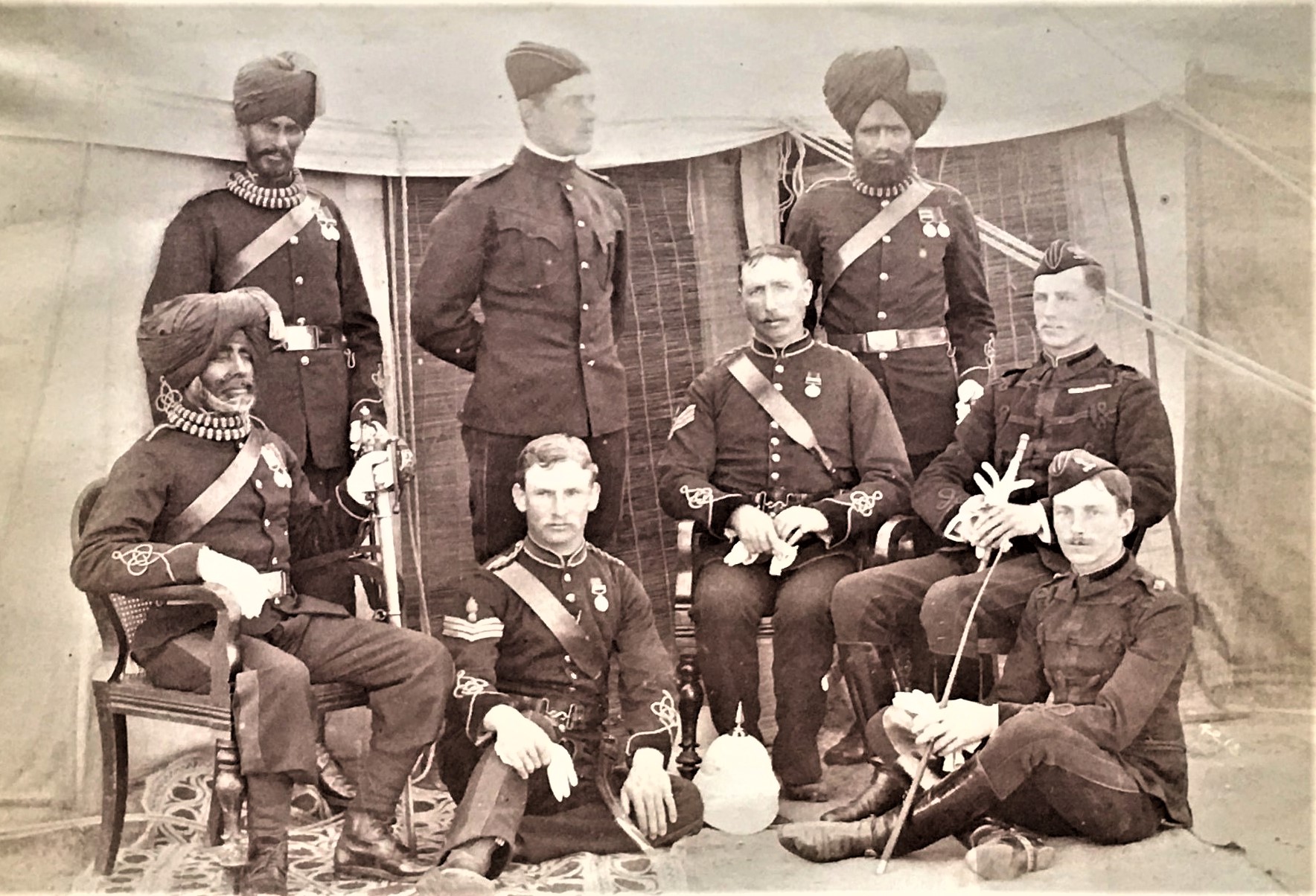
Merut - 1888. Lieut. Gerard M. Heath sitting on the right. Subedar Sood Sing sitting in chair on left. Lieut. G.M. Harper sitting in middle. Lieut A.E.Sandibank sitting in chair on the right above Gerard.
Saturday 12 May 1888
Morning Post
The Queen's Levee
By command of the Queen a Levee was held yesterday afternoon at St.James's Palace by his Royal Highness the Prince of Wales on behalf of her Majesty. Presentations to his Royal Highness at this Court are by the Queen's pleasure, considered as equivalent to presentations to her Majesty.
His Royal Highness the Prince of Wales, attended by his Gentlemen in Waiting, and escorted by a detachment of the Royal Horse Guards, arrived at the Garden entrance of the Palace from Marlborough House about two o'clock, and was received by the Great Officers of State and the Royal Household.
The following presentations to the Prince of Wales were made, the names having been previously left at the Lord Chamberlain's office, and submitted for her Majesty's approval:-
- - - Heath, Major F.C., R.E., on promotion by his father. Adm. Sir Leopold Heath. - - -
Tuesday 16 May 1899
Morning Mail (Dublin)
Brevet Lieutenant-Colonel Kincaid R.E., serving at Curragh Camp, and who only lately joined in Ireland from Egypt, where he served under Lord Kitchener in the late Soudan campaign, will take over the appointment of Brigade Major and Secretary, School of Military Engineering, Chatham, on the 14th July, in succession to Major F.C.Heath who will then complete his term of service.
-
Friday 18 May 1888
Louth. The Rev. H.B. Gray, formerly head master of Louth Grammar School, was presented at the Royal levee last Friday, as also Major F.C. Heath. C.E.
Saturday 27 May 1899
Chatham, Rochester and Brompton Observer
Army Jottings - - -
On relinquishing the appointment of Brigade Major at the S.M.E. Major F.C. Heath R.E., proceeds to Ireland for duty.
Monday 28 May 1888
London Evening Standard
Mercantile Marine Defence
This afternoon, at the Cannon St Hotel, Admiral Sir G.Phipps Hornsby delivered an address to the members of the London Chamber of Commerce, on the subject of "Mercantile Marine Defence." The chair was taken by Lord Charles Byresford M.P., and amongst those present were:- - - - - Admiral Sir Leopold Heath, - - - Rear-Admiral Colomb - - -
Wednesday 30 May 1888
Morning Post
Wanted - for the country, a respectable Person as Upper Housemaid of two, thoroughly understanding her duties and an early riser. - Address Miss M.G. Linley Wood, Stoke-upon-Trent.
Saturday 2 June 1888
Hampshire Chronicle
Heath - On Sunday, at Esher, Surrey, the Rev. Dunbar Isidore Heath M.A., formerly Fellow of Trinity College, Cambridge, and vicar of Brading, I.W. aged 72
Saturday 9 June 1888
Wallington and Carshalton Herald
Deaths
Heath - On the 27th ult., at Esher, the Rev. Dunbar Isidore Heath M.A., formerly Fellow of Trinity College, Cambridge, and Vicar of Brading, Isle of Wight, aged 72,
Saturday 9 June 1888
Gravesend Reporter
The death of Mr Dunbar Isidore Heath seems to have passed, so far, unnoticed by the papers. Some five-and-twenty years ago they were filled with the tale of his heresies and of his struggles in the law-courts, which resulted in his deprivation. Since that time (1862) he has busied himself no further with theology. The minor scientific societies of London will, however, miss him.
Esher News and Mail.
from the Esher Recorder - June 1888
The Rev.Dunbar Isidore Heath
Esher has lost a distinguished Resident by the death of Mr.Heath which occurred on Trinity Sunday, May 27th. Although Mr.Heath had for many years withdrawn through ill health from active work in the world, he was at one time one of the foremost Egyptologists of his age.
By parentage he was the son of Mr.Sergeant Heath, of Kitlands, near Dorking,and through his mother (nee Miss Dunbar) he was connected with Sir John Moore, the hero of Corunna, and Sir Graham Moore, of Cobham.
He graduated as fifth Wrangler at Trinity College, Cambridge, in 1838, of which college he was elected Fellow; and he subsequently accepted the College Living of Brading, I.W., in 1846.
On his retirement from Brading, after a decision by the Privy Council upon a technical difficulty contained in one of Mr.Heath's published works, he took up his residence in Esher, in 1861, and resided here until the day of his death. Mr.Heath published several works among which those entitled "The Exodus Papyri," "The Proverbs of Aphobis," a record of the Patriarchial Age, B.C. 1900; and the "Phoenician Inscriptions," obtained a high ranking among the Archeological Writings of the Victorian Era.
His elder son, the Rev.Douglas Leopold Heath, now Vicar of Bushend, near Chelmsford, was ordained to the Curacy of Esher in 1878
Monday 11 June 1888
Evening Mail.
To the Editor
Sir.
l think Sir Kdward Hamley passes too lightly over the difficulties of landing in the Crimea in 1854.
On that occasion the late Admiral Sir Sydney Dacres had charge of the landing on the beach, and he had for assistants Admiral Powell and myself.
I find from my records that 28,000 men, with 54 guns and 4,000 horses, were landed by the English (doubtless Sir Edward includes the French in the number he quotes), and I find that, notwithstanding the careful provision made of small steam tugs for towing the boats and of specially-contrived platform boats for carrying horses and guns, it took three and a half days to land this force (the landing, however, having been interrupted by the surf on the beach for more than half a day) ; and it must be remembered that there was not the slightest opposition to our landing either from the shore or on the sea.
Contrast this unopposed and undisturbed landing with that of a force intending to invade England. Grant that the hostile fleets had met and had dealt with each other as did the Kilkenny cats, but there would still remain the smaller fry, the torpedo boats, the coastguard ships, and all the improvised small but sharp-stinging mosquitoes that would have been fitted out in anticipation of the attempt: and surely in these days of telegraphs we could lot be taken so completely by surprise as to be unable to bring down some force to resist the landing and to erect at least a few invisible earthwork batteries such as the Wasp Fort, which at the naval bombardment of Sebastopol did us so much damage with, it was believed, almost perfect impunity to itself.
The invading force whether carried in large steamers, themselves previous to the smallest projectiles, and from which the troops must be landed in open boats, or in the smaller craft, apparently suggested by Sir Edward, would certainly have a bad time of it even before they reached the shore.
I believe it is still of matter of doubt whether Napoleon really intended to invade England; but certainly his statement to his Admiral, quoted by Sir Edward, did not show that he really had assembled that large force, but only that he wished the world to believe it; and as to the quotation from Alison that "experiment proved that 100,000 men with 300 pieces of cannon and their whole caissons and equipages could find their places in less than half an hour,” I can only say that I hope the rest of his history is more reliable.
I am, Sir, your obedient servant
Holmwood, June 6 - L.G.Heath Admiral
Thursday 14 June 1888
Birmingham Mail
The Rev. Dunbar Isidore Heath, formerly vicar of Brading, in the Isle of Wight, whose death has just occurred, was born in 1816, and took his Bachelor's degree at Trinity College, Cambridge, as Fifth Wrangler, in 1838, and obtained a Fellowship. He held the living of Brading from 1846 down to 1862, when, having used in his sermons certain expressions which were thought to be derogatory to the Thirty-nine Articles, he was deprived of his living, and the sentence was confirmed on appeal.
Thursday 15 June 1899 - ??
Naval and Military Record and Royal Dockyards Gazette
Royal Engijneers' Changes.
The following changes of station and movements are notificed:-
- - - F.C.Heath, brigade major, Chatham, ordered to Curragh - - -
Saturday 16 June 1888
Isle of Wight Observer
Brading
The Rev. Dunbar Isidore Heath, formerly Vicar of Brading, whose death was referred to last week, was born in 1816, and took his bachelor's degree at Trinity College, Cambridge, as fifth wrangler, in 1838, and obtained a fellowship.
He was ordained deacon in 1843 by the Bishop of Ely, by whom he was admitted into priest's orders in the following year. He held the living of Brading from 1846 down to 1862; when, having used in his sermons expressions which were thought to be derogatory to the Thirty-nine Articles, he was deprived of his living, and the sentence was confirmed on appeal.
Saturday 16 June 1888
Hampshire Telegraph
The argument between Lord George Hamilton and General Lord Wolseley as to the amount of tonnage required for the transport of an army consisting of 100,000 men across the Channel has been entered into by several correspondents.
Sir Samuel Baker points out that during the Russo. Turkish war in 1878 the late General Valentine Baker Pasha embarked 5,133 Turkish soldiers on board the frigate Selimieh for transport from the little port of Kara-Agatch on the Aegean Sea to Gallipoli.
The embarkation by means of country boats took a day and a half. It was blowing half a gale of wind, and the passage occupied 24 hours. The frigate arrived at Gallipoli late in the evening, and the following morning the troops disembarked without any casualty. The Selimieh is a ten-knot screw wooden frigate of 4,717 tons displacement. She carries 25 6-inch and 24 4¼.inch B.L. guns. These would, of course, occupy considerable space on her decks.
Admiral Heath, who was one of the Assistant-Beach Masters, in landing 28,000 men, 54 guns, and 4,000 horses at the Crimea in 1854, says that the landing, which was interrupted for half-a-day by the surf, took three days and a-half, although there was no opposition on the part of the enemy.
In the Rouse of Commons on Monday Lord George Hamilton, in an able speech, explained his estimate of 480,000 tons of shipping being required for the conveyance of 100,000 troops from France to England. He reduced the 480,000 tons gross to 312,000 tons net measurement, and cleverly turned the laugh against Lord Wolseley by quoting from the "Soldier's Pocket Bool." He reckoned the 100,000 men as representing three army corps, and calculated at the rate of 1½ tons per man and 4 tons per horse.
Saturday 23 June 1888
Newcastle Guardian - -
Newcastle Board of Guardians
The usual fortnightly meeting of the Board was held on Monday at the Union Offices, Croft St, Newcastle, there being present: Mr T.F. Twemlow (Chairman), Rev. P.E. Mainwaring, Messrs T. Edge, S. Hyalop, M. Colclough, S. Edwards, W Mellard, R. Mosley, G. Booth, T. Wardle, M. Brown, J. Wrench. J. Smith and T.Rawes -
The Master (Mr T. Edwards) reported that on the kind invitation of Mrs Twemlow, the elder girls attended the annual festival of the Girls Friendly Society, held at Linley Wood on Thursday last week. On the motion of Mr Hyslop cordial thanks were passed to Mrs Twemlow for the interest she had taken in the girls. - - -
Wednesday 27 June 1888
Chester Courant
Lawton Garden Party. - On Wednesday afternoon a garden party was held on the Rectory Lawn, Lawton, by the kind permission of the Rev.S. and Mrs Nunn, and notwithstanding the threatening aspect of the weather a large number of persons assembled to make the acquaintance of the grounds, which are prettily situated.
Rode Hall Band was in attendance for dancing, and supplied excellent music. Mr. R. Lucas acted as M.C., and Mr E. Massey as secretary. Refreshments were provided by Mr Havery Buckley, and tea was served by Mrs Holt, Mrs Nunn, Mrs Bibbey, Mrs Brooks, and the Misses Rigby, Clegg, and Eldon. Two large tents were available for dancing in case of rain. Amongst those present were the Misses Marsh-Caldwell, Mrs Skene, and Miss Lawton, Mr and the Misses Lucas, - - -
Thursday 29 June 1899
Naval and Military Record and Royal Dockyards Gazette
During the next month the following staff appointments and commands will become vacant:- - - brigade major, School of Military Engineering, Major F.C.Heath R.E. (12th);
Saturday 30 June 1888
Surrey Advertiser
Board of Guardians - Tuesday
Present - Mr Henry Lee Steere (chairman),Messres H.J. Chaldecott, R. Lee U. Loxley, G. Bergersen, J.Bargman, M. Rose,T.Comber, A. Baxter, H. Roffey, and the Rev. T.P.Hill - - -
Mr Roffey stated that allotments at Coldharbour were obtainable at 32s. per acre from Sir Leopold Heath. - Mr Perkins, Oakdene, has some suitable land in the vicinity of Beare Green, and the Clerk was given instructions in regard to the matter.
Saturday 30 June 1888
Newcastle Guardian - - -
Primrose Gathering at Linley Wood.
Within the picturesque grounds of Linley Wood, the residence of the Misses Marsh-Caldwell, a "grand festival" of the Coal and Ironworkers' Habitation of the Primrose League was held on Monday under favourable circumstances.
A prettier spot of an al fresco gathering than Linley Wood grounds could not easily be found, and the natural scenery of the place was rendered still more attractive by the brightness of genuine summer weather.
Situate on a slight eminence Linley Wood commands a magnificent view of a well-wooded tract of country, bounded on the north or north-west only by the far off sultry horizon, and on the other side by more or less tree-studded hills.
Within the grounds are delightful walks along steep and rocky footpaths, through leafy dells, and quiet bowers, amid foliage in some places so dense as to effectually preclude the heat of the sun's rays, and in the more cultivated portions terraced paths, flanked with trees, the general effect being enhanced by the blooms of the rhododendron and honeysuckle.
Visitors commenced to arrive shortly after one o'clock, the hour of opening, and attended during the day, to the number of about 1,000. Amusements were provided in the form of dancing, ventriloquial and Punch and Judy entertainments, and musical selections by the Rode Hall Brass Band.
Tea and refreshments were provided under canvas. The chief feature of the festival was the political meeting held in the tent at six o'clock, and attended by a good gathering of visitors, including many ladies. Mr John Loring occupied the chair and was supported on the platform by Miss Marsh-Caldwell, Ruling Councillor of the Habitation, the Hon. Lionel Holland, Mr Horace Chatteron, (Conservative candidate for the Crewe Division), General Sir Richard Wilbraham K.C.B., &c.
Amongst others present during the day were - The Misses Marsh-Caldwell, Major, Mrs and Miss Kenedy J.P. (Sandbach), Mr G.B. Baker J.P., Rev., Mrs and Miss McHutchin (Talke), Rev. A. Trustrum (Talke), Rev H. and Mrs Royds (Brereton Rectory), Miss Ribgy, Mrs Goodwin, Mrs and Miss McNeil, Mr Gambier (Market Drayton), Mr and Mrs J. Loring (Hinstock), Mr H. Henevek (Stoke), Mr J. Evans (secretary), &c.
The proceedings were opened by the Chairman, who in his introductory remarks, extended a hearty welcome to the announced speakers, the Hon. Lionel Holland and Mr Horace Chatterton. Through the name of the former would be unfamilliar to most of those present, that of his father, Lord Knutsford, would be known and recollected for the great service he had rendered to the country. As for Mr Chesterton, he had a hard battle to fight in the neighbouring county of Cheshire, and the support and sympathy accorded him by the League should be as great as possible.
The Hon. Lionel Holland next addressed the assembly. He proceeded to emphasise the advantages of organisation both at election times and in the intervening intervals between the elections. Political gatherings such as that, for the spreading of Conservative principles, would ensure victory at the elections and deal to Radicalism its death blow.
Radicalism, he contended, based itself and thrived upon ignorance, (Hear.) He proceeded to show what Liberalism had done - or what it had not done - for working men, and claimed that the order for progress and reform was the Conservative Party. Contrasting figures on measures affecting the well being of the working classes during the periods of administration from 1874 -80 under Lord Beaconsfield, and 1880-85 under Mr Gladstone, he affirmed that nineteen measures were passed under the Conservative regime, and nine the Liberal, three of the latter having since been superseded.
Having enumerated Acts beneficial to the working man passed by the Tory party, he made references to show that the old Liberal cry of "Peace, Retrenchment, and Reform," had not been ratified in deeds by the Liberals; and concluded with an appeal to the working classes urging the claims of the Conservatives to their support.
The next speaker was Mr Horace Chatterton, who gave an address at great length on political matters generally, and denounced, in unmeasured terms, "the scandal alliance" he claimed as existing between Mr Gladstone and the Parnellite party.
He alluded to the relationship which the Conservative party desired to maintain between Church and State, and to the rights of property, contending that it was in the interests of the poor that property should be maintained sacred and inviolable in every civilised country. - - -
Voices of thanks to the speakers, proposed by General Sir Richard Wilbraham, seconded by Mr F.C. Mayer; to Miss Marsh-Caldwell for the use of the grounds, moved by Mr H. Hancock, seconded by Mr Larmouth; and to the chairman brought the meeting to a close. The company then dispersed throughout the grounds, which were close at 1.am o'clock.
Saturday 30 June 1888
Newcastle Guardian - -
A Popular Dose - The account which our reporter gives of a"Primrose Gathering at Linley Wood" must not be accepted literally. The wood is no doubt a good place for Primrose gathering when the reputed favourite of the late Lord Beaconsfield is in bloom: but, just now, it is out of season.
As a consequence, any such gathering at Linley Wood as at the Primrose League meeting there last Monday would be of "flowers of speech." It was a very enjoyable al fresco fete despite the fact that a heavy supply of politics was served up in the comprehensive bill of fare. But, as there were amusements in the shape of dancing, ventriloquist, a Punch and Judy show, music, and tea, the one thousand visitors would be hard to please if they could not realise pleasure from some feature in the varied entertainments.
Monday 9 July 1888
Manchester Courier
The Subscription List will be open on and from Monday, July 9th, and close Friday, July 13th. The Angier Steam-Shipping Company Limited.
The Companies Acts of 1862 and 1883, Authorises Share Capital £200,000 in 40,000 Shares of £5 each, of which 7,940 shares have been issued and are fully paid up; Debentures, £23,000, bearing interest at 6 per cent per annum.
Present issue, 16,000 Shares of £5 each, payable - £1 on application, 1on allotment,3 not earlier than two months after allotment.
Council
Admiral Sir Leopold G. Heath K.C.B., Anstie Grange, Holmwood, Dorking
Thomas Richardson Esq., M.P., (Messrs Paterson and Simons), London
Henry Minchin Simons Esq., (Messrs Paterson and Simons), London
Henry Head Esq., (Messrs John Holman and Sons), St. Mary Axe, London
Managers - Messrs Angier Brothers, Steamship Owners, London
Bankers - The Royal Bank of Scotland, Bisopsgate St, London.
Solitictors - Messrs Parker, Garrett, and Parker, London.
Auditor - Mr R. Payne F.C.A., 34 Moorgate St, London, Registered Offices, 118 Bishopsgate St, Within London, E.C.
The company, which was formed in October 1885,owns and works the S.S.Chelydra, 2,457 tons gross registered - new at the end of 1885 - the the S.S.Federation, 2,472 tons gross register - new at the end of 1885; both steamers being high class vessels, built of steel, and fitted out with triple expansion engines of 1,400 indicated h.p. Out of the earnings of these two steamers dividends of 6 per cent per annum have been paid fo 1886 and 1887, after paying all expenses of formation, and setting aside £4,000 ini cash for depreciation and reserve. This result was attained during the worst period of the late depression. - - -
Friday 13 July 1888
West Surrey Times
Dorking Volunteer Fire Brigade and Cricket Club - Amateur Athletic Sports
Under A.A.A. Laws and N.C.U. Rules - To be held on Monady, August 6, 1888 (Bank Holiday), In the Cricket Field, Pixholme Lane, situtated within five minutes' walk of the Dorking Station. L.B. and S.C.R. and Box Hill Station, S.E.R.
Pelham Clinton Hope, Sir Trevor Lawrence Bart., M.P., Lady Lawrence, Mrs Bovill, the Right Hon. G. Cubitt M.P., the Hon. H.D. Ryder, Admiral Sir L.G. Heath K.C.B., etc etc.
Open Events (entry 2s. 6d. 100 Yards Handicap - Three Prizes of the value of £5, £2, £1
Quarter Mile Do. - Three prizes of the value of £5, £2, £1. - - -
Lady Lawrence has kindly consented to distrubute the Prizes at 6pm. - - - Commencing at 1pm., The Dorking Town Bank, will be in attendance. Entries close July 28th to the Hon. Secs. W. Shearburn, South St, Dorking, C. Herbert Wood, Vincents Lane, Dorking.
Friday 13 July 1888
West Surrey Times
Holmwood
At the invitation of Mrs Malden,the cottagers held a show and sale of work in a marquee on the grounds of Kitlands on Wednesday. The band of the 1st Vol.Batt. "The Queen's' were in attendance. (See report under Coldharbour heading).
Coldharbour
An Exhibition of Art and Industry was held in the grounds of Mr D.D.Heath, Kitlands, on Wednesday. The band the Surrey Volunteers in attendance and the gardens were kindly thrown open to the public.
Fine weather, a great desideratum upon such occasions was the only item wanted Unfortunately showers alternated sunshine (with a preponderance of the former) during the afternoon and evening but notwithstanding the attendance was very satisfactory, the extensive booth (erected by Messrs Kendall Dorking) at times quite crowded.
There were about 500 articles exhibited consisting of carpentry, carving, moulding, brass-work, drawing, painting, needlework and cut-flowers, vegetables, fruit, provisions, curiosities, etc
In fact the heterogeneous character of the exhibits was such to inspire a quantity flowing rhyme from the village poet laureate. Considering that every article excepting the curiosity class was produced in the parish too much praise cannot be bestowed upon the industry of the inhabitants.
The great success of the exhibition was with the hearty cooperation of all concerned, due to indefatigable exertions of Mr H E Malden MA and Mrs Malden. The judging the Misses Hadow, Major Malden (Brighton) and competent gardener from Holinbury gave great satisfaction.
Twenty money prizes were kindly given by the Dowager Marchioness of Hertford, twenty by Mrs Field and others by Miss Field, Mr and Mrs Malden, etc.
The Misses Hadow who have been judges since 1882 could but expatiate upon the great improvement in this year’s exhibits both in quantity and quality. At the close the prizes were distributed by Mrs Malden on the lawn. The Rev R Arnold Pelly and Major Malden proposed votes to all the promoters of the exhibition which were seconded the hearty cheers of the exhibitors and visitors.
Saturday 4 August 1888
Surrey Advertiser
South Reigate Division Conservative Association
A meeting of the members of this association was held yesterday (Friday) afternoon, at the Beare Green, when there was a large and enthusiastic gathering.
The annual dinner took place in two tents, lent by Mr Farnell Watson, and these were gaily decorated with patriotic flags &c. and appropriate mottos. A capital repast was provided by Mr Turner, landlord of the White Hart, and Mr Cuthbert Heath, president of the association, presided over a company of about 100, those present including Mr Arthur Raymond Heath, member for the Louth Division of Lincolnshire; Mr Manning, hon. secretary who arranged the meeting; Messrs R. Lee. J.T. Maybank, E. Butcher, G. Borer, C. Ventham, - - -
After the repast was over Mr Cuthbert Heath impressed upon the company the necessity of looking sharply after the registration, and advised them to form committees in each village. He also expressed the thanks of the meeting to Mr Perkins for his offer of the loan of a field in which to hold the gatherings, thanks which were heartily endorsed by the assembly.
At the meeting which followed, Mr Cuthbert E. Heath occupied the chair and was supported by Sir Trevor Lawrence, Bart., M.P., Mr Arthur Raymond Heath M.P., Sir Leopold Heath , Mr H. Lee Steere, Mr Arbuthnot, Rev E.D.Wickham and Col. De Cetto. Among the ladies present were Lady Lawrence, Lady Heath, Mrs Lee Steere,Mrs Arbuthnot, Mr H. Broadwood,the Misse Broadwood &c. - - -
Mr Raymond Heath seconded, and in doing so spoke in warm terms of praise of the conversion scheme of Mr Goschen and of the Local Government Bill. He was glad to see that an alteration had been made in what at one time he thought was a blot upon the Bill, namely, the advance to Guardians in reference to the poor admitted to the house. As showing the relief(?) that would be made the rates by new fiscal arrangements, he mentioned that three millions would be given for the benefit of the agricultural interest, or equal to 3d. in the £ spread all over the country (applause). - - -Nothing more scandalous had happened in Parliament during the last 20 years than the manner in which Mr Gladstone and others of his party had backed up the Irish party in their abuse of the English judge. (applause). They only wanted the truth, and nothing but the truth, and they were determined to have it.
The Chairman also spoke on the subject, and the Resolution was carried unanimously, and with cheers.
Saturday 11 August 1888
Geelong Advertiser (Victoria)
The diversity of opinion on the possibility of invasion amongst experts is curious reading.- - - Admiral Heath tells us that it took three days and a half to land 28,000 men, 54 guns, and 4,000 horses in the Crimea; - - -
Saturday 11 August 1888
Surrey Mirror
The enclosed comparative view of four Industrial Exhibitions in Coldharbour, (pop. under 600) may be of use and interest if published, as showing what may be done for the encouragement and improvement of local industry and taste.
The total expenses, including a band, average under £28, against which may be put the gate-money. I am, your obedient servant, H. E. MALDEN- Kitlands, August 4, 1883.
"COLDHARBOUR Exhibition and Flower Show. —The fourth of these very popular exhibitions took place on July 11th, in a large marquee erected at Kitlands, where the garden was thrown open by Mr. Heath.
This was by far the best exhibition of any, for not only were more things sent, but the quality of the work had immensely improved since the first exhibition 1882. It is scarcely too much to say that it could not have been better. The prize list will show what were the principal things, but special notice may be taken of the brasswork done by Mrs. Maiden's class in the winter. Being something new, it attracted good deal attention and admiration, and was all sold very quickly.
Then there was a collection of pre-historic flint implements, or rather fragments of flint implements, found on Leith Hill Mr. Maiden who also showed map of Surrey as it appeared at the time of the Doomsday Survey in 1066.
Some of the needlework was as good as it could possibly be. Unfortunately, the weather was unfavourable, and kept away many visitors, but, in spite of the showers, about 500 people were present. The band of the West Surrey Volunteers played indefatigably during the afternoon, and everyone appeared to enjoy themselves.
About 8.30, the prizes, 137 in number, were given away by Mr. and Mrs. Malden. Special prizes had been offered by Mrs. Field, of Cockshotts, and her friend Mrs. Beeton, and the Miss Hadows. The Dowager Marchioness of Hertford, Miss Broadwood, and Sir Trevor Lawrencv, M.P., also kindly gave prizes, and Miss Field gave one for children under ten. Only four infants competed, and they all got prizes.
Owing to the lateness of the season, the fruit and vegetables were not so numerous as before, but the flowers were much better than usual. There were 192 exhibits in the flower show aud of other things the extraordinary number, of 486; total 678; shown by about 230 different exhibitors, which seems very wonderful for so small a parish.
The judges for the flower show were Major Malden, of Brighton, and Mr. Cornish, gardener Sir William Bowman; and for the exhibition, the Miss Hadows, who spent the whole of two days over their work, examining every article most thoroughly. The judging is a most difficult and anxious business, but it seems to have been very successful, and to have given great satisfaction on the whole, though it is too much to expect that all the 500 spectators should agree with it entirely. At the end of the day, it was found that goods had been sold to the amount £26. 16s., which, with the prizes amounting to £12 l1s., makes nearly £40 distributed in the parish.
Coldharbour may therefore well pleased with the result of all the trouble and pains that have been taken to make this show a success. A short statement is appended, giving comparison of all four Industrial Exhibitions. ----
Saturday 1 September 1888
Hampshire Telegraph
The deplorable collision between the steamers Thingvala and Geyser has called forth a hot discussion on the "Rule of the Road at Sea," which has been entered into by Admirals Colomb, Heath and De Horsey. The international rules which were adopted in 1862 say, In cases two ships are crossing each other's course so as to involve risk of collision, the one that has the other on her own starboard side is to keep out of the other's way. Mr Gray's doggerel verse says, -
"If to my starboard red appear - It is my duty to keep clear - To act as judgment says is proper, - To port or starboard, back, or stop her."
Admiral Colomb, on the other hand, says that collisions are caused by keeping away from apparent danger instead of facing it, and would not allow the ship having to give way to starboard to a red light or port to a green one. Admiral Sir Leopold Heath believes there would be fewer collisions between passing steamers if the deviating vessels were more given to stopping and backing. Lieut. Caborne, R.N.R., attributes collisions between steamers in the mercantile marine "to the iniquitous and wholly indefensible, but almost general practice of officers keeping watch and watch."
Wednesday 12 September 1888
Morning Post
Malden - On the 7th inst. at Kitlands, the wife of H.E.Malden, of a son.
Saturday 29 September 1888
Knaresborough Post
Birstwith
Marriage of Mrs Rohde Hawkins. - On Thursday, September 20th, at 2.30pm. at St.Saviour's Church, St.George's Square, London, the marriage was solemnized of Henry Helsham Helsham-Jones, colonel on the staff at Malta, late Lieutenant-Colonel in the Royal Engineers, and Mary Littledale (Greenwood), widow of Mr Rohde Hawkins, of Redlands, Surrey, only daughter to the late Frederick Greenwood of Swarcliffe, and Mrs Greenwood, of Ingerthorpe Grange, in this county.
The officiating clergy were the Rev. George Hales, rector of Barningham, and rural dean, Yorkshire, assisted by the Rev. C. Jones, vicar of Pakenham, Suffolk.
Mrs Rohde Hawkins wore a dark prune velvet dress, trimmed with old lace, and bonnet to match, and carried a bouquet of heliotrope and tea roses. She was given away by her cousin, Mr Edward Sidgwick, in the absence of her mother, who was not well enough to be present; and Mrs Rowland-Wilson, Miss Dury, and Miss Constance Helsham-Jones stood by her, each holding beautiful "posies," presented by Colonenl Helsham-Jones.
After the ceremony, all adjourned to 88 Belgrave Rd (kindly lent for the occasion by Miss Frances Turner), and later in the afternoon Colonel and Mrs Helsham-Jones left for Henley-on-Thames for a short visit.
The wedding party was confined to the nearest relatives and friends, amongst whom we noticed Captain Greenwood, Swarcliffe, Louisa, Mrs Greenwood, Mr and Mrs Helsham-Jones, Miss Helsham-Jones, Woodbridge, Suffolk, Mr and Mrs Edward Sidgwick, Mrs Hales, Mr Rowland Wilson, Mr and Mrs Hawkings &c. Many handsome presents were displayed to the guests, including some from the households at Redlands, Ingerthorpe, and Swarcliffe.
Saturday 15 September 1888 ?? (and 22 Sept.)
Brighton Gazette
Brighton Visitors -
Clarendon Hotel
- - Major Heath - - -
Saturday 13 October 1888
Army and Navy Gazette
Sir - I am glad to see that you have opened on the above most important subject, for there can be no doubt that the more publicity that is given to it, and the more "muddle-headed fools" like Admiral Colomb and scientific seamen like Mr W.Baden-Powell bring their intellects and reasoning faculties (?) to bear upon it, the sooner shall be be likely to see the rule of the road at sea laid down and interpreted on a sound practical basis, in accordance with facts and not with fancies.
Mr Baden-Powell's letter, published in your issue of the 22nd ult., is a fair specimen of the style of argument with which Admiral Colomb's opponents insult our common-sense by asking us to accept as an answer to a man who, after years of labour and thought, guided by a practical experience second to none, has succeeded in formulating and setting down in a clear and comprehensive manner all the most important facts connected with this subject - - - -
- - - - Mr. Baden-Powell’s little joke lacked these Qualities, otherwise it was admirable and very funny.
I pass on now to notice far graver and weightier opponent of Admiral Colomb’s. Sir G. H. Richards, late Hydrographer to the Admiralty, is a name which commands respect not only in Great Britain, but all over the nautical world and it is, therefore, the more to be regretted that he should have thrown his authority into the opposition scales, and should deliberately deprecate all revision of the present disastrous rules of the road at sea.
In a letter which Sir George Richards addressed to the Times the 19th ult., he commenced, and, indeed devoted a good deal of his space to, the stock argument of quoting the ability and reputation of the men who framed the present rules, as if this were valid argument to bring against Admiral Colomb’s facts, figures, and statistics.
It is as if Jenner had been confronted (which probably was) with string of the names of the pre-vaccination doctors, or Galileo with the astronomy of the Babylonians. It is always an invidious task to criticise the acts or the opinions of those scientific and enlightened seamen who have gone before us, and who have done so to raise the British Navy to its present high position ; but this question is too important to mince matters over, and I think it must be obvious to all impartial observers of this controversy that neither Sir Geo. Richards, Sir Leopold Heath, Admiral de Horsey, Mr. Thomas Gray, nor any other of Admiral Colomb s opponents—no, not even the brilliant and witty Mr. Baden-Powell—have so far adduced anything in the shape of valid argument to controvert Admiral Colombs very plain and deliberate statements and contentions, as set forth in his book and his numerous letters to the Times. - -
Saturday 3 November 1888
Surrey Mirror
Accident - On Saturday evening an accident happened in London Rd, at the corner of the drive leading past the Star & Garder Hotel to the L.B. & S.C.R. Station.
It is a very dark at this spot, and as a brougham belonging to Admiral Sir Leopold Heath, Bart., was being driven to the station, it collided with a van being belonging to Messrs Kendall and Sons, upholsters, High St, which was coming from the direction of Box Hill.
The result of the collision was that the body of the brougham was lifted off the hind wheels, the springs being broken. There were no lamps lighted on either vehicle. The brougham was occupied by the Admiral's brother and another gentleman,and there was a coachman and footman on the box. Fortunately no one was hurt, but the carriage was, of course, useless, and had to be left at the Star & Garter yard.
Saturday 3 November 1888
Dorking and Leatherhead Advertiser
A "Spill." - A collision between a furniture van, the property of Messrs. Kendall & Son. and a brougham belonging to Mr. Douglas Heath, of “ Kitlands,” Holmwood, occurred near the London Brighton and South Coast Railway Station on Saturday evening.
It appears that the furniture van was returning to Dorking from Leatherhead, and had reached the road that leads to the station when the brougham, drawn by a spirited horse, passed by quickly in the direction of the station. The hind wheels of both vehicles collided, and as the brougham was the most lightly built, the wheels of that conveyance, with the axletree, were tom from the springs, and the hind part of the carriage fell to the ground.
Messrs. Kendall's van was not at all damaged, nor did the occupants of the brougham sustain any injury.
Saturday 17 November 1888
Newcastle Guardian
Talke and Music - We are disposed to think that in a contest, music would beat take far away; but we all must recognise that they go well together. Hence, we think that a good movement has been started at Talke for the establishment of a Brass Band to enliven the Talkites with strains of music. With such generous contributors as Sir Smith Child and the Misses Marsh-Caldwell (of Linley Wood), there was no fear of failure in procuring the needful instruments for the band. This has been done.
Saturday 24 November 1888
Swindon Advertiser
Murder of a Gamekeeper.
On Sunday considerable excitement prevailed in Dorking on its becoming known that a gamekeeper had been murdered, and that two men were in custody for being concerned in the crime.
It appears that party of keepers were out watching in the neighbourhood of Leith Hill, a district that abounds with preserves. Between three and four o'clock in the morning a number of shots were fired, and, going in the direction from which the reports came, the keepers came upon two men in cover upon the estate of Mr. Lee Steere (formerly Member for West Surrey), at Oakley.
The men were taken by surprise, and one of them, a navvy named Edwards, working upon the Dorking Sewerage Works, was at once seized. He offered little if any resistance, but his companion ran away.
He was at once followed by a keeper in employ of a brother of Admiral Sir Leopold Heath, named Groombridge, a young man only 23 years old, and living at Coldharbour with his parents. He had not run far when the poacher turned, and it is said, taking deliberate aim, fired the keeper.
The unfortunate man received the contents of the gun in his breast, and fell to the ground mortally wounded. Some of the other keepers rushed to his assistance, but he expired almost immediately.
The murderer meanwhile made good his escape. The body of the unfortunate keeper was removed to his home, where it now awaits the inquest. The man Edwards was taken to the police-station at Dorking, and subsequently the police apprehended a companion of his, a navvy, known by the cognomen of " Mouse," on suspicion of being the man who fired the shot.
The man gave an account of his proceedings during the previous night which, upon inquiry, proved be inaccurate, and he was, therefore, detained, and will be brought before the magistrates, with Edwards. It is stated, however, with some confidence, that in his case an alibi will be proved, and as the police have a full description of the man who fired the fatal shot, and he is said to be known in the locality, it is expected that he will soon be in custody.
Saturday 1 December 1888
Dorking and Leatherhead Advertiser
Murder! Fatal Affray with Poachers, A Gamekeeper Killed
The Prisoner before the Magistrate - Scene of the Murdurer - The Inquest
The inhabitants of Dorking and the surrounding villages were rudely aroused from their wonted sabbath quietude, on Sunday last, by the dire news, which swiftly flew around, that early in the morning a gamekeeper, employed on some neighbouring estate, had been cruelly shot dead by one of a gang poachers, of whom he was in chase. And as the day advanced the more reliable information that was afforded only served to substantiate the rumour of the early morning, and the residents in and around Coldharbour, Ockley, and Holmwood were grieved to hear that a young man named William Groombridge, a native of Coldharbour, of whom all held the highest opinion and respect, was the victim of the affray.
An outline the occurrence may be given in a few words. It ap pears that during this season the gamekeepers of Mr. Pennington, J.P., Mr. D. D. Heath, J.P., and Mr. Lee Steers, J.P., whose properties lie almost coterminous with one another, have been considerably troubled with the visits and marauds of poachers.
With a view of rendering the capture these midnight rovers more certain, the keepers have banded together, and worked in harmony with one another.
On Sunday morning one of their party —Mr. Scholey, gamekeeper to Mr. Pennington— heard, by the reports of a gun, the poachers at their work on certain parts his employer's estate. Accordingly the whole band—seven in number—met together, and having briefly arranged an outline of the proceedings, for the guidance of all, the party set off in quest of the enemy.
Eventually the poachers were detected in High Tree Copse—the property of Mr. Lee Steere—aud ere many minutes had elapsed, one of the two, that comprised the party of trespassers, was safe in the arms of keeper. But in the course of this adventure the cruel and cold-blooded deed, which has sent a thrill of horror through the neighbourhood, was enacted.
Groombridge, the murdered man, seeing one of the poachers safely secured, apparently hurried in pursuit of the other man (the bearer of a single barrelled gun), who was making a hasty departure. But the desperado was never captured. Before the keeper could overtake him he turned, and discharged the contents of bis gun fully in Groombridge’s left side, and while the companions of the murdered man were anxiously, but uselessly endeavouring to alleviate his suffering, the poacher made off.
The body was taken to Coldharbour, and Edwards was handed over to Police Inspector King, who had him safely secured behind the bars of the police cell in Dorking station by six o’clock.
A few minutes after the Inspector brought Belton in also, and placed him under lock and key. It appears that the latter is well-known to the police, and as he was unable to satisfactorily account for his whereabouts during Saturday night, it was considered advisable to detain him.
He was, however, discharged on Monday. During Sunday some valuable information was gleaned respecting the escaped poacher. For the previous day or two he had, in company with a female, been lodging at the Model Lodging House, in Church Street, and at a late hour on Saturday night, he and Edwards were seen drinking together at the bar of the Surrey Yeoman, High Street.
From those persons who afforded this information a fair description of the man’s dress and appearance was obtained, and by Monday these necessary particulars were freely circulated among the county police. So far, however, their efforts have not been attended with any success, and we believe that not the slightest clue is held as to the man’s whereabouts.
The Magistrate (to Superintendent Lambert); in the neighbourhood—He was not seen in the neighbourhood. I have made inquiries, and I have every reason to believe he is not concerned in the murder.
Therefore you not intend to proceed with any charge against him whatever
—No, sir.
The Magistrate (to accused): You are discharged. - - -
Superintendent Lambert, who appeared to prosecute, then called George Holloway, who said, in answer to questions put to him by the magistrate : —I reside at Trouch Farm, Ockley, and am night watcher the employ of Mr. Douglas D. Heath, of Kitlands.
Were you on duty on the night between Saturday and Sunday
—Yes, sir. what part of the estate —At Beare Lodge. Here I first heard the shooting. I heard one shot hero. About half an hour afterwards I heard other reports in rapid succession.
What did you do
—I made towards Broome Hall, from which direction the shots had come.
What did you see there
—l saw the prisoner Edwards and another man in the wood.
Did you see the other man
—Yes, I saw him, and that was all.
Were you able to distinguish him
—No, sir.
Was he some distance from you
—About 16 or 17 yards, I should say.
Did you see his face
—No, sir ; but he had a dark jacket on.
Witness, continuing, said he was first accompanied by George Scholey, a gardener at Broome Hall, but they were afterwards joined by other keepers and labourers, viz,, George Weller, Stephen Weller, John Jenkins, George Scholey (the elder), Bill Groombridge (the man who was killed), the party numbering seven altogether. They arrested Edwards, and the other man passed them as they were doing so.
Prisoner (interposing) : He ran down below where you took me.
Witness ; Yes, below you.
Continuing, witness said Bill Groombridge (the deceased) had been with them the whole of the time. When they took Edwards the latter struck at Scholey and witness, and afterwards hit Scholey on the head when witness had got hold of him.
The Magistrate: When you seized him, then, struck Scholey
—Yes, sir. Jenkins and Scholey then took Edwards to Mr. Steere’s, at Jay’s.
Did you hear any shots fired
—Prisoner : They had down on the ground when the shot was fired.
Witness: Yes; that’s it. When Scholey and I were struggling with Edwards and had - - -
DORKING MURDER FUNERAL THE VICTIM
The remains William Groombridge the under-gamekeeper who was shot in poaching affray were interred in the churchyard at Coldharbour yesterday (Friday) afternoon Punctually at 2 o'clock the cortege left the deceased’s mother’s house, the coffin being borne the shoulders of six members of the sect known as Exclusive Brethren The chief mourners were the widowed mother, the two brothers and two sisters.
A very large number of people including gamekeepers, night-watchers and others employed on neighbouring estates with inhabitants of that and adjoining parishes had congregated in the road in front of the house as the procession wended its way to the churchyard those assembled joined in behind.
On arrival the body was taken direct the grave-side situated in the portion the churchyard close to the spot where the remains of deceased’s father already lie buried
The funeral service of the Brethren was then gone through, those taking part being Colonel Holland (Bognor), Mr Nunnery and Mr Gregory. The service throughout was of an earnest and solemn character and seldom if ever has an event of so impressive a nature been known in the the village.
Sympathy for the widowed mother and family manifested itself on every hand, it being computed that over 200 people assembled round grave, and this notwithstanding that rain fell in torrents during the whole time.
Deceased's brother gamekeepers attended in large numbers to show their respect for whose memory will ever remain green in their hearts
Amongst be noticed were Mr E Dawney gamekeeper to Sir Leopold Heath (Anstie Grange), Mr W. Capon gamekeeper Mr R Barclay (Bury Hill), Mr G. Scholey sen., gamekeeper Mr F. Pennington (Broome Hall), Mr Tulett gamekeeper to Mr L. H. Broadwood (Lyne), Mr J. Still gamekeeper Mr Farnell Watson, Mr Jenkins, gamekeeper to Mr H. Lee Steere and also gamekeepers and others from Kitlands (Mr Douglas Heath), Redlands (Messrs Lascelles and Tickner), Tillingbourne etc.
Amongst grave-side were Mr Cuthbert Heath, Mr H. E. Malden, the Rev R. A. Pelly, Captain Barry (Dorking), and Messrs Roffey, Harrison, Colyer, Lipscombe, R. Smith, Weller, Mitchell, Towler, Edwards, Greaves, Pavings, G. Smith, E. Smith, Stephen Weller jun., etc. A large number of the household from Kitlands were also present.
The coffin bore the following inscription : ‘William Groombridge died November 1888 aged 23 years’ On lid were placed some beautiful wreaths some of which were sent by the gamekeepers and others employed upon Kitlands and Broom Hall estates.
It was understood that the members of the Ockley Court of Foresters were to attend but owing to the course events took in regard the conduct of the service this part of the proceedings fell through.
We understand that Mr Douglas Heath very generously offered to defray the whole the funeral expenses
THE WIDOW
The threw (?) out in yesterday’s (Friday’s) issue that a fund for the benefit Mrs Groombridge would meet with considerable support has been received with general favour. We are glad further hear that Groombridge’s employer and other gentlemen interested are considering what steps to take and will provide for Mrs Groombridge in way after consultation with her surviving son. Before fact was known Mr A Powell had authorised us that he would perfectly willing to help in the matter and Mr Pennington his readiness to subscribe £5 towards the fund.
PRISONER BEFORE THE MAGISTRATES TO-DAY
By Telegraph At the Dorking Police Court this morning before Mr W W Clark (Chairman) Colonel de Cetto' and Captain Scovell' Messrs L. M. Rate, G. Arbuthnot and A. Powell.
James Edwards brought up on remand charged with night poaching and assaulting George Scholey jun. The evidence given by Holloway at last court, already reported on our eighth page was read over.
Prisoner had no questions to ask, saying he pleaded guilty to what Holloway had said.
John Jenkins repeated the evidence given the inquest. He said he saw Edwards strike young Scholey with stick.
By Prisoner : He (prisoner) seemed much upset when he Groombridge was dead. Witness did not hear him ask to go in search of the murderer.
George Scholey jun. deposed that when he ran to Edwards in the coppice he turned and struck him with stick. Edwards aimed at his but witness parried the blow and received the blow on his shoulder. Witness then struck Edwards, and closed with him and they struggled together. He then saw the flash of a gun and afterwards Groombridge lying in the ride.
Edwards had surrendered to the party of watchers before the fatal shot fired. A bag was produced containing two pheasants, this having afterwards been found the ride High Tree Coppice.
By the magistrates : None of his companions ran in pursuit of the other poacher but all stopped with deceased.
George Scholey sen., gamekeeper Mr Frederick Pennington, said he saw the struggle between his son and the prisoner Edwards. Both used sticks. Edwards afterwards said ‘I’ll give up.’ He heard a shot fired and afterwards found deceased on the ground in the ride.
By prisoner: You were at the time about fifty yards from where the was man shot.
The magistrates remanded the prisoner until Saturday next for the production of further evidence. The accused asked to be granted bail. He said he would guarantee that he would not run away and would see Supt Lambert every day. As at the previous hearing he said he would swear to the other man among a thousand.
The Chairman said that under the circumstances magistrates could not allow bail and therefore the prisoner was removed in custody. The court was crowded and great interest was manifested in the case. Up to the present Stevens who committed the murder, has not been arrested
Friday 7 December 1888
Morning Post
A marriage has been arranged, and will take place at Woodbridge, Suffolk, on January 23, between Brevet-Major F.C.Heath R.E., second son of Admiral Sir L.G.Heath K.C.B., and Miss Constance Helsham Helsham-Jonnes, only child of Colonel Helsham-Jones, now commanding the Royal Engineers at Malta.
Tuesday 18 December 1888
London Evening Standard
The Staff College
The following have passed the final examination at the Staff College: - - - - - Brevel Major F.C. Heath, Royal Engineers. - - -
Thursday 20 December 1888
The Scotsman
The ninth ordinary general meeting of the Devali Moyar Gold Mining Company (Limited) was held at the Cannon Street Hotel, London, this afternoon. Major-General Alfred Light presided. The Chairman, in moving the adoption of the report, said the working of the year had been devoted almost exclusively to mining, in order to sink another lode and prospect it. As regarded the accounts, the expenditure under the head of capital was much larger than last year, owing to the purchase and erection of drilling machinery and the additional skill required to work it.
The small profit on the growth of coffee was more than counterbalanced by the loss on the Cinchona, in consequence of the serious reduction in the value of Cinchona bark. Sir Leopold Heath seconded the adoption of the report, which was agreed to.
Thursday 20 December
Dubllin Daily Express
The Staff College
The following have passed the final examination recently held at the Staff College. The qualifications in subjects not included in the obligatory course are appended to the names:-
Brevet Major F.C. Heath, Royal Engineers - Applied Science. - - -
Michael Heath-Caldwell M.Arch
Brisbane, Queensland
ph: 0412-78-70-74
alt: m_heath_caldwell@hotmail.com