Michael D.Heath-Caldwell M.Arch.


Michael Heath-Caldwell M.Arch
Brisbane, Queensland
ph: 0412-78-70-74
alt: m_heath_caldwell@hotmail.com
- Home
- Architectural Projects 0
- Architectural projects 1
- Architectural Projects 2
- Architectural Projects 3
- Architectural Projects 4

- The Crystal Palace
- Timeline
- 1693
- 1745
- 1770
- 1783
- 1784
- 1785
- 1786
- 1788
- 1789
- 1791
- 1792
- 1793
- 1794
- 1795
- 1796
- 1797
- 1798
- 1799
- 1800
- 1801
- 1802
- 1803
- 1804
- 1805
- 1806
- 1807
- 1808
- 1809
- 1810
- 1811
- 1812
- 1813
- 1814
- 1815
- 1816
- 1817
- 1818
- 1819
- 1820
- 1821
- 1822
- 1823
- 1824
- 1825
- 1826
- 1827
- 1828
- 1829
- 1830
- 1831
- 1832
- 1833
- 1834
- 1835
- 1836
- 1837
- 1838
- 1839
- 1840
- 1841
- 1842
- 1843
- 1844
- 1845
- 1845-46 Oxford
- 1846
- 1847
- 1848
- 1849
- 1850
- 1851
- 1852
- 1853
- 1854
- 1854/55 Appendix
- 1855
- 1856
- 1857
- 1858
- 1859
- 1860
- 1861
- 1862
- 1863
- 1864
- 1865
- 1866
- 1867
- 1868
- 1869
- 1870
- 1871
- 1872
- 1873
- 1874
- 1875
- 1876
- 1877
- 1878
- 1879
- 1880
- 1881-1
- 1881
- 1882
- 1883
- 1884
- 1885
- 1886
- 1887
- 1888
- 1889
- 1890
- 1891
- 1892
- 1893
- 1894
- 1895
- 1896
- 1897
- 1898
- 1899
- 1900
- 1901
- 1902
- 1903
- 1904
- 1905
- 1906
- 1907
- 1908
- 1909
- 1910
- 1911
- 1912
- 1913
- 1914
- 1915
- 1916
- 1917
- 1918
- 1919
- 1920
- 1921
- 1922
- 1923
- 1924
- 1925
- 1926
- 1927
- 1928
- 1929
- 1930
- 1931
- 1932
- 1933
- 1934
- 1935
- 1936
- 1937
- 1938
- 1939
- 1940
- 1941
- 1942
- 1943
- 1944
- 1945
- 1946
- 1947
- 1948
- 1949
- 1950
- 1951
- 1952
- 1953
- 1954
- 1955
- 1956
- 1957
- 1958
- 1959
- 1960
- 1961
- 1962
- 1963
- 1964
- 1965
- 1966
- 1967
- 1969
- 1971
- 1974
- 1975
- 1976
- 1979
- 1983
- 1990
- 1991
- 1998
- 2001
- 2002
- 2004
- 2005
- 2006
- 2007
- 2008
- 2009
- 2010
- 2011
- 2012
- 2013
- 2014
- 2015
- 2016
- 2017
- 2018
- 2019
- 2020
- F.C. Heath-Caldwell
- C.H.Heath-Caldwell Memoirs
- Palmer Family
- Palmer Timeline
- 1912 - Palmer
- 1914 - Palmer
- 1916 - Palmer
- 1918 - Palmer
- 1919 - Palmer
- 1924 - Palmer
- 1925 - Palmer
- 1926 - Palmer
- 1929 - Palmer
- 1932 - Palmer
- 1934 - Palmer
- 1936 - Palmer
- 1938 - Palmer
- 1939 - Palmer
- 1944 - Palmer
- 1946 - Palmer
- 1961 - Palmer
- 1967 - Palmer
- 1970 - Diary - Joe Palmer
- 1971 - Diary - Joe Palmer
- 1972 - Diary - Joe Palmer
- 1991 - Diary - Joe Palmer
- 1992 - Diary - Joe Palmer
- 2010 - Diary - Joe Palmer
- Venice Earthquake 1873
- Old Letters 1
- Old Letters 2
- Old Letters 3
- Old Letters 4
- Old letters - Mid 1800
- More Old Letters
- Eaton Hall, 1943
- Marsh Family Timeline
- James Caldwell papers 1
- James Caldwell papers 2
- James caldwell papers 3
- Old letters 1800s
- Old Letters 1800s 2
- HH Sultan Taimur bin Turki 1913
- Frank Featherstone Wright 1921-2014
- Frank F. Wright 1
- Frank Featherstone Wright early
- Frank F. Wright 2
- Frank F. Wright Videos
- Old Featherstone album 1
- Old Featherstone album 2
- Old Featherstone album 3
- Old Featherstone album 4
- Old Featherstone album 5
- Arthur Eversfield Featherstone Album 1
- Arthur Eversfield Featherstone Album 2
- Arthur Eversfield Feartherstone Album 3
- Grasmere
- Frank E Wright Album 1a
- Frank E Wright Album 1b
- Frank E Wright Album 1c
- Frank E Wright Album 1d
- Frank E Wright Album 1e
- Frank E Wright Album 1f
- Frank E Wright Album 1g
- Frank E Wright Album 2a
- Frank E Wright Album 2b
- Frank E Wright Album 2c
- Frank E Wright Album 2d
- Frank E Wright Album 2e
- Frank E Wright album 2f
- Frank E Wright Album 2g
- Frank E Wright Album 2h
- Frank E Wright Album 2i
- Frank Edward Wright drawings
- Cathy Featherstone 1910a
- Cathie Featherstone 1910b
- Norma Featherstone 1913
- Norma Featherstone Part2
- Norma Featherstone Part3
- Norma Featherstone Part4
- Norma Featherstone Part5
- Kitlands House
- Moorhurst Manor
- Redlands House
- Milland House
- Anstie Grange
- Ebernoe House
- West Ham House
- Vigo House
- Linley Wood
- Crimean War
- James Caldwell letters 4
- James Caldwell letters 5
- James Caldwell letters 6
- James Caldwell letters 7
- James Caldwell letters 8
- James Caldwell letters 9
- Eton & Oxford 1830/40s A
- Eton & Oxford 1830/40s B
- Eton & Oxford 1830/40 C
- Eton & Oxford 1830/40 D
- Eton & Oxford 1830/40 E
- Eton & Oxford 1830/40 F
- Back in England. Early 1800s
- Arthur Heath 1872-4
- Sicily 1800
- Naples - 1830
- Trentham Hall
- Paris 1810
- Cromptons on the Lusitania
- HMS Illustrious 1948
- The Minoans
- Henry Crompton 1836-1904
- Orongorongo 1957
- Another Page
- Gertie Wheeler 1909
- The Ahsan Manzil
- More old letters 1800s
1993 - 1894 - 1895
Eliza Louisa Marsh-Caldwell – known as Louisa – aged 75/76 of Linley Wood
Georgina Marsh-Caldwell – Gies – aged 73/74 of Linley Wood
Rosamond Marsh-Caldwell – Posy – aged 71/72 of Linley Wood
Admiral Sir Leopold Heath – aged 76/77.
Lady Mary Heath – (ne Mary Emma Marsh) – aged 67/68
Arthur Raymond Heath ex-M.P., - aged 39/40
Marion Heath – May – aged 38/39 - (Mrs Cotton - widow)
Brigade-Major Frederick Heath R.E.– (Gen. F.C. Heath-Caldwell) aged 35/36
Constance Helsham Heath (ne Helsham-Jones) aged 25/26
Cutbhert Helsham Heath (-Caldwell) - aged 4/5
Martin Frederick Heath (heir to Linley Wood) - aged 0/1
Cuthbert Eden Heath - aged 34/35
Ada Randolph Heath - aged 33/34 (Mrs Broadwood)
Lt. Herbert Leopold Heath R.N. - aged 32/33
Capt. Gerard Moore Heath R.E. - aged 30/31
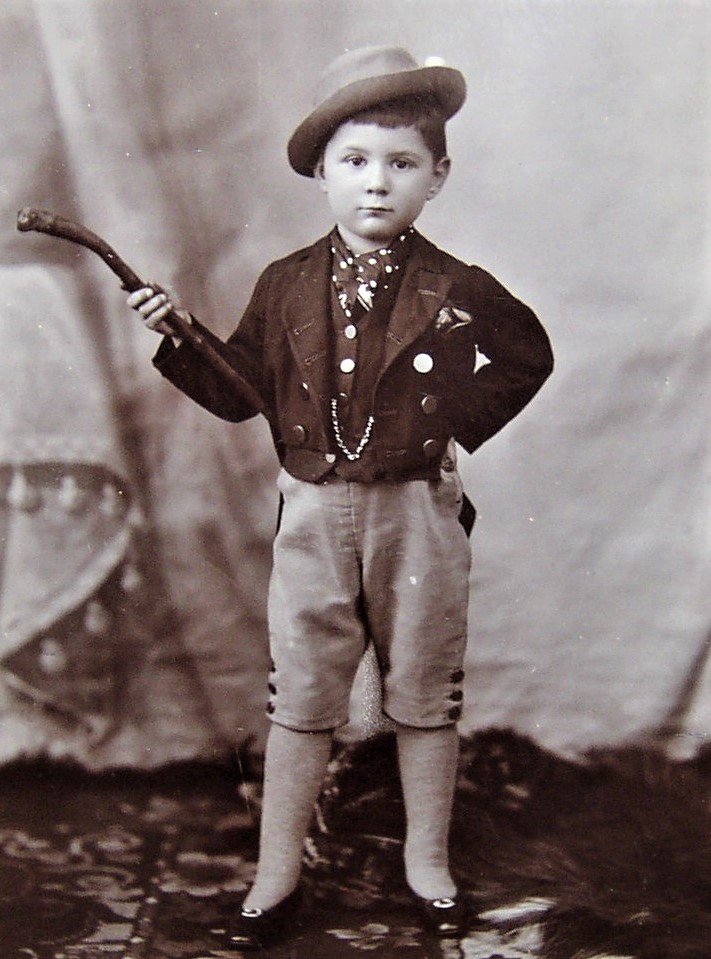
Cuthbert Helsham Heath(-Caldwell) in 1894
Wednesday 3 January 1894
Civil and Military
Lord Roberts on the Navy
A public meeting, convened by the President and Council of the London Chamber of Commerce, was held on Dec. 12 at the Cannon Street Hotel to consider the question whether our present Navy is adequate for the proper security of our food supplies, commerce, and communications in time of war, and to afford the commercial community an opportunity of giving expression to the anxiety which exists upon the subject.
Sir Albert Rollit M.P. the president, took the chair in the absence of the Lord Mayor through illness. The Great Hall, in which the meeting was held, was crowded, and among those on the platform were Lord Roberts, Lord Chelmsford, Admiral Field, M.P., Admiral Sr L. M'Clintock, Sir John Colomb, Admiral Rawson, Admiral Woollcombe, Admiral Cleaveland, Admiral Fanshave, Admiral Heath, Admiral Ward, Admiral Church, Commander Bethel, M. 13 Field• Marshal Sir L. Simmons, General Gibb, General Osborne, Sir E. Hill, M.P., Sir J. Fergusson, M P., Sir A. Hickman, M.P., Sir R. Temple, M.P., Sir E. Ashmead-Bartlett, M.P., and many others.
Mr. C. T. Ritchie moved :—'' That this meeting views with deep concern and anxiety the present state of our Navy, and urgently presses upon the Government the necessity of taking immediate steps to provide such additional means of defence as shall afford that security which our Empire and our commerce demand.''
Lord Roberts, who rose to support the motion, was received with loud and prolonged cheering. He said that he was glad to have been asked to support the resolution as a representative of her Majesty's Army. (Cheers.) Every Britisher who had studied the question must recognise that the efficiency of our Navy should be our first care. (Hear, hear.) It was our foremost and main line of defence. Wherever our arms might be called upon to take the field the Army could not hope to be successful
Saturday 20 January 1894
Surrey Mirror
Primrose League Meeting at Holmwood
A large and enthusiastic meeting was held in the iron-room at the back of the Norfolk Arms, on Wednesday evening, under the auspices of the Dorking Habitation of the Primrose League. The room was very tastefully decorated with plants, ferns, and so forth.
Colonel Helsham- Jones, Ruling Councillor of the Dorking Habitation. presided, and among those present were Mrs. Helsham-Jones, Misses Dorothy and Margaret Helsham - Jones. Mr.. Mrs., and the Misses Perkins. Dr. and Miss Robinson, Mr. and Mrs. Saunders, Mr. and Mrs Atkins. Mr. Rixby. Mr. Pierce, Mr. Sanders. &c., &c. —
In the middle of excellent programme of songs and recitations, the President called upon Lieutenant - Colonel Loyd. Ruling Councillor of the Hove Habitation, address the meeting, remarking that Colonel Lloyd was an old friend whom he had known in the service.—
Lieutenant-Colonel Loyd said the prosperity of the League was evidently what they had at heart, judging by the large gathering present. The League had clearly defined objects and principles of government, and taking these as they had stood from the formation of the League, it would be correct to say that it was not a party organisation. It was principle that should belong to every man, matter what his party might be, to endeavour to obtain for his country good government. (Hear, hear.)
- - - If the Primrose League did nothing more than this, it would be doing grand and noble work, worthy of recognition by all good people who love their country. (Applause)
- - - In conclusion he set forth the great influence which the individual members of the League might use in promoting the interests which they all had at heart.—
Colonel Helsham-Jones also addressed the meeting. He thought it was of the highest importance that England should maintain her supremacy on the sea. this country was not self-supporting. With regard to religion they all knew they could not get along without that. Mr. Gladstone's Government had done everything they could to break down religious education and to break down the Church in Wales: and it had just now leaked out as to what they wished to do with the plunder of the churches.—
The Misses Dorothy and Margaret Helsham-Jones played some violin and piano duets with great delicacy and skill, while Miss Carlos Perkins evoked loud applause by the excellent recitations she contributed. Songs were also rendered by Mrs. Perkins, Dr. and Miss Robinson. Mr. Gore. Mr. Woodnutt, and Mr. Michele.
The usual compliments having been passed to the Chairman and Lieut.-Col. Loyd, the meeting concluded with the National Anthem.
Wednesday 31 January 1894
Englishman's Overland Mail
1st Punjab Cavalry
Captain G.M. Heath, Royal Engineers, to be a Company Commander, vice Lieutenant E.H.Bland, Royal Engineers, reverted to the Imperial establishment.
Saturday 3 February 1894
Surrey Mirror
Speech by the Duke of Norfolk
A most successful gathering was held under the auspices of the Dorking Primrose League the Public Hall, Dorking, on Wednesday evening, when, in addition to a first-class programme of music, addresses on the political situation were delivered by the Duke of Norfolk and Mr. G Lane-Fox, Vice-Chancellor of the Primrose League.
The hall was well filled, and among those present were:—Colonel Helsham-Jones, (Ruling Councillor of the Dorking Habitation), Sir Trevor and Lady Lawrence, the Hon. Henry Cubitt, M.P., Colonel Calvert, Messrs. M. and B. and the Misses Bovil, Mr. R. Barclay, Captain H. Harman Young, Dr. Blakeney, Mr. A. C. Powell, (late ruling councillor) and Mrs. Powell, Mr. R. J. and Miss Clark, the Misses Weddell, Mr. S. Cook. Mr. and Mrs. W. Saubergue, Mr. and Mrs. W. J. Down. Messrs F. Appleby, John Young, H. J. Chaldecott, W. F. Floyd, F. J. Dibble, John Attlee, J. Mason, J. T. Maybank, E. Butcher, T. Scott C. H. Wood, etc.
The members of the League wore their badges. The proceedings opened with a number of selections by the Dorking Town Band, after which Miss Eveleen Carlton delighted the audience by singing "The Castalian Maid." Mr. Clifford Essex received an enthusiastic encore for a banjo solo entitled, - - - -
At this point, the Duke of Norfolk, Mr. G. Lane-Fox, and Col. Helsham- Jones took their seats on the platform, the last named occupying the chair, and was supported by the Hon. H. Cubitt, M.P.. Sir Trevor Lawrence, Col. Calvert, Messrs. R. S. Cook, A. C. Powell, Appleby, H. J. Chaldecott, R. Barclay, Clark, and J. Mason.
The Chairman briefly introduced The Duke of Norfolk, who, in opening, said it might seem somewhat cruel to interpose with an address when they came to listen to music, but they must accept it as an example of what they must suffer and undergo if they wished to serve the interests of their country. (Hear, hear, and laughter.)
He had observed that the ladies and gentlemen, by the delightful way they had carried out their parts had met with encores, but he could assure the meeting that his feelings would not hurt if they did not encore him. (Laughter.)
Whereas, said, it was the custom for the Primrose Leagues to make such gatherings as these pleasing and agreeable, if only for the purpose of reminding themselves that there were stern duties to perform, it was their wont to give their time to more serious thoughts. - - - Mr. Clifford Essex contributing comic songs and a banjo solo; the singing was undertaken by Miss Devhurst and Miss Carlton, and the Town Band wound up the programme with a number of patriotic tunes.
Saturday 10 February 1894
Beverley and East Riding Recorder
Funeral of Mrs Hildyard
The remains of Mrs Hildyard, wife of Mr J.G.B.T. Hildyard J.P.,of Cherry Burton House, whose death occurred on Monday last - - - Wreaths were forwarded by the family, Col. and Mrs Saltmarshe, Col. and Mrs Helsham-Jones, - - -
Saturday 3 February 1894
Surrey Mirror
Speech by the Duke of Norfolk
A most successful gathering was held under the auspices of the Dorking Primrose League the Public Hall, Dorking, on Wednesday evening, when, in addition to a first-class programme of music, addresses on the political situation were delivered by the Duke of Norfolk and Mr. G Lane-Fox, Vice-Chancellor of the Primrose League.
The hall was well filled, and among those present were:—Colonel Helsham-Jones, (Ruling Councillor of the Dorking Habitation), Sir Trevor and Lady Lawrence, the Hon. Henry Cubitt, M.P., Colonel Calvert, Messrs. M. and B. and the Misses Bovil, Mr. R. Barclay, Captain H. Harman Young, Dr. Blakeney, Mr. A. C. Powell, (late ruling councillor) and Mrs. Powell, Mr. R. J. and Miss Clark, the Misses Weddell, Mr. S. Cook. Mr. and Mrs. W. Saubergue, Mr. and Mrs. W. J. Down. Messrs F. Appleby, John Young, H. J. Chaldecott, W. F. Floyd, F. J. Dibble, John Attlee, J. Mason, J. T. Maybank, E. Butcher, T. Scott C. H. Wood, etc.
The members of the League wore their badges. The proceedings opened with a number of selections by the Dorking Town Band, after which Miss Eveleen Carlton delighted the audience by singing "The Castalian Maid." Mr. Clifford Essex received an enthusiastic encore for a banjo solo entitled, - - - -
At this point, the Duke of Norfolk, Mr. G. Lane-Fox, and Col. Helsham- Jones took their seats on the platform, the last named occupying the chair, and was supported by the Hon. H. Cubitt, M.P.. Sir Trevor Lawrence, Col. Calvert, Messrs. R. S. Cook, A. C. Powell, Appleby, H. J. Chaldecott, R. Barclay, Clark, and J. Mason.
The Chairman briefly introduced The Duke of Norfolk, who, in opening, said it might seem somewhat cruel to interpose with an address when they came to listen to music, but they must accept it as an example of what they must suffer and undergo if they wished to serve the interests of their country. (Hear, hear, and laughter.)
He had observed that the ladies and gentlemen, by the delightful way they had carried out their parts had met with encores, but he could assure the meeting that his feelings would not hurt if they did not encore him. (Laughter.)
Whereas, said, it was the custom for the Primrose Leagues to make such gatherings as these pleasing and agreeable, if only for the purpose of reminding themselves that there were stern duties to perform, it was their wont to give their time to more serious thoughts. - - - Mr. Clifford Essex contributing comic songs and a banjo solo; the singing was undertaken by Miss Devhurst and Miss Carlton, and the Town Band wound up the programme with a number of patriotic tunes.
Saturday 10 February 1894
Beverley and East Riding Recorder
Funeral of Mrs Hildyard
The remains of Mrs Hildyard, wife of Mr J.G.B.T. Hildyard J.P.,of Cherry Burton House, whose death occured on Monday last - - - Wreaths were forwarded by the family, Col. and Mrs Saltmarshe, Col. and Mrs Helsham-Jones, - -
Thursday 1 March 1894
Dorking and Leatherhead Advertiser.
Holmwood.Narrow Escape of Lady Heath.
On Wednesday the 21st inst., Lady Heath drove into Dorking, and when she was returning over Holmwood Common, the horses shied at a passing vehicle and bolted.
The coachman stuck manfully to the reins, and the animals ran up a bank on to the common, where their career was cut short by a large furze bush. The pole of the carriage as broken, and the windows smashed but her ladyship escaped injury.
A fly was obtained from a neighbouring hostelry, and Lady Heath was driven home to Anstie Grange. One of the horses was rather badly cut about the legs.
Envelop. May not be related to above letter.
J. Isaacs return for S.A.
Miss R. Marsh Caldwell
Linley Wood
Talke o Hill
Staffordshire
Postmark Worcester 12 April 1901
Saturday 10 March 1894
Surrey Mirror
The recent accident to Lady Heath. The Surveyor (Mr Rapley) reported the receipt of a letter from Sir Leopold Heath, informing him of the recent accident at Holmwood, by which Lady Heath had a very narrow escape. The horses shied at a vehicle belonging to Mr Webber. The owner had been in the habit of leading (leaving?) it by the side of the highway, covered by a tarpaulin or some other white cloth, which not unnaturally frightened the horses.
Sir Leopold added that he thought the matter should be brought to the notice of the Highway Board, with a view to preventing a similar mishap in the future. - The Board instructed its clerk to write and inform Mr Webber that unless the vehicle was removed, and the danger thus obviated, proceedings would have to be taken against him.
Thursday 5 April 1894
Dorking and Leatherhead Advertiser
Holmwood Church
The New Organ: £450 in six promises
The annual Easter Vestry Meeting was held at the Working Men's Institute on Saturday evening last, for the purpose of receiving the Churchwarden's accounts for the past year, electing churchwardens and sidesmen for the present year, and to consider the advisability of applying for a faculty to erect an organ-chamber and new vestry, also the question of purchasing a new organ.
The Vicar, the Rev. C. Hamerton Gould presided over a numerously attended meeting, among those present being the Rev. E.D. Wickham (the late Vicar of Holmwood), the Ref. J.F.D. Hoernle, Admiral Sir Leopold G. Heath K.C.B., and Messrs A.F. Perkins, J.B.Nichols, A. Chaldecott, S.J. Hack, W.Rapley, A. Booker, R. Watson, J. Sayers, - - -The Vicar nominated Mr J. Bixby as his churchwarden for the ensuing year,and on the proposition of Sir L.G.Heath, seconded by Mr W.J. Pierce, Mr Rapley was unanimously re-elected as people's churchwarden. - - -
The question relating to the proposed new erections was then fully discussed, plans for the same being produced. It was unanimously resolved that application be made for the necessary faculty, and that subscriptions be elicited. The Rev. C.H.Gould generously started the fund with a promise of £100. This was promptly responded to by the Rev. E.D. Wickham, £100, Mr A.F. Perkins, £100, Sir L.G. Heath £50, Mr A. Chaldecott, £50, Mr S.J.Hack £50.
Saturday 7 April 1894
Army and Navy Gazette
Royal Engineers
Capt. G.M.Heath from Meerut to Roorkee
Saturday 21 April 1894
West Middlesex Herald
Bay Brougham Horse (good stepping) to be Sold: handsome and powerful; eight years old; full 16 hands; price 70 guineas - Apply, Sir Leopold Heath, Anstie Grange, Holmwood. Surrey.
Thursday 17 May 1894
Dorking and Leatherhead Advertiser
So it seemed on Wednesday. A horse action - a local Admiral the plaintiff - a Holmwood resident fighting his own case as defendant - certainly it promised well. And so a goodly number of familiar Dorkingites, like the men in the Bible, abandoned the proving of oxen, the inspection of purchases, the compounding of nostrums, or whatever their wont might be, to be present at the - really I was almost writing entertainment. And well -known, too, were the five jurymen, Messrs R.J.Clark, F.J.Dibble, H.T.Challacombe, Brooker, and Payne.
Mr Scott briefly opened, and stated that if a man placed even on his own ground any object calculated to frighten passing horses, the liability for any resulting accident would be his. Mr A.Webber, of Woodside, Holmwood, a cottage not far from "The Norfolk Arms," placed by the a governess car, which was enveloped in a white cover, and the horses of Sir Leopold Heath's omnibus wagonette, passing on February 21st, shied at this object, swerved and went right on to the Common. There was considerable damage to the carriage and to one of the horses, and no small shock to Lady Heath, the carriage occupant. But for all that, had defendant thought fit to express his regret, Sir Leopold would not have pressed for payment.
What with Mr Scott calling his witnesses. They were Walter Spring, Sir Leopold's coachman (who said he had been in a stable all his life, and must, therefore, have been delighted to have at least one day out, to see what the world was like), Joseph Stokes, lately Sir Leopold's groom, and Spring's companion on the fateful 21st; W.Rapley, the respected Surveyor of Highways; Walter Smithers, coolest of "vets." in a witness box; Richard Adams, harness maker, and Thomas Henry Sherlock, coach-builder.
From these, it appeared that the plaintiff's case was that the horses shied when just opposite Mr Webber's white-covered governess car, which was placed two feet from the side of the roadway, and was covered with a white sheet. Spring lost control. The pole snapped, and the off-side horse then plunged and broke both traces. The carraige went off the road. The near-side horse went down. The carriage was greatly knocked about, but Lady Heath, who was its occupant, happily escaped without serious injury.
Mr and Mrs Webber were almost instantly on the scene, and rendered neighbourly held to Lady Heath. Spring declared that he told Mr Webber that his covered car made the horse shy and caused the accident, and the Mr Webber did not reply.
The sequel was that one horse was permanently blemished on the near hind leg. It had been cut between the hock and fetlock joint. It might not take to harness again.
Sir Leopold, who gave £80 for it about six years ago, and who said, in the box, that it was the best horse he ever had, was no offering it for sale, and £30 was the highest offer so far.
Mr Sherlock had repaired the carriage, dividing his account into work rendered necessary by the accident, and any other work desired, and the former account was about £18. The traces were too much injured for Mr Adams to mend, and he had supplied others. His bill and Mr Smithers's together made about £8, and the damage to the horse being put, on Mr Smithers's authority, at not less then 20 guineas; the plaintiff altogether claimed £47 17s.
Mr Rapley's evidence, backed up by an ordnance map, went to prove that defendant's trap was placed 15 feet from the centre of the road, and only two feet from the roadside gutter - dignified by Mr Rapley wiht the name water table, a phrase which, by a humorous slip of the tongue by the defendant, afterwards perverted to Table Bay, whereat certain listeners could hardly contain themselves.
The vehicle was standing on a bit of ground which is vested in the County Council. Mr Rapley had seen it standing by the road-side on previous occasions. This witness added, that after the accident, a letter was written to Mr Webber by the Highway Board, calling upon him to desist from placing his trap there in the future.
Mr Webber repudiated all liability. He conducted his own case with no little ability, the judge conceding every reasonable latitude. He called Mrs Webber and their daughter Mabel, and their young son, Edgar. The two children were very collected and clear. He also called Mr Howes, a blacksmith, who came on the scene, and saw the detachment of the omnibus top, and who was, to say the least, doubtful if that omnibus top could be held on, against a sharp jerk, if only two of the five fastening-on locks had been duly fastened by the coachman. "Two might, or might not hold it," he added, when Mr Scott cross-examined.
From his various witnesses and his own statements on oath, Mr Webber compounded altogether an elaborate reply. Mrs Webber proved that they always unharnessed the pony promptly on returning him; and the car was enveloped in a glove-fitting cover, and wheeled away to a neighbour's coach-house, "Woodside," not having a coach-house attached.
On the 21st, the car was duly thus enveloped, and Mr Webber drew it down an incline to a point over six feet from the road. Mr Webber ridiculed the measurement in air, with his pocket-handkerchief, by which Mr Rapley had satisfied himself as to the distance from the road of the nearest part of the cart.
Then too, Mr Webber urged that the car was placed on his private road to his house (This contention, his Honour said was arguable. Mr Rapley, examined on the point, said it was on a grass-covered track). As to the white cloth, men might, and did, paint their wagons white; a dairy-man sometimes chose cream - "to suggest the business." It was important as affecting the commerce of the whole kingdom that a man's right to do what he (defendant) had done without liability for chance mishaps should be recognised.
Mr Webber did not hear Spring say that the car caused the accident, but he did hear Lady Heath say that the horses had not been exercised lately. Lady Heath could not attend - through ill-health we regret to say. Spring was re-called, and declared the horses had daily exercise, which reminds me that we had some lively questioning regarding those horses when Sir Leopold appeared to his subpeoena as a witness.
Sir Leopold, in direct sailor fashion, admitted that he had written Mr Perkins, asking him to remove a large white copingstone, which frightened Lady Heath's horses. "What did Mr Perkins reply?" "Well, really you have extraordinary means of getting information. He wrote a jocular letter that Lady Heath really should not drive such hysterical horses and added that he would remove the stone. The Admiral wondered if anyone had been ferreting in his waste paper basket. Mr Webber vows that no horses, hysterical or otherwise, would drag out of him how he obtained this tit-bit.
Possibly Sir Leopold thought yet more had been learnt and decided to anticipate. Anyhow he followed with a frank statement that he sold another horse to a carrier who knew everything about its tendency now and again to bolt. It did not bolt with the carrier's weighted waggon, but it knocked down and killed a boy. Sir Leopold had been wrongly informed; the lad Jennings is recovering. "I don't buy bad horses, or at least I don't keep them," was Sir Leopold's parting word hereanent.
Mr Webber could not shake the trade witnesses who declared that the traces and the whole carriage were of first quality. He slightly scored, however, when he pressed Mr Smithers about the deep-seated wound, and learnt that it was near the fetlock. However, "it went down to, and bruised the bone," the "veterinary" declared.
"What would happen if the car wasn't quickly covered and put up?" defendant asked his daughter, "You'd be cross," was the naive reply, "Quite right," said he; and he proved that he had only arrived home about five minutes before the "glove" cover was actually bring put on. He had not placed the car in that spot since the Highway Board wrote, but that was because he did not approach his home exactly in that way in fine weather.
His Honour put four questions to the jury. Was the accident caused through defendant's placing his cart on the highway, where it was placed, and covering it as he did with a white cloth? Was the defendant's trap left in that position for an unreasonable time, and was it left negligently? Was the trap so left dangerous to common vehicles on the metalled road? Lastly, was there negligence on the part of plaintiff's servants?
These questions being put to the five good men and true, the judge aided them with a few remarks. He had carefully noted Mr Webber's contention that the top of the wagonette was not properly fastened. The jury, if finding for plaintiff, might consider this neglect, if they thought it proved. But there was not much evidence of it.
His Honour cited another damages claim where the plaintiff won. "You never get cases with facts exactly alike," said he. In this comparison, as Pat might say, even the horses were not "on all fours," for the brute in the cited case was vicious, and no one suggested that Mr Smither's patient had any vice. The judge, in this cited action, held that if a man obstructed the highway, and caused a vicious horse to shy, there would be no virtue in that vice, whereby the obstructor could claim immunity.
The jury answered to the first question that it was defendant vehicle which caused the horses to shy; to the next, that defendant did not leave that vehicle near the highway for an unreasonable time, and was not negligent; to the third, that his vehicle, so placed near the roadside, was a danger to other vehicles using the highway; and to the last, that there had been no negligence on the part of the defendant's servants.
The judge had asked them to appraise damages, in case it was ultimately held that damages must be paid. They named £35. With that, the jury's duty ended, but not the judge's, for he preferred to reserve judgment till the Court sits in July, that he might look at any similar cases.
Mr Webber, asked by the judge if he had any word to add before they left, made the happy reply that he left himself entirely in his Honour's hands.
Saturday 19 May 1894
Gentlewoman
Admiral Heath is at the Hotel de Hollande. Lady Steele is stopping at the same hotel. - - (??)
Saturday 19 May 1894
Surrey Mirror
The Accident to Sir Leopold Heath's Carriage
At the Dorking County Court on Wednesday before his Honour Judge Martineau, Admiral Sir Leopold Heath, of Anstie Grange. Holmwood, sued Mr. Webber, Woodside. Holmwood, for damages sustained to carriage and horse belonging to the plaintiff through the alleged obstruction of the highway by the defendant.
Mr. T. A. Sommers Scott appeared for the plaintiff, and the defendant appeared in person. The case was tried with a jury.
Mr. Scott, in opening the said the action was brought by Sir Leopold Heath under the following circumstances:—
On Feb. last Sir Leopold's carriage was being driven from Anstie Grange to Dorking. The carriage, which was an omnibus waggonette, was drawn by two horses. When the carriage arrived just this side of the Norfolk Arms, nearly opposite to Mr. Webber's residence, the coachman became aware of some object covered with a white cloth tarpaulin at the side of the road. As they approached this the horses, and one of them in particular, took fright, became unmanageable, and ran the carriage on to the common. and the carriage and harness were much damaged.
He was instructed at this stage of the case to say that had the defendant had seen fit to express any regret in any shape or way for having caused the accident the action would never have been brought. He had not done so. and Sir Leopold thought his course was to bring the action.
The object which caused the horses to take fright was a small pony cart belonging to Mr. Webber, which was covered with a white sheet or tarpaulin, and drawn upon the side of the road. Mr. Webber's residence was many yards away from the road.
The chief points which would be left for the jury would be whether or no the accident took place owing Mr. Webber's cart being where it was. and covered in "the way it was. and whether the leaving the cart where Mr. Webber left it constituted a reasonable use of the highway.
As to whether any person was liable for damages for obstructing the highway in the way he alleged it was obstructed on this occasion, he thought there could, on the decided cases, be no question.
Walter Spring, coachman for the plaintiff, said on February 21st he was driving Lady Heath into Dorking. Sir Leopold had had the horses for ten months, and witness had driven them constantly. They had not been the habit of shying. On the day in question he saw the cart, covered with a white sheet, standing on the edge of the road. When just opposite the cart the near horse shied and snapped the pole of the carriage. The off-side horse then plunged and broke both traces. The near side horse got his legs over the splintered bar and fell down. The carriage was very much damaged.
Witness told the defendant the cause of the accident, and the defendant did not answer.
Cross-examined - he was driving about six miles an hour, and saw the cart when he was 100 yards away. The horses took no notice of the cart until they were within twenty yards of it.
On the defendant putting a question to whether the witness knew what to do in the case of a bruise to a horse, his Honour remarked that it did not show the witness could not drive because he did not know how to doctor a horse. He himself did not know how to doctor a bruise, but rather thought he could drive. (Laughter.)
Joseph Stokes, a footman groom, formerly employed by the plaintiff, said he was with the last witness on the occasion of the accident. He did not see the defendant's trap until they got opposite Mr. Webber's house. The car., which appeared to have a sheet over it. was at the side of the road, and the near horse shied at it. Witness then went on to describe the accident.
Cross-examined -The horses were quiet, and as far as he knew, had never shied before. did not know when the horses were out before February 21st, but as rule they, were out every day except Sundays.
William Rapley, surveyor to the Dorking Highway Board, said he was on the scene soon after the accident. saw the horses released and the carriage standing with the pole broken. Mr. Webber's trap was standing two feet from the back of the water-table, and fifteen feet from the middle of the road, on a part which was vested in the County Council. The trap was covered with a white material, and in his opinion it was a dangerous thing as regards traffic. The car was standing on a track, but there was grass there.
Cross-examined The water - table meant where the water ran—the gutter. He measured the distance of the trap from the road with a red pocket handkerchief, as he had not got rule with him. The track where the cart was standing was a right of way over a portion of the road vested in the County Council.
The defendant —Is a fact that you in certain circumstances are appointed by the justices of the peace? Witness -No.
May it not be that the justices of the peace may have the election of the Surveyor.
I read it so in the Highway Act ?
Mr. Scott -That Act has been repealed.
Walter Smithers, veterinary surgeon, of Dorking, said he was called to see the one horse, and found it considerably cut about the hind legs, the near hind leg being the worse. He attended the horse for some time, and his account was £3 5s. Before the accident the horse was worth 80 guineas in his opinion. Now he should say its value was deteriorated by not less than 20 guineas, and it might be more. The horse was permanently blemished on one leg. and it was very likely it would not take its harness again properly. Some horses would be very likely to shy at the cart covered with white sheet.
Cross-examined —The wound in the horse's hind leg was a deep seated one, and injured the bone. The horse was eight years old.
Richard Adams, saddle and harness maker of Dorking gave evidence for the damage done to the harness which cost 17s. to repair. The damage would have been caused by such an accident as had been described.
Thomas Henry Sherlock, coach builder of Dorking said the repair of the carriage came to £18. There was no defect in the pole which broke. The carriage was one of the first quality.
This closed the case for the plaintiff.
Mr. Webber defence denied that his pony carriage was in the position described by Mr. Rapley. He said distinctly it was very much farther from the highway than Mr. Rapley stated. The carriage was left where it was necessarily, not negligently. It had been said that the cart was covered with a white cloth. The cover that fitted on to the cart was made in such way that it might be a cart painted white. The question was whether a man had a right to paint his cart white, or yellow, blue, or green.
The horses he alleged were not exercised as they should have been. Mr. Scott said it could not be alleged that that was contributory negligence.
Mr. Webber went on to refer to Mr. Scott's remark that had the defendant expressed his regret no action would have been taken and said he had a letter from the plaintiff thanking him and his wife for the assistance rendered to Lady Heath on the occasion of the accident. He maintained the words on paper were not to be compared with actual deeds.
Mr. Scott: Please read the whole of the! letter.
Mr. Webber said the letter from Sir Leopold was follows: "I have been waiting in expectation of hearing from you on the subject of the damage done to my carriage and horse on the recent occasion when one of the horses shied at your cart. The coachmaker estimates the repairing of the carriage will cost £18. There is also the veterinary surgeon's bill — probably two or three—and the damage to the horse certainly not less than £20, at least. £40 in all. You are probablv aware that under the Highways Act you are liable to a fine as well as to make good the whole of the damage. I shall be glad to hear from you on this subject and in the meantime I will be obliged by your expressing my thanks to Mrs. Webber for her kindness to Lady Heath on the occasion."
In reply to the letter he wrote: "It would be nothing short of affectation on my part were I to assume ignorance of the purport of your writing. I take exception in every sense of the word to your remark, 'You are probably aware that under the Highways Act you are liable to a fine as well as to make good the whole of the damage.' by inference, your opinion. While appreciating thoroughly the cause, I nevertheless sincerely sympathise with you on account the inconvenience and expense incurred by the accident, but having regard to the instincts of courtesy, I regret you leave no alternative but to return your letter herewith requisite to signify distinct repudiation any claim that may be implied therein."
Mrs. Webber stated that on the evening in question they returned from a drive and being late, unharnessed the pony at the top of the private road leading from the drive. The ponytrap was placed over six feet from the road by Mr. Webber. She told the girl put the cover on the carriage. Almost instantly she heard a noise in the road and found the accident had happened. As a rule the horse was unharnessed and the cover put on the trap, and Mr. Webber wheeled the trap along the road and put it in the neighbouring premises.
On this occasion about five minutes elapsed between the time they arrived home and the time the accident happened. They had no coach-house and the carriage was usually kept in a neighbour's yard. —
Cross-examined —The carriage was now being kept on the lawn. Maliel Webber, daughter the defendant, gave evidence as to the usual course adopted on arriving home from a drive, which was to take out the pony, unharness it and put the cover on the trap. She always put the cover on.
Mr. Webber What happens if there is any delay ? Witness—You get cross with me. (Laughter.) The cover fitted tightly over the pony cart and was buttoned on. The pony trap was generally taken away immediately it arrived at the house.
Edgar Webber also gave evidence of a similar nature. —
Cross-examined: His father always took the carriage in immediately he arrived home. Mr. Webber called for Lady Heath as witness, but Mr. Scott said Lady Heath was ill. Sir Leopold Heath went into the box and stated that Lady Heath was quite unable to attend.
Mr. Webber said had Lady Heath been present he should have asked her why she made the remark that the cause of the accident was that the horses were not sufficiently exercised.
Joseph Howes said he was present soon after the accident and assisted in releasing the horses. He afterwards removed the waggonette to his premises where it remained for the night. The locks holding the top of the carriage on were not all fastened. If they had all been fastened the top might not have come off the carriage.
The coachman Spring was recalled and with respect to the amount of exercise the horses had had, he said they were out every day in the carriage or exercising in the meadow. The horses had quite sufficient exercise.
Sir Leopold Heath was called by Mr. Webber and questioned about a letter he had written to Mr. Perkins. Sir Leopold said he wrote ask Mr. Perkins asking him remove a big stone he had put at the end the lane which frightened all the horses in the country. This was a fortnight ago and the accident caused by Mr. Webber happened three months ago.
Mr. Webber—What was Mr. Perkins reply? He said "You really must have most hysterical horses, I will have the stone removed to-morrow morning." You must have most extraordinary sources of obtaining information. How you got hold of Mr. Perkins' joking letter I don't know, you must have ferretted it out my waste paper basket. I never told you and I am sure Mr. Perkins would not have done so.
Mr. Webber referred to an accident which happened two years ago when one of Sir Leopold's horses knocked down a parapet. What sort of a horse was that ?
Sir Leopold Heath —It was a horse that killed a boy in Dorking. (Loud laughter.) It was not the horse in this action.
Mr. Scott -Naturally you got rid of it Sir Leopold.
Sir Leopold Heath, in continued cross-examination, said he bought the carriage from the Burlington Carriage Company for £80 and an old carriage. The carriage was worth £110. He had not got the bill.
Mr. Webber said he had a pamphlet from the Burlington Company, in which was a list patrons commencing with Princes and Princesses, and going on to Dukes, Generals, and Admirals. (Loud laughter.) Sir Leopold Heath's name was not amongst these, and as he could not produce the bill for the carriage, what were they to infer ?
Mr. Scott— Is my client to be held responsible for his not being put down in the Burlington Company's pamphlet ? (Laughter.)
Sir Leopold Heath - Mr. Webber infers that I have told a deliberate lie because I cannot produce the bill from the Burlington Company. Mr. Webber then went into the box as witness, and said his carriage was not nearer to the highway than six feet. -
Cross-examined: He did not take the trap so near his gate in the winter as in the summer because the ground was wet. Since February 21st last it had been dry that he had not left the carriage near the road He had received a letter from the Highway Board complaining of the trap being left near the road. Five minutes was the outside time the trap was left at the side of the road.
His Honour intimated that he should leave to the jury three questions
(1.) Whether the accident was caused by the defendant's cart being placed on the highway and being covered by white sheet
(2) W hether the trap was left where it was unreasonably and negligently and
(3) Was the trap so placed dangerous to vehicles passing along the metalled part of the road ?
Mr. Webber, in summing up his case, disclaimed any intention to imply that Sir Leopold Heath had told a lie, and if there was any offence he withdrew what he had said.
His Honour, in summing up, put the points he had suggested to the jury, and also asked the jury to consider whether the plaintiff's driver could by any means have averted the accident.
After His Honour had summed up, Mr. Webber said the horses were frightened by the top of the waggonette coming loose and grating against the wheel.
His Honour--I shall not leave that to the jury because there was not a single witness called on that point.
The jury found
(1) That the accident was caused by the defendant's cart.
(2) That the cart was not left for an unreasonable time and was not left negligently
(3) That the cart was placed it was dangerous to vehicles passing along the metalled part of the road, and
(4) That the driver could not have prevented the accident.
They assessed the damages at £35.
Mr. Scott claimed judgment on the answers to the questions 1, 3, and 4.
He submitted that question 2 was immaterial. Mr. Webber said he should leave himself in His Honour's hands.
His Honour said the point as to damages on the findings ought to be argued. He should reserve judgment until the next Court.
Old Newspaper article
22nd May 1894
Correspondence.
The Alexandria Sporting Club's Outgoing Secretary.
To the Editor of the Egyptian Gazette.
Sir, -
We cannot allow Major Heath to leave this country without expressing the lively gratitude of many of the Members of the Sporting Club for the admirable way in which he has managed its affairs, both financial and social.
When he undertook the Honarary Secretaryship the Club was in a bankrupt condition and he leaves it to his successor with a balance of about £70.
Besides increasing the funds of the Club, Major Heath, at the same time, carried out many reforms. The number of tennis courts has been increased, golf club has been established, the grand stand greatly improved and a covered refreshment pavilion erected. His latest project, a sheltered terrace on top of the grand stand, which will command a view of the whole race course, will be fit for use in time for the Summer Meeting on the 14th and 16th June.
With such a record Major Heath ought not to be allowed to leave our shores without some distinct recognition of his invaluable services.
Your etc,
A Member of the Alexandria Sporting Club,
Alexandria,
21st May 1894
Receipt or bill Josiah Wood and Sons, 1894
London Show Rooms.
108 Hatton Garden,
Holborn Circus, E.E.
Thursday 24 May 1894
Dorking and Leatherhead Advertiser
Primrose League - The annual meeting and entertainment of the Dorking Habitation will take place on Thursday May 31st, at the Public Hall. Business meeting at 7.15. Chairman, the Ruling Councillor, Colonel Helsham-Jones. - - -
Saturday 2 June 1894
Surrey Mirror
Dorking Primrose League
Annual Meeting and Entertainment.
The annual meeting of the Dorking Habitation of the Primrose League was held at the Public Hall on Thursday evening. The walls at the rear of the platform had been very tastefully decorated mainly through the efforts of Mr. Herbert Wood, one of the wardens. Trophies of flags were arranged with pretty effect, and beneath was the handsome banner of the Habitation, the gift two years since of Mrs. Arthur Powell.
In the foreground the platform were number of beautiful plants, very kindly lent Mr. Henry Appleby.
The chair was occupied by the Ruling Councillor, Colonel Helsham-Jones. Mr. Bovil gave an account of the finances. - - - - The Ruling Councillor proposed the re-election of Lady Lawrence as Dame President. Mr. Saunders seconded, and the same was agreed to. Mr. Arthur Powell, proposing the reappointment of Colonel Helsham Jones as Ruling Councillor, expressed his belief that the reason why their associates had not been more numerous was because Dorking was Conservative.
Mr. Hicklin seconded, and the motion was carried. Miss Bovill was re-elected hon, sec., in proposing which the Ruling Councillor referred to the indefatigable efforts which Miss Bovill and her family had made in the interests of the Habitation.
Mr. Herbert Wood proposed that Mr. Bristow Bovill be asked to continue in the position of hon, treasurer. Mr. Mark Rose seconded, and Mr. Bovill promised that both he and his sister would continue to do their best on behalf of the Habitation. - - -
At the customary entertainment which followed, there was a full attendance, the seating accommodation being taxed to the utmost. the company present we noticed Mrs, and Miss Helsham Jones. General and Mrs. Godby. the Hon. Mrs. and Miss Legge, Mrs. and Miss Demaret. the Misses Bovill. Mr. M. Bovill, Mr. B. K. Bovill. the Misses Bryant, - - - The proceedings terminated with the singing of the National Anthem, the solo being rendered Miss Bovill.
Saturday 6 June 1894
Army & Navy Gazette
Royal Engineers
Changes of station &c. - - - - Brevet-Major F.C.Heath from Alexandria to Chatham
Wednesday 13 June 1894
London Evening Standard
Brevet Major F.C. Heath has been selected for the post of Brigade Major and Secretary of the School of Engineering
Saturday 16 June 1894
Altrincham, Bowdon and Hale Guardian
Brevet-Major F.C.Heath has been selected for the post of brigade-major and secretary of the School of Military Engineering.
Saturday 16 June 1894
Surrey Mirror
Dorking
Assault on Mr James Taylor - On Wednesday, before Admiral Sir Leopold Heath and Mr A. Brooke, - Arthur Jefferies was charged with assualting James Taylor at Dorking on the 11th inst. Mr Taylor, who is a partner in the firm of Taylor and Brooker, said prisoner was discharged from their employ on the 4th May. They had had considerable difficulty with him. He had been previously discharged on several occasions, but owing to his having met with an accident in the works some years back they had taken him on again in the hope that his conduct would be more satisfactory. On the 11th inst they had to have him ejected from the premises. - - -
Tuesday 19 June 1894
Epsom Journal
The Local Government Act. - Vestry Meeting at Dorking
A largely attended vestry meeting was held on Thursday afternoon at the Dorking Public Hall to consider (1) a proposal to transfer to the parish of Capel that part of the Ecclesiastical district of Coldharbour at present within Dorking parish; (2) to consider the desirability of dividing the rural parish of Dorking into wards for the purpose of the election of District Councillors. The Rev. E.A. Chichester (vicar of Dorking) presided, and among those present were Sir Leopold Heath, Mr Douglas Heath, the Rev. C. Gould (Coldharbour), and Messrs T. Scott, J. Young, H.J. Chaldecott, F.J. Bargman, - - -
Mr Bird, one of the overseers, said the overseers had held a meeting to discuss the questions, and had passed several resolutions which would be submitted to the meeting. They were a little surprised to hear of the proposal of the inhabitants of Coldharbour. That proposal would cut off from the rural parish of Dorking about 760 acres, with the accompanying revenues. They suggested that the rural parish should be divided into two wards, eastern and western, with the Coldharbour Rd as the dividing line. - - - Sir Leopold Heath moved as an amendment "That the new boundary shall be along the Wood Rd to the junction with Coldharbour Lane, across in the direction of Cocker's Farm, to rejoin the existing boundary according to a scheme to be decided upon by Mr Scott, and the overseers. He commented upon the composition of the meeting, and said that it was probable that the majority of those present were resident in the urban part of Dorking parish; yet they were going to make recommendations to the County Council with reference solely to the rural parish. Those recommendations would have no effect as regarded the rural parish, and if the overseers were obliged to make recommendations they should take care that they were in the interest of the rural district, which would be perfectly independent of them on Nov.8. The main point with the inhabitants of Coldharbour was that they should be in one parish and one administrative district. Under the new Act each parish would deal with its own affairs and it was very undesirable that Coldharbour should be divided.
Mr Douglas Heath seconded, and the original motion having been withdrawn, the motion of Sir Leopold Heath was carried.
Mr Bird then moved that the proposed division of the rural parish into two wards as suggested by the overseers be agreed to.
Mr Saunders seconded.
Sir Leopold Heath said he had no personal objection, but he thought it unfair that the Local Board District should legislate for the rural parish.
Saturday 23 June 1894
Surrey Mirror
The Dorking Union and the Local Government Act
On Monday evening Mr. T. Guildford, Mr. H. M. Weston, J.P., and Mr. Wm. Welch opened an inquiry on behalf of the Surrey County Council, at the Dorking Public Hall, in regard to the provisions of the Local Government Act, as affecting the Union of Dorking.
The proposals laid before the Commissioners were,
(a) a proposal to alter the boundaries of the parishes of Capel and Dorking by transferring that part of the ecclesiastical district of Coldharbour, which lies in the parish of Dorking, to the parish of Capel;
(b) applications by the parishes of Abinger, Capel, and Dorking that these parishes might divided, for the purpose of electing parish councillors, into wards;
(c) the names to be given to the new parishes into which the existing parish of Dorking will be divided ; and
(d) the number of guardians or rural district councillors to be elected for each parish within the Dorking Union, whether any parishes within the union shall be divided into wards, and in what year the guardians or rural district councillors shall retire.
Amongst those present, in addition to the Commissioners, were Lord Farrer, of Abinger. Admiral Sir Leopold Heath, Mr. Douglas Dennon Heath, Colonel Helsham-Jones, the Rev. J. R. Rooker (Coldharbour), the Rev. S. C. Lowry (North Holmwood), Mr. W. A. Calvert, the Rev. A. C. Haynes (Holmbury St. Mary), Mr. H. Lee Steere, Messrs. T. H. Bryant, T. A. S. Scott, G. Scales, J. T. Maybank, J. Mason, W. A. Marsh, H. Blackburne, W. Stone, R. J. Clark, C. A. White, G. Alloway, E. R. Bird, King, Harris, Turner, H. L. Playfoot, and T. G. Rise, Mr. T. W. Weeding, deputy clerk to the Surrey County Council, &c.
With regard to the alteration suggested in the boundaries of Capel and Dorking, Mr. Scott, on behalf of Coldharbour, said he was instructed to amend the original proposal, which was to include in Capel the whole of the ecclesiastical parish of Coldharbour, which was in Dorking. On further consideration, his clients had decided that it would answer their purpose if they simply included in Capel a small portion of the area, amounting to only 28 acres. This was a well defined boundary in every respect, and was more natural than the present one. The present boundary was very ill-defined, and he might mention that it ran through the very centre of a cottage, the owner of which paid rates both in Dorking and Capel. There were 14½ houses in this portion of the parish, and the population was 48.
The present village of Coldharbour was very compact, and if the persons living in the small part of the parish which it was proposed to transfer to Capel were included in Dorking, they would have no interests in common with the rest of the parish. They were much more in touch with Capel than with Dorking, and the geographical division was very much more in favour of Capel than Dorking.
One strong reason for asking them to accede to this application was proposed to applv that Coldharbour should become a ward of Capel, and it was very important that this small portion should be included. There was apparently no opposition to the suggestion.
The Vestry of Dorking had passed it unanimouslv,and Holmwood was also in favour of it.—Mr. Scales, on behalf of the overseers of Dorking, offered no opposition to the scheme.
With regard to the division of Abinger, Capel, Dorking into wards. Lord Farrer remarked that it was extremely likely the division into wards might result in a division of the parishes, and there might ultimately be an application for the division of Abinger into two parishes, as it was 10 miles long.
Sir Leopold Heath said the meetings of the inhabitants of Holmwood and Westcott approved of the application. With regard to Abinger. Mr. Scales stated that the total acreage was about 7,287, population 1,394, and rateable value £9,050. was proposed that the parish should be divided into two wards, the upper and the lower.
The upper ward would be 3,005 acres, 759 population, and £6,028 rateable value. The lower ward would have an acreage of 3,605, 635 population and rateable value £3,022. The boundaries were already defined for the purposes of the Parliamentary list, and the road from Forest Green formed the boundary.
Lord Farrer said that for all practical purposes the divisions were now distinct. A letter was read from Sir Rowland Vaughan Williams, who was at Chester on circuit, urging that the parish should remain undivided. the northern part (Sir Rowland proceeded) was to a large extent occupied by houses of well-to-do people, who were more or less strangers, and in the event of that portion being made a separate ward they would not be likely to elect a working man or agricultural labourer on the parish council.
The population of the southern part was almost entirely agricultural, and would probably elect an agricultural representative from the working classes. If a majority of members should be given to the northern portion, which he thought would be the case if the number of members was proportioned to the rateable value, the agricultural labourer would have a voice in the council, while if the portion remained undivided the constitution would probably represent the agricultural labourer.
As the Act intended to effect an expression of purely local interests, he ventured to urge upon the County Council the above reason for not dividing the parish. He thought that a poll of the parish would show a very different result from the vestry meeting, where very little was known about the matter.
Lord Farrer agreed that the vestry knew very little about the matter. Those who represented the upper division were against dividing the parish, and the motion in favour of division was carried by majority from the lower part. (Laughter).
In reply to the Chairman, Mr. Scales stated that there was school accommodation in each part of the parish. Mr. Scott, on behalf of Coldharbour and Capel, said that the boundaries of the proposed wards were such part of the ecclesiastical parish of Coldharbour as was now in the parish of Capel. There was no difficulty at present as regards the ecclesiastical boundary. The part already in Capel included 742 acres of cultivated land, and 67 acres of waste, a total of 809. With the acres also proposed to be included they would have an area of 837 acres. The rateable value of the portion in Capel was and of the smaller portion referred to £100, a total of £1,642.
The total population would be 270. A resolution had been passed at the Capel Vestry in favour of this portion of the parish being formed into a separate ward. In the other part of Capel there were 1,262 inhabitants. He had already dealt with the reasons for the suggested change when he brought before them the alteration of the boundary.
If Coldharbour were made a ward of Capel they would be assured of representation. Coldharbour was far above Capel and it was quite possible that the question of the water supply for Capel might crop up, and the only way which such supply could be given was by bringing it from the parish of Coldharbour. That being so it was only reasonable that Coldharbour itself should have something to say in the matter.
Capel was three miles from Coldharbour, and the interests of the two places might not be identical. There were schools in both places, and conveniently placed for holding the elections. The inhabitants were unanimously in favour of it.
The Chairman remarked that the proposed ward would only get a representation of about one and a half out of nine. Mr. Scott had done his work very well, but it was not much of a case. Mr. Scales, on behalf of the overseers of Dorking, stated that it was suggested that the parish of Dorking outside the urban district should be divided into two wards, the boundary being Coldharbour-lane. In each of the wards there was a large village, the one being Westcott and the other Holmwood. The total rateable value at present of the rural parish was £22,212. The rateable value of the proposed eastern ward would be £13,476, and of the western £8,930. The acreage of the wards would be 4,519 and 4,162 respectively, and the population 1,734 and 2,047.
Practically there was a good division of the rural parish into two halves. There were good schools at Westcott and Holmwood, and the villages were situate on each side of the division. The Chairman said he thought that was all satisfactory.
Mr. Scales further pointed out that the places in question were getting populous, and time went on something would have to be done in the way of drainage works, when each part could bear its own burden.
With regard to the names the wards should bear, Mr. Scales stated that it had been suggested that they should be called Dorking Urban and Dorking Rural. There seemed to be a desire that the name of Dorking should be obliterated from the history of the county. The Chairman pointed out that the one name would be a misnomer, as the ward could not be urban—it would be rural.
Sir Leopold Heath said that if Holmwood and Westcott were to be the names of the two wards he should suggest that Westholm might be a good parish name. Westcott was very jealous that the parish should not be called Holmwood, and Holmwood people were equally jealous that it should not be called Westcott.
The Chairman said the objection to this was that both names were well established, and people were acquainted with them. The whole of the new parish would be called Dorking Rural, and the wards would be called Westcott and Holmwood.
Colonel Helsham Jones said it should be clearly understood that the name of the one district was "The Holmwood," and not "Holmwood." On the ordnance maps it was called Holmwood Common. During the recent revision of the ordnance survey, the surveyors brought their maps to him. and he pointed out that the name Holmwood Common was incorrect, and that it should be "The Holmwood." —The matter was referred to the Director General of the Ordnance Survey, who was at first indisposed to make any alteration.
With the permission of the Duke of Norfolk, the Lord of the Manor of Dorking, Mr. Rent, the keeper of His Grace's muniment room, had made a search, and wrote saying that he found the question was proved up to the hilt." In every deed to which Mr. Kent referred the name was invariably The Holmwood," and not "Holmwood Common," and this name was as old as the 13th century.
In consequence of this investigation, the Director General of the Ordnance Survey had given orders that in future editions of the maps the name "Holmwood Common " should be removed, and "The Holmwood" should appear.
In respect to the number of Guardians, Mr. Scales stated that the present Board suggested that the number should remain as at present, 16. Mr. Maybank suggested that there should be two more for Dorking, but the Chairman remarked that Dorking seemed to have a fair representation. They did not gain anything by increasing the number, as some gentleman would stay away from the meetings thinking some one else was sure to be there. He thought there would probably have to be three representatives for the urban district, and 14 for the rural. This concluded the business, the question of when the Guardians should retire being left with the Commissioners.
Saturday 23 June 1894 (?)
Army and Navy Gazette
Royal Engineers - At the Hotel Metropole, on the 16th inst. Present:- H.R.H. the Duke of Cambridge, Col. in Chief (in the Chair), with Col. Sir J.C. Ardagh, R.E. A.D.C., in waiting; Gens. Sir J.S. Hawkins, H.W.Montagne - - - F.C. Heath R.C. (?)
Saturday 23 June 1894
Army and Navy Gazette
Brevet-Major F.C.Heath has been appointed Brigadier-Major and Secretary of the School of Military Engineering, Chatham, vice Lieutenant Colonel St.G.M. Kirke
Thursday 28 June 1894
Sutton Journal
Funeral of the Rev. E.D. Wickham M.A. - Holmwood.
There was a large but mounful gathering at the beautifully situated church at Holmwood on Thursday, when the remains of the Rev. Edmund D. Wickham whose death we announced on Saturday - - Among those in attendance besides the mourners and clergy were Col. and Mrs Helsham-Jones, Co. Colquhoun - - - Those who wrote regretting inability to attend were Lord Ashcombe, Sir Leopold Heath, Mr Malden, Mr Henry Lee Steere, - - -
Saturday 30 June 1894
Morning Post.
The Queen's Levee - By command of the Queen a Levee was held yesterday afternoon at St.James's Palace by his Royal Highness the Prince of Wales, K.G., on behalf of her Majesty. Presentations to his Royal Highness at this Court are, by the Queen's pleasure, considered as equivalent to presentations to her Majesty. - - - Admirals - - Sir Leopold Heath K.C.B. - - -
Saturday 30 June 1894
Surrey Mirror
Mickleham - The Primrose League
In pleasant weather, the members of the Mickleham Habitation, thanks the kindness their Ruling Councillor, Mr. Gordon Clark, J.P., were enabled to pass a most enjoyable time in the pretty grounds of Mickleham Hall, on Thursday evening. This occasion was the annual gathering of the Habitation, and there was a numerous company present, who first partook of tea on the terrace, also at the invitation of Mr. Gordon Clark.
The subsequent meeting was held under the shade of one of the trees. The Ruling Councillor himself presiding, and the attendance included Mr. G. W. Tallants. Conservative candidate for Stoke Newington, Mr Cooke. Provincial Grand Secretary of the League for the Home Counties, Mr. and Mrs H. P. Grissell and Misses Grissell. Mr. and Mrs. Blake. Mr. and Mrs. Evans, the Rev. H M. Harke, Mr. and Mrs. Stanley Gordon Clark, Miss Pott, Mrs. H. C. Lee Steere, Mr. and Mrs. Charles Churchill, Capt. Lang. Colonel Helsham Jones (Ruling Councillor of tlx Dorking Habitation), &c. - - -
Colonel Helsham Jones, in proposing thanks to Mr. Tallants and Mr. Cooke for their interesting addresses, expressed the hope that in the course of a short time they would have existing in the Division a divisional council, which would have the effect of knitting the members of the respective habitations more closely together in order to guard more closely the principles of the League. (Hear, hear.) The vote was carried, and Mr. Grissell proposed hearty thanks to Mr. Gordon Clark for his kindness in again welcoming them to his pretty grounds.— - - -
File PB130098
Letter to Georgina from Posy about Nele Loring proposing to Mable Alice Isaac, married Sept 1894.
Linley Wood
Talk o th Hill
Staffordshire
6th July [1894?]
Darling Gies,
They are both very happy! It was settled between them yesterday afternoon. Nele coming back early [with Horse?] Connie [Constance Heath-Caldwell] and Nettie and Mr Wedgwood gone to Old Moreton. The rest of the party to the Pit and John not returned! May wisely refused the pit walk and took a walk with Nele in the wood instead.
It was late in the afternoon, as the dinner was put off to 8.15 as the pit expedition was at 6.30. I was lying down resting a bit after dressing when a knock on my door and dear May [Mable] came in looking the picture of happiness and telling me what had happened and I shall love you all so much all my life Aunt Posy for your kindness in bringing me here.
Of course she had thought something serious when Nele offered himself, and it was a dreadful week Aunt Posy, after! She is evidently devoted to Nele. She had not opportunity of knowing what he felt until this morning and he is very happy both L [Louisa] and I find (by the way, of course May went and told Louisa first) and told me he thought she was made for him. And I think he is right. She is just the woman to suit him. Plenty of sense and wits and feeling and he delights in her physical felitepe[?] so I think darling Geis you may be quite happy about your boy, and have done admirably for him.
He thinks of getting a house if he can at Hodnet and he does not like Hinstock Villa and evidently would rather be further away. I think Hodnet would suit them admirably. The Corbets and Cholmondeleys would, I am sure, be very friendly. As to the Percys, no one counts upon them!
May very properly did not with anything to be said about the engagement until she had told Amy. She is stopping on her road for a few hours with a cousin who is not well and she promised to go and see, but has sent on a note to Amy by her maid, so she will soon know.
Nele goes there on Saturday for Sunday. All the party went off this morning. The 4 Heaths for Doddington via Crewe. John has a horse for Raymond or Fred, I forget, think to look at Fred, I think. So all the whole party Mr L, Mr W 2 [frare?] left together. (John and Nettie started at 8 this morning.) The men walking, all professed to have enjoyed themselves very much and I think even Mr W has amused the Pell business has not to our knowledge come off, but there seemed a sort of inseparability! And he thanked me so much and said he had so enjoyed his visit though looking melancholy all the time. Though I am sure he will not be refused if he asks.
Of course one particularly saw mighty little of them all on Wednesday evening [Pila dux?] and last night. Spoon, blind mans bluff in which Mr W joined. Croquet has been a great resource and they have played it all the afternoon.
May looked very nice, especially in a white [Dodften? Moving?] costume with blue silk shirt and hat to match which was [lent her?] I dont think her hats are becoming and that evening she had a pretty dress.
Dinners were all good, but [that?]be equal to Mrs Harpers!
So glad to get your letter and know you had got all right to Little [Wabesend?]. By the way will you please thank Arthur for cheque and note. It was a skurry you going darling G but it always is that more or less and I am sure you said all that was sweet and dear to L and me.
You will promise me will you not to telegraph for me if you should want me. But I have every hope all will go well with you dear and that you will come back seeing with your two eyes and perhaps without even one stick.
I am sorry on Marys accounts that Hillone is going, but for some reason perhaps it is as well. A chattering maid is not very safe to take out with one.
Did L tell you on Wednesday I took Flora, May and Nele to a tea at Rode. Katherine as ever very nice of course. R and L and L and C smell a rat! And of course the rest, all perhaps except Mr W saw what was going on. In fact one should have been rather dim sighted not to have done so well, it is a pleasure to see two people so happy. Of course this morning like two drops of water. They ran together and were walking in the garden before breakfast! L down to do chaperone!
East wind again, and a gale! And now luncheon is coming. I think I have told you all. Oh no. I had a little note from Miss [Gore Radno?] which I shall enclose when I have answered it which I hope to do after luncheon. And have to write to Helen and if I can, find the Spectator she sent me with such a pretty account by herself of the birds and birds nests at Hentlyfield.
Oh yes, and Bessie and Sybil came up to lunch and Bessie sat by Mr W and they had a good talk together and then we all sat out in the garden and they discussed on Cecilias [?] Alpine flowers she sent Louisa and did not leave us until 4 when Katherine was going to see them whom we met rushing out in their carriage, one horse for [their?] gate and nearly upset as the horse had to be turned [aways?]! My love to A and N and children.
Your loving
Posy.
Of course you will have heard all from Nele, but you will like these little extras! Louise so pleased as indeed I am at the match. Remember me to Mrs Harper. So glad you are comfortable with her.
Saturday 7 July 1894
Army and Navy Gazette
Major F.C. Heath, late commanding R.E. at Alexandria, has been selected for the appointment of Brigade Major and Secretary of the School of Military Engineering at Chatham.
11 July 1894
Works and Show Rooms
Etruria, Stoke-on-Trent
Within 5 minutes walk of Etruria Station, North Stafford Railway. Train both ways frequently.
Registered Trade Mark for China Portland Vase
Original Trade Mark in use since 1760. now registered Wedgwood
Bot. of Josiah Wedgwood & Sons
Potters
Etruria, July 11, 1894
Miss Marsh-Caldwell, Linley Wood
Returned Packages to be addressed to Etruria, Stoke-on-Trent, Via Hanley.
1. Bfast @ Saucer, French Y4000 7/- 70. 0.7.0
Saturday 14 July 1894
Surrey Mirror
Notice is hearby given in compliance with the provisions of the Act 9.Geo.4th cap.43, that the Statement of which the following is a copy, was laid before the Justices of the Peace for the County of Surrey, at the Quarter Session of the Peace holden at Kingston-upon-Thames, in and for the said County, on Tuesday, the 3rd day of July instant. - - - And whereas the Justices of the Peace usually resident or acting as such within the proposed new and extended Division of Dorking are: - Gordon.Wyatt Clark, Esq. (Chairman), George Arbuthnot, Esq., Arthur Brooke, Esq., Lieut.-Col. A. M. Calvert, W. A. Calvert, Esq., Col. L. de Cetto, W.J. Evelyn, Esq. Sir. W. R. Farquhar. Bart., The Right Hon. Lord Ferrer, Hon. L. Leveson-Gower, D. D. Heath, Esq., The Right Hon. Lord Ashcombe, Admiral Sir L. Heath, Sir Trevor Lawrence, Bart., Fredk. Pennington, Sen.. Esq., Fredk. Pennington. Jun., Esq., A. C. Powell, Esq., L. E. Rate. Esq., Captain Scovell, Henry Lee Steere,Esq., and H. H.Gordon Clark, Esq.
Now therefore, we, the undersigned Justices of the Peace for the County of Surrey, do hereby state and represent that in our opinion the - - -
17 July 1894
Formal typed letter.
37, Harrington Gardens
London, S.W.
July 17th, 1894
The Right Hon. Lord Roseberry, K.G. has kindly consented to present Mr. A.H. Lorings Testimonial (Clock and Purse) at No.10 Downing Street, next Thursday, July 19th, at 2.45 p.m.
It is hoped all Subscribers who can make it convenient will be present.
Pray excuse short notice.
S. Vaughan Morgan
Honorary Treasurer
Thursday 26 July 1894
British Australasian
Souvenir
The Silver Fete
of the Eastern and Eastern Extension Telegraph Companies
at the Imperial Institute.
The twenty-fifth anniversary of the establishment of submarine telegraphy with the Far East was celebrated at the Imperial Institute on the evening of the 20th and the morning of the 21st of July 1894, for the fete commemorating this great event, together with the various incidents of the anniversary, occupied the best part of nine hours. The occasion was regarded as historic, and to do fitting honour to it, and therefore to an invention which, as the United States Ambassador observed in the course of the banquet, "has wholly changed the relations of mankind to each other," a brilliant and distinguished company assembled, including his Royal Highness the Prince of Wales, Field-Marshall his Royal Highness the Duke of Cambridge, her Royal Highness the Princess Louise - - -
At the banquet the company numbered nearly 500, the reception was attended by about 5,000 guests, and a party of about sixty, including the Royal visitors, was entertained in the Fellows' dining room, which was denominated for this occasion the Royal supper-room. - - The following is the complete list of guests:- - - Admiral Sir L.G.Heath K.C.B
Saturday 21 July 1894
Gentlewoman
The latest arrivals at Wiesbaden are Lady Halferd, Mrs Flemming, Mrs Bladen-Black, Miss Gray, Mr and Mrs Gaskell, Colonel and MrsWeldon, Miss Marsh-Caldwell, Mr Fitzgerald, Mr and Mrs Cooke, Mr Fraser, Mr and Mrs Richards, and Prince Ernst von Lowenstein.
June/July 1894
Letter to Georgina Marsh-Caldwell
Linley Wood
4th.
Dearest G
Thanks for you letter. It is curious how alike your weather is to ours. Harper just brought in a basin of Honeysuckle[Librts?] brought us, so lovely! It simply poured yesterday all morning. Began to clear about 12 and kept without rain till about 5 when slight showers getting heavier when it began to pour again about 7 and went on with slight intermissions till 8.30 when every one was ready to go.
They enjoyed themselves, all who came [166?] children, 54 laundry, 106 in dining room, for it blew such a Westerly gale the tent would not stand so there had to be a rush about 2 to prepare the dining room, all which was done! 233 guests, band 15, 29 servants altogether 568. I think about 100 less than last year.
Weather of course, preventing and very few outsiders came up. 2 Miss Pooles, Mr [Skene?] and the 2 children, 5 MacHutchins, and Mr Haslam and Mrs Wood and her 3 girls and Grace and Miss [Twiltone?] Mr Goddard and 2 children, Miss Rigby and Mrs Rigby and 4 children, the 2 [Mchalls?] and Mr Thomas were the guests, the Woods and MacHutchins worked so hard and were so helpful with the childrens games. The band played well and constantly and Mrs H got up a race for them for a new [dress?] and white satin tie which caused great excitement.
Nele (Loring), looking very bright and happy, appeared before lunch. John, Nettie and her 4 children who greatly enjoyed themselves came about 2.30. Ned [Finu?] and looking very well and boyish the others looking very well and Meg[?] so pretty. Kate is getting to the ugly age, all arms and legs but I think she will grow up pretty.
The Hutchinsons did not come. Mrs Hutchinson weaken but very bright, happy and patient. Florence writes they have got a night nurse as the daughters were getting over done.
The feast went of very well on the whole. Sibbilts[?] came and stayed the night. She is engaged to her old friend Mrs Harper knows and is to be married on the 5th September. He is Manager in a grocers shop in [East, Little?] Drayton and wisely instead of going into business themselves and losing probably all they have saved, he will continue where he is and when he is practically master and they have taken a little cottage and we have promised Sibbilts when we go to [Melton?] Drayton to go and see her when she is settled.
She looks very happy but sadly too thin and her eyes brighter than I like. I do trust she will have her health. She does not intend to take in dress making but make her husbands house bright and cheerful. So wise of her. She said she had enjoyed herself very much.
Beeston and Mrs Beeston came but of course we did not see much of them. They put up at Wainwrights and came to see us this morning. Beeston, I am sorry to say is not so well and Mrs B is evidently very unhappy about him. He was going to see Dr Gt Rex who I hope may set him right again. Southport seems to have not suited, of course.
Both and [Jelbilts] enquired after you. John and Nele left by 8.50. Nettie and children leave 3.20. The 4 [chicks?] are now in the Drawing room, very quiet. Shall I go and see what they are about.
As Ada (Heath) says in her letter they jumped up and did and found hers refreshing themselves with gooseberries. Ada will only bring Stewart with her and we hope may come when the A.L.s are here.
Marion (Heath) is to go to [Hounslow, Houston?] and Leo [Heath] will either stay at Anstie or go home. Their building is getting on but Ada wants to be back as soon as possible as she wisely knows work men dont go unless you are there!
I am going on Monday to L to ls for the Christian Unity Meeting on Tuesday and come home Thursday as I will not leave L for longer. She gave me a sort of invite to go and meet the Gaskells week after next but of course I could not though Louisa would much like me to have done so had it been possible and so would I.
Clara will come to us 1st week in October so Louisa (Marsh-Caldwell) has written to ask Mrs Bickersteth to come then and fix the day. Clara and she knew each other well at Cheltenham.
Lunch!
Since lunch.
How it rains fine mizzle in which 3 o'clock they have just left in carriage, well since lunch.
Rob came in his insinuating little way and said May we have the box opened. And so Ned and I opened it. Rob possessed himself of a puzzle. Ned and May took various toys and played together. Kate sat by Aunt Louisa and was giving her very intelligent answers to her inquiries as to what she had seen at the British Museum and then some question arising Nettie [Loring] got one of those Roman Antiquities books we bought and Rob got on her knee and all four heads were very interested over it. But it was very nice the intelligent interest Kate took.
There arose a question where did the Danube fall into and the wildest answers to all! Baltic, North Sea, Bay of Biscay etc etc. And Berlin and Brussels suggested as the town it ran by! So it resulted in Louisa giving them her World, Europe, Asia and Africa set, North and South America Maps to hang up adjacent the wall and I told Nettie how Sir Henry Holland used to teach Emily and me and how I learnt more Geography that way than any other.
So next time we will hope they will know all about the Danube!
We are so glad that you have found some people you like in the Klinik and it is delightful that dear Chenda (Buxton) will be with you for some time and we think you seeing your lovely lady opposite you is a grand sign of how good after all your eye sight must be as you can do that through blue glass on ordinary ones. No wonder your lovely lady because she is lovely can do with dressed hair and no cap!
Well I think the Professor had better have said things must be made more comfortable It seems hardly fair not to do so as of course, in a way, people are at his mercy.
We have fixed our Garden party for the 21st as Tuesday suits John (Loring) and we want to have it when the A.Ls [Arthur Lorings?] are here. I am afraid you will not be back for it. I do hope you may though Fanny seems quite gay and I am glad to say Mrs Thurston Holland is come to live at [Sketcby?] but it is 9 miles off and she was going to tea with Mrs Richard Arnold and met there Mrs Matthew Arnold. Mr R.A. is Inspector of Factories and they live in Worcester so there are two more pleasant people for Fanny to know.
It appears the invitations to the Wedding are not yet set out. So that is why John, Arthur and we have had no notice. Violets ball dress was very simple, satin brocade ( I should not have thought that very simple for a girl but they all go into silks and satins now) trimmed with a little chiffon and had seen none of them since so had heard nothing of this 1st ball!
There seems no Political news except that Sir W Harcourt is putting on the closure on the Amendments to the Eviction Bill [Sir William Harcourt, Chancellor of the Exchequor] and the opposition will have nothing more to do with it. Which the Times seems to think is a pity. And so [opinions?] the Lords will know it out.
China and Japan seem in for, I fear, a terrible war. 1580 Chinese and 2000 Japanese already victims and one is so afraid it may lead to war between the great powers sooner or later.
The Colliers here seem to have quietly accepted the terms settled by the Conciliation Board. The tram way goes much oftener so I hope they find that they make it out and better with more days to work.
I see I have forgotten to tell you that the Trustrams have 3 MacHutchin girls and Mrs [Haslin, Hastie?] and Thomas staid supper at which Ned of the children was admitted, the others had their tea in the Room I think now I have really, I think, told you all dear, so will stop. One is tired and stupid.
Kindest remembrances to Mrs Harper.
Your very
loving Posy. (Rosamond Marsh-Caldwell)
File P1010063
Letter to Georgina from Louisa after the party at Linley Wood enclosed with Posys letter.
March 9th.
The little line dearest G. to add to Posys.
I hope you got down as all right as we did. All seems perfectly in order and as we should wish it to be. The house now beautifully clean and smelling of soap and soda than I have ever seen it before.
I hoped to get down to the farm today. But it is snowing so steadily that I doubt it! One is very busy shaking down as you may imagine [paying?] yesterdays books, 1 balancing!! What I have done to /8df too much ale [London?] and Posy cant find the blunder. As soon as I have made the costs [known?] I will send it you. One of Mr Johns cheques I made too much. As I remembered afterwards some money for P was included on the cheque.
In spite of its being dull, thick [acrid?] and snowing, Linley Wood looks dear and homey. But going to Wilton Street has done one oceans of good!
I will write again very soon darling G. and tell you all about farm etc etc.
Hope [turning?] your Louisa
(rest unreadable)
Heatheyfield.
Wednesday 25 July [1894?]
Dearest G,
From what you say in your last letter to L [Louisa] of having had one or two letters from me, I am afraid Mary must have missed for ever since after you left I have written repeatedly every other day, long letters to you. And ones with really interesting things. I am so sorry you should think I had neglected to write to you dear. When I have really done my best to send you as amusing letters as I could.
It is unfortunate that you will be kept so long at W [Wiesbaden] as I am afraid it means you missing the A.Ls [Adelaide Loring, Admiral Leopold?] visit which will be I know a great disappointment to you both. But for all that you are glad you went and of course the recovery of an eye is of the more importance to you than a visit which we hope will often come again of the A.L.s.
Yesterday the G.P. came of here very successfully in spite of a dull murky sky as if London had ordered down its smoke for the occasion. Some 50 or more people came and all seemed amused and talked away to each other so that I never saw any one sitting out alone. Happily there was no rain so every one kept out of doors standing and sitting about on the group of chairs set about the lawn under the trees with little tables and vases of flowers and behind the Rhododendrons under the fir tree a table covered with bowls of Macedonia which I had helped Helen in the morning to make by picking currents and skinning grapes and which Macedonias were much appreciated.
The two tables, one with tea and one with coffee, with cakes, bread and butter and cucumber sandwiches were set under the verandahs and served by 3 maids looking to pretty and nice. The three, black gowns, white aprons and 2 caps.
There were [glasses?] which were not much frequented. People seemed to like to talk and walk and sit about [first?] L took over some of Helens sketches in Switzerlandand Scotland. She has had bound 2 which were on a table under a [Mesgileu?] tree.
Charlotte and Lillian came very late, just as everyone was going as Lilian had been detained at the Nurses House and Convalescent Hospital where they have a Bazaar today, to which Helen and I are too tired to go. Lilian did look so nice. She has such a taking face I think.Charlotte looked very well in a very becoming [Ille bracid?] and long silk cloak.
Lilian does not want to be a brides maid. She says she feels such a giant amongst all those little people. I can quite understand, cant you.Charlotte had not had any further news of Harry. From young [felend?] he seems very [drue?] but I dare say it will all come right for him, is sure to do.
William did not come being otherwise engaged. I was sorry for G till talking with him. Of course I knew very few and dare say little of those I did know as all the party seemed friends and were fully occupied with each other and nice Mr Wodehouse one of those one has met at Boughton came over early and helped so pleasantly and staid dinner
[next page] is to be out all night tonight with his regiment to meet and I suppose if they can dispense the flying column which is supposed to be going to attack Aldershot. The Duke of Connaught keeps them all alive and very much to their soldiering. Both he and Harry declare that our men are far finer men and better soldiers even than the Germans! I shall finish this tomorrow. May pick up some scraps of news in the course of the day, but every one is going to the Bazaar, as it is the local charity.
Thursday 26th. It turned out a lovely afternoon and Harry and I walked across a charming common to the Chapmans House to return the 2nd volume of Marcelle which is decidedly interesting and clever, but over loaded with sentiment, descriptions and events which don't need repetition. I think so I don't understand the rush for it and admiration!
We found all the family out so walked in the garden laid out in the middle of the woods. Pretty, but nothing extraordinary. This morning I have an affectionate invitation from Isabella for 31st of course I cannot go. And an invitation to dine at the Cunninghams on Saturday which also I cannot accept.
Archibald Milman comes down for the couple of nights on Saturday. He delights in getting down here for fresh country air after sitting day by day and all day lone in the stuffy atmosphere of the House. I go home tomorrow [cant bare London hotel?] 2 trains as not able to get up in time to catch the 12.10.
Good bye dear, I hope you are enjoying getting out in the garden and it is a blessing to know that the P [Professor] is quite satisfied with your progress. My kindest remembrances to Mrs Harper.
Your loving Posy.
I have had as ever a charming visit here.
Thursday 26 July 1894
British Australasian
Souvenir
The Silver Fete
of the Eastern and Eastern Extension Telegraph Companies
at the Imperial Institute.
The twenty-fifth anniversary of the establishment of submarine telegraphy with the Far East was celebrated at the Imperial Institute on the evening of the 20th and the morning of the 21st of July 1894, for the fete commemorating this great event, together with the various incidents of the anniversary, occupied the best part of nine hours. The occasion was regarded as historic, and to do fitting honour to it, and therefore to an invention which, as the United States Ambassador observed in the course of the banquet, "has wholly changed the relations of mankind to each other," a brilliant and distinguished company assembled, including his Royal Highness the Prince of Wales, Field-Marshall his Royal Highness the Duke of Cambridge, her Royal Highness the Princess Louise - - -
At the banquet the company numbered nearly 500, the reception was attended by about 5,000 guests, and a party of about sixty, including the Royal visitors, was entertained in the Fellows' dining room, which was denominated for this occasion the Royal supper-room. - - The following is the complete list of guests:- - - Admiral Sir L.G.Heath K.C.B.
Thursday 26 July 1894
Dorking and Leatherhead Advertiser
Dorking County Court. Wednesday, - Before his Honour Judge Martineau
Heath v Webber: Judgment.
Application for New Trial Refused.
His Honour, on taking his seat, proceeded to deliver his reserved judgment in this jury case, tried last May.
Admiral Sir Leopold Heath claimed damages from Mr. A. Webber, of Woodside, Holmwood, by reason of injury caused to his carriage and to one of the horses.
His Honour recited the leading facts of this case, and alluded to the authority cited at the hearing. He proceeded that he should have hesitated long before he said defendant's vehicle was source of danger to persons driving along the highway. But no doubt a man had no right obstruct or interfere with the highway.
The timidity and suspiciousness of horses must be remembered. Horses would shy at anything. He had often known them shy at a heap of stones placed by the roadside ready for metalling. They would shy at a sign post, at a white gate, or even at a bit of paper.
He had never heard of their shying at a carriage with white cover left for a few moments by the roadside. No horse was shown to have shied at it before. He should not have expected this car to be a danger to the traffic.
Possibly a friend of the plaintiff’s was not far wrong when he described plaintiff s horses as hysterical.'’ But that question of fact was for the jury. The jury heard the Surveyor swear the car was dangerous. The jury found that though the car was not left an unnecessary time, still it was left in a dangerous place. He could not disregard that finding. Judgment for plaintiff for £35 and costs.
Mr. Webber thereupon applied in person for a new trial on the grounds that Lady Heath, who might have given important evidence, was not called, though he had sub-poenaed her.
Again the Registrar though having a wide discretion had not summoned jurymen familiar with horses and driving. The jury were mistaken in giving an opinion on a subject on which they were not practical.
The Judge : Are you not hoist with your own petard ? You would not leave this case to me.
A little later during the argument his Honour said he would rather have a case affecting himself tried by a good judge than by a jury. It had happened constantly in his court that people had chosen to have a jury and had failed to secure a verdict which they would have got from him. At the same time juries often got at the truth; sometime in curious ways, but nevertheless they did get at the truth.
On the subject of driving the judge said the jury were probably quite as good judges as he, although he knew something of horses and of driving. Everyone in England considered he knew something about horses and driving (laughter).
Mr. Webber urged that evidence which might have been given that had been withheld. They had no account of what happened between the time the coachman saw the pony car and the time the horses shied. There was no proof that he did anything or used any skill or caution.
The Judge: The jury decided that question. I don’t think they were wrong. They found there was no want of care.
Mr. Scott asked Mr. Webber if this application was simply to save time. Was Mr. Webber prepared to pay the money?
Mr. Webber said he was not going to be cross-examined by Mr. Scott.
The Judge: Certainly not.
His Honour refused the application. A doctor’s certificate had been handed in to explain Lady Heath’s absence. And probably she having been inside the carriage could not have given evidence of any value. He might have asked for adjournment in order that Lady Heath should attend, if he thought she would have given important evidence as to the horses not having been exercised for some time.
Next, it was contrary to all practice that the Registrar should subject jurymen to a kind of preliminary examination as to their expert knowledge. For one thing it would mean large correspondence. The only general direction he gave the Registrar was that where possible people living at distance from the homes of parties to action should be empanelled, and he generally advised that publicans should not be called, as the parties might have visited their houses.
As to there being special care on the coachman's part, it lay with the defendant after the establishment of a prima facie case by the plaintiff to disprove it. Interference with the road had to be proved on the one hand, or negligence on the other.
Wednesday 8 August 1894
Dublin Daily Express
School of Military Engineering - Capt. and Brevet Major F.C. Heath, Royal Engineers, to be Brigade Major and Secretary in succession of Lieut. Col. St. G.M. Kirke, Royal Engineers, who has vacated that appointment.
Friday 10 August 1894
Home News for India, China and the Colonies
School of Military Engineering = Capt. and Brevet-Major F.C.Heath, R.E., to be Brigade Major and Secretary in succession to Lieut.-Col. St.G.M.Kirke R.E., who has vacated that appointment.
Saturday 11 August 1894
Staffordshire Advertiser
Kidsgrove.
Talke - On the 3rd inst, the Talke Sunday school children, numbering about 600 boys and girls, had their annual treat in the beautiful grounds of Linley Wood. The church officials were also invited, as well as the tenants on the Linley Wood estate.
A bountiful tea was provided by the Misses Marsh-Caldwell for about 900 people. The school children paraded through the village, headed by St.Martin's Mission Brass Band, and reached the Hall between three and four o'clock.
Tea was soon afterwards commenced. After tea came the usual games. Valuable prizes were awarded to the lads who were winners in the races. Later on the inhabitants of the village thronged to the Hall. Unfortunately, the weather put an end to the dancing sooner than was wished for. After the singing of some songs and three hearty cheers to the kind entertainers, a very pleasant and enjoyable day was brought to a close.
Friday 17 August 1894
Morning Post.
Royal Military Academy - Woolwich
The annual distribution of prizes and announcement of commissions took place yesterday at the Royal Military Academy, Woolwich.
Gen. Sir W. O. Lennox, Director- General of Military Education, presided, being accompanied by Col. A. M. Delavoye, Assistant Director ; Maj.-Gcn. E. O. Hewett, C.M.G., Col. D. A. Scott, Deputy-Adjutant-General R.E.; Col. A. E. Turner, C.B., Deputy-Adjutant-General R.A.; and Maj. F. C. Heath, R.A.
Lieut.-Gen. Sir W. Stirling, Governor of the Academy, presented his report, which stated that the commission class consisted of 45 cadets, whose average age was 19½ The conduct of the cadets, with certain exceptions in the first class this term, had been exemplary. - - - -
Saturday 18 August 1894
Surrey Mirror
The Thunderstorm
A storm of exceptional violence visited the neighbourhood of Dorking on Friday evening. The thunderclaps were such as have not been heard for some time past, while the lightning was extraordinarily vivid. Several casualties are reported, but none, fortunately, are of a serious character, and were restricted to damage to property. At Westcott the lightning played havoc with the bells at the house of Lady Florence Blunt, the wires and other apparatus being also seriously injured.
Anstie Grange, the residence of Admiral Sir Leopold Heath, at Holmwood, unhappily, did not escape, though the consequences might have been far more severe. The electric fluid spend itself upon one of the chimney stacks, some of the loosened debris falling into the grounds, and breaking one of the windows. Several trees in the immediate vicinity of Dorking were partially demolished.
Friday 21 September 1894
Birmingham Daily Gazette
Lord Houghton at Alsager.
Yesterday afternoon the Lord-Lieutenant of Ireland (Lord Houghton) laid the foundation-stone of a new church, which is to be the parish church of Alsager. Of recent years the district of Alsager has greatly increased in population, it having become a favourite residential place for very many engaged in business in the North Staffordshire potteries. - - -
The proceedings yesterday commenced with a public luncheon in the new schools, over which the Rev.G.W. Skene presided, Amongst those present were Lord Houghton, Colonel Cotton-Jodrall M.P., the Rev. Canaon Blackburn, - - -the Misses Marsh-Caldwell (Linley Wood), - - - -
Saturday 22 September 1894
Surrey Mirror
Wednesday - Before His Honour, Judge Martineau
A Complaint - Wednesday. Before His Honour. Judge M&rtinean. A Complaint.—Mr. T. A. Scott sad he would like to draw his Honour's attention to certain circumstances which had happened with reference to the case Heath v. Webber which came the court some time ago. and he thought that when his Honour had heard all he had to say, he might probably be inclined make some remarks about the matter.
His Honour would remember that in the case referred to, his client, Sir Leopold Heath, obtained judgment against Mr. Webber for £35 and costs.—
His Honour : I don't think I ought to go into this unless it concerns the court.—
Mr. Scott resuming said it did concern the court, and also his Honour himself. After that case was heard, and before judgment was delivered, it was discovered that the defendant was an undischarged bankrupt. When he discovered this he wrote his client advising him that he could not recover damages against an undischarged bankrupt, and they agreed to come to a compromise with the defendant.
He then wrote to Mr. Webber informing him that if he chose call upon him (Mr. Scott) he might possibly hear something to his advantage, he having received instructions from Sir Leopold to accept a smaller amount than that obtained in court, and so get the matter settled.
His Honour would remember that defendant asked for a new trial, and the case, at his request, eventuallv came before a jury.
Well, on August l6th, Webber addressed a letter to the foreman of the jury (Mr. R. J. Clark), in which occurred the following passage: My object in writing to you is to try and get a logical reply, any justification you are able to give for this "fault" by which you and your co-jurors incurred for me on account of more than £45, so that you may not afterwards regret having done so."'
Defendant also called upon Mr. Clark and asked him for an explanation of the verdict they had found. Mr. Clark very properly replied that his duty as foreman the jury ended when he left the Court, and he did not feel called upon to give any explanation of their verdict whatever.
Mr. Webber had also been to all the jurymen and questioned them in the same strain, and it seemed to him that it certainly was not a proper thing for jurymen after they had conscientiously performed their duty, to be subjected to such treatment as that.—
His Honour said had no power to interfere.—
Mr. Scott: Just so your Honour; but I think you might give direct expression of your opinion that this was not a right course to pursue.—
His Honour said could not do this. He did not doubt for moment that all Mr. Scott had said was true, but he could not give an expression of his opinion until he had heard any explanation Webber might have make.
He might ask the matter had been settled between Sir Leopold and Webber. Mr. Scott replied that Sir Leopold had offered accept £15 instead of the £45 for which judgment was obtained, and defendant had paid this.—
His Honour: Then that settles the matter.—
Mr. Scott agreed with this, but he wished also to state that defendant had since published what he called "satire," in which he made certain reflections upon his Honour, the jury, and himself (Mr. Scott) also. If such conduct was to allowed, it struck him that it miuht seriously interfere with the jurymen in conscientiously performing their duty.—
His Honour said Webber might make just what remarks he chose about himself, he might even say that he had sold justice in this case, this would not in the least affect him, nor would he ever take the slightest notice such aspersions.—
The matter then dropped.
Saturday 3 November 1894
Surrey Mirror
South Reigate Division Conservative Association
Dinner and Meeting at Capel
The Hon. Henry Cubitt, M.P. for the Reigate Division, attended, on Friday in last week, a gathering of his supporters resident in Ockley, Capel, Holmwood, and the neighbouring districts.
The occasion was the dinner and meeting annually held under the auspices of the South Reigate Division Conservative Association, and the proceedings were conducted in a large marquee erected in a meadow adjoining the King's Head, Capal.
The weather was anything but favourable, rain falling heavily during the afternoon. The attendance, however. was most satisfactory, and the gathering proved, in all respects, a most successful one.
The arrangements made by the hon, secretary, Mr G. Manning, were, in every way, excellent. The capital repast prepared by "mine host" of the King's Head was enjoyed by a company of about sixty, who subsequently had the pleasure of listening to several excellent addresses on the political topics of the day.
The chair the public meeting was occupied by Mr James Broadwood, who was supported, in addition to the hon. member for the Division, by Admiral Sir Leopold Heath, K.C.B., Col. Helsham-Jones, Mr H. E. Maiden. Mr W. A. Calvert, J.P., Mr Henry Lee Steere, J.P., Mr Harrv Lee Steere, Dr Arbuthnot Robinson, Mr Goodchild, Mr H. G. Chaldecott (the District Divisional Secretary), Mr G. Hemmings (of the National Union of Conservative and Constitutional Associations), &c.
Mr Cuthbert Heath wrote regretting his absence, which was due to his having to fulfil a previous engagement.
The foreground of the platform was nicely arranged, with ferns and flowers, kindly lent by Mr Calvert and Mr. Mortimer.
The Chairman in opening the proceedings, expressed the hope that the Legislature might able to do something for the agricultural population. It was not only the tenant farmers. he said, who suffered by the present depression, but the landlords and the labourers as well, and it was, therefore, to all their interests that they should pull together. (Hear, j hear.)
The Hon. Henry Cubitt. M.P., who met with cordial reception, said he had heard a good deal of their association - - - - . Mr Broadwood had remarked taht he wished something could be done for the ills of the country. He supposed they all wished that, but he would be a very bold statesman who would propose, with any chance of carrying it through at the present time, any legislation of the character which Mr Broadwood had in his mind.
It would, indeed, be very difficult to bring forward any measure which would benefit the farmers on a clay soil in a season like the present one. (Hear, hear.) - - -
He (Mr Cubitt) did not think the Radical party had much cause to pride themselves on having increased the Navy, (Hear, hear.) They all knew that they would not have done it had it not been drummed into them by the leaders of the Unionist party, backed by the country generally. (Hear, hear.)
Lord Rosebery also said that their foreign policy had been very successful; that they had won ever the whole of the Liberal party as well as the Conservative party, and that the "little England" party was dead.
He (Mr Cubitt) wondered whether the Prime Minister had read that amusing paper called Truth— (laughter)—for he would find that the gentleman who edited it was still a "little Englander" and was likely to remain so. (Laughter and hear, hear.) - - -
He thought they would agree with him that there were a great many "little Englanders" left, and that the party was by no means dead. (Hear, hear.) In conclusion, the hon. member assured his constituents that it would be his object to support in every way he could the greatness of our Empire and its supremacy both on sea and land. (Applause.) - - -
repair that awful blunder made by Mr Gladstone. when he repealed the malt tax, that British beer should be made of British barley —(hear, hear) —which would give our agriculturalists some hope of an increased demand for an article which could be produced at home. (Hear, hear.) - - -
Colonel Helsham Jones proposed vote of thanks to Mr Cubitt and the other speakers, and alluded to the admirable way their member fulfilled his arduous Parliamentary duties.
Admiral Sir Leopold Heath, in seconding, said that if there were any opponents present that afternoon, he thought the effect which the speeches they had heard would have upon them would be that they would in future prepared to give their support to the party by Lord Salisbury and his intelligent, active, and clever nephew. (Hear, hear.) - - -
Thursday 29 November 1894
Dorking and Leatherhead Advertiser
Notes by the Way - - -
Forty Six years, work at Capel! How many are living in the parish now who were in it when the late Vicar first took charge? How many has he baptized, married and buries? I hear that of his intimate friends in this neighbourhood who were here when he first came, only two remain - Sir Leopold Heath and Mr Douglas Heath. His Churchwarden, Mr J. Lee Jardine, came to Capel several years after the Vicar.
Thursday 6 December 1894
Dorking and Leatherhead Advertiser
Holmwood Parish Meeting
About eighty parishioners of the Holmwood Ward of Dorking Rural assembled on Tuesday in North Holmwood Schoolroom at 6 o’clock, for the parish meeting.
There were present : Mr. E. R. Bird, overseer, and Mr. George Alloway, assistant overseer, Miss Curtis and Miss T. Curtis, the Revs. C. Hamerton Gould and S. C. Lowry, Sir Leopold Heath, Col. Helsham Jones, Col. the Hon. E. H. Legge, Captain Vincent, Dr. Robinson, and Messrs. W. Arbuthnot, Arthur Chaldecott, T. Sannders. Sims, Hack, Jeal, Skeet, Davey, Huggett, Wilkins, Rapley, Aveling, Kelsey, Reynolds, Boult, Clifton, Hoad, Manning, Tins, Piper, Bixby and Thompson.
Sir Leopold Heath then proposed and Colonel Legge seconded that the Rev. C. H. Gould preside.
Mr, Gould was voted to the chair and said:- I beff to thank you for the honour done to me in electing me chairman of this first parish meeting. It is an honour which I believe will not again fall to any man in Holmwood so long as the world lasts (laughter.)
Nominations were then received, and the ten minutes stipulated for by the Act were allowed to pass during which no business was done except that the nomination papers were being examined at the table. None were invalid. Only one nomination paper was read in each case.
The nominations were ; John Arthnr, South Holmwood, bricklayer, proposed by William Sanders, Holmwood Farm, seconded by Walter S. Piper, North Holmwood.
John Clifton, Castle Mill, Dorking, corn dealer and miller, proposed by Wm. Rapley, Hawthorn Villa, seconded by Frederick Wm. Pledge, Holmwood.
John William Hoad, Stenning Cottage, carrier, proposed John Hack, of Knoll Road, and Joseph Bixby, of the School House, South Holmwood.
William Jeal, Goodwin’s Farm, North Holmwood, farmer, by John Clifton, Castle Mill, and Wm. Saunders, Holmwood Farm.
Joseph Keane, Leslie Road, Dorking, by Albert Funnell, Level Crossing, South Holmwood, and Thomas Oliver, Boehm Cottages. North Holmwood.
William Finch, common-keeper, by Albert Sims, Arlington Cottage, and Henry Duffell, Bents Brook Cottages.
Albert Funnell, Level Crossing, signalman, by Henry Davey, Redland Cottages, grocer, Holmwood, and Congreve Thompson, carpenter. South Holmwood.
Sidney John Hack, North Holmwood, gentleman, by William Rapley, and John Higgins, Holmwood.
Others nominated were the Vicar, and Messrs. Sims and King. The Chairman said no one should vote for more than six candidates. He read a letter from Mr. Funnell, in which the writer regretted he should be absent and promised to carry out his duties with a fair aud impartial consideration of all matters.
The vote resulted as follows;
(Rev.) S. C. Lowry (Id aplause)
Hack 55 (applause)
Hoad 53 (applause)
Sims (applause)
J. Clifton 44
Funoell 37
These were elected. Those unsuccessful were: Arthur 35 Jeal 32 Finch 17 Keane 12 King 10
Mr. Arthur, bricklayer, demanded a poll.
20 December 1894
Letter from Julia Moore, 23 Bolton Street, London, to George Heath, The start with C.E.Heath at Winchester House, E.C.
My dear George,
Your good news gives me the sincerest pleasure. I have little doubt of your succeeding in your new work and it will be a real happiness to you to have employment as well as the more substantial good.
It is lucky that this prospect opens at a time when you needed consolation (x) but you have a wife and two dear boys to work for and a new life opens to you.
Best love and congratulations to dear Lotta.
Ever affectionately yours,
Julia Moore.
x = death of my beloved uncle John Harmon.
Wednesday 26 December 1894
Liverpool Shipping Telegraph
Our London Letters
Where I blame the critics of the Board of Trade is that they have somewhat over-ready to write the members of the Conference and of the subsequent representative Committee down as idiots. It is a strong word but their action amounts to nothing less, for to suppose the Conference could resolve one thing and then agree to a rule diametrically opposed to this resolution is to charge the people so dong with being mentally incompetent. It is always safer when your opponent seems to have made himself a particularly big fool to suspect your own judgment and to go very carefully over the ground in search of the probable flaw in your line of argument.
Nothing I could, I venture to think, illustrate this better than Admiral Heath's letter in The Times on the same day as that of Mr Norman Hill. The gallant Admiral "goes for" Commander MacIver, who had a letter in The Times of December 13. Read literally, Commander MacIver's letter one would suspect emanated from an asylum, and the gallant Admiral treats it as such. But if you give Commander MacIver credit for being at large you perceive what he is supposing it is superfluous to mention, and then his letter is, not only perfectly sensible, but the best on the subject of the screening of side-lights which has yet appeared.
I trust Admiral Heath, if he should see this, will not think I am rude; but if he will re-read Commander MacIver's letter with a little clarity it will appear in quite a different light.
Wednesday 26 December 1894
Liverpool Mercury
The Rule of the Road at Sea
Commander Henry MacIver R.N.R., writes as follows to the "Times:" - I notice in the "Times" a letter from Admiral Heath warning young officers of the merchant service not to beled away by my authority, and stating that I take credit for having saved a collision by breaking the rule of the road.
If Admiral Heath will refer again to my letter, I think he will find the interpretation he has placed upon it is hardly a correct one and his remarks are not justified by the facts. When the red light first became visible it was only slightly on my starboard bow and I thought the steamer showing it was approaching nearly end on to me and would cross my course at a very fine angle - as already stated in my letter.
Upon taking my night glasses and looking attentively at the steamer, I noticed that, although not far off, the red light did not materially alter its bearing as it would have done had the steamer been crossing from starboard to port, and fortunately I realised my position of affairs in time to prevent the porting of my helm in accordance with the "Rule of the Road at Sea."
When two steamers are meeting end on or nearly end on (although the course steered by one may cross that steered by the other) the rule applying to the case is not Article X.V.I., quoted by Admiral Heath, but Article X.V., as follows:- " If two ships under steam are meeting end on or nearly end on, so as to involve risk of collision, each shall alter her course to starboard, so that each may pass on the port side of the other."
Admiral Heath may possible be quite correct in his statement that "I have not a complete knowledge of the present ordinary rules, notwithstanding their comparative simplicity, but the argument contained in his letter does not establish the correctness of that statement, and I can assure him that the majority of young officers in the merchant service are not likely to confuse Article XVI with Article XV., although many seamen of the old school have difficulty in construing these correctly.
Michael Heath-Caldwell M.Arch
Brisbane, Queensland
ph: 0412-78-70-74
alt: m_heath_caldwell@hotmail.com