Michael D.Heath-Caldwell M.Arch.


Michael Heath-Caldwell M.Arch
Brisbane, Queensland
ph: 0412-78-70-74
alt: m_heath_caldwell@hotmail.com
- Home
- Architectural Projects 0
- Architectural projects 1
- Architectural Projects 2
- Architectural Projects 3
- Architectural Projects 4

- The Crystal Palace
- Timeline
- 1693
- 1745
- 1770
- 1783
- 1784
- 1785
- 1786
- 1788
- 1789
- 1791
- 1792
- 1793
- 1794
- 1795
- 1796
- 1797
- 1798
- 1799
- 1800
- 1801
- 1802
- 1803
- 1804
- 1805
- 1806
- 1807
- 1808
- 1809
- 1810
- 1811
- 1812
- 1813
- 1814
- 1815
- 1816
- 1817
- 1818
- 1819
- 1820
- 1821
- 1822
- 1823
- 1824
- 1825
- 1826
- 1827
- 1828
- 1829
- 1830
- 1831
- 1832
- 1833
- 1834
- 1835
- 1836
- 1837
- 1838
- 1839
- 1840
- 1841
- 1842
- 1843
- 1844
- 1845
- 1845-46 Oxford
- 1846
- 1847
- 1848
- 1849
- 1850
- 1851
- 1852
- 1853
- 1854
- 1854/55 Appendix
- 1855
- 1856
- 1857
- 1858
- 1859
- 1860
- 1861
- 1862
- 1863
- 1864
- 1865
- 1866
- 1867
- 1868
- 1869
- 1870
- 1871
- 1872
- 1873
- 1874
- 1875
- 1876
- 1877
- 1878
- 1879
- 1880
- 1881-1
- 1881
- 1882
- 1883
- 1884
- 1885
- 1886
- 1887
- 1888
- 1889
- 1890
- 1891
- 1892
- 1893
- 1894
- 1895
- 1896
- 1897
- 1899
- 1900
- 1901
- 1902
- 1903
- 1904
- 1905
- 1906
- 1907
- 1908
- 1909
- 1910
- 1911
- 1912
- 1913
- 1914
- 1915
- 1916
- 1917
- 1918
- 1919
- 1920
- 1921
- 1922
- 1923
- 1924
- 1925
- 1926
- 1927
- 1928
- 1929
- 1930
- 1931
- 1932
- 1933
- 1934
- 1935
- 1936
- 1937
- 1938
- 1939
- 1940
- 1941
- 1942
- 1943
- 1944
- 1945
- 1946
- 1947
- 1948
- 1949
- 1950
- 1951
- 1952
- 1953
- 1954
- 1955
- 1956
- 1957
- 1958
- 1959
- 1960
- 1961
- 1962
- 1963
- 1964
- 1965
- 1966
- 1967
- 1969
- 1971
- 1974
- 1975
- 1976
- 1979
- 1983
- 1990
- 1991
- 1998
- 2001
- 2002
- 2004
- 2005
- 2006
- 2007
- 2008
- 2009
- 2010
- 2011
- 2012
- 2013
- 2014
- 2015
- 2016
- 2017
- 2018
- 2019
- 2020
- F.C. Heath-Caldwell
- C.H.Heath-Caldwell Memoirs
- Palmer Family
- Palmer Timeline
- 1912 - Palmer
- 1914 - Palmer
- 1916 - Palmer
- 1918 - Palmer
- 1919 - Palmer
- 1924 - Palmer
- 1925 - Palmer
- 1926 - Palmer
- 1929 - Palmer
- 1932 - Palmer
- 1934 - Palmer
- 1936 - Palmer
- 1938 - Palmer
- 1939 - Palmer
- 1944 - Palmer
- 1946 - Palmer
- 1961 - Palmer
- 1967 - Palmer
- 1970 - Diary - Joe Palmer
- 1971 - Diary - Joe Palmer
- 1972 - Diary - Joe Palmer
- 1991 - Diary - Joe Palmer
- 1992 - Diary - Joe Palmer
- 2010 - Diary - Joe Palmer
- Venice Earthquake 1873
- Old Letters 1
- Old Letters 2
- Old Letters 3
- Old Letters 4
- Old letters - Mid 1800
- More Old Letters
- Eaton Hall, 1943
- Marsh Family Timeline
- James Caldwell papers 1
- James Caldwell papers 2
- James caldwell papers 3
- Old letters 1800s
- Old Letters 1800s 2
- HH Sultan Taimur bin Turki 1913
- Frank Featherstone Wright 1921-2014
- Frank F. Wright 1
- Frank Featherstone Wright early
- Frank F. Wright 2
- Frank F. Wright Videos
- Old Featherstone album 1
- Old Featherstone album 2
- Old Featherstone album 3
- Old Featherstone album 4
- Old Featherstone album 5
- Arthur Eversfield Featherstone Album 1
- Arthur Eversfield Featherstone Album 2
- Arthur Eversfield Feartherstone Album 3
- Grasmere
- Frank E Wright Album 1a
- Frank E Wright Album 1b
- Frank E Wright Album 1c
- Frank E Wright Album 1d
- Frank E Wright Album 1e
- Frank E Wright Album 1f
- Frank E Wright Album 1g
- Frank E Wright Album 2a
- Frank E Wright Album 2b
- Frank E Wright Album 2c
- Frank E Wright Album 2d
- Frank E Wright Album 2e
- Frank E Wright album 2f
- Frank E Wright Album 2g
- Frank E Wright Album 2h
- Frank E Wright Album 2i
- Frank Edward Wright drawings
- Cathy Featherstone 1910a
- Cathie Featherstone 1910b
- Norma Featherstone 1913
- Norma Featherstone Part2
- Norma Featherstone Part3
- Norma Featherstone Part4
- Norma Featherstone Part5
- Kitlands House
- Moorhurst Manor
- Redlands House
- Milland House
- Anstie Grange
- Ebernoe House
- West Ham House
- Vigo House
- Linley Wood
- Crimean War
- James Caldwell letters 4
- James Caldwell letters 5
- James Caldwell letters 6
- James Caldwell letters 7
- James Caldwell letters 8
- James Caldwell letters 9
- Eton & Oxford 1830/40s A
- Eton & Oxford 1830/40s B
- Eton & Oxford 1830/40 C
- Eton & Oxford 1830/40 D
- Eton & Oxford 1830/40 E
- Eton & Oxford 1830/40 F
- Back in England. Early 1800s
- Arthur Heath 1872-4
- Sicily 1800
- Naples - 1830
- Trentham Hall
- Paris 1810
- Cromptons on the Lusitania
- HMS Illustrious 1948
- The Minoans
- Henry Crompton 1836-1904
- Orongorongo 1957
- Another Page
- Gertie Wheeler 1909
- The Ahsan Manzil
- More old letters 1800s
1821 - 1822 - 1823
-----------------------------------------------------------------
James Heath R.A. aged 64/65
Mary Heath (ne Phillipson) aged 64/65
George Heath aged 42/43
Anne Raymond Heath (ne Dunbar) aged 34/35
Julia Anna Heath - (later Harrison) aged 14/15
John Moore Heath aged 13/14
Douglas Denon Heath aged 10/11
Dunbar Isidore Heath 6/7
Leopold G. Heath 4/5
Emma Jane Heath (later Whatman) 0/1
The Heath Family Engravers 1779-1878, Volume 1. James Heath A.R.A. by John Heath
The Lady's Magazine or Mirror of the Belles Lettres. Vol.III. - engraved by James Heath after Henry Corbould, published by S.Robinson. The engraving possibly comes from an eariler edition of Sir Walter Scott's Works. This volume also contains two engravings by Charles Heath, to show that in the year of James Heath's formal retirement, his son was carrying on the tradition of illustration in the Lady's Magazine.
1.Frontispiece: The Pirate. - plate size 10 x 8cm.
----------------------------------------------------------
Hogarth's Works - 119 plates engraved by James Heath after William Hogarth, published by Baldwin, Cradock and Joy. A large elephant folio edition of re-engraved Hogarth plates, commissioned when the publishers took over the originals from Boydells in 1820 (Boydells had already republished 103 of them in 1790). According to Tuer Vol.I. James Heath was paid 'up to £1,000' for rebiting and re-engraving the additional plates, making a total of 119 in all. These were issued in 24 parts at one guinea each.
The Gentlemen's Magazine for 1822 commented: 'Mr Heath has performed a very delicate task in a most satisfactory manner, having restored Hogarth so as not to offend the most prejudiced admirer.'
Tuesday 1 January 1822
Statesman (London)
Also (portrait?) of Mr.Kean, in the character of King Richard the Third, engrave by Mr.Heath, to range with his Theartrical Portraits), from the Drawing by De Wilde, price 42. 6s.
Wednesday 2 January 1822
London Courier and Evening Gazette
In three Vols. post 8vo. price 1/. 11s.6d.boards.
The Pirate; a Romance. - By the Author of Waverley, Kenilworth, &c.
Printed for Archibald Constable and Co., Edinburgh; and Hurst, Robinson, and Co. 90 Cheapside, London.
Of whom may be had Illustrations of the Novels and Tales of the Author of Waverley, in 12 Prints, with vignette Title. Engraved by Warren, Engleheart, Heath, Romney, Lizars, &c. from original designs by William Allan. In 12mo. 1/. 4s. - 8vo. 1/. 11s.6d. - Proofs, on India Paper, Imperial 4to. 2/. 12s. 6d. Ditto before the letters Colombier 4to. 3/. 3s.
Thursday 3 January 1822
Birmingham Chronicle
This day is Published, handsomely printed on imperial octavo, price 12s. boards; and on quarto, with Proof Impressions of the Plates, Price One Guinea in boards, Part 3. with Plates, of a mew Edition of.
The Holy Bible, Embellished with New Engravings, by Charles Heath, from Designs by Richard Westall Esq., R.A.
Published by Hurst, Robinson and Co., 90 Cheapside, London; and sold by R.Wightson, Birmingham and all other Booksellers.
This edition will be comprised in Ten Parts, (each containing three engravings,) one of which will be published on the 1st day of each month, until the whole is completed.
The Engravings, which are entirely new, have been in progress, will ensure a punctuality of publication which, with Works of Art, can rarely be calculated upon.
A few sets of Proof Impressions of the Plates are printed for separate sale upon India Paper, on Columbier Quarto. The Price of those before the writing is £6.6s. - Proofs, Columbier Quarto, not on India, Price £4 14s. 6d.
"These Illustrations of Holy Writ are decidedly the best, both as it respects design and execution, which have been, as yet, offered to the Public in this form." Literary Gazette.
Thursday 10 January 1822
Worcester Journal
Andrews's Original Circulating Library. No.99 High Street, Established upwards of Half a Century. The Subscribers and Public in general are most respectfully informed, that the above is Re-Opened, and that every exertion will be used to render it worthy the continuance of their patronage and support.
The following among other highly interesting and valuable Works will be found in this Library:- Vancouver's Voyage round the World, 3 vols, 4to. fine Plates, with a folio volume of Charts; the Works of Horace Walpole, 5 vols. 4to.; Salt's Voyage to Abyssinia, with Engravings by Heath, 4to.; - - -
Thursday 17 January 1822
Public Ledger and Daily Advertiser
New and Valuable Publications, (Embellished with suitable Engravings,) Printed for T.Kelly 17 Paternoster Row, London.
- - -
11. Thomson's Seasons; with a Sketch of his Life, and an Essay on the Poem; with a complete Glossary and Index. The Engravings by Messrs Stothard, Heath, &c. Price 10s.6d bound.
- - -
Thursday 17 January 1822
Birmingham Chronicle
The London Journal of Arts and Sciences.
An Original Work, exhibiting the progressive advancement of Practical Sciences in the various branches of Arts, Manufactures and Agriculture.
This valuable Repository of Scientific information will in future be published on the first day of every month, at 2s. 6d. each number. The arrangements of this work are,
1st. A Report of all New Patents, with occasional remarks and references to similar subjects.
2nd. Original Communications, connected with, and relative to, the Arts and Sciences.
3rd. Novel Inventions and Discoveries in Mechanics and Chemistry for which patents have not obtained.
4th. Proceedings of the Royal Society; Society of Arts, and other Scientific Institutions, both at home and abroad.
5th. Critical Notices of New Books on the Arts and Philosophy; and
6th. A Miscellany of Polytechnic and Scientific Information, selected from Essays, Journals, and Private sources, Foreign and Domestic. The whole embellished with numerous plates, illustrative of the subjects, engraved in the best style by C.Heath, Perkins, Fairman, Sievier, I.Taylor, Porter, Bacon, Gladwin, Owen &c.
London; Published by Sherwood, Neely, and Jones, Parternoster Row; and by Newton, 66 Chancery Lane; to whom Correspondents are requested to address their favours, and by whom Patentees may be assisted in the representation and description of Machinery, by Drawings, Explanations, &c., for the Specifications of Patent Inventions; sold also by R.Wrightson, Birmingham
Friday 18 January 1822
Morning Herald (London)
Sir Walter Scott's Works
This day are published, handsomely printed in eight volumes, foolscap 8vo., with a portrait of the Author, engraved by C.Heath, price 3/.12s. boards.
The Poetical Works of Sir Walter Scott, Bart.
The Poetical Works of Sir W.Scott are now, for the first time collected and published in a uniform manner, and contain sundry pieces never before given to the Public.
Printed for Longman, Hurst, Rees, Orme and Brown, John Murray, and Hurst, Robinson, and Co., London; and Archibald Constable and Co., Edinburgh.
Of whom may be had The Poetical Works of Sir Walter Scott, Bart. including the Minstrels of the Border, and Sir Tristram. In 10 vols. 8vo., with ten vignettes from original drawings, by Nasmyth, and portrait of the Author, 6/. boards.
Also, new editions of The Minstrelsy of the Scottish Border, the Lady of the Lake, and the other Poems of the Author, in octavo.
Sunday 20 January 1822
John Bull.
Tenth Edition of Lalla Rookh. - Just published, in 8vo. price 14s.
Lalla Rookh, an Oriental Romance. - By T.Moore Esq., - Printed for Longman, Hurst, Rees, Orme, and Brown, London. - Also published in 8vo. price 12s.
Illustrations of the Poem, engraved by Charles Heath, from Paintings by R.Westall R.A., - A few of each may be had in 4to.
Sunday 20 January 1822
Wooler's British Gazette
Law Intelligence
Insolvent Debtors' Court, Tuesday Jan.15.
The Pseudo Princess of Cumberland in re Olive Wilmot, calling herself Princess of Cumberland
Mr.Heath moved for a rule to shew cause why the Princess of Cumberland should not be allowed to file her petition in this Court, pursuant to the provisions of the "Act of 1st.George IV., for the relief of Insolvent Debtors in England." This application was made on the ground that she had not complied with one of the sections of the Act, which required the petition to be filed within 14 days after imprisonment.
The Learned Counsel handed in an affidavit signed "Olive." It set forth that she was confined in the Fleet prison; that she had but £2/. in her possession; that she was entirely supported by the charity and benevolence of her friends, that she had wasted no personal property, and that she should have applied within the 14 days required by the act, had she not expected that some of her friends would have become security for her debts until her claims were established.
The Court said that the petitioner could gain nothing by her affidavit as it was signed "Olive" only, without the addition of her surname. The petitioner must know whether her surname was Wilmot of Serres.
The learned Counsel, in order to set aside this objection, called Trannell, the deputy tipstaff of the Fleet prison, who stated that the petitioner was committed by the name of "Olive" without any surname.
Mr.Heath therefore contended that as the affidavit corresponded with the commitment, the petitioner was entitled to this petition.
The Court then granted the motion
Tuesday 22 January 1822
New Times (London)
Campbell's Poetical Works, This Day is Published, foolscap 8vo, a new edition illustrated by Engravings from Designs by R.Westall R.A., price 8s. boards of The Pleasures of Hope, with other Poems. By Thomas Campbell. Printed for Longman, Hurst, Rees, Orme, & Browne, London; and Stirling and Slade, Edinburgh.
Off whom may be had, by the same Author, Gertrude of Wyoming; or, the Pennsylvanian Cottage, and other Poems. In f:cap 8vo. 7th edition, with Engravings by C.Heath, from Designs by Westall, price 9s. boards.
The Plates may be had separate to illustrate the former Editions of these Works.
The Pleasures of Hope. price 9s.4to, and 5s. f.cap 8vo.
Gertrude of Wyoming, price 7s. 4to, and 4s. f.cap 8vo.
Thursday 24 January 1822
James Heath to Dawson Turner
My dear Sir,
I have to thank you for the brace of pheasants. Almost all the Friends I had used to send me game are dead, so that except Mr.Greene and yourself were so kind as now and then to remember me I should seem utterly forsaken.
My health has for a long time been very uncertain, sometimes I expect to be as well as ever I was in my Life, at other times I am quite desponding. I am at present unable to go on either with the Holy Family or Puck. To a Person so fond as I was of my Profession this deprivation is severely felt.
I have nothing left but to submit patiently to the will of Providence.
I have paid the money according to your request. I am sorry the Drawings are not in your possession as they are many of them quite valuable. I beg to be kindly remembered to Mrs.Turner and your Daughters, and remain as ever,
James Heath.
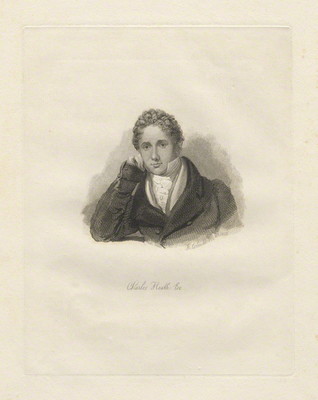
Charles Theodosius Heath by Mary Dawson Turner after etching by Henry Corbould
Friday 25 January 1822
Stamford Mercury
Case of Settlement.
At the Surrey Sessions, the court was occupied during the morning of the 17th inst. in the appeal case of Ilford v Lingford, on which the Judges of the Court of King's bench had been divided in opinion, and referred it back to he Sessions for a re-hearing. The question was, whether a servant who had been hired by the plaintif, became entitled to a settlement as a pauper, in the parish where she had so served for upwards of a twelvemonth?
The pauper, Mary Webb, stated, that she been hired by Mrs.Tyrrel, a farmer's wife at Ilford, on the 10th January, 1820, for a month, for which she was to receive 6s. wages. The mistress however, immediately afterwards made a new agreement, by which the girl was to continue with he during the summer, on the terms of a month's warning or a month's wages. The girl continued in this service until the 1st of March in the following year, when she had a child, and was turned away; and, as her month did not expire until the10th, her mistress gave her a month's wages. She had received her wages at Christmas and Lady Day.
Mr.Heath argued at considerable length, that this was a hiring from month to month, which did not entitle the pauper to any settlement at Ilford.
Mr.Turton addressed the court in behalf of the respondent parish, contending that this should be legally considered a general hiring, that entitled the pauper to a settlement.
The court, after a long consultation, decided, by a majority of one only, that a hiring on a month's warning or a month's wages, was a good service, and entitled the pauper to a settlement in the parish of Ilford
Tuesday 12 February 1822
Charles Heath to Dawson Turner.
My dear Sir,
At length I have of forwarding you the promised parcel. I fear you will think it strange it should be so long after the time but when I assure you it was owing to my wish to make it more worth your acceptance I trust you will pardon the seeming negligence.
The fact is I have been kept from day to day waiting for the Papers (herewith enclosed) from Mr.Winston, whose whole time is engaged at Drury Lane Theatre and it was only an hour since I received him - he promised me a large quantity and many very curious when he can get a few leisure hours to look over his very large theatrical collection. I am certain he will keep his word as I gave him in return all the theatrical portraits I can procure.
I have likewise wished to defer the parcel until I could send a perfect set of Proofs to Crabbe's Poems, but as that would delay it another week I prefer making another with the next Germany, etc. I therefore only send you twenty out of thirtyone, likewise send the proof of Lauterbrunn, Shakespeare etc. etc.
I am very happy to be able to say I never was so occupied at any period of my life. The Arts flourish though the farming does not - the Booksellers of Paris are sending their Plates to be Engraved in England in consequence of the high esteem our small prints are held in that capital.
With regard to our Steel Engraving it is flourishing beyond all our hopes. The government of Portugal has adopted it and passed it into a law that our plan is to be used, all the present Paper Money is to be called in and ours substituted. We understand it will require eight Million of Notes - besides which there is a new Bank on the plan of our Bank of England, the issue of Notes from which will be very great - we have likewise great hopes the Prussian Government will adopt it.
Our general business increases so much we are obliged to build new Presses and Machinery - the Manchester Calico Trade is likely to produce us a great deal of business of itself. Mr.Perkins is now at Manchester for the purpose of procuring information etc.
In my next I will send you some proofs of our latest works. Should the Paper System continue I have not doubt we shall have the whole country currency to make.
I hope all your family has improved in health since I last heard from you. I beg you will present my best respects. - I must now thank you for your kindness in cashing the Bills I trouble you with. I am afraid you will [find] me too troublesome. I can only say my dear Sir that any service I can render you in return I shall take a pleasure in doing and I beg if in any way you can make me useful you will command.
Yours most sincerely,
Charles Heath
Wednesday 13 February 1822
Morning Advertiser
Insolvent Debtors' Court, Feb.12.
John Dale, whose case had adjourned after a former hearing, to give time for an affidavit from Mr.Locker, a banker, a Walsal, was brought up for the decision of the Court.
The insolvent, on his first coming up, had been opposed by Mr.Heath, on behalf of the Walsal Bank, who held a bill of the insolvent's for 17/.10s. on which they had sued him and obtained judgment at an expense of 70/.
The insolvent on his examination stated that he drew the bill for the accommodation of his brother-in-law, to whom, after it had been some time due, he gave money to pay it at the Walsal Bank, where it had been discounted; but said he was informed by his brother-in-law, that on paying the money to Mr.Locker, the banker, he placed it to his (the brother-in-law's) account, he being in debt to the Bank at the time, and refused to give up the bill. - - -
The Court said it was very evident, from Mr.Lockyer's affidavit, that the insolvent had never paid the bill. - The judgment of the Court was, that he should not be discharged till he should be in prison twelve months from the date of filing his petition.
Isaac Drew, a butcher, living in Bedfordbury, was opposed by Mr.Heath, on behalf of five other butchers. It appeared that the insolvent had bought meat from his several opposing creditors to the amount of 104/. from the 15th of October to the 20th, and that he sent so much of it to be sold in Newgate Marketat an under-price as amounted to 52/. The insolvent explained his conduct by saying, that after he made the purchases the weather became warm and muggy and he could not keep the meat to sell in his own shop, without its being spoiled.
The Court said, they could not admit the insolvent's defence of his conduct had contracted his debts fraudulently, and therefore adjudged that he should not be discharged till he should be eight months in prison.
Charles Tracey, the half-pay Ensign, who was opposed last week by Mrs.Johnson, a widow of no very youthful appearance, on the ground of having borrowed 8/. from her on a promise of marriage, came up to receive the judgment of the Court, not having had it in his power to satisfy the widow's demand, which he, however, positively promised to do on the first payment of his half-pay.
Wednesday 13 February 1822
New Times (London)
Debrett's Peerage. New Edition
In a few Days will be Published, with a Portrait of his present Majesty, in his Coronation Robes, engraved by C.Heath, and a Set of Prints, entirely new, a New Edition, corrected to the present time, of -
The Peerage of the United Kingdom of Great Britain and Ireland; with the extinct and forfeited Peerages, a List of their Family Names, Second Titles, &c. and a Translation of their Mottos. Also a List of Knights Grand Crosses, Knights Commanders of the Bath, alphabetically arranged, and of British Subjects holding Foreign orders of Knighthoods.
By John Debrett,
Editor of the New Baronetage of England.
Printed for Rivingtons; Egerton; Cuthell; Clarkes; Longman and Co.; Cadell; Richardson; Booth; Lloyds; Booker; Black; Kingsbury, and Co.; Baldwin and Co.; Bagster; Hatchards; Harding; Rodwell and Martin; Whittaker; and Edwards and Knibb.
Sunday 17 March 1822
Constitution (London)
Insolvent Debtors' Court
In the Matter of Olive, calling herself Princess of Cumberland.
Wednesday morning the Court was excessively crowded with persons waiting in expectation of hearing the examination of this Lady, who was to be brought up to take the benefit of the Insolvent Debtors' Act.
At twelve o'clock the case of "Olive, Princess of Cumberland" was called on by the Clerk of the Court, when the Lady made her entrance, and at the request of Mr.Pollock who stated that she had had the misfortune to fracture her leg lately, she was accommodated with a seat.
The Officer having called - "Who opposes Olive, Princess of Cumberland?" Mr.Heath said - I opposed on behalf of Mr.Longstaff and Mr.James. A creditor named John Lewis appeared in person
Mr.Heath stated that he intended to oppose this lady on a preliminary objection, that she had not included in her schedule a certain document relating to property. The Learned Counsel called Mrs.Longstaff to prove the existence of the document.
Mr.Pollock objected to the course of his Learned Friend was pursuing but the Court over-ruled the objection.
Mrs.Longstaff then stated that she had seen in the lady's possession whilst she lodged in her apartments, a paper which the lady said was signed with the sign manual of his late Majesty which bequeathed to her the sum of £15000/. but that it was not to be produced till after his Majesty was dead.
Mr.Pollock then examined the Insolvent who said it was a paper signed by Lord Chatham and the Earl of Warwick. She had frequently applied through the medium of Sir Benjamin Bloomfield and it as out of delicacy to his Majesty that it was not made public before. She did not consider it as a debt, but as a bequest and the paper was now in the hands of Mr.Bayfield, a proctor to be regularly proved as a will.
The Chief Commissioner said this was a case of every day's occurrence. It was the case of an Insolvent, who, believing that he had some claim to property, was bound to state the nature of that claim in his schedule, and to produce and file in Court all the papers connected with it; the same must be done in this case.
Mr.Pollock said he had stated to the Solicitor that the paper should be produced; he had hoped it would be in Court and intended to apply to have it put in the schedule but as it was not in Court he feared an adjournment was necessary. The Insolvent said it had been presented to her that it was not necessary to return the document; and she could not see her Counsel to advise with him.
Mr.Heath said no one could doubt that the document must be highly important to the creditors.
Chief Commissioner - Let the case be adjourned for fourteen days and in the mean time let the paper be delivered in.
It was finally fixed that the case should be heard on the 25th inst.
Saturday 23 March 1822
James Heath, 42 Howland Street, London - to Dawson Turner.
My dear Sir,
Owing to the death of a Person to whom I had lent some money, and who has died suddenly, I am obliged to take some Houses in an unfinished state. I have made a contract with a Builder for ready money to complete them and I find he draws upon me rather faster than I am with my usual income able to supply him. I have therefore sent the enclosed which if you will have the goodness to discount it will answer all my purposes.
I have the pleasure to inform you that my health is much improved although I cannot say it is fully re-established. The Holy Family and Puck are lying idle for the present unless my Son with whom I am in treaty for the latter plate should take it in hand (which I rather think he will) to finish it immediately.
I understand that the steel schemes are doing wonders. They have got among many other Banks, the Portugal Bank which of itself is a little fortune. How I shall dispose of myself this summer I have not yet determined but if I travel I shall have great pleasure in stretching as far as Yarmouth.
I beg to be kindly remembered to your friendly family and believe me,
As ever,
Yours very truly,
James Heath
Friday 29 March 1822
Morning Herald (London)
Courts of Request
Mr.Lennard rose to call the attention of the house to a subject on which he had given notice, and which most seriously affected the lower class of society. He would inform the House that a Court was established in Middlesex to recover debts under forty shillings; the presiding officer was required to be a Barrister of three years standing.
By the returns which he held, it appeared that the average of causes tried in London amounted to 17,000 annually. Last year there were nearly 18,000. The Act prescribed that the Court should sit one day in each week in London, and once a month in the hundreds of Ossulton and of Isleworth; but the practice had been, from accumulation of business, that it was held twice a week in London.
Since the date of the Act which appointed these Courts, the population of London had increased many fold, and that of the other Hundred was also much augmented. There were 180 causes tried every day; he was justified in fixing the average at 220, some of them of an intricate nature, perhaps requiring witnesses to be called. It was absolutely impossible that so many could be despatched within that time with justice to the parties.
The process of the Court was for a person to take out a summons, requiring the attendance of the other party on the next day. The plaintiff must then have to be at the Court by nine o'clock in the morning, and might perhaps have to wait there till nine at night. The chief object was defeated for which at first those Courts of Conscience were established; they were instituted to afford to the poor man a cheap and expeditious mode of recovering small debts due to him.
A principal objection with him was to the situation of the Court - it was not sufficiently centrical: it was held in the vicinity of Red-Lion-Square, and its jurisdiction extended as far as Turnham Green and Brentford. A person suing another at that distance, and serving personally the different forms of the Court, would have to walk backwards and forward eighty miles in five days. To avoid such difficulties, there were agents occasionally employed, but they increased the expense, and defeated the object of the Legislation.
These Courts were called the poor man's courts, and were intended to give him redress without expense; but that intention was not a present carried into execution. He would undertake to say that there were, on some court days, 480 summonses issued.
He would beg distinctly to say that he did not attempt to make any charge against Mr.Heath, who presided in that court; on the contrary, he believed that he endeavoured to discharge his duty in the fairest manner, and he had reduced the fees of the situation one-sixth since he came into office. He begged to call the attention of the House to the report of that officer on the subject of fees. In the time of his predecessor, he stated that the fees on each cause was three shillings; since he came into office, he reduced them to two shillings and sixpence.
The number of causes tried were, on an average, 17,000 a year. He had also said that he had to pay various expenses of the Court, and salaries of various officers, out of these fees. He had not specified the amount.
If the question went to a Committee, it could be shown from the statement of the Under-Sheriff, who had appointed him, that the fees on each cause were three shillings. If they took the report to the Chief Officer himself, his income would appear to amount to £2,100, and that of the County Clerk to £1,600.
It was said that fees were taken on the postponement of causes, and also that a fee of 3s. 4d. was paid on a process coming to execution. He could not find anything in the Act to authorise these exactions. Supposing the average amount of debts sued for to be ten shillings, and the costs thereon five shillings, he would find on the number of cases a sum of £8,000 or £10,000 a year paid into the Court. He could not help remarking that during twenty-five years, in which the last gentleman was at the head of the office, there was no account of unclaimed money. It was probable that money must remain in the court, when it was considered that debts were paid in by distant instalments, perhaps not more than one shilling a week, and that many of the suitors may have changed their places of abode, had died, or left the country.
He would allude to one other topic and complained that four hours were only allowed to receive the payments of the week; by an order of the late officer, from ten to two on Friday was appointed for that purpose. Frequently the crowd was so great, that many persons were obliged to return home without being able to get into the office to receive their money.
The Hon. Gentleman then repeated the different grounds of grievance, and concluded by moving that a Committee might be appointed to inquire if the Proceedings of the Court of Requests might be simplified - if the Amount of Fees could be diminished - and whether the County Clerk might not act as the President of Court in the Hundred of Ossulston.
Mr.Bernal said that the last Hon.Member had certainly done every justice to the character of the officer now at the head of the Court. He considered that if any complaint was made, it should emanate from some suitor in the Court, or from some sufferer under its arrangements. The Chief Officer had expended £2,000 of his own money to erect a proper building for the purposes of the Court, which had been constructed in Kingsgate Street, Holborn. There was a necessity of having a gentleman of experience and of judgment to decide these causes. He had given up his practice in the Court of King's Bench, and declined to go circuit, to attend to this situation. He considered that no case had been made out for the attention of the House; and, as they had no petition before them, no complaint from any suitor in the Court, he certainly would call on the House to refuse the motion for a Committee.
Mr.Bennet supported the motion, though the Hon.Member had not adopted the most prudent course of bringing the question before the House. He considered there was sufficient ground shown for inquiry. He would beg to know if the situation of the chief officer had not been bought and sold, or what right the Sheriffs of London had to make sums of money by the disposal of it, as it was reported that they had done?
He regretted that his Hon.Friend had not taken another course. He should have brought in a Bill to regulate the Court, which would have been the most effectual mode. It was said that cases were decided with the assistance of three Jurymen. He had seen them, and they appeared to look more like convicts than men competent to serve on Juries, and far different from the description of persons who were imagined suitable for such a duty.
The Solicitor-General opposed the motion. He did not think there was any case made out for Parliamentary interference. The constitution of these Courts even had the support of the best law authorities - in particular the commendation of Mr.Justice Blackstone. The Learned Gentlemen at length defended the practice of the Courts, and the form adopted by the present Chief Officer. He praised the superintendence of Mr.Heath, and concluded by giving a decided negative to the motion.
Mr.Lennard then replied and said that finding the sense of the House against him, he should not press his motion. He could not, however, help observing that an individual who was in bad health at the time, had offered five years' purchase, or £10,000 for the situation.
After a few words from Mr.W.Smith, Mr.P.Moore, and Mr.W.Courtenay, the question was put, and the motion negatived without division.
Sunday 31 March 1822
Observer of the Times.
Middlesex County Court ?
Saturday 6 April 1822
Mirror of the Times.
Insolvent Debtor's Court. - Thursday.
Thomas Scrivenor came up to be heard on his petition to be discharged. The insolvent stated that his wife had twelve houses at Ware, which, together with an estate sold some time since, she had possessed before her marriage. After hearing witnesses, Mr.Heath, on behalf of some creditors, submitted to the Court, that the insolvent, who obtained credit from the possession of his wife's estate, should not be allowed to run 1100/. in dept to persons who could badly afford the loss, some of whom it would actually ruin, and then take the benefit of the Act, and go out of prison to spend the same income, and laugh at the credulity of his creditors. The Court adjudged him to be guilty of fraud, and ordered him to be imprisoned twelve months.
Sunday 14 April 1822
The News (London)
Saturday''s London Gazette - Bankrupts.
T.Abbotts and R.Abbotts, Skinner Street, wine-merchants.
Attorney, Mr.Heath, King's Bench- Walk, Temple
Monday 15 April 1822
Morning Advertiser
Bankrupts
Thomas Abbotts and Richard Abbotts, of Skinner Street, London, wine-merchants, April 16, 30, and May 25, at one, at the Court, Basinghall Street, Attorney, Mr.Heath, King Bench Walk, Temple.
Monday 15 April 1822
Bell's Weekly Messenger
Original Works of Hogarth.
In Imperial Folio, published by Baldwin, Cradock, and Joy. Price 30/. in Numbers, or 31/. 10s. handsomely half-bound in Russia.
The Works of William Hogarth,
from the original Plates restored by James Heath Esq., R.A. with the Addition of many Subjects not before collected. To which are prefixed a Biographical Essay on the Genius and Productions of Hogarth, and Explanations on the Subjects of the Plates, by John Nicholls Esq., F.S.A.
On completing this Edition, by far the most perfect that ever was offered to the public,, of the original Works of Hogarth, the Publishers cannot refrain from expressing their grateful acknowledgements for a patronage far beyond their expectations, and which has enabled them to render their publication much more valuable than they had originally contemplated, or than it could have been made without such encouragement and support.
In addition to the valuable collection, late the property of Messrs.Boydell, fac-similes have been engraved of several curious plates, not now to be found, and perhaps no longer in existence; and, further to enrich the work, the publishers have purchased many very interesting and valuable plates: thus adding twenty-eight subjects to what constituted the collection of Messrs.Boydell.
Tuesday 21 May 1822
New Times (London)
This Day is Published, in one elegant vol. f.cap 8vo, ornamented with a beautiful Engraving by C.Heath, after a Drawing by Stothard, price 6s. boards.
Dangerous Errors, a Tale. - The events of this Tale will prove that happiness cannot be obtained if in the pursuit of feelings is outraged, or duty forsaken. It will paint the dangers to which a want of mature deliberation, or of just and well directed motives will lead, and will be found a most useful and interesting companion for the young and inexperienced Female.
Printed for Lupton Relfe, 13 Cornhill
Wednesday 5 June 1822
Morning Chronicle
Insolvent Debtors' Court.
Monday, the Reverend James Cradock came up to be heard on his Petition to be discharged, and was opposed by Mr.Heath for Miss Martin.
The insolvent was examined by Mr.Heath. His father was John Craddock, a tailor, in Winchester. He (the insolvent) was baptised, and generally known by the name of James Craddock. - Being asked whether he ever went by any other name, he appealed to the Court, to know whether he were bound to answer?
The Court desired him to answer the question. He had used the name of Abraham de Carrier, for commercial purposes, but not generally. He dropped it five or six years ago, just before his bankruptcy. He was declared a bankrupt by the name of Craddock. There was no dividend under the commission, all his property being wasted on expenses. His property at the time was worth one thousand pounds. He did not obtain his certificate. -
He was ordained by the present Bishop of Bath and Wells, and produced at the time of his ordination the regular testimonials. - He had contracted to pay 25,000/. for the purchase of a church living; 20,000/. in advance, and to give a bond for 20,000/. conditioned for the payment of the remainder of the purchase money and the performance of covenants. "Pray, Sir, were you at the time worth 20,000 pence?" - "I was worth the property I gave up under my bankruptcy."
In the year 1808 he was chaplain on board the St.George, but quite forgot whether he drew any bills on Mr.Light, a Navy Agent, or whether he provided for them. He never took the benefit of the Insolvent Act but once, that was in the year 1819. He petitioned again about two years ago, but did not proceed; at that time he was in custody five months, for a debt of 395/. due to Miss Martin, for board and lodging and wine, and borrowed money. The debt was contracted in the years 1816 and 1817, but was omitted in his schedule when he was discharged under the Act in 1819. After he had filed his Petition in 1820, he procured his discharge from prison, by giving Miss Martin a warrant of attorney for the debt.
The Court said, the insolvent's present insolvency was not owing to misfortune, but to his own misconduct, in omitting to return a creditor for a considerable sum in his former schedule, to the truth of which he had sworn; his Petition must therefore be dismissed.
Tuesday 18 June 1822
Morning Herald (London)
Finished and Unfinished Proof Prints, &c. of James Heath Esq., A.E.R.A., Historical Engraver to the King - By Messrs Robins, at their Spacious Rooms, Piazza, Covent-garden, on Thursday next, and following Day, at 12 without reserve.
The Finished and Unfinished Proof Prints from the celebrated Plates of the Death of Lord Nelson - Death of Major Pierson - the Dead Soldier - the Drowned Fisherman - General Washington, &c. and a variety of Illustrations and Embellishments for Books, private Portraits, &c., &c. of James Heath Esq. A.E.R.A. retiring.
May be viewed till the Sale, and Catalogues had at the Rooms.
Tuesday 18 June 1822
Sun (London)
Insolvent Debtor's Court, June 17
John Charles Ridgway, a young man, very elegantly dressed, appeared to take his discharge under the act. He was opposed by Counsel on behalf of Messrs.Gilman and Lucas, Messrs.Johnson, and other creditors. In his examination, he stated that he was married in 1820, and went to prison in April last. His mother-in-law, Mrs.Frances Matthews, an innkeeper at Sheerness, lent him £500/. about 6 weeks before his marriage. For this sum he gave her on the 1st Feb. last, a warrant of attorney - On the 7th of the same month he incurred a debt to a considerable amount with Messrs.Gilman, Lucas and Co., for goods; and on the 15th called a meeting of his creditors. - - - -
Mr. Heath, who was Counsel for the insolvent, proposed a reference of the case to Mr.Dance: this was agreed to, and the further proceedings in the case were postponed until the 2d. July.
- - - -
William Hobday was opposed on two grounds: 1st. undue preference; 2dly, vexatious legal proceedings against creditors. The principal opposing creditor was a Mr.Tyson, to whom the insolvent was indebted to a very considerable amount. - - - -
Mr.Heath, as Counsel for the insolvent, maintained that there was a collusion between the creditors against the insolvent - such a collusion as imperatively called upon the Court to interfere. Mr.Perkins had in fact abandoned his opposition at the request of Mr.Tyson, but would not acknowledge it.
The case was directed to stand over, for the production of certain papers. The decision of the Court will then be given.
Saturday 22 June 1822
The Heath Family Engravers 1779-1878, Volume 3. by John Heath
Letter from C.Heath to unknown
My dear Sir,
I will thank you to let the bearer have my Proofs of the large Plate of Christ Healing the Sick.
Yours very truly,
C.Heath.
Thursday 27 June 1822
Morning Herald (London)
This day is published, in five vols. crown 8vo., beautifully printed on yellow laid paper, embellished with a Portrait of Chaucer, from the Harleian MSS. of Hoccleve; and a reduction of the celebrated Picture by Stothard, of the Canterbury Pilgrimage, finely engraved in the line manner by Worthington, price 2/.12s. 6d. bds.
Fifty Copies only are printed on large paper with an additional etching of the Pilgrimage, price 5/.5s.
The Canterbury Tales of Chaucer.
with an Essay upon his Language and Versification, an Introductory Discourse, Notes, and a Glossary. By T.Tyrwhitte Esq. London:- Published by W.Pickering, 31 Lincoln's Inn Fields, and R. and S. Prowett, 269 Strand. - - -
Cursory Remarks on the English Poets by Mr.Neve. The celebrated Large Engraving of the Canterbury Pilgrimage, painted by T.Stothard A.R.A.; engraved by Schiavionetti, Heath, and others, may be had of the same publishers.
Tuesday 9 July 1822
Manchester Mercury
Friday and Saturday Posts.
London July 4, 1822
Mr.Heath's engaving from West's grand picture of Christ healing the Sick, purchased by the British Institution in 1811, for 300 guineas, is at length finished. Mr.H. had 100 guineas for his task, which was to have been completed in four years, but has occupied him no less than eleven.
Saturday 20 July 1822
Leicester Chronicle
Insolvent Debtors' Court - July 13
Henry Smith came up to be heard on his petition to be discharged from debts amounting to £50,000, and was opposed by Mr.Heath, on behalf of Miss Bakewell, a creditor for upwards of £20,000. It appeared by the insolvent's examination, that he was an attorney, and had resided for a great length of time at Ashby-de-la-Zouch, in Leicestershire. In the year 1804, Miss Bakewell, who is a lady of considerable fortune in that neighbourhood, was induced to appoint the insolvent her agent to receive her rents, and having great confidence in his integrity, and not being in want of money, she allowed the principal part of the money to remain in his hands, bearing interest.
This continued for 15 years, at the end of which the insolvent was indebted to Miss Bakewell in the sum of £20,687, for which he then, in the year 1819, gave her a bond with judgment as a security. The insolvent in accounting for the disposal of money, stated, that he purchased an estate, and built a house upon it, that cost him near £10,000; and admitted, that his income at the time did not amount to more than about £250 a year, and his household expenses alone amounted to upwards of £600.
It also appeared that he was in the constant habit of borrowing considerable sums of money from different persons, particularly Mr.Grundy, to whom he gave a warrant of attorney for £5,500. Although it appeared by the insolvent's schedule that the bulk of his debts had been contracted before this transaction, he swore that he believed himself solvent at the time it took place, as he then valued his estate of Norris Hill, on which he resided, at £18,000, but which was since much depreciated.
Miss Bakewell, in the month of April, in the year 1818, demanded a security for the money due to her, on which occasion he gave her his bond; but in the month of August following, he assigned over his property to Miss Vincent, in payment of a debt of £4,500 - - - - The insolvent admitted, but with much difficulty, that he was in insolvent circumstances at the time he gave the bonds to Miss Bakewell and Miss Vincent.
Mr.Heath said, he would withdraw his opposition if the insolvent would even then, although it was the eleventh hour, agree to give up the property he had conveyed to Miss Vincent and his son, for the general benefit of the creditors, with whom they might equally share.
The insolvent said he had already been confined several months, he would prefer taking the judgment of the Court to entering into an arrangement which it might not be possible for him to fulfill. - - -
The chief Commissioner, in pronouncing the judgment of the Court, said it was quite clear that the insolvent had conveyed his property to his family, to the prejudice of all his creditors, and no doubt with a view to his own benefit as a member of that family. It was his duty to make every amends in his power to his creditors, but he persevered to the last moment and was pleased to say he would rather received the judgment of the Court than enter into any arrangement. - - - - The Court, the learned commissioner said, thought it barely possible that, of all the multifarious cases that had come under their consideration, one or more ever presented itself; and he hoped the judgment he was about to pronounce might produce that arrangement which had been so promptly and unjustly refused by the insolvent. The judgment of the Court was, that the insolvent should not be entitled to the benefit of the Act until he should be confined for a period not exceeding two years and four months from the date of filing his petition, at the suit of all his detaining and opposing creditors. - - -
Mr.Heath said he was aware it was not usual to appoint a female assignee, but in this case he should beg that Miss Bakewell might be appointed.
Court. - Let it be so; but it is on the condition that she contests these matters.
Mr.Heath. - I am instructed to say, that point is clearly understood as the condition.
Mr. Commissioner Harris. - In this case I can't help observing that the insolvent owed £8,000 at the time he began to receive Miss Bakewell's rents; yet he has ventured to swear that he considered himself at that time to be solvent.
Sunday 28 July 1822
Bell's Weekly Messenger
The truly astonishing performance of the Longuemere family, at Vauxhall Gardens, have attracted universal admiration; which with the other excellent amusements of this delightful retreat; have this week assembled all the rank, beauty, and fashion of London; and the novelty, termed "Pleasing Reflections," has delighted both young and old. It staggered our philosophy, and made us laugh in spite of ourselves, to see the solid John Bull (at the sound of a bell) leave the substantials at table, to pursue the shadows of fancy. The following names are part of these we noticed: - Earl Sefton, Marchioness Lansdowne, Earl of Westmoreland, Sir Walter Waller, Gen. Mitchell, Sir George Warrender, Hon. Mr.Stanhope, Lord Alvanley, Tripolitan Ambassador, Lord Beresford, Lord A.Hill, Lord Huntington, Countess Blessington, Sir David and lady Ogilby, Lady Isabella Turner, Sir Henry Torrens, Lady Drake, Sir Wykeham Martin, Lady Wilder, Lady Westmeath, Miss Fitzclarence, Hon. Charles Talbot, Dr. and Mrs.Mant, Capt.Turner, Mr.Phillips and family, Mr. and Mrs.Marshall and family, Dr.Woollaston and family, Mrs.Rogers and family, Mrs.Steward and family, Mr. and Mrs.Heath and family, Mr. and Mrs.Hamilton, Mr. and mrs. Fennell, &c. &c. &c.
Saturday 3 August 1822
Charles Heath, 6 Seymour Place, to Dawson Turner.
My dear Sir,
I have the pleasure of sending with this a small parcel containing various Proofs of Landscape Annual two numbers wanting to complete your Paris, a set of Plates I have just finished to be published in Paris for Paul & Virginia and the last number published of the Shakespeare.
I likewise enclose three Bills which it will very greatly oblige me if you can conceivably cash. I have made every enquiry respecting the Validity of a certain House and have every reason to believe all is correct. Though what you stated was perfectly just - they explained the thing to a friend of mine, it was a Draft given to Messrs. Arch of Cornhill and which though returned was paid the same day. Several Bills of mine have been I know regularly paid which makes one think they are perfectly safe. If they were considered otherwise in the trade I should certainly have heard of it.
We yesterday had an order for making the Notes for the Norwich Crown Bank - they have just been Forged on I believe to some extent and Sir William Congreve's Stamp was so well done the Commissioners of Stamps could not tell the difference, this at present a profound secret as the Bank do not wish it to be known until the new Notes are ready.
We are daily adding up our list. We hear there is a gang of Forgers now counterfeiting Country Notes - I hope very soon to send you some beautiful Calico printed on our Plan. We have every reason to think it will be most successful.
With best respect to yourself and family. Believe me Dear Sir,
Yours truly obliged
Charles Heath
Monday 19 August 1822
Bell's Weekly Messenger
Insolvent Debtors' Court.
The Bowditches.
Jean Bowditch, William Bowditch, and James Scarlett, severally came up to be heard on their petition to be discharged, and were opposed by Mr.Pollock, on behalf of Mr.Harmer, the Solicitor.
Joan and William Bowditch are two of the persons whose case for a long time excited a considerable degree of public attention, and on its development, no small share of public sympathy, in consequence of their prosecution by Maria Glenn &c. James Scarlett is son-in-law of Joan, and brother-in-law of William Bowditch.
Mr.Harmer was a creditor for the balance of his bill of costs in defending the Bowditches, and prosecuting Maria Glenn, for which Scarlett, it was stated, had become security. - - -
The insolvents stated that they had granted an assignment of their whole property for the sum of £1021/. which had been all expended during the proceedings in which Maria Glenn's prosecution had involved them. Mr.Harmer's bill of costs amounted to £864/.; £500/. of which had been paid.
Mr.Heath, who was counsel for the insolvents, observed, that they were the most injured family on earth; they had all, but one, who had the good fortune to be in Ireland, been totally ruined, by the foulest conspiracy that had ever been contrived. Some of them had sunk into the grave under the weight of their sufferings.
Mrs.Bowditch was in tears during the time of her examination, which the benevolence of the Court and the opposing Counsel made as short as possible.
There were all declared entitled to the benefit of the Act, and discharged forthwith. Mr.Harmer was appointed assignee.
Friday 6 September 1822
British Press
Insolvent Debtors' Court - Thursday, September 5.
John Broom, a drover and salesman in Smithfield, was opposed by Mr.Pollock and Mr.Heath, on behalf of a great number of creditors. The Insolvent was supported by Mr.Cooke. The Insolvent had carried on the business of drover and salesman for upwards of 20 years, and had been employed by several of his opposing creditors to sell sheep. He had had current accounts with them, and the sums specified in his schedule were the balances of these accounts. - - - The Counsel on both sides addressed the Court, and the Court, having observed, that it did not appear that the Insolvent had engaged to pay to his employers the specific sums received on the sale of the cattle, declared him entitled to the benefit of the Act, and ordered him to be discharged forthwith.
James Harris was opposed by Mr.Heath on behalf of one of his creditors, upon the ground of a concealment of property. - - - The Court looked upon the transaction as a concerted fraud, and ordered the Insolvent to be imprisoned for 18 months.
James Mathewson was opposed by Mr.Cooke, on behalf of Messrs.Currie and Co., distillers, on the ground of having contracted a debt fraudulently. The insolvent, who had been bookseller in Oxford, and failed in that business, became a licensed victualler, and about the month of November 1821, contracted a debt with Messrs.Currie to the amount of £57/. for spirits. - - - It was no contended by Mr.Heath, that as Messrs. Currie accepted the warrant of attorney subsequent to the contracting of the original debt, it was to be held a waiver upon their parts of any fraud which might have been committed. He further insisted that the acknowledged payment of £50/. in January to Messrs. Currie was nearly equivalent to the 10s. in the pound which they might have had under the compromise with the body of the creditors.
It was argued on the other side for the creditors that although the general principle was such as Mr.Heath had stated it, yet if the subsequent security were attended with fraud, it would deprive the Insolvent of the benefit of the veil which might otherwise have been thrown over the original transaction. The case being heard it was found that some of the notices had not been served, and the case was adjourned for the purpose of completing them
Sunday 25 September 1822
The Heath Family Engravers 1779-1878, Volume 3. by John Heath
Letter - from J.S.Bacon to Charles Heath.
Dear Sir,
I should have written you last evening, but the Brighton Notes were not received from the Stamp office until after 4 o'clock and then in so scathing a state that after despatching 5 letters it required Mr.Petch, Sam and myself until near 7 o'clock to get them ready ofr the mail. No letter from Mr.H. has been received either at your House or Office and nothing of importance has occurred since you left.
We have now 13 printers at work and I think we can find employment for 14 or 15 in the course of next week. Should anything in particular occur by tomorrow night I shall write again but not late as it will be important you should be home on Saturday which day I think you calculated on returning when you left.
The Roll is finished which you saw before you left and had bitten in very deep and well.
Please present my respects to Mrs.Heath and believe me etc.,
J.S.Bacon.
Mr. Perkins say he shall not be ready to go to Manchester until next week.
[J.B.Bacon was a partner in the family printers, Perkins and Bacon]
Tuesday 22 October 1822
Morning Herald (London)
Kingston Sessions - Monday
James Barnet, Alfred Leech, and James Hill Field, were indicted for stealing from the bleaching grounds of Mr.Bailey Austin, of Mitcham, ten pieces of printed calico.
Mr.Heath very ably opened the case.
Mr.Baily Austin, the prosecutor, proved that he was the owner of the bleaching-grounds, at Ravensbury, in the parish of Mitcham; and that on the night of the 26th of June last, ten pieces of printed calico, each piece containing 24 yards, were stolen from thence.
Thomas Drinkwater, one of Mr.Austin's workmen, proved that he put out the ten pieces of calico on that day, on that part of the grounds which was near Lady Barnet's field, and that he saw them there so late as seven o'clock on that evening, when he went round the factory. On the following morning at six o'clock, he missed the whole of them.
George Fisher, a labouring man, stated that he had some conversation with Drinkwater about twenty minutes after nine o'clock, on the night of the robbery, and that immediately after, as he passed over a stile, called Puddingfield Stile, from which there was a path that leads to Phipp's Bridge, at about twenty yards distance, he saw Barnet and Leech, and bade them good night. They went on towards Drinkwater's cottage, but he did not observe that they made towards a gap in the hedge.
- - - continues.
Sophia Heath saw Field about five o'clock on Monday morning the 1st of July, sitting on the green, on the side of the iron railway; he had a basket and a bundle with him. Directly as she passed, he got up and followed her towards Wandsworth. She also saw him on the same morning between ten and eleven o'clock, walking on another part of the railway (nearer the place where the property was afterwards found) , and he then also had a bundle, and a basket with him.
- - - continues - - -
Cross examined - He is a waterman by day; and night too.
Mr.Thessiger - Do you nothing on land by night?
Witness - That's not a fair question, I think.
Mr. Heath - I will not conceal it, he has been what is called a "body-snatcher." You (speaking to the witness) had better explain.
Witness - He had acted as a porter to Mr.Carpue, the surgeon, and sometimes let in the men at the surgeon's dissecting-room in the night. He had also been as a body-snatcher himself. He had never been tried at the Old Bailey. He was not so fond of the matrimonial life as to have two wives. He had never been tried for bigamy, but he had been accused of it, and discharged.
Charles Collingbourne, the police officer,apprehended Leach. When Leach was taken into custody he said he supposed Miles had been at his tricks again, and that he dared to say that he (Collingbourne) wanted him for Austin's business.
The Forman of the Jury said that the Jury were quite satisfied that the prisoners were Not Guilty, and a verdict to that effect was recorded, after the trial had lasted five hours.
Tuesday 29 October 1822
Globe
Insolvent Debtors' Court - Monday October 28.
This day Philip McGowan was opposed by Mr.Heath on behalf of several creditors. The insolvent, as soon as his case was called on, addressed the Court, and asked leave to relate all the circumstances of his case, as far as related to the ship Lord Nelson, and to his marriage with the widow Roberts, or, as she was called in the newspapers, the buxom widow Roberts.
The insolvent, without waiting for any reply from the Court, proceeded to relate his story with a volubility that rendered him scarcely audible. He said he married the widow Roberts in St.Andrew, in New Brunswick; soon after which he came to this country with his wife. He purchased the Lord Nelson partly with his wife's money, and partly with how own, and having entered into a charter party to go to Madeira, his wife gave out that he was going to run away with the cargo, in consequence of which he was arrested, and was obliged to let a ship-broker put a master in the vessel, who went the voyage; and although she made £1,300/. freight, the master brought her in debt £400/.
The Insolvent proceeded to state that the ship was illegally detained in the river Thames, that he register was illegally detained by the ship-broker, and that his creditors and his wife had entered into a conspiracy to ruin him. He was proceeding with great fluency when the Chief Commissioner told him that when he had exhausted his abuse of his wife and creditors, he must answer the questions put to him by the Learned Counsel.
The Insolvent, on receiving this check, declared himself ready to answer; and in reply to the questions put to him by Mr.Heath, stated that he was committed to Whitecross Street prison on the 9th of December 1820, and was removed by Habeus Corpus to the King's Bench on the 4th of May, 1821. On reference to the affidavit filed in the Court, on which the Insolvent obtained leave to petition, it appeared that it stated that the Insolvent had been first committed to prison on the 4th of May 1821, and had not petitioned within fourteen days from that date, in the expectation that he would be able to pay all his creditors by the sale of is ship, the Lord Nelson.
Mr.Heath submitted that the Insolvent's petition could not be allowed to stand. It stated the time of the Insolvent's arrest five months later than it was in reality; and, in consequence it did not account for his not petitioning within 14 days after he was arrested, but for not petitioning during 14 days that did not arrive for several months after his arrest.
The Court said the objection taken by the Learned Counsel was fatal to the petition, which must be dismissed.
Sunday 22 December 1822
British Luminary
Insolvent Debtors' Court, Dec.18
Morgan Davis a young mountaineer from Wales, who appeared by his manner to have been very lately caught, was opposed by Mr.Pollock, on behalf of a Glamorganshire Attorney, who was also a considerable dealer in horses.
It appeared, by the insolvent's examination, that he had been articled to his opposing creditor as an apprentice; but the intensity of his application to forensic studies having impaired his health, he was under a necessity of exchanging the profession of the law for some more salubrious avocation, and for six months he occupied the well-known Cambrian Mews at Cheltenham. During the time of the insolvent's following the business of a horse-dealer, he bought a couple of horses from his former master, for which he did not pay; and his discharge was opposed on the ground of his having obtained credit for these horses by misrepresentation; in proof of which Mr.Pollock put in several of the insolvent's letters to his late master, with whom he maintained a constant correspondence, in all of which he represented himself as doing well, and having the best prospects. At the end of six months, however, the landlord put in a distress for rent, and sold the insolvent's whole stud, leaving nothing for any other creditor.
Mr.Heath, who was Counsel for the insolvent, said, the only answer he should give to the opposition, was to read a few paragraphs from one of the letters written by the opposing creditor to the insolvent, from which, and from what the Court had seen of the insolvent, they would judge whether it was possible for the insolvent to doubt that he possessed such extraordinary abilities as must insure success in any undertaking he might engage in. The Learned Gentleman here read some extracts from the Glamorganshire attorney's letter, which produced an extraordinary effect on the risibility of the audience. The writer told the insolvent "that the people there (in Glamorganshire) had no idea of the prospects that were before him (the insolvent) but he (the writer) who well knew his genuine talent, was fully convinced that he must be successful beyond his most sanguine expectations; indeed, he only lamented that such gigantic abilities should only be employed in the acquisition of a fortune, instead of the command of a Patriot Army."
As soon as the laughter which this prediction of the attorney had produced was subsided, Mr.Heath read another extract from the letter, to which the writer exhorted the insolvent not to refuse taking a little practical advice from him, whose experience was great, and by no means to hesitate warranting that the bay horse he then sent him was sound - provided he were not actually lame at the time of the sale.
As soon as the silence could be procured, the Court observed, that the misrepresentation appeared to be on the opposing creditors' side, rather than the insolvent's. The opposition, we may literally say, was laughed out of Court; and the insolvent was ordered to be discharged.
1822 circa
The Heath Family Engravers 1779-1878, Volume 3. by John Heath
Letter to C.W.Ward Esq., from James Heath
Dear Sir,
Mr.Burgess informs me that Mr.Sheridan had given him a £100 share for me, but I have never been able to get it from him. I am therefore determined to ahve 400 Pounds in money for the half of my £3000 share.
If you will therefore be so good as to get if for me, and transfer it to me or tell me where to call for it I will thank you.
I am, Yours truly,
James Heath
Please to direct to East Acton.
[ie post 1822]