Michael D.Heath-Caldwell M.Arch.


Michael Heath-Caldwell M.Arch
Brisbane, Queensland
ph: 0412-78-70-74
alt: m_heath_caldwell@hotmail.com
- Home
- Architectural Projects 0
- Architectural projects 1
- Architectural Projects 2
- Architectural Projects 3
- Architectural Projects 4

- The Crystal Palace
- Timeline
- 1693
- 1745
- 1770
- 1783
- 1784
- 1785
- 1786
- 1788
- 1789
- 1791
- 1792
- 1793
- 1794
- 1795
- 1796
- 1797
- 1798
- 1799
- 1800
- 1801
- 1802
- 1803
- 1804
- 1805
- 1806
- 1807
- 1808
- 1809
- 1810
- 1811
- 1812
- 1813
- 1814
- 1815
- 1816
- 1817
- 1818
- 1819
- 1820
- 1821
- 1822
- 1823
- 1824
- 1825
- 1826
- 1827
- 1828
- 1829
- 1830
- 1831
- 1832
- 1833
- 1834
- 1835
- 1836
- 1837
- 1838
- 1839
- 1840
- 1841
- 1842
- 1843
- 1844
- 1845
- 1845-46 Oxford
- 1846
- 1847
- 1848
- 1849
- 1850
- 1851
- 1852
- 1853
- 1854
- 1854/55 Appendix
- 1855
- 1856
- 1857
- 1858
- 1859
- 1860
- 1861
- 1862
- 1863
- 1864
- 1865
- 1866
- 1867
- 1868
- 1869
- 1870
- 1871
- 1872
- 1873
- 1874
- 1875
- 1876
- 1877
- 1878
- 1879
- 1880
- 1881-1
- 1881
- 1882
- 1883
- 1884
- 1885
- 1886
- 1887
- 1888
- 1889
- 1890
- 1891
- 1892
- 1893
- 1894
- 1895
- 1896
- 1897
- 1899
- 1900
- 1901
- 1902
- 1903
- 1904
- 1905
- 1906
- 1907
- 1908
- 1909
- 1910
- 1911
- 1912
- 1913
- 1914
- 1915
- 1916
- 1917
- 1918
- 1919
- 1920
- 1921
- 1922
- 1923
- 1924
- 1925
- 1926
- 1927
- 1928
- 1929
- 1930
- 1931
- 1932
- 1933
- 1934
- 1935
- 1936
- 1937
- 1938
- 1939
- 1940
- 1941
- 1942
- 1943
- 1944
- 1945
- 1946
- 1947
- 1948
- 1949
- 1950
- 1951
- 1952
- 1953
- 1954
- 1955
- 1956
- 1957
- 1958
- 1959
- 1960
- 1961
- 1962
- 1963
- 1964
- 1965
- 1966
- 1967
- 1969
- 1971
- 1974
- 1975
- 1976
- 1979
- 1983
- 1990
- 1991
- 1998
- 2001
- 2002
- 2004
- 2005
- 2006
- 2007
- 2008
- 2009
- 2010
- 2011
- 2012
- 2013
- 2014
- 2015
- 2016
- 2017
- 2018
- 2019
- 2020
- F.C. Heath-Caldwell
- C.H.Heath-Caldwell Memoirs
- Palmer Family
- Palmer Timeline
- 1912 - Palmer
- 1914 - Palmer
- 1916 - Palmer
- 1918 - Palmer
- 1919 - Palmer
- 1924 - Palmer
- 1925 - Palmer
- 1926 - Palmer
- 1929 - Palmer
- 1932 - Palmer
- 1934 - Palmer
- 1936 - Palmer
- 1938 - Palmer
- 1939 - Palmer
- 1944 - Palmer
- 1946 - Palmer
- 1961 - Palmer
- 1967 - Palmer
- 1970 - Diary - Joe Palmer
- 1971 - Diary - Joe Palmer
- 1972 - Diary - Joe Palmer
- 1991 - Diary - Joe Palmer
- 1992 - Diary - Joe Palmer
- 2010 - Diary - Joe Palmer
- Venice Earthquake 1873
- Old Letters 1
- Old Letters 2
- Old Letters 3
- Old Letters 4
- Old letters - Mid 1800
- More Old Letters
- Eaton Hall, 1943
- Marsh Family Timeline
- James Caldwell papers 1
- James Caldwell papers 2
- James caldwell papers 3
- Old letters 1800s
- Old Letters 1800s 2
- HH Sultan Taimur bin Turki 1913
- Frank Featherstone Wright 1921-2014
- Frank F. Wright 1
- Frank Featherstone Wright early
- Frank F. Wright 2
- Frank F. Wright Videos
- Old Featherstone album 1
- Old Featherstone album 2
- Old Featherstone album 3
- Old Featherstone album 4
- Old Featherstone album 5
- Arthur Eversfield Featherstone Album 1
- Arthur Eversfield Featherstone Album 2
- Arthur Eversfield Feartherstone Album 3
- Grasmere
- Frank E Wright Album 1a
- Frank E Wright Album 1b
- Frank E Wright Album 1c
- Frank E Wright Album 1d
- Frank E Wright Album 1e
- Frank E Wright Album 1f
- Frank E Wright Album 1g
- Frank E Wright Album 2a
- Frank E Wright Album 2b
- Frank E Wright Album 2c
- Frank E Wright Album 2d
- Frank E Wright Album 2e
- Frank E Wright album 2f
- Frank E Wright Album 2g
- Frank E Wright Album 2h
- Frank E Wright Album 2i
- Frank Edward Wright drawings
- Cathy Featherstone 1910a
- Cathie Featherstone 1910b
- Norma Featherstone 1913
- Norma Featherstone Part2
- Norma Featherstone Part3
- Norma Featherstone Part4
- Norma Featherstone Part5
- Kitlands House
- Moorhurst Manor
- Redlands House
- Milland House
- Anstie Grange
- Ebernoe House
- West Ham House
- Vigo House
- Linley Wood
- Crimean War
- James Caldwell letters 4
- James Caldwell letters 5
- James Caldwell letters 6
- James Caldwell letters 7
- James Caldwell letters 8
- James Caldwell letters 9
- Eton & Oxford 1830/40s A
- Eton & Oxford 1830/40s B
- Eton & Oxford 1830/40 C
- Eton & Oxford 1830/40 D
- Eton & Oxford 1830/40 E
- Eton & Oxford 1830/40 F
- Back in England. Early 1800s
- Arthur Heath 1872-4
- Sicily 1800
- Naples - 1830
- Trentham Hall
- Paris 1810
- Cromptons on the Lusitania
- HMS Illustrious 1948
- The Minoans
- Henry Crompton 1836-1904
- Orongorongo 1957
- Another Page
- Gertie Wheeler 1909
- The Ahsan Manzil
- More old letters 1800s
1824 - 1825 - 1826
James Heath R.A. aged 67/68
Mary Heath (ne Phillipson) aged 67/68
George Heath aged 45/46
Anne Raymond Heath (ne Dunbar) aged 37/38
Julia Anna Harrison (ne Heath) aged 17/18
John Moore Heath aged 16/17
Douglas Denon Heath aged 13/14
Dunbar Isidore Heath 9/10
Leopold G. Heath 7/8
Emma Jane Whatman 3/6
George Heath buys a house in Park St, to make up for buying Kitlands in faraway Surrey.
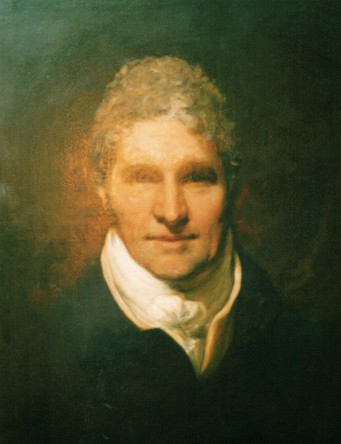
James Heath R.A., by Jackson
Saturday 1 January 1825
Morning Chronicle
Insolvent Debtors' Court - Friday
Removal of Insolvents to the Country. - In the matter of Robert North, late High Constable of Cassington and Yarnton, Oxfordshire, an insolvent.
Mr.Pollock said it was in the recollection of the Court that he made a motion, a few days ago, that the insolvent be removed from his custody, in London, to Oxfordshire, for examination. The motion was made at the instance of Mrs.Cole, one of the insolvent's creditors. he admitted that there was no opposition entered against the insolvent, but the majority of his creditors wished an opportunity to be afforded them of examining his property.
Mr.Heath did not think the motion ought to have been made against his client, when there was no opposition entered against him; but he could not resist the application if pressed.
Commissioner Bowen regretted that the Act had not given the Court a discretionary power in such cases. The clause rendered it imperative, on the part of the Court, under any circumstances, to send a petitioner down to the country. There was an ambiguity about the clause, particularly the 13th Section, and he wished the subject to be solemnly argued.
Mr.Heath said the questions, as to the power of creditors to remove and insolvent to the country, after he had undergone the term of imprisonment in London, and also, at whose (the creditors' or insolvents') expense the removal ought to be at, were of very deep importance. - - -
Mr.Commissioner Law was of opinion that advertising in The Gazette and Newspapers would be a sufficient notice. After some further observations the insolvent was remanded till next Tuesday, when the question will be argued, and a Rule of Court promulgated on the subject.
Monday 3 January 1825
Evening Mail.
Insolvent Debtors' Court - Friday Dec.31\
In the Matter of James Martin
The insolvent, who was formerly a druggist at Bristol, was discharged under the act in the beginning of the year 1822. Some time ago, Mr.Heath, on behalf of one of the creditors, obtained an order for bringing up the insolvent to be reheard on the ground of his having made fraudulent transfer of his business and property to his brother Charles, and also of his having been collusively arrested at the suit of Mr.Rowles, on a fictitious debt. In consequence of that order, the case came up on for rehearing today, and occupied the Court until past six o'clock in the evening.
The insolvent stated that he went to gaol in 1821. He became a bankrupt in 1819, but did not obtain his certificate. About the time of his bankruptcy, Mr.Rowles, an attorney and conveyancer at Bristol, lent him the several sums of £31/.10s. £18/.10s. and £15/., and also took three journeys to London for the purpose of endeavouring to procure his certificate for him, for which he charged him £20/.; making his debt to Mr.Rowles altogether £85/. for which he passed him his bill. He denied having come to town for the purpose of Mr.Rowles arresting him, or having gone to the King's Bench prison the day before he did arrest him, to bespeak convenient apartments for himself; but he admitted that he did go there the day before his arrest for the purpose of inspecting the premises. - - -
Mr.Heath, having closed his case, Mr.Cooke examined the insolvent in explanation. He then called John George Crannidge, who stated that he was an accountant at Bristol, and made up the accounts between the insolvent and his brother. He was present when the latter purchased the insolvent's property from the assignee for £180/. of which he saw him pay £100/. in cash, and give his note for the balance. - - -
After hearing further evidence, and the arguments of counsel on either side, the Court deliberated for a few minutes and then pronounced their opinion, without being called upon to decide upon the question of property, that there was no debt existing between the insolvent and Mr.Rowles, at the time of the arrest of the former; and consequently that his discharge must be revoked, and his petition dismissed.
Tuesday 4 January 1825
Morning Advertiser
Insolvent Debtors' Court, Monday Jan.3
Payment of Twenty Shillings in the Pound.
Mr.Heath made an application to the Court on motion, praying that the report of the provisional assignee of a gentleman of the name of Brewen, who some time since received the benefit of the act. The certificate of Mr.Dance set forth that he had received £2500/. on account of the insolvent's estate which when finally distributed, would pay every creditor in the schedule the full amount of his claim. Upon this representation Mr.Heath further prayed that the petition on the file of the Court might be dismissed, which was granted.
The Chief Commissioner could not refrain from expressing the satisfaction he felt on the account of the statement which had been made, and he begged to observe that there had been three or four similar instances during the last three months.
Mr.Heath said there were many instances of the kind which never came before the Court in the manner this had; if they were so it would be seen that very that very considerable dividends were frequently made.
The Chief Commissioner considered the public were strangely mistaken in this particular, for it had gone forth to the world that insolvent's estate seldom or never produced a dividend, than which nothing could be more erroneous. Beyond the actual dividends which were made, there were many persons who petitioned the Court that never appeared before it, but while in prison they made arrangements with their creditors rather then take the benefit; this he considered to be one of the beneficial consequence of the Act by which the Court was governed.
Saturday 8 January 1825
Manchester Courier
Views of London
On the 10th of January 1825, will be published No.1 containing five highly-finished Engravings of a Series of -
Picturesque View of London, and its Environs.
Engraved by Charles Heath from drawings by P.Dewint, W.Westall A.R.A,and F.Mackenzie.
London: printed for Hurst, Robinson & Co., 99 Cheapside and 8 Pall Mall; and R.Jennings, Poultry.
Conditions - This Work will comprise the most beautiful and remarkable Scenes on the River Thames, Delineations of the most important Public Buildings, and a variety of miscellaneous picturesque Views in the British Metropolis and its extensive environs.
It is intended that it shall consist of Twelve Numbers, each containing Five Engravings, with brief appropriate letter-press descriptions of the several views.
The plates will be executed in the most finished line manner, by Mr.Charles Heath from drawings made expressly for the work; the picturesque views of Dewint; the architectural Mackenzie and Westall.
In consequence of the advanced state of most of the engravings the publishers can confidently promise that a number shall appear regularly on the first day of each month, so that the work will be completed within a year. The parts will be published in the following sizes, and at the prices annexed.
Imperial 8vo. price 9s. Proofs, royal 4to 14s. India proofs, royal 4to 1/. A few copies will be taken off before the writing, on India paper, imperial 4to. 1/.10s.
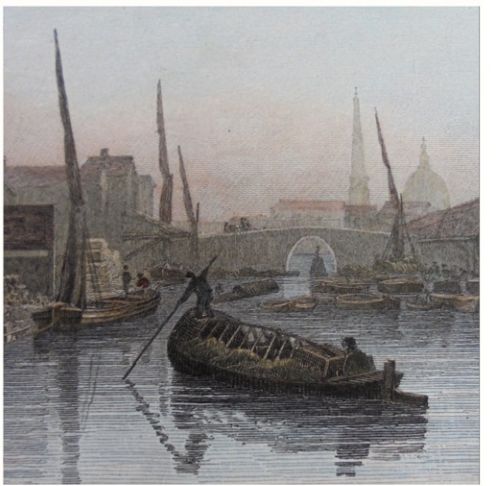
Regents Canal, London, Engraved by Charles Heath - 1825
Tuesday 18 January 1825
George Heath's Almanacs. Records of the Heath Family, Vol.1
To London. Overturned.
Saturday 19 February 1825
Charles Heath, 6 Seymour Place, London - to Dawson Turner.
My Dear Sir,
I enclose a Bill which if you can oblige me by discounting I shall feel obliged. You have no doubt been expecting the drawing of Puck for the last two months. The Plate is all done but the observations of the draftsman, Mr.Uwins who is and has been expected to return from Italy the last 4 months. If he does return in a week or so I must finish without him and then I shall immediately send you the drawing.
The third number of the London [Views in and about London] will be published on the last day of this month when I shall make up a parcel and enclose them for you. The large Proofs you have I will likewise compleat.
I have just begun a most splendid work from Turner the Academician. He is making me 120 drawings of England and Wales. I just got four and they are the finest things I ever saw - they cost me 30 gns each and I have been offered 50gns each by two or three different Gentlemen. The Drawings, what is very unusual they will yield a Profit as much as the Plates, they will be engraved the size of the coast work of Cooke's, anyone who has seen them says it will be the best and most lucrative speculation ever executed of that description. I mean to have them engraved by all the first artists. Messrs. Hurst and Robinson are to have the Drawings and half of the Profits at no risk.
I shall send you fine proofs of course of the whole work. The Art of Engraving never flourished as it does now - there is so much doing that very Engraver is full.
With best regards to all your Family.
Believe me Dear Sir, Yours most sincerely,
Charles Heath
Thursday 3 March 1825
George Heath's Almanacs. Records of the Heath Family, Vol.1
D. came home, measles.
Thursday 24 March 1825
George Heath's Almanacs. Records of the Heath Family, Vol.1
Julia measles; 28th -- very ill. 29th, better
Saturday 9 April 1825
Letter from Charles Heath to Mr.White.
In consideration of certain proof drawings, pictures etc, left in Mr.White's possession for the purpose of selling, he [Mr.White] has accepted the bills dated as under for the sum of £500 for the accommodation of proofs etc. etc. and Mr.C.Heath undertakes with Mr.White to renew such portion of the said bills as they become due as Mr.White has not sold property to meet.
Any proofs etc sent to Mr.White after this date are to be considered as part of this agreement. Mr.White to receive 10 per cent commission on the sale.
Charles Heath
Tuesday 12 April 1825
Charles Heath, 6 Seymour Place, London to Dawson Turner
My Dear Sir,
I have the pleasure of forwarding you by this days coast a Parcel containing various Proofs which I hope you will like. I send you the first three numbers of London on small paper which I think is best size to bind up. I shall of course complete your large India Proof copy 10 of which I believe you have. I have now upwards of 41 plates complete. I send you 4 Proofs from a Shakespeare I am about for Hurst and Robinson. They are not quite finished but only to show you the size of. I shall reserve you a complete set.
I must crave your indulgence a short time longer for the Puck as Messrs.Hurst etc. are unwilling to publish until Mr.Uwins has touched the Proof. I shall in my next parcel send you the first state for my ground work from Turner of England & Wales, 120 Plates to be engraved by all the first rate Artists.
I am most happy to inform you that the Provincial Bank of Ireland after appointing a committee to examine all the plans for Notes have adopted ours - and we are now making the Plates. The issue will be immense, some Millions in a few years.
We have likewise a new National Scotch Bank whose order is Five Hundred Thousand Notes and a Bank for Aberdeen about one hundred thousand. Besides many others of minor import.
I must likewise inform you we have had a forgery on us but as I have only just learned the particulars I must give you the details in my next. I will however just say it was on the Leeds Bank. We have 3 people in custody. It cost us they say 300 gns to engrave and took six months. This I think is greatly good proof how much safer our plan is. They have not opened 50 Notes consequently will be minus a large sum. We are making a new spare for the Bank. I told the Bank of Ireland Committee of this forgery notwithstanding which they did not hesitate a minute.
I take the liberty of again using your friendly aid, if you can cash the enclosed it will very much oblige me.
I hope all your Family are well. I beg [?] my best respects and remain Dear sir,
Yours most sincerely,
Charles Heath
P.S. The issuers of the forged Notes state they were obliged to gain twelve shillings for each Note.
Monday 25 April 1825
George Heath's Almanacs. Records of the Heath Family, Vol.1
Private road to Kitlands began
Perthshire Courier
The Directors of the Provincial Bank of Ireland have contracted with Messrs Perkins and Heath for their Bank note; who have engaged to forfeit the whole cost of the notes in circulation, amounting in value, probably to some thousand pounds, if a passable forgery of it is at any time made.
Tuesday 21 June 1825
Morning Herald (London)
The Late Robert Roy - A few remaining Prints of the engraving of J.Heath from the Portrait painted by Shee, of the above much-respected character, may be obtained of J.Baber, stationer, &c., No.227 Regent Street, near Maddox Street, at One Guinea and a Half each. - The Plate being destroyed, there will be no further opportunity for any of the numerous pupils of Mr.Roy to obtain a copy of this Memorial to him.
Friday 5 August 1825
New Times (London)
Dr.Southey's New Poem - In 1 vol. 12mo. with Plates, from designs by Westall, and engraved by Charles Heath, 10s.6d. bds.
A Tale of Paraguay. by Robert Southey LL.D. &c. &c., Printed for Longman, Hurst, Rees, Orme, Brown, and Green. - of whom may be had
The Poetical Works of Robert Southey LL.D. in 15 vols. 8vo. price 6d. bds. Or, separately, Roderick, the last of the Goths - - - continues.
Friday 19 August 1825
Morning Advertiser
The English and Bristol Channels Ship Canal Company
Yesterdays meeting of the subscribers to the above undertaking was held at the London Tavern, Bishopsgate Street. There were not more than one hundred gentlemen present. A considerable pause ensued, after which David Pollock Esq. was unanimously called to the chair.
The Chairman regretted that some person of more opulence and importance than himself had not been called upon to fill the situation which he then had the honour of filling; but this was accounted for by the season of the year. This was the first meeting since the passing of the Act of Parliament, and it was the earliest day, consistent with the Act of Parliament that it could possibly be held. He then referred to the opposition that had been made to the present undertaking. The amount of capital to be raised was 1.750,000/., and until that sum was raised, the operative part of the concern could not go on according to the terms of the Act of Parliament; but the preliminary matter, such as appointing Directors, might be proceeded in. He would, therefore, now, under the terms of the Act of Parliament, proceed to appoint fifteen Directors.
After some remarks, the Chairman proposed the following fifteen gentlemen as Directors:-
Alex. Baring Esq.,M.P., John Bent Esq., M.P., David Pollock Esq., William Hanning Esq., The Rev.Dr. Palmer, Stephen Pitt Esq., George Heath Esq., Robert Colmer Esq., .... continues...
Thursday 1 September 1825
George Heath's Almanacs. Records of the Heath Family, Vol.1
Pond (at Kitlands) finished.
Saturday 24 September 1825
British Press
Insolvent Debtors' Court. Sept.22
Alex. Solomon, alias Slowman, who originally stood opposed by several creditors of the Jewish persuasion, came up to be finally heard in the matter of his petition.
After the report of the Provisional Assignee, Mr.Dance, (to whom all matters in dispute had been referred) had been read, an altercation arose as to the qualification and appointment of an assignee under the insolvent's estate, when a person of the name of Levy applied to the Court to fulfil that office, and was opposed by Mr.Heath, when the following curious dialogue took place:-
Mr.Cooke - When did you take the benefit of the Act?
Mr.Levy - Eight years ago.
Mr.Cooke - Are the debts in your schedule paid?
Mr.Levy - My brother-in-law paid them, and for which I married his sister. (Much laughter.)
Here a dispute arose between the Learned Counsel (Mr.Heath) and Mr.Norton, the insolvent's attorney as to the amount of the debt claimed by the creditor, who Mr.Norto was dictating to, against whose interference Mr.Heath objectged.
Mr.Norton - You are always snapping at me. I have as much right to do my duty to my client as you have, and I will.
Mr.Heath - You are insolent -
Mr.Norton - I am no more insolent to you than you are to me.
Chief Commissioner - I am surprised, Mr.Heath, that you should condescend to hold any argument with -
Mr.Norton - I am as respectable as Mr.Heath.
Mr.Heath was silent, and the dispute terminated.
Thursday 29 September 825
British Press
Insolvent Debtors' Court. Sept.28
Walter McGregor Logan, a music arranger, was opposed by Mr.Heath, on behalf of Messrs. Welsh and Hawes, music sellers, of the Argyll Rooms.
The insolvent, in his examination, stated that although he was a music arranger, he neither taught nor played, nor did he compose music.
Two years and a half ago, he hired a pianoforte from the opposing creditors, Messrs Welsh and Hawes. He disposed of the instrument, but did not know who purchased it, It was sold at an auction room in Vere Street. He never pledged it nor pawned it, but he once lent it for two or three days to a person of the name of Goadby, who resided in Poland Street. This person taught music. He let him have it for a loan of money; the sum he received was 8/. He left it as a sort of pledge
Mr.Heath - I call that pawning. Pray, Sir, don't you?
Insolvent - Allowed.
Mr.Heath - No affectation, Sir, if you please. Answer me - "Yes" or "No."
Insolvent - I did not know that you were not aware of the meaning of the word "allowed."
Mr.Commissioner Harris admonished the insolvent to be more careful of his language.
The insolvent continued. About six weeks after the hire of the piano Mr.Hawes told him that he might keep it, and set off the price of it against what was owing to him for arranging music. Mr.Hawes did not fix a price, but he was then in the insolvent's debt for arranging the music in Der Freischutz.
Mr.Goadby, at this period, entered the Court: and the insolvent was asked whether it was to that gentleman he lent the piano for a sum of money.
The involvent replied that that was not the Mr.Goadby. The person to whom he alluded he met at the Hole-in-the-Wall tavern, and had not seen him since. He should be able to point out his house in Poland Street, but did not know the number.
Mr.Goadby was then examined, and stated that he was acquainted with the insolvent about two years ago. He (Mr.Goadby) then lived in Poland Street. He had a conversation with him in the month of March 1824; and the insolvent then said he had pawned the pianoforte, and showing him a duplicate for 8/. It was a regular pawnbroker's ticket,and not a private one.
John Wright stated that he was manager of the firm of Messrs. Welsh and Hawes, of the Argyll Rooms. The pianoforte in question was hired by the insolvent in September 1823, and was not purchased; if it had been ever purchased he should have been aware of the circumstance, as all purchases were made exclusively through him.
In the month of April last the insolvent came to him, and asked for his bill for the hire of the piano, which he then promised to return, but never said he purchased it, or that any arrangement with reference to its purchase had been made between him and Mr.Hawes. He said, however, that he meant to set off his account for arranging music against the bill for the hire.
Mr.Hawes was now on a visit to the Duke of Argyle, or he would have been in Court. Every arrangement relative to the business at the Argyll Rooms was made through him.
The insolvent said that Mr.Wright had nothing to do with the settlement for arranging Der Freischutz.
Mr.Wright replied that he had written out a check for the amount.
The insolvent asserted that the check was written out by Mr.Hawes himself, in his presence. The only conversation that had occurred between him and Mr.Wright, in April last, was a request that a bill of what he owed might be made out, and sent to his lawyer. He would not swear to this. He continued on good terms with Mr.Hawes, until Der Freischutz was performed at the English Opera House. Mr.Hawes offered to make up matters with him, when in prison, and employed for the purpose that person (pointing to one of the attorneys of the Court.)
The Attorney denied that he knew any thing of such a transaction.
The Insolvent - Oh! that is not the person.
Mr.Commissioner Harris - We are trying a collateral issue. The only question for the Court was, whether the pianoforte was purchased or not.
Mr.Heath, on the part of the opposing creditors, contended that a Jury would not believe the statement of the insolvent, contradicted as it was by two respectable witnesses - one of whom had distinctly sworn that he had see the pawnbroker's ticket for the piano; and the other, that no sale of the piano had ever taken place.
Mr.Pollock, who supported the insolvent, argued, that, notwithstanding what the witnesses had sworn, it was by no means impossible that some arrangement relative to the purchase of the piano had been made between Mr.Hawes and the insolvent. The Court could scarcely believe that Mr.Hawes never transacted any of his business without the knowledge of Mr.Wright.
Mr.Commissioner Harris said it was impossible that the Court could remand the insolvent. A debt it appeared had been claimed by him for arranging music, and from him for the hire of a pianoforte; and where such disputes occurred, the Court would be doing too much in remanding a debtor for having committed a fraud - in the absence of satisfactory evidence.
If Mr.Hawes had been present, the case might have been different; but as it now stood, it was wholly out of the power of the Court to remand the insolvent.
The insolvent was therefore discharged.
Mr.Heath observed that if Mr.Hawes pleased, he might make an affidavit contradicting the statement of the insolvent, and the order for his discharge would be revoked.
Mr.Wright replied that Mr.Hawes would certainly do so.
Thursday 3 November 1825
British Press
Insolvent Debtors' Court, Wednesday Nov.2
Charles Steward, the younger, riding-master, residing in the neighbourhood of Blackfriars Road, was brought up on his petition to be discharged.
He was opposed by Mr.Cook who appeared for several creditors.
It appeared the insolvent, after being in custody for three months, produced a certificate of ill health from a physician, which induced the Court to grant an order allowing him the liberty of the Rules of the King's Bench, in which prison he was confined. It was now stated that he had broken prison by entering the Surrey Theatre and an adjoining coffee-house, by which he lost his claim to take the benefit of the Act, neither of those buildings being within the Rules. - - -
The Commissioner said it was possible the insolvent may have been indiscreet enough to enter the theatre; and if such an act had been distinctly proved he should be disposed to construe the Act strictly and reject the insolvent's petition. But the evidence on this point was by no means satisfactory, for the witness could not fix the precise period he saw the insolvent near the theatre - - -
Mr.Cook thought the conduct of the father was by no means creditable. He allowed the son to contract debts for the benefit of an establishment of which he described himself as the sole proprietor, and then disclaimed the debts. He also gave his son the unlimited control of the establishment whilst those debts were being contracted, and then found it convenient to resume possession. - - -
Mr.Heath, for the insolvent, submitted that there was no evidence of partnership between the insolvent and his father.
The Commissioner did not conceive that sufficient evidence have been adduced to fix a fraudulent intention upon the insolvent. His proceeding in bringing the writ of error, however, was extremely reprehensible; and under the discretion which the 18th section of the Act gave on this point; his judgment was, that the insolvent should not be discharged until he had remained in prison for three months after the filing of his petition.
Sunday 27 November 1825
Johnson's Sunday Monitor.
Price 12s. illustrated by several splendid Engravings.
The Amulet.
Or, Christian and Literary Remembrancer.
A Work, on the plan of the German Litarary Almanacks, combining Religious Instruction with Literary Amusement, and forming a beautiful and interesting Christmas Present, or New-year's Gift. The volume will contain sixty original tales, descriptions, essays, or poems, communicated by above forty eminent authors, - - - -
No expense has been spared to render the volume in every department as perfect as possible; the designs (twelve in number) are by Martin Westall, Corbould, Wright, Brooke, Stephens &c., and the Engravings by Heath, Finden,Mitchell, Melville, Roberts &c.
London; Printed for William Baynes and Son, Paternoster Row,and H.S.Baynes, Edinburgh.
Monday 5 December 1825
Charles Heath, 6 Seymour Place, Euston Square, London to Dawson Turner
My Dear Sir,
I write not knowing whether you are at Yarmouth or not but should wish you to drop me a line when you do return as I have a parcel all ready which I think it better not to send till you are in the way.
With best respects to yourself and family.
I remain Dear Sir, Yours most truly,
Charles Heath