Michael D.Heath-Caldwell M.Arch.


Michael Heath-Caldwell M.Arch
Brisbane, Queensland
ph: 0412-78-70-74
alt: m_heath_caldwell@hotmail.com
- Home
- Architectural Projects 0
- Architectural projects 1
- Architectural Projects 2
- Architectural Projects 3
- Architectural Projects 4

- The Crystal Palace
- Timeline
- 1693
- 1745
- 1770
- 1783
- 1784
- 1785
- 1786
- 1788
- 1789
- 1791
- 1792
- 1793
- 1794
- 1795
- 1796
- 1797
- 1798
- 1799
- 1800
- 1801
- 1802
- 1803
- 1804
- 1805
- 1806
- 1807
- 1808
- 1809
- 1810
- 1811
- 1812
- 1813
- 1814
- 1815
- 1816
- 1817
- 1818
- 1819
- 1820
- 1821
- 1822
- 1823
- 1824
- 1825
- 1826
- 1827
- 1828
- 1829
- 1830
- 1831
- 1832
- 1833
- 1834
- 1835
- 1836
- 1837
- 1838
- 1839
- 1840
- 1841
- 1842
- 1843
- 1844
- 1845
- 1845-46 Oxford
- 1846
- 1847
- 1848
- 1849
- 1850
- 1851
- 1852
- 1853
- 1854
- 1854/55 Appendix
- 1855
- 1856
- 1857
- 1858
- 1859
- 1860
- 1861
- 1862
- 1863
- 1864
- 1865
- 1866
- 1867
- 1868
- 1869
- 1870
- 1871
- 1872
- 1873
- 1874
- 1875
- 1876
- 1877
- 1878
- 1879
- 1880
- 1881-1
- 1881
- 1882
- 1883
- 1884
- 1885
- 1886
- 1887
- 1888
- 1889
- 1890
- 1891
- 1892
- 1893
- 1894
- 1895
- 1896
- 1897
- 1899
- 1900
- 1901
- 1902
- 1903
- 1904
- 1905
- 1906
- 1907
- 1908
- 1909
- 1910
- 1911
- 1912
- 1913
- 1914
- 1915
- 1916
- 1917
- 1918
- 1919
- 1920
- 1921
- 1922
- 1923
- 1924
- 1925
- 1926
- 1927
- 1928
- 1929
- 1930
- 1931
- 1932
- 1933
- 1934
- 1935
- 1936
- 1937
- 1938
- 1939
- 1940
- 1941
- 1942
- 1943
- 1944
- 1945
- 1946
- 1947
- 1948
- 1949
- 1950
- 1951
- 1952
- 1953
- 1954
- 1955
- 1956
- 1957
- 1958
- 1959
- 1960
- 1961
- 1962
- 1963
- 1964
- 1965
- 1966
- 1967
- 1969
- 1971
- 1974
- 1975
- 1976
- 1979
- 1983
- 1990
- 1991
- 1998
- 2001
- 2002
- 2004
- 2005
- 2006
- 2007
- 2008
- 2009
- 2010
- 2011
- 2012
- 2013
- 2014
- 2015
- 2016
- 2017
- 2018
- 2019
- 2020
- F.C. Heath-Caldwell
- C.H.Heath-Caldwell Memoirs
- Palmer Family
- Palmer Timeline
- 1912 - Palmer
- 1914 - Palmer
- 1916 - Palmer
- 1918 - Palmer
- 1919 - Palmer
- 1924 - Palmer
- 1925 - Palmer
- 1926 - Palmer
- 1929 - Palmer
- 1932 - Palmer
- 1934 - Palmer
- 1936 - Palmer
- 1938 - Palmer
- 1939 - Palmer
- 1944 - Palmer
- 1946 - Palmer
- 1961 - Palmer
- 1967 - Palmer
- 1970 - Diary - Joe Palmer
- 1971 - Diary - Joe Palmer
- 1972 - Diary - Joe Palmer
- 1991 - Diary - Joe Palmer
- 1992 - Diary - Joe Palmer
- 2010 - Diary - Joe Palmer
- Venice Earthquake 1873
- Old Letters 1
- Old Letters 2
- Old Letters 3
- Old Letters 4
- Old letters - Mid 1800
- More Old Letters
- Eaton Hall, 1943
- Marsh Family Timeline
- James Caldwell papers 1
- James Caldwell papers 2
- James caldwell papers 3
- Old letters 1800s
- Old Letters 1800s 2
- HH Sultan Taimur bin Turki 1913
- Frank Featherstone Wright 1921-2014
- Frank F. Wright 1
- Frank Featherstone Wright early
- Frank F. Wright 2
- Frank F. Wright Videos
- Old Featherstone album 1
- Old Featherstone album 2
- Old Featherstone album 3
- Old Featherstone album 4
- Old Featherstone album 5
- Arthur Eversfield Featherstone Album 1
- Arthur Eversfield Featherstone Album 2
- Arthur Eversfield Feartherstone Album 3
- Grasmere
- Frank E Wright Album 1a
- Frank E Wright Album 1b
- Frank E Wright Album 1c
- Frank E Wright Album 1d
- Frank E Wright Album 1e
- Frank E Wright Album 1f
- Frank E Wright Album 1g
- Frank E Wright Album 2a
- Frank E Wright Album 2b
- Frank E Wright Album 2c
- Frank E Wright Album 2d
- Frank E Wright Album 2e
- Frank E Wright album 2f
- Frank E Wright Album 2g
- Frank E Wright Album 2h
- Frank E Wright Album 2i
- Frank Edward Wright drawings
- Cathy Featherstone 1910a
- Cathie Featherstone 1910b
- Norma Featherstone 1913
- Norma Featherstone Part2
- Norma Featherstone Part3
- Norma Featherstone Part4
- Norma Featherstone Part5
- Kitlands House
- Moorhurst Manor
- Redlands House
- Milland House
- Anstie Grange
- Ebernoe House
- West Ham House
- Vigo House
- Linley Wood
- Crimean War
- James Caldwell letters 4
- James Caldwell letters 5
- James Caldwell letters 6
- James Caldwell letters 7
- James Caldwell letters 8
- James Caldwell letters 9
- Eton & Oxford 1830/40s A
- Eton & Oxford 1830/40s B
- Eton & Oxford 1830/40 C
- Eton & Oxford 1830/40 D
- Eton & Oxford 1830/40 E
- Eton & Oxford 1830/40 F
- Back in England. Early 1800s
- Arthur Heath 1872-4
- Sicily 1800
- Naples - 1830
- Trentham Hall
- Paris 1810
- Cromptons on the Lusitania
- HMS Illustrious 1948
- The Minoans
- Henry Crompton 1836-1904
- Orongorongo 1957
- Another Page
- Gertie Wheeler 1909
- The Ahsan Manzil
- More old letters 1800s
1823 - 1824 - 1825
-----------------------------------------------------------------
James Heath R.A. aged 66/67
Mary Heath (ne Phillipson) aged 66/67
George Heath aged 44/45
Anne Raymond Heath (ne Dunbar) aged 36/37
Julia Anna Harrison (ne Heath) aged 16/17
John Moore Heath aged 15/16
Douglas Denon Heath aged 12/13
Dunbar Isidore Heath 8/9
Leopold G. Heath 6/7
Emma Jane Whatman 2/3
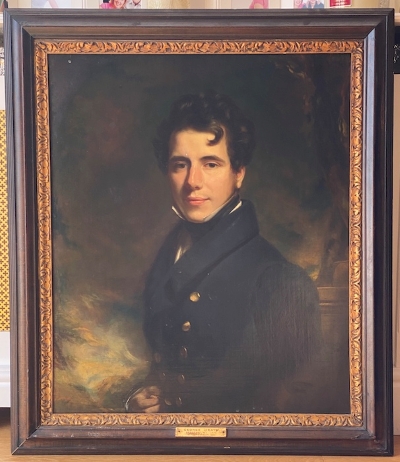
George Heath
The Heath Family Engravers 1779-1878, Volume 2. James Heath A.R.A. by John Heath
The Works of Benjamin Franklin - two plates engraved by James Heath after G.Hughes, published by W.Baynes ad Son, and others. Published in the Dove's English Classics Series
1. - Frontispiece: 'When they were about to satisfy their hunger...' - plate size 8 x 6cm.
2. - Title page: 'But if when the Husband rises in the morning...' plate size 6 x 6cm.
--------------------------------------
Young's Night Thoughts, or The Complaint - Two plates engraved by Charles Heath after Henry Corbould - published by W.Baynes and Son, and others. Published in Dove's 'English Classics series, and reprinted in 1845 by Thomas Allman.
1. - Frontispiece: 'What numbers...' - plate size 8 x 6cm.
2. - 'Warning for less...' - plate size 6 x 6cm.
--------------------------------------
Roderick, the Last of the Goths (Robert Southey) - Six plates engraved by Charles Heath after Richard Westall R.A.- published by Longman, Hurst, Rees, Orme and Brown.
1. - 'Before the cross...' - plate size 9 x 7cm.
2. - 'Well it was...'
3. - To Roderick then...'
4. - 'His loose robe this day...'
5. - 'Behold the man...'
6. - 'With firm ese...'
--------------------------------------
Illustrations to Irish Melodies (Thomas Moore) - six plates engraved by Charles Heath after Thomas Stothard R.A. - published by Robert Jennings and S.Robinson. The Balmain copies are marked (in pencil) 'never published.'
1. - 'Come send round the wine...' - plate size 10 x 7cm
2. - Come rest in this bosom...'
3. - But while o'er the roses...'
4. - 'Rich and rare...'
5. - 'Oh the heart that has truly loved...'
6. - 'Beauty lies...'
--------------------------------------
Gems of Devotional Poetry - Engraved by Charles Heath after Thomas Stothard R.A. - published by Thomas Tegg.
1. - Title page - plate size 7 x 6cm - Dated 'Sept 1824.'
--------------------------------------
Gems of Lyric Poetry - engraved by Charles Heath after Thomas Stothard R.A. - published by Thomas Tegg.
1. - Title page - plate size 7 x 6cm. - dated 'Sept 1824.'
--------------------------------------
Poetical Sketches (Alaric Watts) - Two plates engraved by Charles Heath after Thomas Stothard R.A. - published by Hurst, Robinson.
1. - Frontispiece: 'Then they fling the snow-white veil aside...' plate size 9 x 7cm.
2. - 'Upon his brow the damps of death...'
--------------------------------------
The Improvisatrice and other Poems (L.E.L.) Laetitia Landon) - Four plates engraved by Charles Heath after J.M.Wright - published by Hurst, Robinson. There was 'A New Edition'in 1831. 'L.E.L.' was editress of Heath's Book of Beauty' from 1833 until her death in 1838. Disraelie described Miss Landon rather unkindly as 'the snub-nosed Brompton Sappho.'
1. - Frontispiece: 'He heard her prayer...' - plate size 9 x 7cm.
2. - no caption
3. - Rosalie.
4. - no caption
--------------------------------------
Tales of a Traveller (Washington Irvine) - Five plates engraved by Charles Heath after Thomas Stothard R.A. - published by John Murray.
1. - no caption - plate size 10 x 8cm
2. - German student.
3. - The Young Italian
4. - Wolfart Webber, or Golden Dreams.
5. - The Bold Dragoon.
--------------------------------------
Poems (Samuel Rogers) - Six plates engraved by Charles Heath after Richard Westall R.A. - published by Hurst Robinson.
1. - 'Oft as he turned...' - plate size 9 x 7cm - oval prints
2. - 'Want with her babes...'
3. - 'So thro' the grove...'
4. - 'Her sense had fled...'
5. - 'If o'er the mead...'
6. - 'Flies from her home...'
--------------------------------------
A Critical enquiry into Ancient Armout (Samual R. Meyrick) - Three plates engraved by Charles Heath after H.Bridgens - published by R.Jennings.
1. - Frontispiece. - plate size 9 x 18cm.
2. - Vol.II
3. - Vol.III
--------------------------------------
Separate print - engraved by Charles Heath "Shakespeare."
Sunday 4 January 1824
Englishman
Insolvent Debtors' Court - Saturday
Edward Harrold was opposed by Mr.Heath for a creditor named Rowland. The insolvent stated that he kept the Wrekin Tavern previous to Michelmas, 1821, when he went to live in King Street, and became a wine-merchant. In two years, between 1821 and 1823 his law expences, in defending various actions, amounted to £300/. In the year 1817 he had a prize in the lottery of £1,000/. with which he commenced business. His books contained an account of every sixpence he had received and paid.
Mr.Heath having proceeded so far in the insolvent's examination, declined any further opposition, and the insolvent was discharged forthwith.
Wednesday 21 January 1824
Morning Herald (London)
Insolvent Debtors' Court - Tuesday
Edward Williamson Hay was opposed by Mr.Pollock, on the ground of having incurred debts to a large amount, without any reasonable means or prospect of paying the same. It appeared that he had held a situation as clerk in the War-Office, with a salary of £130/. a year; that in 1821, he had got considerably in debt, and that then his father made a composition with the creditors by paying them ten shillings in the pound.
The insolvent then had his clear salary of £130/. to live on, but instead of confining himself within that income he kept his country home, his horse and gig; and since the composition in question got again in debt to the extent of £900/.
The Chief Commissioner commented with great severity on this unjust and extravagant conduct, and sentenced him to be confined within the walls of the prison for the space of twelve calendar months.
Samuel W.D.Fores was opposed by Mr.Heath. The insolvent had been collecting clerk at Messrs. Champion and Green, vinegar-merchants. In the month of September last those gentlemen found that he was very backward in settling his accounts, and therefore they began to suspect that he had been embezzling their property. When he was closely questioned respecting the monies he received, he confessed that he had received £338/. which he had not accounted for. After that he acknowledge to having kept back one hundred and fifty pounds more. In the month of May last, when his employers had no suspicion of him, they took a bond of security from his father and brother to the amount of £400/. Upon this bond they had since recovered a verdict, subject to a reference, and part of the £400/. was paid. From these circumstances, it was contended by the Learned Counsel that the insolvent had been guilty of embezzlement, and must undergo the punishment provided by the Act.
Mr.Pollock, on behalf of the insolvent, submitted that the opposing creditors had waived their right of opposition on the ground of fraud by the compromise they made with the father and brother.
The Court observed that judgment could not then be pronounced in this case on account of certain affidavits that still remained to be filed; but at the same time conceived that even in this stage it was proper to give an opinion respecting the insolvent's conduct. - - - The present was a case of great enormity; and in such a case the Court was bound to notice it in a way that should be inflicted on this insolvent; but it was necessary that their opinion should be thus stated generally. The insolvent was ordered to be brought up again on the 2nd of February.
- - - - -
William Cozens was opposed by his detaining creditor, Mr.Henry Easton, a Solicitor, who claimed a debt against him of £58/. Being asked when he found himself insolvent, he said in the beginning of 1823. - - - He never put off any of his creditors by saying he had not received his rents. He had bailed a debt in June or July last for Thomas Thurtell; perhaps he might have bailed within three months. He had been bail for Thurtell in about five or six months, amounting altogether to £100/. He was not bail for him on the misdeamour. Being asked when he had been bail for Mr.Noyes -
Mr.Heath objected to the question, unless the bail-bond was produced.
Mr.Easton then produced a paper, proving the fact of the insolvent having bailed Noyes. Mr.Eaton then proceeded to state that he had called on the insolvent at Kensington three months ago, when his shop appeared to have a great quantity of goods in it. - - -
The insolvent being questioned by his Counsel, Mr.Heath, said the debts he now owed amounted to £300/.and the debts owing to him were £170/. He said when Mr.Eaton applied for a part of his bill, he promised to let him have some money at Christmas. This was in the beginning of November; but about the 17th Mr.Eaton took out a writ and locked him up. He had goods and cash of the insolvent to the amount of from £26/.to £30/. When arrested he had no notion of taking the benefit of the Act. He sustained great loses by means of the parties who had been mentioned, and Mr.Eaton knew that.
The Chief Commissioner said there was nothing under the Act in this case, but it would be necessary for the insolvent to amend his schedule, by giving an account of his furniture, and showing that it belonged to Dr.Stenson.
Mr.Eaton - Sir, if that had been set forth in the schedule, I should not have come here to oppose the insolvent.
Commissioner - Mr.Easton, your conduct in this business is perfectly correct.
Sunday 25 January 1824
Englishman
Insolvent Debtors' Court, Jan 19
The Metropolitan Society for the Opposition of Fraudulent Insolvent Debtors against William Perch.
The insolvent was brought up for examination so far back as the18th of September last, when he underwent a long examination. His discharge was opposed by Mr.Heath, standing Counsel of the Society, on behalf of Messrs.Richards and Son, distillers, under the17th section of the Act, for having fraudulently made away with, or concealed property - the charge of concealment applying to the sum of £95/. 14s.4d. in money; and 2dly, to furniture of the estimated value of £400/.
The insolvent, as would appear from his original examination, had formerly kept the Bull Inn, Gray's Inn, which he quitted on the 28th of May last when he received from his brewers, Messrs. Elliot and Co £110/.13.10d. as balance due to him as out-going landlord. On the 3d of June following, the opposing creditors received a circular, calling on them to attend a meeting of his creditors, to which no attention as paid. - - -
The insolvent appearing in Court.
Mr.Heath, the Counsel for the Metropolitan Society, requested the Court to review their notes, before he proceeded to make observations and pray judgment. He observed, that the rule Nisi had been granted on a side wind application, in which the Courft concurred. Mr.H. then proceeded to inquire of the insolvent whether he could give the number of a £50/. note he said he had paid away, when first examined.
The Insolvent could give no satisfactory information.
Mr.Heath: Oh, here is an insolvent who appears to know nothing about his affairs, although he formerly attempted to give an explanation; it therefore only remains for me to second his application for judgment, and I do hope that it will be commensurate with the extreme power vested in that Court. The Learned Gentleman submitted to the Court, that the application of the Court was a novel one - he had been interrogated as to the disposition of property amounting to upwards of £500/. He had attempted to give a feigned account of it, and the Court would judge whether or not the account was not properly designated by his subsequent conduct. The insolvent, instead of coming forward and acknowledging the error he had committed, prayed the judgment of the Court with the weight of all the uncontradicted facts upon his shoulders. The application, he would repeat, was novel, and it was for the Court to consider whether they were bound to pass a judgment on a voluntary application. After referring to the Act, he put it to the Court whether it was bound to adjudicate on an insolvent's case when they were no satisfied with the schedule and papers connected with it.
He (Mr.Heath) would not trouble the Court on this point, as a case was clearly established against the insolvent, which merited the severest judgment under the most penal clause of the Act - it was quite obvious that the insolvent had concealed property of which he had not condescended to give an account which was stamped by truth, or even probability; the insolvent had, however, sworn to certain things, and he must take the chance of all the consequences which might hereafter arise from his temerity.
Mr.Cooke, for the prisoner, submitted that no evidence had been adduced which fixed the insolvent with having concealed property.
Mr.Heath said, that his friend appeared to have misconceived the Act - a clearer case of concealment had never appeared. The insolvent had, by signing a public document, acknowledged the furniture (to say nothing about the money) to be his on the 13th June, and on the 17th it was transferred to Miss Sabing. It was to be observed, and he (Mr.Heath) wished it to be generally known, that persons concerting with an insolvent to conceal property, were liable to three years imprisonment and hard labour.
Chief Commissioner: Let this man be sworn.
This being done, and the warrant of attorney signed, the Learned Commissioner proceeded to pass judgment, and expressed himself in nearly the following terms:-
The Court has given this man every possible opportunity by which he might avail himself of the means of exhibiting to the Court the mode in which he had conveyed away certain property, respecting which he had been interrogated so as to give at least some satisfaction to his suffering creditors. Instead of this he remains silent, and now comes up and prays the Court to pronounce judgment. - - - His conduct has been extremely wicked, and his frauds deliberate and persisted in, consequently it would be a waste of time to dilate upon it; therefore all they could do was to pass the judgment, in which there an unanimous concurrence, viz.- That the insolvent should not be discharged from custody, or receive any benefit or protection under this Act, until he shall have remained in custody at the suit of his detaining and opposing creditors, for a period not exceeding Three Years from the date of filing his petition, and that he be during such period confined within the walls of the prison, and deprived of rules and day-rules, for having fraudulently made away with his property with a view to defraud his creditors.
Tuesday 3 February 1824
Morning Chronicle
Insolvent Debtors' Court. - Monday
Thomas Walter, an elderly man of respectable appearance, came up to be heard on his petition to be discharged, and was opposed by Mr.Heath, for Mary Walter.
Mr.Pollock, who was Counsel for the insolvent, stated to the Court that there was but one creditor, named Mary Walter, in the insolvent's schedule, and she was his wife. He submitted to the Court that a wife could not oppose her husband's discharge.
Mr.Heath said the facts of the case were, the wife had sued the insolvent in the Consistory Court of Litchfield, for alimony, and obtained a decree of that Court of Litchfield, for alimony, and obtained a decree of that Court against him., and if she could not oppose his discharge, that decree would be a nulity; besides the insolvent had inserted his wife's name in the schedule as a creditor, from whose claim he sought to be discharged - let him strike out her name, and the opposition would be given up.
The Court asked Mr.Heath whether a wife could oppose her husband's discharge for having contracted a debt fraudulently with her?
Mr.Heath said, the opposition in the present case merely referred to the insolvent's property, not to any fraud in contracting the debt. He would be equally satisfied to have the wife's name left out of the schedule.
Mr.Pollack said the Act of Parliament would not permit the insolvent to omit his wife's name in his schedule, even if he were willing to do it.
The Court referred to the Act of Parliament, by which it appeared, that an insolvent was required to insert in his schedule "the names of all persons to whom he was indebted, or who to his knowledge or belief claimed to be his creditors."
The Chief Commissioner said, it appeared to him, that under the words of the Act, the insolvent was bound to insert in his schedule the name of his wife, who had sued him in a court of competent jurisdiction, and obtained its decree for a debt against him; and her name being properly inserted in his schedule as a creditor, it was competent for her so far to oppose his discharge, as to obtain satisfaction on the subject of his property; if Mr.Pollack thought otherwise, the Court would be glad to hear him argue the point.
Mr.Pollock declined entering into any argument.
Mr.Heath then moved, that the case should be referred to the Provisional Assignee of the Court for investigation, to report thereon to the Court. The motion was granted as a matter of course.
Tuesday 3 February 1824
Morning Herald (London)
Insolvent Debtors' Court
Thomas Walter came up to be heard on his petition to be discharged, and was opposed by Mr.Heath, at the instance of Mary Walters, his wife, on the ground that he had not conformed with the terms of a certain decree issued by the Ecclesiastical Court for the payment of a certain sum at specific periods by way of alimony. The Learned Counsel observed that he should not pursue his instructions further than to pray that the Insolvent's case might be referred to Mr.Dance, the professional assignee of the Court, for investigation.
Mr.Pollock, for the insolvent, wished to know by what law a wife had power to imprison her husband for a debt.
Mr.Heath explained that his client was not the person at whose suit the insolvent was detained.
Mr.Pollock - Be it so: yet if any doubt exist, she might have been a detaining as well as an opposing creditor.
Mr.Heath submitted to the Court that if a decree has issued in favour of a wife, she was entitled by law to sue for her alimony, and the party liable to pay having giving notice of application to the Court, she had a right to come pro tanto, and recognise her claim, and this she might do either by her proctor or her next friend.
The Court intimated that this insolvent had admitted the claim in a certain degree; hence the creditor was entitled to come in.
Mr.Heath said he only prayed a reference to inquire as to property supposed to be in his possession, which would enable him to discharge his client's claim. He would, however, consent that the defendant should be struck off the schedule.
Mr.Pollock said this could not be consented to, inasmuch as the insolvent was bound to swear that it contained every demand to which, in law or conscience, he thought himself liable.
After a long desultory conversation, the Court referred the case to be investigated by Mr.Dance, pursuant to the prayer of Mr.Heath.
Sunday 8 February 1824
Englishman
Insolvent Debtors' Court - Saturday
Lewis Solomon, a jew slop-seller, in Chatham, was opposed by Mr.Heath, for Messrs Harris and Co., hat manufacturers, in London, and Green and Co., soap-makers, in Chatham. The Insolvent stated, that he followed business in Chatham for some years previous to September last, when he assigned his stock over to his brother, a navy agent, by whom the business is continued. The soap he ordered from Green and Co. was intended for Captain Thompson, but he having sailed without it, the insolvent was then obliged to see it to another.
Mr.Green stated, that the insolvent purchased from him five hundred of soap, for which he promised to pay ready money, as no credit would be given him. He told witness, at the time of making the purchase, that it was for Captain Thompson, of the Brisk, then in the river, and two days after, the Brisk having sailed in the meantime, that Captain Thompson had taken the soap and other goods, to the value of £200/. without paying for them. -
Another witness proved that the insolvent sold the soap to a person in Chatham, under price, the moment he received it.
Mr.Harris proved that the insolvent kept a box of hats, which had been sent to another customer at Chatham, and directed to the insolvent by a mistake, after credit had been refused him, and while his acceptance was lying unpaid in Mr.Harris's hands.
The Court said the insolvent's conduct was clearly that of the grossest swindling, and remanded him for 14 months to be confined within the walls of a prison
- - - -
William Twight was opposed by Mr.Heath on behalf of several creditors. It appeared by the insolvent's statement, that previous to the month of April 1822, he carried on the oil trade in King Street, Covent Garden. In that month he was arrested and remained a prisoner in the King's Bench till September following, when he obtained his discharge by compounding with his creditors. - - - The Court would not allow the case to proceed till the insolvent should file a new balance sheet, stating the several sums of money he had omitted, and accounting for their expenditure.
Thursday 12 February 1824
New Times (London)
Insolvent Debtors' Cour, Feb.11
The following insolvents were discharged without opposition, viz.:-- Ann Groucock, G.Howford, J.Graham, J.R.Widgnall, A.Simpson, and L.C.Hollis.
Important Decision for the Protection of the Attorneys of the Court.
John Adolphus Moore, who was discharged in October last, renewed his application, and was opposed by Mr.William John Carpenter, one of the Attorneys of the Court, and the only creditor on the insolvent's schedule.
Mr.Heath stated to the Court that he appeared on behalf of Mr.Carpenter, whose ground of opposition was the non-payment of costs connected with the insolvent's prior application. He apprehended that the Courts would decide the case in such manner as would effectually protect the Attorneys of the Court against attempts like the present to oust them of their costs. This case was a strong one; for Mr.Carpenter had entered an action for the balance of his account in the Palace Court, when judgment went by default, and a verdict given for £11/. and upwards of costs, on the taxed bill allocator being produced.
He (Mr.Heath) had been informed that the defence intended to be set up on the present occasion was, that Mr.Carpenter had contracted to transact his business for £6/. £3/. of which, however had only been paid. If the insolvent had any defence to make, why had he not offered it in the Palace Court? He contended that the Court could not consider this a second application arising from unavoidable misfortune - hence he prayed that the petition might be dissolved. He further wished to remind the Court that the insolvent had £80/. a year as half-pay, hence he had no reasonable plea f poverty.
Mr.Carpenter deposed that he was an attorney of the Court, and as such transacted the insolvent's business, and obtained his discharge in the autumn of last year. He denied having made any contract - the agreement was, that the insolvent should pay £6/. on account, and the balance when his half-pay because due; the insolvent afterwards requested that he (Mr.C.) would receive £3/. in part, and let the other remain until Half Quarter-day, which witness acceded to; this was all he received, although his bill was taxed by the Officer of the Court, at £14/.2s.1d. The insolvent not offering to settle the account, he proceeded to the Palace Court, of which he was not an attorney, after which a tender was made of £5/. and costs, by a person of the name of Montriou.
By Mr.Pollock - The taxation was ex-parie, as was always the case, unless notice was required on the other side. Mr.Pollock was about to examine the insolvent, when -
The Chief Commissioner inquired how he could succeed successfully to the teeth of the verdict. If the Court were to deviate from the rule laid down, they would thereby act with cruelty towards every insolvent, for no attorney would be found to do their business; the consequences of which was obvious.
Mr.Pollock said he was prepared to prove that a contract had been made by Mr.Carpenter, and a subsequent tender on the part of the insolvent.
The Court intimated that they would hear evidence, and then it would be for them to judge whether any reason was assigned to induce them to deviate from established usage.
Thursday 15 April 1824
Charles Heath, 6 Seymour Place, London to Dawson Turner.
My Dear Sir,
I enclose a bill on Messrs. Hurst, Robinson & Co. which if you can oblige me by cashing it will very much serve me. And the obligation would be greater if I could have it by Monday next.
I shall very shortly have the pleasure of sending you a Proof of Puck from Sir Joshua and any small prints I have engraved since I last sent to you. I am most happy to say that Mr.Perkins engine will succeed most completely. He has completed a sale to a Banker in London and another Gentleman for one third for which he is to receive £25,000. 5,000 will be paid down in a few Days indeed he has received 2,000.
All our other business increases so rapidly that we are compelled to build 6 more presses making in all 34 and I feel concerned that by the time they are up and at work we shall want as many more.
With best respects to yourself and Family believe me Dear Sir,
Yours most sincerely,
Charles Heath
Be so good as to address the answer to Fleet Street as I shall [collect it?] some Hours earlier.
Friday 16 April 1824
Evening Mail.
Society of British Artists
On Tuesday evening a grand dinner took place at the new Gallery in Suffolk Street, Pall Mall East, to celebrate the establishment of the above institution. The pictures which are intended to be exhibited on the opening of the gallery on Monday next were hung up, and naturally attracted much of the attention of the company. As another opportunity will be afforded us of offering such remarks as we think necessary upon the works here offered to the notice of the public we shall contain ourselves on the present occasion with remarking that the exhibition on the whole is one of considerable merit, and far superior to what might have been expected to have got together by an infant society.
Haydon, Martin, Lintet, Heaphy, Glover, Holland and other well-known artists, have several excellent pictures. - - -
At half-past six o'clock the company, in number about 150, sat down to an excellent dinner. Mr.Heaphy, the President of the society, was in the chair, and was surrounded by His Royal Highness the Duke of Sussex, the Hon.D.Kinnaird, Mr.Hart Davis, M.P., Mr.Bolland, Captain Morris, Mr.Thomas Campbell and many other gentlemen eminent in their rank or abilities.
The usual toasts having been drunk after the removal of the cloth, Mr.Kinnaird proposed the health of the Duke of Sussex, which was drank with three times three. The Duke of Sussex, after expressing his thanks for the honour which had been conferred upon him, observed that he felt very warm interest in the success of the society. He thought that the Royal Academy, so far from feeling any jealousy with respect to the present society, ought to look upon it with satisfaction and pride. - - - The Royal Academy was drank with three.
Mr. Heath returned the thanks.
"The British Institution" was next drank with like honour.
Mr.Hart Davis returned thanks and expressed a warm wish for the prosperity of the institution.
The Chairman next proposed "The Royal Society" which was drunk with three. - - -
Several other appropriate toasts were given, and the company did not separate till a late hour.
Saturday 17 April 1824
Lancaster Gazette
Insolvent Debtors' Court - Friday April 9.
Re. Lord Charles Spencer Churchill.
Charles Spencer Churchill Esq., commonly called Lord Charles Spencer Churchill came up for final hearing. The Petitioner stated that he was a Captain in the 85th Regiment of Foot, and had retired on half-pay, amounting to 7s.per diem, beyond which he received an annual allowance of £400 from the Trustees under the will of his late Noble Father. This allowance, however, was discretionary, he imagined, as they had thrice withheld it; and he had reason to believe that it was suspended at present.
He was the second brother to the present Duke of Marlborough, and it was possible the estate would fall to him in event of the demise of the Marquis of Blandford. He had twice been a candidate for a seat in Parliament for the borough of St.Albans which privilege he obtained in the second contest, the first effort having been ineffectual. Both the elections took place in the year 1818, whereby he became, and was then liable to debts to a large amount, which arose out of the contest, notwithstanding he had paid £3,000 in part of the debts contracted at the first and unsuccessful contest. He borrowed the money off a gentleman named Simpson, to whom he gave a bond. He was induced to contract this loan because it would have been useless to have again offered himself to the electors unless the prior debts have been cancelled. The second contest proved successful and he took his seat in Parliament. During his attendance on his senatorial duties, he contracted several debts, but denied that he now possessed any carriage or jewellery, or any person in trust for him.
Mr.Cooke, who appeared for the St.Albans creditors, said he would not interrogate the Noble Lord any further, but addressed the Court on behalf of his client. - - -
Mr.Holsgrove, a bootmaker, stated to the Court, that Lord Churchill had contracted a debt with him to the amount of £13.4s.6d. and complained of his Lordship's breach of promise, the original agreement being for ready money. It appeared, however, that although the first delivery remained unsettled, Mr.H. sent an further supply of goods to Harrowgate.
Mr.Pollock addressed the Court on the part of the petitioner. He commenced that he felt as much distressed as his Learned Friend (Mr.Cooke) did, when he addressed the Court on behalf of the creditors. - - -
Mr.Heath followed on the same side. - He partly represented the Trustees, who, he was instructed to say, drew a distinction very properly between the election and the tradesmen's debts, the latter of which would one day be paid, and no bona fide creditor would be damnified by his Lordship's present application. There were £6,000 worth of debts on the schedule connected with the election, which the complainants were unable to recover; hence he submitted that the Court would not entertain the opposition raised by those parties. - - -
The Chief Commissioner pronounced the judgment of the Court. He begged leave to state that the Court made no distinction between a person of high birth and the meanest subject of the kingdom, when either appeared before it as petitioners; and if it should appear that one of the former class had offended against the spirit of the Act of Parliament, the Court would be more careful to exercise its power. - - - Under all the circumstances attending the case, and as no tradesmen appeared to complain (with one exception) the Court considered the petitioner entitled to his discharge forthwith; and at present they would not make any order relative to his half-pay.
After some concurring observations by Mr.Commissioner Harris, the Noble petitioner was sworn to his schedule and discharged.
Saturday 24 April 1824
British Press
Insolvent Debtors' Court, April 23
William Heavens, who was before the Court on the 2d instant, when his case was referred to the Provisional Assignee, came up for trial hearing and judgment.
Mr.Pollock appeared to oppose the insolvent for Messrs (Dead?) and Co., and Messrs Barclay and Co., brewers; and Mr.Toombs, a publican, opposed in person.
The report of Mr.Dance, the provisional Assignee, having been read, the insolvent was examined. He stated that he lately (lent?) a public house called the Hat and Plough, of which Messrs. Dead and Co were landlords. To enable him to take the public house, he borrowed £200/.of a Mrs.Locock, and £100/. of his father, added to which he possessed a small capital of his own. When he applied to negotiate for the house, he concealed the fact that he had borrowed the money; hence they supposing it to be his own, advanced him £100/. more.
Some time after he had been in business, Mrs.Locock expressed her dissatisfaction, and got her solicitor to procure a warrant of attorney, which was obtained, and through which she eventually recovered her money. The insolvent disposed of the goodwill of the house for £150/.and received altogether £360/.from the incoming tenant, £40/.of which he transferred to his father, in liquidation of his debt. The insolvent stated that Mrs.Locock was a single person, and the money advanced by her to him were her savings through life. - - -
Mr.Heath, for the insolvent, contended, that so far as Mrs.Locock was concerned, the insolvent had not been guilty of a fraudulent preference, but admitted that the insolvent did not stand in so favourable a position in regard to the money he paid over to his father. He was confident that the eminent brewers who appeared to oppose would not lay great stress on the payment of £40/. to his father, especially as in most cases those gentlemen took great care to secure themselves.
The Court observed that it was quite clear that the insolvent had done everything in his power to contravene the 17th section of the Act. A clearer case of undue preference, and fraudulent transfer of property, never came before the Court, and it was well that amount was not large. - - - They then ordered the insolvent to be remanded for eight calendar months, and to be confined within the walls of the prison, for making away with his property with a view to diminish the dividend.
- - - -
William Thistleton applied for his discharge, which was opposed by Messrs.Lucas and Thompson, the late Sheriffs of London and Middlesex.
The Clerk from the attorney's office stated, that the insolvent became liable to the late Sheriffs, by becoming bail to them for a person of the name of Ford. The defendant in the action absconded, and a writ was served on the insolvent, who caused considerable expense to the pursuers, by setting up a vexatious defence.
The insolvent said that he was a police-officer belonging to the Hatton-Garden office, and Ford, the defendant in the original action, was formerly the chief clerk therein, at a salary of £260/. a year, besides perquisites, which were considerable. When Ford was arrested he became bail at his request, and never knew but the action was settled until he was served with a writ, when he went to Ford, who assured him that he should sustain no injury. He was quite ignorant of the vexatious defence, as he never employed an attorney. Ford had since absconded.
Mr.Heath submitted to the Court, that the insolvent's case was one which deserved their humane consideration.
Mr.Commissioner Harris - Do the Sheriffs of London pray for judgment in this case?
Mr.Pollock - Yes.
The Court then remanded the insolvent for ten weeks from the day of his petition, which only entails on him ten days further imprisonment.
Tuesday 11 May 1824
Sun (London)
Extraordinary Case.
Bow Street - Yesterday, John Foster, the landlord of the Prince of Wales public house at Brompton, and William Horne and John Bradley, two officers of the County Court of Requests, of Middlesex in Kingsgate Street, were brought before Sir R.Birnie by Wootton, one of the patrol, charged with committing a most extraordinary outrage upon the person of Miss Sidney Cowell, a lady residing also at Brompton.
Miss Cowell, who appeared to be in very delicate health, and gave her evidence under the influence of strong agitation, was ordered by the Magistrate to have a chair, and having been sworn, she stated that she resides with her mother, who is a widow, and keeps the house No.20 York Place, Queen's Elms, Brompton. She stated that the officers had behaved with great outrage and indecency, but as the case will be subject to legal investigation, we do not think it proper to detail the particulars. After this outrageous conduct, Miss Cowell was finally driven to Whitecross Prison, where she was found on Saturday by her mother in a deplorable state. - - -
Horne, in his defence, denied that he had used the violence imputed to him, and produced his warrant, alleging that he had only acted in the performance of his duty in taking Miss Cowell's person. - - -
Miss Cowell and her mother said they had lived for years in respectability in the neighbourhood, and could adduce ample proof of their integrity.
Sir R.Birne - I think this is the grossest instance of violation of the liberty of the subject that ever came under my cognizance. Bind over the parties to prosecute, Mr.Richmond (the Clerk), and I shall write to Mr.Heath, the Judge of the County Court, to acquaint him with the conduct of his officers. - -
Tuesday 11 May 1824
London Courier and Evening Gazette - (repeat)
Police - Bow Street
Yesterday John Foster and William Horne and John Bradley, two officers of the County Court of Requests of Middlesex, in Kingsgate Street, were brought before Sir R.Birnie by Wootton, one of the patrol, charged with committing a most extraordinary outrage upon the person of Miss Sidney Cowell, a lady residing also at Brompton.
Miss Cowell, who appeared in very delicate health, and gave her evidence under the influence of strong agitation, was ordered by the Magistrate to have a chair; and having been sworn, she stated that she resides with her mother, who is a widow, and keeps the house, No.20 York Place, Queen's Elms. Brompton. They were in the habit of letting lodgings; and some time ago, a half-pay officer, of the name of Royston boarded and lodged with them. When he had been there some months he became embarrassed, and quitted the lodgings very considerable in her mothes's debt. He contracted several other debts in the neighbourhood, and among them was a score at the Prince of Wale, kept by the defendant Foster, for beer and other liquors. When Foster learned that Royston was gone, he applied to witness's mother for payment of his bill. - - -
Sir R,Birnie - I think this is the grossest instance of violation of the liberty of the subject that ever came under my cognizance. Bind over the parties to prosecute, Mr.Richmond (the clerk) and I shall write to Mr.Heath, the Judge of the County Court, to acquaint him with the conduct of his officers. - - -
Friday 14 May 1824
London Packet and New Lloyd's Evening Post
Court of King's Bench, May 13
Criminal Information
The King v Geo.Heath Esq and - Dubois
On a former day a Rule was obtained calling upon Mr.Heath, who is clerk of the County Court and Mr.Dubois, his deputy, to show cause why a criminal information should not be filed against them for having prevented a person named Hulme to make his defence to an action brought against him by his servant in the County Court; for having taken cognizance of this action, which exceeded 40s.; for having exacted excessive fees; and for having refused to deliver to Hulme a list of the fees taken in that Court pursuant to Act of Parliament.
Mr.Scarlett and Mr.Broderick this day, in showing cause against the Rule, put in the affidavits of the defendants and of the officers of the Court. These affidavits stated, that since Mr.Heath's appointment to the office of County Clerk, he had made many alterations in the practice of that Court, and which alterations were made for the benefit of the suiters; that the application for the list of fees was made to the Registrar of the Court and not to either of the defendants; that upon complaint being made against the late clerk of the County Court respecting the fees exacted in this Court, it was decided by Lord Ellenborough and Sir Vicary Gibbs, that the amount of fees complained of (the fees now paid) was not more what was allowed by Act of Parliament; and that person named Brock who lived in the service of Hulme, applied for a summons to the officer of the Court to compel to pay him £2.10s, a month's wages, on the ground that Hulme turned him away without giving him a month's notice according to agreement.
The officer informed Brock that this Court did not take cognizance of any debt exceeding 40s. whereupon Brock reduced his demand to £1/.19s.11d. for which sum he took out a summons against Hulme who attended on the Court day, and said that he turned Brock away because he got drunk and was therefore guilty of a breach of contract. A person named Perry was called to prove this defence; but he swore that he did not think Brock was drunk; and there being no contradiction of Brock's statement on oath, judgment was given in his favour. The affidavits went on further to state, that Hulme was not in any way prevented from making his defence. The learned Counsel contended that the charge was answered in every particularly, and therefore the Rule ought to be discharged with costs. He did not think the fees taken in that Court were greater than what was allowed by Act of Parliament; but even admitting they were, it could not be said that Mr.Heath,by receiving such fees, was acting criminally; and for this reason, that it was the opinion of two very Learned and profound Lawyers, the late Lord Ellenborough and the late Sir Vicary Gibbs, that the Clerk of the Court was entitled to those fees by Act of Parliament.
The other Judges concurred in opinion with his Lordship - Rule discharged.
Friday 14 May 1824
Monring Herald (London)
Court of King's Bench - Thursday
The King v. The Clerk and the Deputy Clerk of the County Court of Middlesex.
A rule was obtained by Mr.French, in Hilary Term, calling on George Heath Esq. and Mr.Dubois, the clerk of deputy clerk of the County Court of Middlesex, to show cause why a criminal information should not be filed against them for misconduct in their office. The specific charges against the defendants were, that they took fees on the proceedings in the cause Brock v Hulme, to which they were not entitled by law, and that they refused to hear the defendant make his defence.
Mr.Scarlett now showed cause against the rule. He began by reading an affidavit made by Mr.Heath and Mr.Dubois, in which those gentlemen denied that any fees had been taken in the cause in question, or in any other which came before the County Court, to which they were not entitled according to the practice of their predecessors. The affidavit of the prosecutor charged that the clerk or his deputy had taken illegal fees.
Mr.Justice Bayley - Does the affidavit state the complaint in that way "that the clerk or his deputy took illegal fees?"
Mr.Scarlett - It does, my Lord.
The Lord Chief Justice - It is not clear to me that if the attention of the Court had been drawn to that part of the affidavit when the rule was applied for, the rule would have been granted at all.
Mr.Scarlett - My Lord, the defendants are anxious to have this matter investigated to the bottom, and they hope that the Court will not stop the inquiry in limine, upon a defect in the mode of stating the charge. There were parties who seemed anxious to represent to the public that Mr.Heath and his deputy had been in the habit of extorting illegal fees, and they were desirous, therefore, that the circumstances should be stated as fully as possible. With respect to the fees, the 23d Geo.II set forth the table of fees, which the Legislature thought fit to allow to be taken in the County Court of Middlesex, and the 16th section of the Act provided, that if at any times fees were taken beyond the amount there specified, or any other malpractices crept into the Court, it should be competent to two or more of the suitors, to prefer a petition to the Lords Chief Justices of the Court of Common Pleas and King's Bench, who were authorized to hear their complaint and decide upon it.
In the year 1815 it so happened that a petition was presented, under the provisions of the Act, to Lord Ellenborough and Sir Vicary Gibbs, in which the fees complained of were set forth exactly in the way and to the amount in which they were stated in the affidavit of the present prosecution, Mr.Hulme; and those Learned Judges decided, that the fees then complained of were warranted by the Act.
In the present case, no more fees were taken than the decision of the two Learned Judges on that petition fully warranted. With respect to the other charge the circumstances were these. Brock, it appeared, had been living as a clerk with Hulme, and he dismissed him from his service without giving him a month's wages or warning, according to the terms of his engagement. Brock sued him in the County Court for a debt of £1.19s.11d,;
double up
Mr.Broderick followed on the same side, and stated that the table of fees allowed to be taken in the County Court of Middlesex, by the 23d.of Geo.II. was as follows:
£ d
For entering plaint 4
For every warrant 4
For every summons 4
For every order 4
For entering every order 8
For hearing. 6
For entering the appearance of the defendant 6
For execution 4
For Crier, for every call 1
To officer for service of summons 4
For levying execution on goods £2
For levying execution on person £3
The proceedings in each case varied a little as their Lordships might well know. For instance, if the defendant appeared to the first summons, there was no necessity for serving him with an order nisi, and the fees consequently would be less. In the case in question, the proceedings and the fees were as follows:-
£ d
For the entry of the plaint 4
For warrant 4
For summons thereon 4
Service of summons on defendant 4
Order nisi for judgment, unless the defendant shall appear 8
Entry of order nisi 4
Service of order nisi on defendant 4
Hearing plaintiff in defendant's absence 4
Crier for two calls at such hearing 2
Entering defendant's appearance 6
Hearing a cause 6
Order on such hearing 2
Order for judgment 8
Entry of such order 4
Making out execution 4
Service of execution on person £3 0
8. 10
Their Lordships could see that every item of these fees was warranted by the table set forth in the Act.
The Lord Chief Justice - Even if they were not strictly conformable to the table, a criminal investigation was not the proper mode to try that question. The Court, however, would hear the other side.
Sunday 16 May 1824
Weekly Globe
The King v The County Clerk of Middlesex.
This was a rule obtained last Term by Mr.French calling on George Heath Esq., to show cause why a criminal information should not be filed against him for supposed corrupt conduct in his office of County Clerk of Middlesex.
Mr.Scarlett now showed cause. The rule was obtained on the joint affidavits of James Hulme, a pawnbroker, of No.55 Museum Street, Bloomsbury, and Charles Perry, his servant.
From this, it appeared that a person named Joseph Brock, who had been in the service of Mr.Hulme, at a salary of £30 per annum, and having been suddenly dismissed in December last, summoned his master in the County Court, Kingsgate Street, (appointed by the statute of 23 George II.) for a month's wages, on the ground that he was entitled to a month's warning.
The sum claimed was 11.19s.11d..
On that occasion of Hulme and Perry attended for the purpose of disproving Brock's claim, but George Heath Esq., the County Clerk, or his deputy, who then presided, prevented Mr.Hulme, as was alleged, from entering into his defence,and upon persisting in his desire to be heard, he and his servant were desired to hold their tongues and quit the Court; whereupon the County Clerk, or his deputy, or the Register or Clerk , made out an absolute order for the payment of 11.19s.11d. debt, and 5s.6d. costs; and on the 24th of January he (Hulme) was arrested, and he then paid the debt and 8s. 10d. costs, for which he obtained a receipt form an officer.
The affidavit then stated,that in two other instances (dates not mentioned) Hulme had been summoned twice in the same Court, by two persons, named Gent and Griffin, respectively, for debts, and that, although in one instance he had been summoned before the Commissioners of Requests, in Castle Street, Leicester Square, who determined that there was no pretence for the demand, and in the other he had been summoned before the Magistrates of Marlborough Street, who also determined that the claim in that case could not be supported, yet G.Heath Esq. or his deputy, then presiding on those occasions respectively, refused to hear Hulme in his defence, telling him that the County Court had nothing to do with any other Courts, and desiring him to hold his tongue.
From this statement three heads of complaint were to be collected.
First, the supposed refusal to hear Mr.Hulme in his defence, to the summonses taken out by Brock; second, the supposed refusal to hear him in his defence to the summonses of Mr.Gent and Mr.Griffin, respectively;and third, a demand of more fees than were authorised by the statute by which the Court was constituted.
The affidavit mentioned a fourth complaint, namely, that the cases in question were determined by a Jury of only three persons, instead of twelve as required by the same statute.
Now, in answer to this case there was a decisive objection in point of for, which, as Mr.S thought would be alone sufficient to dispose of the rule. The rule was obtained against Mr.Heath, whereas the supposed misconduct was imputed to the Deputy County Clerk,for whose supposed criminal act his principal could not be liable.
It was curious that the affidavit imputed the supposed misconduct of Mr.Heath Esq., or his deputy then presiding; the fact being that the deputy alone had presided; and, in conclusion, the affidavit alleged that Mr.Heath, in the conduct adopted by the deputy, was actuated by corrupt motives towards the complainant.
The Court, after hearing Counsel in support of the Rule, discharged it with costs, the Judges having given their opinion seriatum, that the answer made to the charge was a complete acquittal.
Friday 28 May 1824
Morning Advertiser
Insolvent Debtors' Court. May 27
The Metropolitan Society for prosecuting and opposing fraudulent Insolvent Debtors v Frederick Bechtell.
Mr.Cooke, who appeared on behalf of Robert Lancaster and Mr.James Taylor, members of the above society, took an objection in limine owing to an irregularity in the Insolvent's description.
The insolvent being sworn, was examined by Mr.Cooke. -
What is your name? Frederick Bechtell.
Have you no other name, nor passed by another Christian name than Frederick? - No.
Are you quite sure of that? - Oh yes! I have a name called Emanuel.
Then your real description is Frederick Emanuel Bechtell? - No; Emanual stand first, but I never use it.
Were you not always known as Emaual Frederick Bechtell? - No; I always took only one name, Frederick (laughter).
Will you venture to swear that the inscription over the window of your shop is not E.F.Bechtell, &c.? - It is so.
Mr.Cooke submitted to the Court, that the insolvent's petition could not be entertained.
Mr.Heath, the insolvent's Counsel, said it was impossible for him to defend conduct to repugnant to the spirit and letter of the Act, and his client must abide by the consequences arising from his own conduct.
The Court ordered the petition to be dismissed, but signified that they would allow the insolvent to commence de noro.
Wednesday 16 June 1824
Insolvent Debtors' Court - This Day.
The Petition of Job Roe was heard in the Court of King's Bench this morning; the prisoner was opposed by Mr.Hall. The counsel retained were Mr.Heath, for the prisoner, and Mr.Pollock for the opposing Creditors.
It appeared from the statement of Roe, that he was a copper plate printer, residing at Shadwell; and that his wife kept a little shop or stall in Chiswell Street, for the sale of books. At this time(1822) he considered his property in books to be of the value of £400/. He continued to live upon the property he obtained by the gradual deposal of the books. He became security for five bills of £70/. each, drawn by Mr.Hall, upon his wife's son-in-law; and did not think at the time there was the least chance of their being dishonoured by his son, who was then holding the lucrative situation of steward on board a steam-packet.
The opposing creditor was sharply cross-examined by Mr.Heath. He admitted, after considerable equivocation, that he had levied under warrant of attorney for £350/.; he recovered part of his goods; part was deficient. He, however, likewise obtained, under the levy, some goods belonging to the son-in-law. Would not swear the extra goods were worth £100/.; nor would he swear his own goods were deficient in more than a book-case, which he valued at £10/. persuaded the son-in-law to furnish him a warrant of attorney without consulting the prisoner as the security; it was furnished, and the seizure was made upon its authority.
He denied having received any money in payment of the Bill, notwithstanding the levy in question. On his being pressed on this point, he said he applied the money to the discharge of a distinct debt for wine.
Mr.Pollock and Mr.Heath severally addressed the Court: the latter said that his client was valid security, having sworn himself worth £400/. at the time of the transaction. In addition to this, there was still the furniture of the house, which he might rely on as further security; but plying the proceeds to a different purpose to that specified in the warrant of attorney.
The Court decided that the prisoner was fully entitled to his discharge; he appeared to have been unfortunate, but not fraudulent. It regretted that there were individuals who, unless the powers of the Insolvent Debtor's Act interfered, would like to consign a man to prison for his misfortunes, apparently to the end of his life. He was accordingly discharged.
Sunday 4 July 1824
The News (London)
Insolvent Debtors' Court, June 28
The Metropolitan Society for prosecuting and opposing Fraudulent Debtors, on behalf of Ginever and another v. Robert Rumford.
Judgment.
The insolvent was this day brought up to received the judgment of the Court, his case having been investigated on the 11th inst., when it was alleged against him, and clearly proved, that he, by falsely representing himself as the Private Secretary to the Marquis of Conyngham, obtained credit to a large amount.
Mr.Cooke (for Mr.Heath, the counsel for the Society) appeared on behalf of Mr.Genever, and Mr.Thompson and Mr.Pollock for the insolvent. - - -
The Court adjudged that the insolvent be remanded for 18 calendar months from the date of filing his petition, and the he be confined within the walls of the prison, and deprived of all its rules and liberties, for fraudulently contracting debts. - - -
Wednesday 18 August 1824
New Times (London)
Insolvent Debtors' Court. August 17
John Johnson, late of Alfred Place, London Road, corn-dealer, came up to be heard on his petition, an no creditor appeared to oppose his discharge; notwithstanding which the insolvent underwent a long examination by the Chief Commissioner. It appeared that the insolvent had given a warrant of attorney (on which judgment had been entered) to Michael Rivers, his wife's brother, residing at Bishop Sutton, Hants, and that he had accepted bills for Charles Rivers, another brother, to a considerable amount. The warrant of attorney was given to his brother-in-law, in the year 1820, but execution thereon did not issue until last May, when judgment was entered upon.
The defendant further stated, that his son was carrying on his former business for Mr.Rivers and that he, the insolvent, had no control over it.
The Court expressed great dissatisfaction at these communications, and was about to adjourn the case when -
Mr.Heath, (for the insolvent) observed that there was no person to complain of the operation of the warrant of attorney; the only question therefore for the Court to decide was, whether the instrument was bona fide or not, and that it was given at the time the insolvent had sworn it to have been. Having been given four years since, the insolvent could not have executed it in contemplation of an application to this Court. The Learned Counsel went on to state, that he never recollected an instance wherein the Court required parties to appear to explain, when the transaction was of so remote a date. Under the circumstances, therefore, he submitted that his client was entitled to the benefit he prayed.
Mr.Drew, the attorney for Mr.Rivers, stated that before the judgment was entered up, his client (Mr.R.) made the regular affidavit of debt before a Judge, and the witness had no doubt that the whole was a bona fide transaction.
Mr.Heath said that he was glad to hear this testimony, and reiterated his former arguments in the insolvent's behalf.
The Chief Commissioner said, that the testimony of Mr.Drew had given a different complexion to that part of the argument of the Learned Counsel, where he laid stress on the circumstances of no creditor appearing to oppose, and hence that the insolvent's statement must of necessity be correct. When, in a case like this, accommodation bills have been given to one branch of the insolvent's family, and a warrant of attorney to another, and every part of the schedule pregnant with suspicion, the Court had a right to exercise its discretion (although the insolvent was not opposed), and call for further evidence, or remand the insolvent for six calendar months. - Insolvent discharged.
- - - -
John Phillips was opposed by Mr.Heath, on behalf of Mr.Goding, the ale-brewer at Knightsbridge. The insolvent was opposed through the medium of the Society for the Prosecution and Opposition of Fraudulent Insolvent Debtors. The insolvent was examined at great length, and the prominent facts elicited were these:- The insolvent keeps the Blackeney's Head public-house, Islington. The ground of Mr.Goding's complaint was that the insolvent came to him and wished to borrow £130/. under the pretext of going to the Load of Hay public-house - at first there was some hesitation, but afterwards a conference was held with Mr.Green, his collecting clerk, and from representations made to him the money was advanced for the specific before-named - it turned out, however, that the money it was applied to other purposes than that for which it was advanced - the Blakeney's Head was disposed of, and the money went to Elliot and Co. who held a warrant of attorney. - - - Witness went on to state, that after the money was advanced, he found out that the person's shop was shut up, and he was reported to be a great swindler. The result was, that Mr.Goding never was repaid.
Mr.Heath, for the Society, addressed the Court at great length, and contended, that a case of greater fraud never came before the Court.
Mr.Pollock admitted that the insolvent ought to have applied the money to the purpose for which he obtained it, or otherwise returned it; yet, he hoped the Court would remember that Mr.Goding had not made strict investigation as to the responsibility of the party before he lent the money, a circumstance he submitted which was mitigatory of the insolvent's conduct.
The Chief Commissioner said, that the Court considered that the insolvent had been guilty of a gross fraud - Remanded for eighteen months within the walls of the prison.
Wednesday 13 October 1824
New Times (London)
Insolvent Debtors' Court. Oct.12
John Theobald, an elderly man, was opposed by Mr.Heath on behalf of two creditors of the names of Farquharson and Bevan.
The insolvent stated that he considered himself heir-at-law to Charles Rampan Esq., and entitled to considerable freehold property in Milbank Street and Peter Street, Westminster, and also in the West Indies - beyond the Westminster property he had no claim to other property in this kingdom, nor had he ever represented that he had. He never said that Theobald's in Hertfordshire was his property, but might have said that he knew where the writings were lodged; never said that Theobald's Row was his, but that it once belonged to his ancestors.
He also denied that part of the Bedford Harpur Charity was his, and that the Duke of Bedford or his steward had offered to purchase it.
He swore positively that he never told Mr.Farquharson so, or any other perosn.
He had lodged some documents which he collected from the West Indies with Mr.Franklin in 99, Holbourn Hill, for safety; others were lodged with persons of the names of Young and Masson.
The insolvent further stated that he considered Mr.Farquharson to be indebted to him although he was detained in prison at his suit.
Mr.Pope, an attorney, produced the answer of the insolvent to the interrogatories filed against him, and the account of moneys received and paid on account of the deceased.
The insolvent state that the Duke of Bedford had received 190/. out of the assets, and he denied that the opposing creditor had any further claim in the estate, although he did not deny that he was minus to the estate in the sum set down in the answer. Charlotte Young had received her share by taking the furniture, plate &c.
The Court held that the insolvent was entitled to his discharge, which was directed to issue.
Mr.Heath - Then I'll refer this case to Mr.Dance, for it is too much for the insolvent to bring an action and get non-suited, and then come here and again claim a debt.
It further appeared, on reference to the schedule, that it was entirely blank as to the documents in question, whereupon it was ordered that the papers should be filed in Court, and that the case should be referred to the provisional assignee.
Tuesday 23 November 1824
English Chronicle and Whitehall Evening Post.
Partnerships Dissolved
Jacob Perkins and George Thomas Heath, of Regent's Park, engineers.
Wednesday 8 December 1824 circa
The Heath Family Engravers 1779-1878, Volume 3. by John Heath
Letter from Longmans to Charles Heath
To Charles Heath
Dear Sir,
We have suffered so much loss and inconvenience from not being able to get a regular supply of plates for Mavors Spelling Book and the plate is now so much worked that we have been under the necessity of getting another plate engraved.
That there may be no loss to you on that head we will if you desire it pay you any portion of the cost of the drawing.
Yours faithfully,
Longman & Co.
Paternoster Row.
Pray have you found the India Drawing.
[ie India paper or? engravings on India]
Thursday 16 December 1824
Public Ledger and Daily Advertiser
Insolvent Debtors' Court, Dec.15
John Noad, late of Stratford-le-Bow, baker, was opposed by Mr.Heath, on behalf of Mr.Josiah Piggott.
The Insolvent stated, that he took the benefit of the Act in April 1819, at which time he lived, as he does now, at Stratford. His son then carried on the business for him, but, after he was liberated, the son relinquished the business, and it reverted back to the Insolvent until very recently, when it was found necessary to renew his application to the Court, to be absolved from debts contracted since his last discharge.
Since the month of July the business became the son's a second time, and the fixtures and implements were valued to the son at £5/. The Insolvent then proceeded to state, that when he as last in prison, an execution came in, at the suit of the landlord, for £79/.which was paid out by a friend; hence it was that he possessed his goods on his return from custody. - - -
Some papers were presented to the Insolvent by the opposing Counsel, which he declared at first to be the original valuation between him and his son; but on being closely pressed on this point, he admitted that the original document was in his pocket-book. He was then told to produce it; but, after a long search, he declared he could not discover it.
Mr.Heath then insisted on the book being handed to him, when the Learned Gentleman turned over a parcel of notes and memorandums, which proved fatal to the Insolvent's application.
Mr.Cook, the Insolvent's Advocate, objected to private papers being read as evidence, but -
The Court said, that it was legitimate, as very important disclosures had frequently been made by such accidental occurrences.
After looking over some of the letters, Mr.Heath enquired, "What is Mr.Curle?" - Insolvent, Curle is a man - I suppose, like you and me.
The Chief Commissioner reprobated the levity displayed by the Insolvent, and gave him a broad hint, that unless he immediately answered the question with decency, he should be remanded to prison.
The Insolvent then said, that Mr.Curle was a stationer, and lived in the Borough. - He was questioned as to the nature of receipt stamps, sent by that person to him on Monday last, and to what use they had been applied. For a long time he fenced with every question, first flatly denying receipt of them, then admitting the fact, but denying all knowledge of the person who brought them; and when asked whether he had used them or not, he denied that he had, but had lost them. - - -
The Chief Commissioner, who observed, that a man who could come before the Court, and act in a manner so unbecoming and disgraceful, was a very unfit object to receive its benefit and protection; therefore they would order the Petition to be dismissed. The Insolvent was removed to his former custody.