Michael D.Heath-Caldwell M.Arch.


Michael Heath-Caldwell M.Arch
Brisbane, Queensland
ph: 0412-78-70-74
alt: m_heath_caldwell@hotmail.com
- Home
- Architectural Projects 0
- Architectural projects 1
- Architectural Projects 2
- Architectural Projects 3
- Architectural Projects 4

- The Crystal Palace
- Timeline
- 1693
- 1745
- 1770
- 1783
- 1784
- 1785
- 1786
- 1788
- 1789
- 1791
- 1792
- 1793
- 1794
- 1795
- 1796
- 1797
- 1798
- 1799
- 1800
- 1801
- 1802
- 1803
- 1804
- 1805
- 1806
- 1807
- 1808
- 1809
- 1810
- 1811
- 1812
- 1813
- 1814
- 1815
- 1816
- 1817
- 1818
- 1819
- 1820
- 1821
- 1822
- 1823
- 1824
- 1825
- 1826
- 1827
- 1828
- 1829
- 1830
- 1831
- 1832
- 1833
- 1834
- 1835
- 1836
- 1837
- 1838
- 1839
- 1840
- 1841
- 1842
- 1843
- 1844
- 1845
- 1845-46 Oxford
- 1846
- 1847
- 1848
- 1849
- 1850
- 1851
- 1852
- 1853
- 1854
- 1854/55 Appendix
- 1855
- 1856
- 1857
- 1858
- 1859
- 1860
- 1861
- 1862
- 1863
- 1864
- 1865
- 1866
- 1867
- 1868
- 1869
- 1870
- 1871
- 1872
- 1873
- 1874
- 1875
- 1876
- 1877
- 1878
- 1879
- 1880
- 1881-1
- 1881
- 1882
- 1883
- 1884
- 1885
- 1886
- 1887
- 1888
- 1889
- 1890
- 1891
- 1892
- 1893
- 1894
- 1895
- 1896
- 1897
- 1899
- 1900
- 1901
- 1902
- 1903
- 1904
- 1905
- 1906
- 1907
- 1908
- 1909
- 1910
- 1911
- 1912
- 1913
- 1914
- 1915
- 1916
- 1917
- 1918
- 1919
- 1920
- 1921
- 1922
- 1923
- 1924
- 1925
- 1926
- 1927
- 1928
- 1929
- 1930
- 1931
- 1932
- 1933
- 1934
- 1935
- 1936
- 1937
- 1938
- 1939
- 1940
- 1941
- 1942
- 1943
- 1944
- 1945
- 1946
- 1947
- 1948
- 1949
- 1950
- 1951
- 1952
- 1953
- 1954
- 1955
- 1956
- 1957
- 1958
- 1959
- 1960
- 1961
- 1962
- 1963
- 1964
- 1965
- 1966
- 1967
- 1969
- 1971
- 1974
- 1975
- 1976
- 1979
- 1983
- 1990
- 1991
- 1998
- 2001
- 2002
- 2004
- 2005
- 2006
- 2007
- 2008
- 2009
- 2010
- 2011
- 2012
- 2013
- 2014
- 2015
- 2016
- 2017
- 2018
- 2019
- 2020
- F.C. Heath-Caldwell
- C.H.Heath-Caldwell Memoirs
- Palmer Family
- Palmer Timeline
- 1912 - Palmer
- 1914 - Palmer
- 1916 - Palmer
- 1918 - Palmer
- 1919 - Palmer
- 1924 - Palmer
- 1925 - Palmer
- 1926 - Palmer
- 1929 - Palmer
- 1932 - Palmer
- 1934 - Palmer
- 1936 - Palmer
- 1938 - Palmer
- 1939 - Palmer
- 1944 - Palmer
- 1946 - Palmer
- 1961 - Palmer
- 1967 - Palmer
- 1970 - Diary - Joe Palmer
- 1971 - Diary - Joe Palmer
- 1972 - Diary - Joe Palmer
- 1991 - Diary - Joe Palmer
- 1992 - Diary - Joe Palmer
- 2010 - Diary - Joe Palmer
- Venice Earthquake 1873
- Old Letters 1
- Old Letters 2
- Old Letters 3
- Old Letters 4
- Old letters - Mid 1800
- More Old Letters
- Eaton Hall, 1943
- Marsh Family Timeline
- James Caldwell papers 1
- James Caldwell papers 2
- James caldwell papers 3
- Old letters 1800s
- Old Letters 1800s 2
- HH Sultan Taimur bin Turki 1913
- Frank Featherstone Wright 1921-2014
- Frank F. Wright 1
- Frank Featherstone Wright early
- Frank F. Wright 2
- Frank F. Wright Videos
- Old Featherstone album 1
- Old Featherstone album 2
- Old Featherstone album 3
- Old Featherstone album 4
- Old Featherstone album 5
- Arthur Eversfield Featherstone Album 1
- Arthur Eversfield Featherstone Album 2
- Arthur Eversfield Feartherstone Album 3
- Grasmere
- Frank E Wright Album 1a
- Frank E Wright Album 1b
- Frank E Wright Album 1c
- Frank E Wright Album 1d
- Frank E Wright Album 1e
- Frank E Wright Album 1f
- Frank E Wright Album 1g
- Frank E Wright Album 2a
- Frank E Wright Album 2b
- Frank E Wright Album 2c
- Frank E Wright Album 2d
- Frank E Wright Album 2e
- Frank E Wright album 2f
- Frank E Wright Album 2g
- Frank E Wright Album 2h
- Frank E Wright Album 2i
- Frank Edward Wright drawings
- Cathy Featherstone 1910a
- Cathie Featherstone 1910b
- Norma Featherstone 1913
- Norma Featherstone Part2
- Norma Featherstone Part3
- Norma Featherstone Part4
- Norma Featherstone Part5
- Kitlands House
- Moorhurst Manor
- Redlands House
- Milland House
- Anstie Grange
- Ebernoe House
- West Ham House
- Vigo House
- Linley Wood
- Crimean War
- James Caldwell letters 4
- James Caldwell letters 5
- James Caldwell letters 6
- James Caldwell letters 7
- James Caldwell letters 8
- James Caldwell letters 9
- Eton & Oxford 1830/40s A
- Eton & Oxford 1830/40s B
- Eton & Oxford 1830/40 C
- Eton & Oxford 1830/40 D
- Eton & Oxford 1830/40 E
- Eton & Oxford 1830/40 F
- Back in England. Early 1800s
- Arthur Heath 1872-4
- Sicily 1800
- Naples - 1830
- Trentham Hall
- Paris 1810
- Cromptons on the Lusitania
- HMS Illustrious 1948
- The Minoans
- Henry Crompton 1836-1904
- Orongorongo 1957
- Another Page
- Gertie Wheeler 1909
- The Ahsan Manzil
- More old letters 1800s
1820 - - 1829 - 1830 - 1831 - - 1840
James Heath R.A. aged 72/73
Mary Heath (ne Phillipson) aged 72/73
George Heath aged 50/51
Anne Raymond Heath (ne Dunbar) aged 42/43
Julia Anna Harrison (ne Heath) aged 22/23
John Moore Heath aged 21/22
Douglas Denon Heath aged 18/19
Dunbar Isidore Heath age 14/15
Leopold G. Heath age 12/13
Emma Jane Whatman aged 8/9
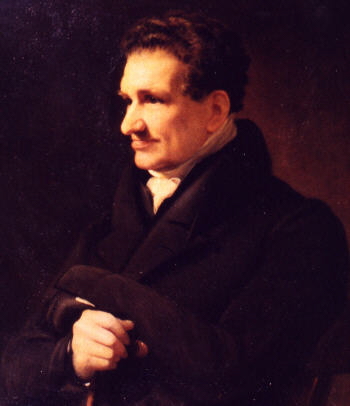
James Heath by Lonsdale
1830 circa
The Heath Family Engravers 1779-1878, Volume 3. by John Heath
Letter from Charles Heath to unknown.
Dear Sir,
I send you the only Proof I can at present put my hands on and I have broken a Set to give you that. I will make enquiries of my Binders and Printer. I think it very likely a waste there may be found.
Yours very truly
C.Heath
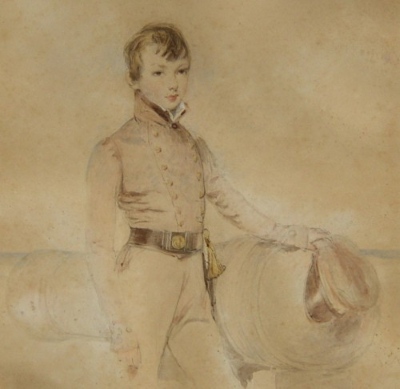
Leopold George Heath, grandson of James Heath (above) starting out in the Navy, posed against a canon.
1830 circa
The Heath Family Engravers 1779-1878, Volume 3. by John Heath
Letter from Charles Heath to unknown.
Dear Sir,
I send you the only Proof I can at present put my hands on and I have broken a Set to give you that. I will make enquiries of my Binders and Printer. I think it very likely a waste there may be found.
Yours very truly
C.Heath
Wednesday 6 January 1830
Evening Mail
Insolvent Debtors' Court - Tuesday Jan.1
Captain henry Nathaniel Rowe, late of No.66 Kennington Street, Walworth, was opposed by Mr.Heath on behalf of ten creditors.
In his examination by Mr.Heath the insolvent stated that he was a commander in the navy on half pay; the amount of his half-pay was £182/.10s per annum and he had a pension of £200/. a year in consideration of his having lost a leg and received other wounds in His Majesty's service. The amount of his debts was £700/. of which £225/. was due to his agents Messrs. Cox and Co, and £100/. due to his sister-in-law, Mrs.Crewe; the balance was for necessaries supplied to his family by 42 creditors, varying in amount from £37/. to £2/.
Since he had been in prison he had received from his agents from £50/. to £60/. on account of his half-pay, and to secure part of the debt due to them, he had insured his life for £200/. He had a wife and seven children. - - -
Mr.Heath said, as it appeared that Captain Rowe had nearly £400/. a year to live upon, he hoped the Court would apportion some of it to pay his creditors, a great many of whom were much poorer than the insolvent. He (Mr.Heath) was aware that it was a sad thing for a gentleman in the insolvent's rank of life to be obliged to live upon a small pittance; but as he had £382/. in half-pay and pension, he could much better afford to dispense with some part than the creditors could afford to lose their money.
Mr.Cooke said it was much to be regretted that all the creditors did not accept the offer of £5/. a month which this gentleman was willing to pay, instead of their arresting him. - - -
The Chief Commissioner (after consulting with the rest of the Court) said the Court would recommend to Government the payment of £82/. 10s. per annum, towards the discharge of the insolvent's debts, leaving him £300/. a year still, which, frugality, the Court hoped would prevent him from again getting into difficulties.
The Insolvent was then ordered to be discharged.
Wednesday 6 January 1830
Public Ledger and Daily Advertiser
Insolvent Debtors' Court
Thomas Smyth, who described himself as a deputy purveyor of the forces on half pay, clerk to a wine-merchant and general dealer, was opposed by Mr.Cresswell on behalf of Messrs.William and James Sharp.
The insolvent stated in his examination by Mr.Cresswell that independent of his half-pay he had also a pension allowed by Government. The whole amount of debts now on his schedule amounted to £18,762/.1s.6d. of which his own private debts were only £621/. and the remainder £18,141/. consisted of liabilities in having put name to a number of bills to that amount, for none of which he had ever received a shilling consideration. A great number of those bills were accepted by Mr.Flaskett, a wine merchant in Gracechurch Street, to whom he was clerk, and the rest he had accepted for other persons but there were all accommodation bills. He swore that he was merely a clerk to Mr.Flaskett and not in any way connected with him by partnership. - - - Mr. James Sharp was in the office when insolvent accepted it, and he consented to take it, and he was of opinion that Mr.Sharp knew he was only a clerk to Mr.Flaskett.
The Chief Commissioner said, however bad this system was, yet it seemed that Mr.Sharp took this bill with his eyes open.
Commissioner Bowen - Yes, he chooses to take the acceptance of a man of straw.
Mr.Creswell begged the Court to hear what Mr.Sharp had to say.
The Insolvent, to further questions, said that he never received a shilling for the £18,000/. worth of bills.
Mr.James Sharp, one of the opposing creditors, stated that Mr.Flaskett owed him and his brother £144/. After repeated applications for the money, Mr.Flaskett asked the witness one day, when he called at the office in Gracechurch Street, if he would take a good bill; upon the witness answering in the affirmative, he called the insolvent upstairs and the bill was drawn by Flaskett, and accepted by the insolvent. When the bill became due it was dishonoured. - - -
Cross-examined by Mr.Heath - The name of Allison was over the shop door, but always seeing the insolvent there, he supposed it to belong to him.
Mr.Heath was about to address the Court on the behalf of the insolvent when the Chief Commissioner told him that he might limit his observations to the application of the portion of the insolvent's half-pay.
The insolvent stated that his half-pay was 5s. a day, and he had also a pension for wounds: the latter was subject to variation and was now under revision.
Mr.Heath then submitted that whatever the Court might order to be paid out of the half pay, would benefit the creditors very little, for the debts were so large, that even if all the half-pay was appropriated to pay them off, the dividend would scarcely be worth receiving. - - -
The Chief Commissioner - - - The Court would not remand the insolvent at their suit and they must take the consequences of their own want of prudence. With respect to the half-pay, as the insolvent had thought fit to encumber himself so heavily with debts he must for the future live more frugally and deprive himself of a few luxuries.
The Court then ordered the insolvent to be discharged and apportion £30/. a year out of his half-pay towards the liquidation of his debts.
Saturday 9 January 1830
New Times (London)
Insolvent Debtors' Court, Jan.8
Henry Cleasby was opposed by Mr.Heath on behalf of Mr.Meeking and several other creditors
Mr.Sargood, a painter, in London Wall, commenced the business by observing to the court that he had no claim upon, or knowledge of, the insolvent; then addressing the latter, he said, "Have you any knowledge of me, for I'm sure I've none of you? " (Loud laughter.)
Insolvent - I don't know you. (Continued laughter)
Mr.Sargood explained that he did some work on the premises, afterwards occupied by the insolvent, but he was employed by a person named Fletcher, to whom he looked for payment.
The insolvent said the premises were his. Fletcher was his brother-in-law, and he (insolvent) carried on the business of the fishing-tackle maker. He was not in partnership with Fletcher, although they lived together in the same premises, and the words "Fletcher and Co." were painted over the door.
Mr.Cooke (insolvent's counsel) called upon him to explain who were Fletcher and Company.
Insolvent - Myself was the company, and Fletcher was nothing. (Loud laughter.)
In his further examination the insolvent stated that among other business he carried on that of a woollen-draper through the medium of agents. He had pledged a large quantity of goods, respecting which the schedule was entirely silent. His father died in 1826, and in consequence of his demise he received a bequest of £500/. and a further sum of £50/.
Mr.Heath said it was impossible to proceed upon the insolvent's schedule as it now stood; but he would ask one more question. To whom, and for what did you dispose of your furniture?
Insolvent - Brother Fletcher had it all - (a laugh) - but I do not know what it sold for.
Mr.Heath - We do know, and that it produced upwards of £200/, and you scarcely filed a vestige of an account relative to the transction.
After some further examination he was remanded to re-advertise with a proper description; to file a new, general, and special balance-sheet relative to the disposition of his property; and to give ten days' notice previously to his coming again to court.
16 January 1830
Records of the Heath Family, Vol.1
Westminster
Dear Heath,
A person of the name of Wheildon has been recommended to me, and has begged me to solicit the office of a bailiff in your Court. I do not intend in any way to be responsible for him, for personally, I know nothing of him, and my former personal knowledge in other instances does not appear to have been very accurate.
Dear Heath, Faithfully, yours, J.Copley
Friday 15 January 1830
Sun (London)
Insolvent Debtors' Court. Jan.14
John Ironside, a cow-keeper, late of Little Saffron-Hill, was opposed by Messrs.Heath and Cooke, on behalf of three creditors named Biggs, Dawkins and Welch.
The insolvent came first before the Court on the 6th inst., when it appeared that on the 29th June last he was arrested for a debt of £55/. upon which he immediately gave bail, Mr.Webber, his present attorney, being then his professional adviser.
Immediately after giving bail he prepared to dispose of all his property; and on the 8th of July, he sold by auction 23 cows, a horse and cart, and furniture, for £374/.17s.; he afterwards sold a quantity of grains for £15/. and the fixtures and fittings up of his premises for £30/. making altogether nearly £430/. - - -
Mr.Heath submitted that the conduct of the insolvent had been of a most fraudulent description. On being arrested, on the 29th of June, for £55/., he gave bail, and immediately disposed of every thing he possessed. By these means he obtained possession of a large sum of money, which would, if properly applied, have produced 12s. in the pound to all his creditors. Instead of acting as he ought, he chose to put £200/. in the fund, which he had fraudulently abstracted two years before: he paid two or three other creditors, and spent the remainder, leaving creditors to the amount of £761/. without a single shilling. There was no doubt that at the time of his arrest he contemplated taking the benefit of the Act, and it was a most fraudulent act to dispose of his property as it was proved he had done.
Mr.Barry, on the insolvent, contended with regard to the re-investment of the £200/. that that was no more than the insolvent was bound by his trust to do. It was not an act done for his own benefit, but it was in pursuance of a trust which he was bound to fulfil; and, to show that the insolvent himself could derive no benefit from it, a distringas had been lodeged at the Bank of England, to prevent him from getting any portion of it back.
Mr.Heath interrupted Mr.Barry by saying that that fact did not appear in evidence; and if it were true, it ought to be proved.
Mr.Barry then called up the witness Mr.Bright, who said he had caused the distringas to be lodged.
In cross-examination by Mr.Heath, the witness stated that after the insolvent's last examination he applied to Mr.Webber, the insolvent's attorney, as to the best way to secure the property in the Bank and Mr.Webber advised a distringas to be lodged. - - -
Mr.Heath addressed the Court on this point and observed that it was monstrous to see what tricks were played in order to enable insolvents to cheat their creditors. He trusted that the Court would take into consideration the conduct of Mr.Webber, who, as an attorney of this Court, first got the insolvent bailed when he was arrested, then undertook to get him through this Court and now since the previous examination had lodged a distringas at the Bank to protect the money paid in by the insolvent from being touched by the creditors - an attempt, however, which the Learned Counsel hoped would fail.
Mr.Barry should not attempt to defend Mr.Webber in all that he had done, but he contended that the insolvent should not be damnified by it. The Learned Counsel repeated that the insolvent was bound to return the money which he had formerly borrowed into the Bank of England. As to selling the property, the insolvent paid a portion of his creditors and while he had £124/. in hand, he offered to compound with his other creditors, which they refused, and he was consequently obliged to render to prison. The Learned Counsel hoped that the Court would not think the case to be of such a mature as to visit the insolvent with any severe judgment.
The Chief Commissioner delivered his judgment of the Court. After recapitulating the points of the case, he observed that it had been proved in evidence that from the beginning to the end of the proceedings Mr.Webber, an attorney of this Court, had been actively employed to further the objects of the insolvent. The Court would be guilty of a great dereliction of its duty if on some future occasion all the Commissioners did not take into consideration the conduct of Mr.Webber, but at present the Court would make no further observations upon that particular fact. With respect to the insolvent a clear case of fraud of the most deliberate description had been made out - a fraud which had not only been deliberately concocted, but perseveringly pursued even down to the day when the insolvent applied to the Court in the vain expectation of being discharged. It was the province of the Court to protect the creditors and render as much as possible such speculations futile as those the insolvent had been a party to. The Court then adjudged the insolvent to be remanded for a period of 14 months from the date of filing his petition for fraudulently making away with his property.
The Heath Family Engravers - Volume 2 - by John Heath
8 March 1830
The Art of Engraving
The trial of Murray v Heath in the Court of King's Bench having decided that engravers are not justified in retaining, according to the long established custom, proof impressions of the plates which they may be employed to engrave, unless authorized by a special contract with the parties interested.
We, the undersigned, feeling that such decision tends to mitigate against the art of engraving as a liberal profession, and to place its professors of the present day (notwithstanding the advanced state of the art of this country) in a position less advantageous than enjoyed by professors when engraving was in its infancy, do hereby announce that henceforth we shall insist on the right to take and retain eight finished proof impressions from all plates that we may undertake to engrave (private plates excepted) not only to prevent further encroachments, but to justify what has hitherto been the practice of the profession.
John Burnett John Le Keux
George Cooke Henry Le Keux
George T. Doo John Pye
William Finden John H.Robinson
Edward Goodhall
21 January 1830
George Heath's old almanacs.
Douglas entered Temple.
Sunday 7 March 1830
Weekly Times
Law Intelligence
Court of King's Bench, March 2.
Murray v Heath, Dolman and Corbould.
This was an issue from the Court of Chancery, directing the Jury to inquire whether or not an engraver has a right to reserve for his own use proofs or impressions from plates which he had been employed to engrave.
The facts of the case have already been before the public. Mr.Heath was employed by Mr.Murray to engrave sets of plates to illustrate Lord Byron's "Don Juan," and "Crabb's Poem," which being executed, Mr.Heath "pulled" a number of impressions for his own use. In 1825 Mr.Heath failed in business and his stock of engravings, among which were the impressions from Mr.Murray's plates were advertised for public sale at Mr.Southgate's rooms in Fleet Street. An injunction was obtained by Mr.Murray and the sale did not take place.
The defendants rested their defence on the ancient usage and custom of engravers, who, they contend, had always been in the practice of taking from three to twelve impressions from all plates they engraved. To prove this case the Jury, said they had merely to direct their attention to one point, viz - whether by law a person employed to engrave had a right to retain a certain number of impressions of the plate? It could not, in his opinion, be lawful unless established by a practice so long known to the trade that every person connected with it must have known and consented to it.
The Jury, after a short consultation, returned a verdict for the plaintiff.
30 March 1830
The Heath Family Engravers 1779-1878, Volume 3. by John Heath
Letter from Charles Heath to Mr.Relph (publisher) (re for the Improvistrice 1831?)
My Dear Sir,
I send you the Drawings. The Drawing of Wrights at Mr.Jennings I ordered to be sent you yesterday and I hope you received it.
I enclose the Bill which as you was so kind s to say you could get cashed I have endorsed.
Yours very truly,
Chas. Heath
P.S. You must interfere with me as little as possible placing your Plates.
30 April 1830
Records of the Heath Family, Vol.1
12 Old Square, Lincolns Inn.
Dear Heath,
Will you be so good as at your leisure to give me some idea how many causes in a year your Court disposes of, and something like the average value of the matters determined, as well as the extent, or rather, population of the district over which your jurisdiction extends. I want to make a comparison with the Scotch small jurisdiction.
Yours very truly,
H.Brougham
30 April 1830
George Heath's old Almanacs
First stone of new room (Kitlands drawing room)
1 May 1830
Records of the Heath Family, Vol.1
To George Heath Esq, 6 Symonds Inn.
My dear Heath,
In the usual course that applications for the Coif should be made in the first instance to the Chief Justice of the Commons Pleas. Will you have the kindness therefore, to write to the Chief Justice first. Pray excuse the delay which has occurred in answering your letter.
Believe me, Ever yours,
Lyndhurst.
1830 - circa
The Heath Family Engravers 1779-1878, Volume 3. by John Heath
Letter - from Charles Heath to unknown. [Re. The Keepsake for 1829]
Dear Sir,
I send you set of the Proofs before Letters of last year. The selling price is two Guineas the price to you 25 shillings ready money.
Yours truly,
Chas.Heath
I shall send you the Boards tomorrow of my Annuals - do what you can for me
11 September 1830
The Heath Family Engravers 1779-1878, Volume 3. by John Heath Memorials of Hope Park
Letter - Charles Heath to William Miller.
The Seashore, Cornwall.
I have this moment received a beautiful plate from Bonington. I am quite delighted with it as well, as is every person I have shown it to.
I enclose you a bill which I have made at four months, because it will be more convenient to me for £52.10s., the sum I pay Mr. R.Wallis and others who engrave for me in London; but if you do not consider that pays you, I am most willing to pay you any further sum.
I shall send you Turner's Drawing and your Proofs etc, immediately. I request as a particular favour that you will consider yourself engaged to do me a Plate for the next year's 'Keepsake,' as well as some for the 'Landscape Annual.'
I should think on the latter you could get some assistance, which would rendrer the text easier. I hope to receive the 'Landscape Annual' Plate by the time you mentioned.
I shall have a splendid Book this year; I think better than ever. Be so kind as to acknowledge the receipt of this.
Yours very sincerely,
Charles Heath.
6 Seymoure Place, Euston Square.
21 October 1830
Records of the Heath Family, Vol.1
My dear Heath,
I will attend directly to your application for the Coif. I had understood, from a conversation you had with Mr.Winslow, that a short delay in making the application to His Majesty would be rather convenient to you than otherwise. I will now, however, attend to it.
Yours very truly,
Lyndhurst.
Saturday 20 November 1830
Charles Heath, 6 Seymour Place, Euston Square, to Dawson Turner
My dear Sir,
I ought to apologise for not answering your kind and friendly letter before with a brace of fine Pheasants but I have been so much occupied having only just returned from Paris that I had not one hour to spare, next week I shall have the pleasure of forwarding a parcel containing my publications as usual - and I will thank you to let me know how many Proofs of the England you have had [20] that I may complete them up to the ten numbers published.
I write you a longer letter with the Books giving all the information I can - at present I shall only say that the success of both the Keepsake and the Landscape Annual is greater than ever. We printed 10,000 of the latter which were all sold before publication and we are reprinting 3,000 more. The Keepsake sold 14,500.
I am quitting town on business till Wednesday morning or Thursday. I shall have the pleasure of writing again. I should send the parcel before but the large paper Copies are not bound.
With best respects, I remain dear Sir, Yours most truly obliged,
Charles Heath.
22 November 1830
George Heath's old Almanacs
Out with the mob. Swing riots in Dorking
Thursday 2 December 1830
Albion and the Star
The King's Sixth Levee
Yesterday his Majesty held a Court and Levee at his Palace in St.James's.
The Noblemen and Gentlemen attending the investiture were afterwards presented at his Majesty's Levee. There were also present - - - Mr.Serjeant Heath - - -
Thursday 2 December 1830
Sun (London)
The King's Court and Levee
Mr.Serjeant Heath, by Lord Lyndhurst, on being appointed Serjeant at Law.
Monday 6 December 1830
Morning Herald (London)
The Glasgow Election
Several witnesses were examined this morning with respect to the usage, as regarded the President having a casting vote at elections in Scotch burghs.
Mr.Sergeant Spankie addressed the Committee at considerable length, contending that by common right the President had no such right, and that it was not known in Scotland, except in cases where it was conferred by the Statute, nor even in England. He instanced the Courts of Justice, where, if the Judges be equally divided, the Chief Justice had not a casting vote, and the cause remained as it stood previously.
Mr.Adam and Mr.Sergeant Heath replied on behalf of the sitting Members, and the Committee then adjourned the consideration of the question until Monday.
Monday 13 December 1830
Albion and Star
Committee Room, House of Commons - Dec.11. The Forfar Election
When the committee met this morning.
Mr.Serjeant Spankie addressed them on behalf of the petitioner, Colonel Ogilvie. He contended there was no evidence to support the charge of treating or bribery. The fact of Colonel Ogilvie having, in a few instances, treated the electors with roasted potatoes, champagne, and claret, was not sufficient to bring the case within the treating act. And with respect to the accusation of bribery, the entire evidence went to show that none of those to whom a bribe had been offered had accepted it, or voted in the interest of Colonel Ogilvie; consequently the charge of bribery was not made out - for there was no instance of a decision, where the mere offer of a bribe, unless accepted and agreed to by the person to whom it had been offered, was held to be bribery. - --
The learned serjeant having concluded his case, Mr.Serjeant Heath replied.
The room was cleared; and the committee having deliberated for two hours - The chairman observed that as there was a general impression in Scotland that the statute of 7th and 8th William III, commonly called the Treating Act, did not extend to that country, - - "that Colonel Ogilvie had been guilty of treating, contrary to that statute." He then pronounced the decision of the committee to be - "That John Stuart Wortley,Esq., was not duly elected; and that the last election was void."