Michael D.Heath-Caldwell M.Arch.


Michael Heath-Caldwell M.Arch
Brisbane, Queensland
ph: 0412-78-70-74
alt: m_heath_caldwell@hotmail.com
- Home
- Architectural Projects 0
- Architectural projects 1
- Architectural Projects 2
- Architectural Projects 3
- Architectural Projects 4

- The Crystal Palace
- Timeline
- 1693
- 1745
- 1770
- 1783
- 1784
- 1785
- 1786
- 1788
- 1789
- 1791
- 1792
- 1793
- 1794
- 1795
- 1796
- 1797
- 1798
- 1799
- 1800
- 1801
- 1802
- 1803
- 1804
- 1805
- 1806
- 1807
- 1808
- 1809
- 1810
- 1811
- 1812
- 1813
- 1814
- 1815
- 1816
- 1817
- 1818
- 1819
- 1820
- 1821
- 1822
- 1823
- 1824
- 1825
- 1826
- 1827
- 1828
- 1829
- 1830
- 1831
- 1832
- 1833
- 1834
- 1835
- 1836
- 1837
- 1838
- 1839
- 1840
- 1841
- 1842
- 1843
- 1844
- 1845
- 1845-46 Oxford
- 1846
- 1847
- 1848
- 1849
- 1850
- 1851
- 1852
- 1853
- 1854
- 1854/55 Appendix
- 1855
- 1856
- 1857
- 1858
- 1859
- 1860
- 1861
- 1862
- 1863
- 1864
- 1865
- 1866
- 1867
- 1868
- 1869
- 1870
- 1871
- 1872
- 1873
- 1874
- 1875
- 1876
- 1877
- 1878
- 1879
- 1880
- 1881-1
- 1881
- 1882
- 1883
- 1884
- 1885
- 1886
- 1887
- 1888
- 1889
- 1890
- 1891
- 1892
- 1893
- 1894
- 1895
- 1896
- 1897
- 1899
- 1900
- 1901
- 1902
- 1903
- 1904
- 1905
- 1906
- 1907
- 1908
- 1909
- 1910
- 1911
- 1912
- 1913
- 1914
- 1915
- 1916
- 1917
- 1918
- 1919
- 1920
- 1921
- 1922
- 1923
- 1924
- 1925
- 1926
- 1927
- 1928
- 1929
- 1930
- 1931
- 1932
- 1933
- 1934
- 1935
- 1936
- 1937
- 1938
- 1939
- 1940
- 1941
- 1942
- 1943
- 1944
- 1945
- 1946
- 1947
- 1948
- 1949
- 1950
- 1951
- 1952
- 1953
- 1954
- 1955
- 1956
- 1957
- 1958
- 1959
- 1960
- 1961
- 1962
- 1963
- 1964
- 1965
- 1966
- 1967
- 1969
- 1971
- 1974
- 1975
- 1976
- 1979
- 1983
- 1990
- 1991
- 1998
- 2001
- 2002
- 2004
- 2005
- 2006
- 2007
- 2008
- 2009
- 2010
- 2011
- 2012
- 2013
- 2014
- 2015
- 2016
- 2017
- 2018
- 2019
- 2020
- F.C. Heath-Caldwell
- C.H.Heath-Caldwell Memoirs
- Palmer Family
- Palmer Timeline
- 1912 - Palmer
- 1914 - Palmer
- 1916 - Palmer
- 1918 - Palmer
- 1919 - Palmer
- 1924 - Palmer
- 1925 - Palmer
- 1926 - Palmer
- 1929 - Palmer
- 1932 - Palmer
- 1934 - Palmer
- 1936 - Palmer
- 1938 - Palmer
- 1939 - Palmer
- 1944 - Palmer
- 1946 - Palmer
- 1961 - Palmer
- 1967 - Palmer
- 1970 - Diary - Joe Palmer
- 1971 - Diary - Joe Palmer
- 1972 - Diary - Joe Palmer
- 1991 - Diary - Joe Palmer
- 1992 - Diary - Joe Palmer
- 2010 - Diary - Joe Palmer
- Venice Earthquake 1873
- Old Letters 1
- Old Letters 2
- Old Letters 3
- Old Letters 4
- Old letters - Mid 1800
- More Old Letters
- Eaton Hall, 1943
- Marsh Family Timeline
- James Caldwell papers 1
- James Caldwell papers 2
- James caldwell papers 3
- Old letters 1800s
- Old Letters 1800s 2
- HH Sultan Taimur bin Turki 1913
- Frank Featherstone Wright 1921-2014
- Frank F. Wright 1
- Frank Featherstone Wright early
- Frank F. Wright 2
- Frank F. Wright Videos
- Old Featherstone album 1
- Old Featherstone album 2
- Old Featherstone album 3
- Old Featherstone album 4
- Old Featherstone album 5
- Arthur Eversfield Featherstone Album 1
- Arthur Eversfield Featherstone Album 2
- Arthur Eversfield Feartherstone Album 3
- Grasmere
- Frank E Wright Album 1a
- Frank E Wright Album 1b
- Frank E Wright Album 1c
- Frank E Wright Album 1d
- Frank E Wright Album 1e
- Frank E Wright Album 1f
- Frank E Wright Album 1g
- Frank E Wright Album 2a
- Frank E Wright Album 2b
- Frank E Wright Album 2c
- Frank E Wright Album 2d
- Frank E Wright Album 2e
- Frank E Wright album 2f
- Frank E Wright Album 2g
- Frank E Wright Album 2h
- Frank E Wright Album 2i
- Frank Edward Wright drawings
- Cathy Featherstone 1910a
- Cathie Featherstone 1910b
- Norma Featherstone 1913
- Norma Featherstone Part2
- Norma Featherstone Part3
- Norma Featherstone Part4
- Norma Featherstone Part5
- Kitlands House
- Moorhurst Manor
- Redlands House
- Milland House
- Anstie Grange
- Ebernoe House
- West Ham House
- Vigo House
- Linley Wood
- Crimean War
- James Caldwell letters 4
- James Caldwell letters 5
- James Caldwell letters 6
- James Caldwell letters 7
- James Caldwell letters 8
- James Caldwell letters 9
- Eton & Oxford 1830/40s A
- Eton & Oxford 1830/40s B
- Eton & Oxford 1830/40 C
- Eton & Oxford 1830/40 D
- Eton & Oxford 1830/40 E
- Eton & Oxford 1830/40 F
- Back in England. Early 1800s
- Arthur Heath 1872-4
- Sicily 1800
- Naples - 1830
- Trentham Hall
- Paris 1810
- Cromptons on the Lusitania
- HMS Illustrious 1948
- The Minoans
- Henry Crompton 1836-1904
- Orongorongo 1957
- Another Page
- Gertie Wheeler 1909
- The Ahsan Manzil
- More old letters 1800s
1837 - 1838 - 1839
George Heath Serjeant-at-Law - age 58/59 1779-1852
Anne Raymond Heath (ne Dunbar) - age 50/51 1787-1842
Julia Anna Heath (later Harrison - age 30/31 1807-1879
John Moore Heath - age 29/30 1808-1882
Douglas Denon Heath - aged 28/29 1811-1897
Dunbar Isidore Heath - age 22/23 1816-1888
Leopold G. Heath R.N. - age 20/21 1817-1907
Emma Jane Heath (later Whatman) - age 16/17 1821-1884
Saturday 20 January 1838
Manchester Courier
Mr.R.Winstanley begs respectfully to announce that he has received unqualified permission from Joseph Scholes Esq., to Offer for unreserved Sale, his Collection of Engravings, Etchings, and Drawings at the Exchange Rooms, Manchester, on Monday and Tuesday, February 5th and 6th at ten o'clock each day.
This collection will be found extremely interesting to conniseurs, as well as admirers of modern art, as it comprises in the English School, the best works of Strange, Sharp, Woollett, Boydell, Tomkins, and others: many fine Mezzotints, with beautiful and more recent publications by Heath, Finden, Sharp, Lupton, Raddon, &c.,. - -- continues. - - -
Sunday 21 January 1838
Age (London)
Lady Blessington's New Work - On Thursday Feb.1, will be published, with Eight Plates, executed under the superintendance of Mr.Charles Heath, 21s.
Confessions of an Elderly Lady - by the Countess of Blessington, Forming a Companion to the "Confessions of an Elderly Gentleman."
London: Longman, Orme and Co.
12 February 1838
Charles Heath, 6 Seymour Place, London to Dawson Turner (Banker)
My Dear Sir,
By this day's coach I send you the remainder of the Proofs for "Shakespeare Gallery" and the Book which I hope you will agree with me makes a splendid volume. As tomorrow [is] the Day after two more of Mr.McCormick's Bills will be run off, making £335 pounds since you did the last, I venture to enclose three for £50 each which if you can cash for me I shall be greatly obliged
Believe me Dear Sir, Yours truly,
Charles Heath
Saturday 24 February 1838
West Kent Guardian
The "Confessions of an Elderly Lady," written to accompany some mawkish and unmeaning portraits, which are pulled into their places by jerks not unlike those which produce the evolutions of a paper scaramouch, and forming the last of the innumerable annual publications of Mr.Charles Heath, is, without any exception, one of the silliest, most vapid, and yet most ambitious attempts at the fashionable novel it has ever been our lot to pursue. We would fain hope that lords and ladies are not the mincing, brainless, frivolous, and vicious animals which Lady Bellington would have us believe; for if we thought they were, we could pardon the Radicals for their invincible hatred of them; and might, even in that respect at least, incur the risk of being converted into Radicals ourselves.
Having, however, met with the most exalted virtues, and the highest mental accomplishments in persons of rank, we are constrained to regard the pictures which Lady Blessington and Lady Bury have given us of the "order," with the natural suspicion with which the testimony of mortified and disappointed witnesses ought invariably to be received.
Of her plot, her ladyship may say with the "Needy Knife-grinder" - "Story! God bless you, Sir, I've none to tell." The father of the heroine (who relates her own story, and talks in the outset of pretentious disquisitions of modern times, and "loosing" her mamma) is a certain Lord Walsingham, who wife dies of consumption during the infancy of her child. The first anxiety of paper is to obtain a governess for his darling, who exhibits a remarkable pertinacity in requiring an instructress who is both "young and handsome" - a "nice pretty young governess." The disconsolate widower accordingly gives directions to his physician (the Halford of his day) to look out for a young lady possessing these qualifications. The doctor's notions of decorum are sadly outraged by this application; but after receiving the assurance of his lordship that the requisites in question were less of his own than his daughter's seeking, the services of a sweet young madonna-looking creature (whose portrait and "air" M.Paris has filched from one of Loenardo da Vinci's pictures) are forthwith secured, with a solemn, sentimental, Werter-faced youth of a brother, who is endowed by Lord Walsingham with a comfortable living the day after his lordship has hired his non-pareil of a sister. No sooner - - -
- - -continues
Such is the plot of this most delectable novel of fashionable life - the moral we have not succeeded in discovering. If we have treated it a little cavalierly, her ladyship will have the consolation of reflecting, that the number of critiques which will class it among the most perfect productions of modern times, will leave us in a very pitiable minority.
24 April 1838
Charles Heath, 6 Seymour Place, London to Dawson Turner (Banker)
My Dear Sir,
Since you were so obliging as to cash the last bills on Mr.McCormick £150 are run off and another 50 will be paid on the 13th of May, I venture to enclose some others to the amount of £250 which if you will cash will greatly serve me. I am in your Debt 15 pounds on the last which occurred in consequence of my being too unwell to go myself and the Cheque that was received had crossed so that it was placed in my Bankers.
That £15 shall, however, be paid with this. I am happy to tell you that at last the "England and Wales" is completed and the last number will be published in a few days. I cannot find the letter in which you state the number of Proofs you have received. I will thank you to let me know and you shall shortly receive the remaining numbers to perfect them.
I shall likewise have the pleasure of sending you a new illustrated novel by "Bulwer" and another by "James" on the same plan as the Pirate by Captain Maryatt.
I am Dear Sir, Very truly obliged
Charles Heath.
P.S. As I shall not be able to dispose of the "England & Wales" as I mentioned till the next October sale of "Longmans" and as one of the 100 Bills comes due next month which you so kindly cashed to enable me to complete it, perhaps you will oblige me by renewing it. I am shortly going to Paris to dispose of a part of my old stock of Plates. Should I not be back in time to send the Bill for renewal it will do very well after I have paid it. It is due on the 16th May.
Tuesday 8 May 1838
Essex & Herts Mercury
Middlesex County Court
(Before Sergeant Heath, Corporal Dubois, and Private Brown)
A very rich subject for the pencil of Salvator Ross, appeared here on Thursday, in the person of Mr.Joseph Costoloney, an Italian of the modern breed, and one lacking the Roman virtue of olden times. Mr.Miller, the plaintiff, was a red-whiskered, spiteful-looking ex-attorney's clerk, and the bill sued for may "speak" for itself. Mr.Joseph Costoloney, to William Miller, - - -balance due £1.6.4.
Dubois: What's the meaning of "moving up stairs?"
Plaintiff: Why, Sir, hat's when he went up higher (Laughter).
Dubois: So I should say: and is that what is called paying by instalments?
Plaintiff: In course and nothink carnt be clearer?
Court: Well, and what do you mean by "odd weeks?"
Plaintiff: Why, one week was disputed,and so I allowed it, and he got the benefit.
The bill in question regularly mystified the jury, and bothered Mr.Dubois; the whole affair was therefore subsequently dismissed.
- - - cases continue - - - -
Monday 28 May 1838
Morning Advertiser
At the Marylebone Vestry, on Saturday, Mr.Kenet (Kensitt?) stated that he and Mr.Young had that day had an interview with Mr.Sergeant Heath on the subject of the Local Courts Bill; and that as the Learned Sergeant was about to bring in a Bill to Parliament for extending Courts of Requests, he would, if approved of, introduce a clause into the measure binding himself to hold a Court for the recovery of small debts in Marylebone for one year, by way of experiment, provided the Vestry furnished him with a room.
Under these circumstances he moved tha the Local Courts Bill be dropped and that a deputation be appointed to confer with Mr.Sergeant Heath for the purpose of getting the clause in question into his Bill.
Mr.Snowden having seconded the motion, it was carried by a majority.
Monday 28 May 18389
Morning Herald (London)
Marylebone Vestry - The Itinarant Court of Justice for the Borough
As usual the members of the vestry of Marylebone met on Saturday. There was much on the notice paper, but little was done, as usual.
Somewhat out or order we give precedence to a proposition made for the establishing of a Court of Justice for the borough, to recover debts under 10/. It may be remembered that the vestry applied to parliament, some short time since, for a bill to establish a local court for this borough, that bill stands for second reading on Tuesday.
After some preliminary business had been disposed of, Mr.Large was submitting a motion for the payment of the rector's fees (noticed below) when -
Mr.Kensit said this motion ought not to come on first. Mr.Large was not to take the place of Lord Teignmouth or Mr.Hall; if they were here the vestry would hear them.
Mr.Large - Neither Lord Teignmouth nor Mr.Hall is present.
Lord Radstock - And Mr.Kensitt is not member ofr the borough of Marylebone - (roars of laughter).
Mr.Kensitt - Not knowing what may happen, my lord - (It is scarcely possible to describe the feeling which were excited by the boisterous burst of merriment which followed this apparently simple declaration). He stated he had a communication of paramount importance to make to the vestry. He and another gentleman had waited on Mr.Sergeant Heath that morning, and he was desirous, before Mr.Large was heard, to state what the result of that conference was.
A great deal of discussion again took place as to precedent, but -
Mr.Kensitt having collected his papers together, stated that he had had a conference with Mr.Sergeant Heath that morning - (loud cheers). He had seen him - (cheers) - upon the paramount question of the Local Courts Bill. He had consulted with Mr.Sergeant Heath, and heard all he had to say. He listened quietly. He sat down in a chair, and never moved till Mr.Sergeant Heath had done - (hear, hear). He was overpowered by his eloquence, and he admitted it - (great cheering). The result of the conference he begged to state to the vestry. Mr.Sergeant Heath promised to insert a clause in his bill, by which he would have the power of coming into Marylebone once a month. He (Mr.Kinsitt) was very anxious to see him very fortnight; but Mr.Sergeant Heath said he could not come so often - (cheers).
Then Mr. Sergeant Heath said he would find all his officers, but he could not afford a room - (hear, hear).
That is, Mr.Sergeant Heath would come in his wig and gown, in a coach, and clerks, tip-staff, &c., in a cab following - (hear, hear). All he (Mr.Kensitt) desired was to avoid expense to the borough - (hear, hear).
If they proceeded with the Local Courts Bill, it would cost much money - (hear, hear). If they abandoned it it would cost them no more, and Mr.Sergeant Heath would do all for nothing; nay he would even save them the trouble of appointing the officers, for he (Sergeant Heath) would do it himself - (cheers).
Now here would be a saving to the borough. Was it necessary to proceed with their bill, when Mr.Sergeant Heath offered to do all that the bill could accomplish for nothing? It would be, as the play said, "Enter Sergeant Heath and tipstaff - justified administered - exit Sergeant Heath and tipstaff, accompanied by prisoners" - (loud cheers).
He would therefore, propose that the clause be inserted in the bill of Mr.Sergeant Heath's, and that in the meantime the agent for the Marylebone Local Court Bill be directed to proceed no further with it.
The motion having been seconded by some one, whose name was not stated, -
Mr.G.A.Young rose and said that, as a member of the deputation, he was desirous of saying a few words, lest it might be supposed the sentiments of Mr.Kensitt were the sentiments of the deputation - (loud laughter). So far from agreeing with what Mr.Kensitt had said, he thought it would be a disgrace to the borough if they submitted to the plan which Mr.Sergeant Heath proposed, and which he would state to them.
It might be as well to tell them, in the first instance, that the bill Mr.Sergeant Heath expected to pass was to make him judge of Middlesex - (loud laughter). He did not mean to attribute to Mr.Sergeant Heath that he could be, any more than another man, in two places at one time; but Mr. Sergeant Heath was to have his deputies, but himself would be the ruling power - (laughter).
Mr.Sergeant Heath condescended to expect that the Common's House of Parliament would consider in him the collective and embodied legal wisdom of the county of Middlesex - (roars of laughter).
But more than that, Mr.Sergeant Heath had that morning said he would not travel with his suite to Marylebone, if there were only 20 cases for trial, because, said Mr.Sergeant Heath, ten will be withdrawn, five will be compromised, and the other five will not pay the fees! - (roars of laughter).
But he (Mr.Young) would seriously ask, whether the borough of Marylebone would submit to this? Was that a fitting place in which to try an experiment for 12 months? Mr.Sergeant Heath asked for no more time, but he had declared that that cheap justice they would not like, and if Mr.Sergeant Heath was the cheap justice, he (Mr.Young) agreed they would not like it. He objected to this plan still more, because it retained the detestable power of imprisonment for debt - (cheers). It retained it in its worst form, for the poorest man was not safe from the clutches of its officers.
Against this inhuman practice he had ever stood up, and ever would - (cheers). But to come more immediately to the question, were they in the borough - the largest and most wealthy in the metropolis - to have a chandler's shop scheme of justice tried - upon condition they should lend a room for 12 months? - (hear, hear.) Was that the justice they required? Was it the judge they required? - (loud cheers.)
He could not believe that parliament would ever entertain so preposterous a notion - (hear). He could not believe, and he refrain from smiling, when he said it, that the borough of Marylebone would not place themselves in the hands of a gentleman who calculated so much upon their simplicity - (great cheering).
How Mr.Kensitt could have sat and listened to what was said at the interview, with the dignified composure he sustained, when he (Mr.Young) and the counsel for the borough, could scarcely suppress their laughter, he (Mr.Young) could not understand.
Mr.Jackson said that, so far from concurring in the proposition of Mr.Kensitt, he should oppose as far as he could, the lord chancellor of Kingsgate Street, for lord chancellor he was as far as all the obnoxious powers of that office extended. He should oppose the entrance of the chancellor of Kingsgate Street into Marylebone - (great cheering). He had been in the court of that learned gentleman once, but for twenty times forty shillings he would never go again - (hear). And yet the gentleman who presided, not only believed, but expressed his opinion that the Kingsgate Stree courty was the paragon of perfection - (laughter); good lawyers, cheap justice, and small fees, for less than nothing - (loud laughter).
It was too silly to suppose for a moment that the gentlemen of the long robe would admit that Mr.Sergeant Heath was the only man fit to dispense justice in the county of Middlesex - (loud cheers and laughter). It was not likely that the powers of the detestable court in Kingsgate Street would ever be extended - (cheers). They had seen too much of it. It was an abomination in a Christian country. It was called a Court of Conscience, rather should they say a court for the practice of iniquity - (cheers).
He was of the opinion that until the great question of the abolishment of imprisonment for debt had been decided they should proceed no further - (hear, hear).
Mr.Joseph strenuously opposed the motion, having seen something of the practice at Kingsgate Street. There were men there who only resembled a jury. There were three men who were automata; they reciprocated the opinions of the judge, and then it was called law - (cheers). He trusted the vestry would never permit such a tribunal to exist in the borough of Marylebone - (hear).
Mr.Wilson and Mr.Gibson spoke in favour of the motion.
The Chairman put the question, which was carried by a very considerable majority. If the Common's House of Parliament be willing, Marylebone may boast of a court of justice never before heard of. Unless the symptoms be very dangerous the physician for the county declares he will not attend. Absurdity where are thy limit?
Mr.Sergeant Heath is to travel round the county, and where there are more than 20 causes to be tried, it will be his pleasure to stop. His mercenaries will catch their prey, and justice may wait till the net is again full.
Justice then attends in the person of Mr.Sergeant Heath, ad infinitum ad nauseum.
Sir William Parker presents his compliments to Mr Serjeant Heath, and at the request of Sir Graham Moore begs to enclose two extracts of letters form the late Sir John Gore respecting Lieut. L.G. Heath.
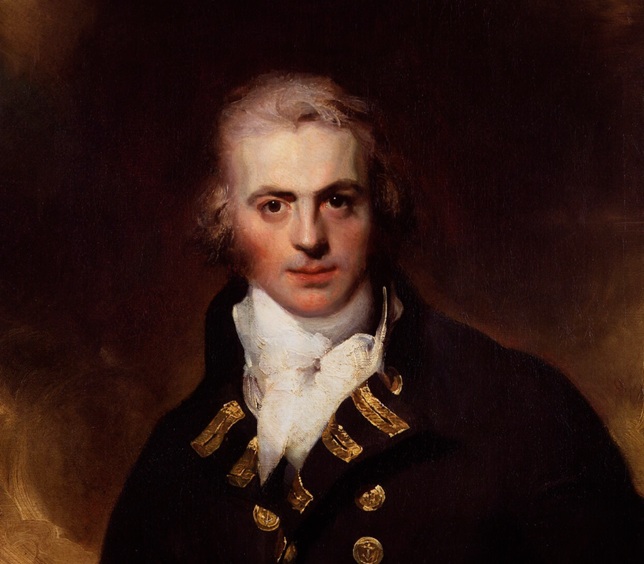
Admiral Sir Graham Moore -
relative of Ann Heath (ne Dunbar)
Sir William has already furnished these extracts to Mr Edward Bethune, and thought that they were in Mr Heath's possession.
Admiralty,
9 June 1838
Thursday 14 June 1838
Morning Herald (London)
Middlesex County Court Bill.
This committee has been sitting several days hearing evidence on the subject of the Middlesex Country Court Bill, which has been prepared by Mr.Sergeant Heath, with a view of extending the jurisdiction of the court to debts of £10, at present the the court having jurisdiction only to debts of 40s. The bill also proposes to take the same territory, viz, throughout the county of Middlesex, except Westminster and the Tower Hamlets, both of which have courts of requests attached to them.
The present court is the ancient court of Middlesex, remodelled by the 23d Geo.II cap 33, presided over at present by Mr.Sergeant Heath. The court is held twice a week for the London district in Kingsgate St, Red Lion Square, and monthly circuits for the country causes to Enfield, Brentford, and Uxbridge.
The new judge, it is proposed by the bill, shall be appointed by the crown, and paid by the fees. In the first instance, Mr.Sergeant Heath has proposed to take the office for a limited time, without any salary or emolument for the causes above 40s. which may be brought forward, but continuing the payment of the fees of causes under 40s.
The parties who opposed the bill were the Palace Court practitioners, and a person named Baster.
Evidence was given to show in what way the court was constituted, and the number of its officers, with the amount of the expenses of conducting a suit.
The testimony of the witnesses showed that, by extending the jurisdiction in the way pointed out by the bill, considerable public benefit would be derived.
A clerk in the Imperial Gas Company stated that the costs of proceeding in an action instituted in the Palace Court amounted to between £7 and £8. In actions brought in that court to recover £120, the costs amounted to £80, whereas the costs in the County Court for the recovering the same amount were only about £8.
Mr.Sergeant Heath was examined on Tuesday at great length upon the mode of proceeding in the courts, the costs to the suitor, the number of cases tried in a week or month, the species of debts generally recovered, the nature and amount of claims, the average time of imprisonment when execution issued.
In the course of the cross-examination of Mr.Sergeant Heath yesterday, at the instance of the counsel for the Palace Court, he said, on being asked what increase of business would be brought to the County Court of Middlesex by extending the jurisdiction from 40s. to £10, I can not tell. It is an experiment, and may be a guide to lead to a knowledge of what would take place if the Local Courts Bill were passed. I was asked by the Lord Chancellor how many judges would be wanted in the event of that general bill passing. I told him it was impossible to tell. This bill of mine is one of experiment, and would lead to an accurate knowledge of what might be done by extending the provisions to all parts of the kingdom. Several actions, net of debt, have been brought, but I never knew a case of slander or libel brought before me, although the court has jurisdiction of such cases. Probably the reason why those actions have not been brought is because people do not like to lay their damages so low. If the jurisdiction were extended to £10 there might be such actions brought; but I really cannot say whether such would be the fact. It might or might not, lead to such actions. I cannot tell how many additional officers would be required. I should try the experiment with the same strength I now have, but I might want another officer or two. My own establishment shall do it if it can. . Another clerk or two would, I believe, be wanted. The sums are generally paid by instalments. The surpluses in my hands have never paid my expenses of collecting the amount.
Mr.T.Duncombe - I find that you have given an account of the balance in your hands of December 1825 (1835?), the sum of £1,201 being that balance.
Mr.Sergeant Heath - Yes, it might be so, but the next month probably I should not have a farthing. Suppose I had in one period £10,000 paid to me, the next month the whole of that would be paid to the suitors. When I came to my office my predecessor was indebted something about £1,200 which I paid. I received from his executors the amount subsequently.
Mr.T.Duncombe - Did he resign?
Mr.Sergeant Heath - No, sir, he died. I endeavour to keep the amount in my hands close paid up, so that my executors may have little or nothing to pay in the event of my death.
Mr.Sergeant Heath was then examined by Mr.Baxter, a petitioner against the bill - I can tell exactly what I have in my hands as a balance. I should think that the executions taken out are from 60 to 100 in a week. I should say a much larger proportion than half have been executed. Since this Imprisonment for Debt Bill has been in agitation the executions taken out have very much increased, probably on account of the apprehension that that bill would make it more difficult to get in their debts. The charges upon every execution are 3s.6d.
Mr.Hawes interposed, saying that this had nothing what ever to do with the preamble of the bill, but had reference to clauses.
Mr.Sergeant Heath was very anxious to give all the information that lay in his power, because, if he did not answer the questions put to him, it might be thought that he was with-holding evidence.
The Chairman - My opinion is that nine-tenths of the evidence already given has really nothing to do with the preamble.
Mr.Denison - And a great deal of a personal nature too!
The Chairman regretted that such a course should be adopted.
Lord Teignmouth submitted that these questions should not be persevered in.
The Chairman then directed Mr.Baxter to confine his questions to such points as those which had reference to the preamble - viz., "whether it is expedient to extend and amend the provisions" of a preceding act.?
Mr.T.Duncombe thought that Mr.Baxter ought to be permitted a little latitude, he not being a professional man.
Mr.Baster then put several questions to the learned sergeant as to the boundaries of the present court.
To other question put, the sergeant stated that there might be about 400 summonses issued in a week. On Thursday there were more; I may have had 500 in a week. I have sat from nine in a morning till nine at night. I have had my deputy also so engaged. The summons list commences at nine in the morning. Sometimes even the longest list makes the shortest day. They consist often of bakers' and butchers' charges.
The Chairman again interposed, stating that such questions as these were irrelevant.
Mr.Baster said he could prove that it was impossible the court ever could accomplish the business which the bill professed to do.
Mr.T.Duncombe - You will have an opportunity of addressing the committee by-and-by. You must now go on with the examination if you have any further questions to put.
In answer to further questions put by Mr.Baster,
Mr.Sergeant Heath said - I am in the court at nine in the morning, and the Brentford casues are placed after the London list; therefore they never could be called so early as five minutes past nine.
Mr.Baster - My reason for asking these -
Mr.Sergeant Merewether - We cannot hear your reason.
Mr.Baster - I am at a loss to proceed, but I have made up my mind by contemplation of the inutility of improving this court - (laughter).
The Chairman - You may ask as many questions as you please, which have a bearing upon the preamble.
Mr.Baster - I have no more to put at present.
Mr.Praed - You recollect you cannot ask the witness any more questions hereafter. If you have,
therefore, anything to ask, now is your time.
Mr.Bastor - I cannot recollect any more questions.
Mr.T.Duncombe - You sit in one court, and your deputy in another?
Mr.Sergeant Heath - Yes. The court in which my deputy sits is not a saloon, certainly; it has been attacked in the newspapers, but it is a room adapted for the purposes.
Mr.T.Duncombe - How long a time do you commit in execution?
Witness - Seven days is the minimum time, and twenty days the maximum. There is a scale by which we act. If the debt be 40s the longest period is taken, and if under 10s the shortest.
Mr.T.Duncombe - There are clauses in the bill which give a power of committing for three months!
WItness - Yes, sir. They are the government clauses.
To further questions put by other hon. members the learned sergeant said - We send the persons committed to the Whitecross Street prison, that being the only prison we can send to - the sheriff's prison. My opinion is that it would be better to pay the judge by fees rather than by salary, but the General County Court Bill proposes a salary - the bill introduced into the House of Commons by the attorney-general.
An Hon. Member - Of course! Mr.Sergeant Heath will be in attendance when we come to the different clauses?
Mr.Sergeant Heath - Undoubtedly. I shall be here, sir.
Mr.Geary, a barrister, practising in the Palace Court, then addressed the committee atsome length submitting that the preamble of the bill had not been, he apprehended, proved. He insisted that, at all events, they were entitled to compensation, but, if the committee thought they were not so entitled, then, before the committee gave their approbation to the preamble, they would be persuaded of its public utility.
The Solicitor for the Marylebone Bill said he had withdrawn it; the 150,000 people of that borough had an anxiety to have a bill for the recovery of small debts, and they concurred in the principle of the bill brought forward by Mr.Sergeant Heath, believing that his bill was capable of producing the effects which theirs would have produced.
If it should, however, happen that Mr.Sergeant Heath felt some of the clauses pinch him, and that he should endeavour to abandon it, he would not act fairly by the Marylebone people. But he would not, however, suppose any such thing; and he confessed it appeared to him that the preamble had been clearly proved.
Mr.Baster was then heard against the preamble, calling upon the committee to examine the books, to sift everything connected with the court to see how much surplus money was now lying unclaimed in the court, before they declared the preamble to be proved. After some further observations, in which he made some charges as to alleged delinquency in the court,
Mr.Praed interposed, saying that the committee would not hear such observations.
Mr.Sergeant Heath wished to be heard in contradiction of what had been said by the petitioner; for there was not a word of truth in it.
The Chairman said there was no necessity for it.
Lord Teignmouth was of opinion that the petitioner ought not to have been permitted to make such remarks.
Mr.Denison - We certainly ought to have stopped him earlier.
Mr.Sergeant Merewether, after stating that his learned friend's character stood to high to require a single word from him in answer to the petitioner, went on to argue that the evidence had most satisfactorily established the importance of this bill, and that the public benefit would be greatly increased thereby. It has been well said, "that justice ought to be brought home to every man's door," and this bill effected that as regarded the county of Middlesex. With regard to the compensation to the parties of the Palace Court he would not urge than topic, nor as regarded the expenses of conducting suits there. After several further remarks on the subject he concluded with believing that the committee would deem that the preamble had been proved.
The room was cleared, and on counsel and agents again appearing, they were informed that the committee had decided that the preamble to the bill was proved.
The preamble runs thus: - "Whereas it is expedient to extend and amend the provisions of an act passed in the twenty-third year of the reign of his late Majesty King George II., instituted,"An Act for preventing Delays and Expenses in the Proceedings in the County Court of Middlesex, and for the more easy and speedy Recovery of Small Debts in the said County Court."
The committee then went on to the consideration of the clauses. After being so occupied until a messenger announced that the speaker was at prayers, the committee adjourned.
continues - - -
Sunday 17 June 1838
Weekly Dispatch (London)
Amongst minor measures an opposition is springing up against that most rascally Bill, called the County Courts Middlesex Bill. On a division of 39 to 19, an extension of time is granted to the Committee to report on this Bill. The County Clerk of Middlesex, Mr.Serjeant Heath, is making a very nice provision for himself, by this snug little contrivance.
Thursday 21 June 1838
Morning Herald (London)
Middlesex County Court.
On the assembling of the committee yesterday, Mr.Gasalee was heard in reply on behalf of the counsel for the Palace Court, of whom he is one, contending, at considerable length, that they had an undoubted right of compensation, for very large sums of money had been paid for the right of practising in it. He had given £4,000 for his privilege.
The statement put forth as ground of compensation by the four officers of the Palace Court may be thus summed up. The Palace Court was created by letters patent of the 6th of Charles I. and 16th of Charles II., and the number of counsel permitted to practise in it is four, the right of appointment vested in the superior officers of the court, to whom heavy fees are paid on admission. It is held to be a freehold office assessed to the land tax, and is a recognised object of purchase, being expressly excepted out of the statute against the sale and brokerage of offices, - - -- continues - - -
In the course of this argument of Mr.Gasalee, he having cited the dictum of Lord Coke, to show what the County Court was, maintained that this bill sought to ingraft a new court upon the old court, so that the argument urged on the other side fell to the ground, that this was not a new court.
Mr.Heath would put it to the committee whether this line of argument was applicable for compensation?
Mr.Gaselee insisted that he was fully entitled to use this line of argument. It had been said that this was a government bill, but it turned out that the only thing authorising such a description of it was, that government did not oppose it.
- - - continues - - - - -
After agreeing to several clauses, some discussion arose upon the clause requiring fees and moneys recovered by the court to be accounted for. As the bill originally stood the commissioners of the treasury were proposed, but they refused to be burdened with this. It was then altered by Mr.Sergeant Heath, that the secretary of state for the home department should have the appointment of the person to act as treasurer, but altered at the suggestion of Captain Wood, for the treasurer of the county of Middlesex to be the officer.
After some consideration of the clauses, a suggestion was made that an account should be opened in the Bank of England to that course.
Mr.Sergeant Heath said he had not the slightest objection.
Mr.Hall suggested that the secretary of state for the home department should have the appointment.
Captain Wood thought that the justices of the county assembled at the quarter sessions should have the money paid into their hands.
Mr.Sergeant Heath would leave it to the committee to decide upon the subject as they thought fit.
Mr.Crawford (the Chairman) - The learned sergeant endeavours to please everybody - (laughter).
The committee, with closed doors, then considered the propositions made by the two hon. members, and on counsel again appearing, they were informed that the committee had determined that the fees and moneys should be paid over four times a year to the treasurer of the county of Middlesex.
Mr.T.Duncombe proposed a clause to the effect that the provisions of the Finsbury Small Debts Bill should not be affected by the present bill, but such a course was objected to, and the proposition was negatived.
It was now proposed by Mr.Serjeant Heath, that a clause should be inserted to hold in and of the parishes of Clerkenwell, St.Luke's, or Islaington, provided a court was formed by the parish authorities.
Mr.T.Duncombe then called Mr.Paris, who said he was an overseer of Clerkenwell, and he had, with other parishioners, attended a meeting held at Mr.Serjeant Heath's chambers the day before yesterday, when it was stated by him (the witness) that the parishioners declined entertaining such a proposition, being anxious to have a bill of their own, for they wished to be excepted from the operation of the present bill altogether.
Mr.Sergeant Heath said that the only question discussed at his chambers was as to the court in Kingsgate Street. He would, however, at once withdraw the clause.
A discussion followed, which terminated in the withdrawal of the clause in question.
Mr.Finch said that he should now propose a clause to pay the clerk of the court by salary instead of by fees. The principle upon which he did this was, that the judge might not be supposed to have an interest in encouraging litigation - an impression likely to prevail if the present system was continued.
The Chairman suggested the propriety of adjourning this proposition until the following day, on account of the absence of several members who were not aware of so important a proposition being now brought forward. If the hon. member, however, persevered in it he should move an amendment to adjourn the question until there was a full attendance of members.
Mr.T.Duncombe said he wished the proposition to be now entertained, as he could not conveniently be present tomorrow morning.
The room was again cleared, after Mr.Serjeant Heath had appealed to be heard upon the question, and after he had been told that before the question was finally settled he should be heard.
Upon the parties being re-called,
The Chairman stated that the committee had come to the resolution that the judge should be paid by salary,and that that salary should be £2,000 a year.
A conversation ensued, in which,
Mr.Sergeant Merewether trusted that the point respecting the salary would not be considered as closed without first hearing the objections to it.
Mr.Duncombe said that the question was not finally disposed of, inasmuch, as no clause had been submitted. It was only a resolution, which might not be acted upon hereafter.
Much discussion followed, and the room was again cleared, when another resolution was come to - That counsel might be heard as to the amount of salary, but not against the proposition of the payment of the judge of the court being by salary.
Mr.Sergeant Merewether - After that resolution, sir, my advice would be, that the committee should not be addressed at all on the subject.
The Chairman then declared the committee to be adjourned until the following morning.
* It as rumoured in the room that, in consequence of the last resolution, the bill will not be persevered in.
Tuesday 26 June 1838
Morning Herald (London)
Middlesex County Court.
A quorum of five members having yesterday assembled, the Chairman (Mr.Crawford) stated that it was understood by the committee on Saturday that Mr.Sergeant Heath would be prepared to give evidence with respect to the average amount of the value of his office, upon which -
Mr.Heath jun. rose to address the committee, in the first instance expressing his regret that Mr.Sergeant Merewether was detained elsewhere (in a committee of the House of Lords), as the duty now devolved upon him to state the reason why Mr.Sergeant Heath could not comply with the desire of the committee, and if he could, why he thought the principles which the committee were anxious to see carried into effect could not be accomplished.
The learned gentleman then recapitulated what the resolutions were to which the committee had before come on Wednesday and on Friday last, which had occasioned the present difficulty. Mr.Sergeant Heath was exceedingly desirous that this bill should have passed, it being one of great public importance, and was intended as a trial of the government measure for the establishment of county courts. The average amount of the receipts and expenditure of the Middlesex County Court might be ascertained by means of a commission, as was done in the act of the 2d of Geo.IV., and the 1st of WM.IV., cap. 58, where compensation was given to various law officers of the superior courts of common law; but the committee had already determined not to delegate the power of such investigation to any tribunal whatever.
Mr.Sergeant Heath, therefore, had resolved not to offer any evidence upon the subject, but to leave the committee to carry out their resolutions in the way they sought fit. Mr.Sergeant Heath, however, had determined that next year he would digest a bill in conformity with the resolutions of the committee, provided the present bill was lost.
The learned gentleman then proceeded to point out the great alterations which the committee had made in the bill as regarded the power of imprisonment, the mode of execution on goods, and other matters which had created some difficulties; nevertheless, so anxious was Mr.Sergeant Heath to have the bill carried, that he waived many points, and framed various clauses to carry out the wishes of the committee, and concluded with stating that Mr.Sergeant Heath was not prepared with any evidence upon the present resolution.
Mr.Finch - Am I to understand that Mr.Sergeant Heath cannot proceed with the bill?
Mr.Heath - If the committee are not satisfied with the bill as it now stands, we must leave it to their decision.
The Chairman - Do I understand, then, that you find it impossible to (give?) the committee such an account of the receipt of fees and disbursements of the County Court for the period that we wish - viz., ten years, as can be relied upon, and that the time now given by the house for going on with the bill is not sufficient for the purpose of completing the bill?
Mr.Heath - That is one of the grounds, sir, certainly; but another reason is, that no principle is laid down by any authority by which the subsequent matters can be safely dealt with, even were the information sought obtained.
The Chairman - You then say that you are unable to furnish this information at present?
Mr.Heath - We take both grounds - viz. of inability, and of not being able to proceed, if the information were produced.
Mr.Praed - Inability of furnishing the evidence, and the impossibility of proceeding, if it were furnished?
Mr.Heath - Precisely so.
Mr.Aglionby - Have you any papers containing information ready?
Mr.Heath - We have, sir, but not such as the committee asked at our hands.
The Chairman - I have seen an account left by the former register of 1829, which appears to me to be so far perfect asto show the amount of fees and disbursements. Now if that form of return were taken as a basis, I think it might be advantageous.
Mr.Aglionby - If the bill should be persevered in, you will get the chairman, or some member to move for an account of the fees and disbursements for the last 10 years.
Mr.Heath - Whether or not, we are desirous of having those returns laid before the house.
The Chairman - How long do you think you would be preparing them?
Mr.Sergeant Heath (who had been some short time in the room) said probably a month would be so occupied.
The Chairman thought that they might be prepared in less time.
Mr.Sergeant Heath thought they could not be prepared under three weeks. However, they should be made out with all expedition. Indeed he had already employed persons to work upon the books, with the view of producing the papers, but as the books were engaged throughout the day, so much expedition as could be wished could not take place.
Mr.Finch thought that by having new books the inconvenience would be remedied.
The Chairman was of opinion that in such a court there must be perpetual reference required to the books.
Mr.Sergeant Heath said such was the case; but that rather applied to the books of the last two or three years.
Further observations upon this subject were made, at the close of which
Mr.Finch inquired whether Mr.Sergeant Heath was now prepared to withdraw the bill?
Mr.Sergeant Heath - I cannot do that. I am so much pressed upon the subject by Mr.Bethune, although the hon.member has expressed a doubt as to whether or not this is a government bill.
Mr.Finch - Since I saw Lord John Russell's letter I have entertained no doubt on the subject.
Mr.Praed - There is no question whatever about it. Lord John Russell, on Friday last, stated that government were very desirous that the bill should pass.
After some remarks had been made among the hon. members with respect to the funds out of which the salary was to come, in conformity with the resolution of the committee, that the clerk of the County Courts should be paid by salary and not, as heretofore, by fees.
Mr.Aglionby inquired whether Mr.Sergeant Heath had any objection to have the matter investigated by commissioners, as had been done in the case which had been cited as a precedent, to which the learned sergeant replied he had not the last objection, but, on the contrary, he wished it.
On its having been stated that this was a "private bill."
Mr.Finch objected to such a description of it.
Mr.Praed said, technically speaking, it was a private bill, and was so treated.
Mr.Finch was aware of that technical consideration, but he still thought a bill of so much general consequence ought not to be called a private bill.
A conversation of some length ensued with regard to the mode of paying by salary, and from whose hands that salary was to come; also with respect to the appointment of the county clerk being in the sheriffs of London, and the propriety of their relinquishing that appointment, in the event of a bill being passed similar to the present; at the close of which the room was cleared, and not again for a considerable length of time.
On the parties re-appearing,
The Chairman said that the committee had come to the following resolution:-
"That this committee finds it impossible to make the arrangements in detail necessary to work out the resolution passed on Wednesday; and, therefore, although this committee fully concur in the principle that it is desirable to remunerate the services of a judge by a salary in preference to fees, yet, considering that this bill is only to be temporary, and that no certain funds can at this time be found on which the salary could be secured, and that no machinery can at present be found to carry the resolution into effect, this committee does not deem it advisable to alter the system of paying the judge of the County Court of Middlesex as at present by fees, during the period for which the provisions of this bill are to be in force."
The committee than proceeded to consider some of the remaining clauses of the bill.
On one of the schedules being brought forward, a conversation took place with respect to the jury of the court being allowed "refreshments."
Mr.Finch thought it was singular that refreshments should be allowed, and inquired what was the nature of them?
Mr.Heath - Coffee and tea are given. The jury meets at nine in the morning, and from twelve to one this refreshment is supplied.
Mr.Praed - No inebriating liquors are supplied?
Mr.Heath - There is a bottle of wine, I believe, given to those who come from the country?
Mr.Praed - What! a bottle to each person?
Mr.Heath - No, sir, but a bottle among the whole - (a laugh).
Captain Wood - Is the jury summoned by the sheriff?
Mr.Heath - Yes,sir.
The bill passed through the committee, and it was ordered that it should be printed as amended, and be distributed among the members of Friday, and reported next Monday.
The act alluded to so Frequently during this investigation, is entitled "An Act for regulating the Receipt and future Appropriation of Fees and Emoluments receivable by Officers of the superior Courts of Law." - - -continues - - - -
Sunday 1 July 1838
Weekly Dispatch (London)
In our last publication we spoke of the Middlesex County Court Bill being as pretty a case of impudent roguery as a dramatist could well imagine; and we called upon honest Members to throw out Mr.Serjeant Heath's genteel design of monopolising justice, and making the monopoly a convenience to his pocket, which he took care to be of the very largest dimensions.
We never heard of a case of more infatuate impudence. It is almost impossible to conceive that the County Court of Middlesex could have existed. The Committee called upon this honest Serjeant to state his amount of fees, and his son rose to show why his father could not comply with request.
This is setting the Legislature at defence, and the great victory is achieved by a most contemptible individual, and yet when Parliament is about to model a Court affecting the well-being of the poor, what can be more reasonable than asking the Judge what he exacts out of the poor mans' pocket? Mr.Serjeant Heath will no answer, and the inference is very plain. We recently exposed a case in which his Deputy had exacted a fee so improperly, that Mr.Serjeant Heath himself was obliged to refund the money to the complainant.
The most arbitrary Court in England, and the most absolute man are here exposed.
More consummate impudence and vulgar roguery we never witnessed than in this case. We speak from a report in a daily paper, Mr. Serjeant Heath refused to give any account of his fees, and, of course, was not inclined to reveal what he gave against the law to the Sheriff for his valuable place; but "he had determined next year to digest a Bill in conformity with the resolution of the Committee."
A shoeblack attempting to kick a King cannot be more absurd. Who is Mr.Serjeant Heath? What is his birth, parentage, and education? On what ground can he conceal his emoluments! Lords Ellenborough, Eldon, and our greatest Judges, made returns of their fees; but Mr. Serjeant Heath will condescend to nothing of the sort, and the only inference is that this Serjeant is a more sensible, honest and compassionate fee-charger than the superior Judge.
He said, or rather his son said for him, that he had framed various clauses to carry out the wishes of the Committee. What revolting insolence is this? Why should Mr.Heath, an interested party, be a framer of the Bill? Why should he refuse all information with respect to his fees, and why should he have the unheard of impudence to tell the Committee that he will frame a Bill according to their wishes?
In this case the House of Commons, instead of being supreme, is actually in a state of downright lacqueyism, or footmanism, to Mr.Serjeant Heath. The sovereign of English justice is this Serjeant. This wonderful man tells the Committee that it is impossible for him to give any account of his fees and disbursements, even within the last ten years, as can be relied on.
Surely this is madness or something worse. We must disgust the public if we go on much further with the subject, for we are exposing how such a Court can have been allowed to exist in the present state of society, or how it ever could have originated. A more swindling and profit-making scheme against the poor never was contrived.
We are told the Mr.Serjeant Heath had resolved not to offer any evidence upon the subject. A very convenient resolution. We acknowledge him to have exhibited a lawyer's good sense. The Member, Mr.Praed, asked him if he was unable to furnish certain evidence on the subject of fees, and Mr.Heath said "Precisely so."
Mr.Aglionby, the Member for Cockermouth, asked his righteous Judge, "Have you any papers containing information ready?" The question was an insult. To suppose a Judge unprepared to produce such papers is actually to accuse him of being the vilest of swindlers.
Mr.Aglionby asked this righteous Daniel whether or not he had any returns of his fees to lay before the House; and this Judge replied that he could not make them up for a month. The Chairman of the Committee thought that the returns might be made up much earlier, but Judge Heath thought differently.
Numerous questions were put to Judge Heath, and he became a non mi recordo gentleman of the law. Some questions arose with respect to the funds out of which the Judge's fees were to be paid. The Member for Cockermouth inquired whether Mr.Serjeant Heath had any objection to have the matter investigated? To be sure he had. You might just as well ask a man, at the bar of Bow Street Police Office, "Have you any objection to the Magistrate asked you questions."
But the insult upon public morals, the perfect exposure of the humbug of Parliamentary Committees, is not whether Mr.Serjeant Heath had any objection to have his matters investigated or not, but the point is, that the Member for Cockermouth should have just such a question.
But in this County Court case, what is to become of Mr.Dubois, the deputy and honest judge of this Court? It is truly disgusting to read the proceedings of this nest-hole of dirty lawyers. Mr.Praed on the committee, as wretched a member, and as great a disgrace to the House as it can plume itself upon, said that "Technically Speaking, it was a private Bill."
Gracious God! What an idea is this of a profligate, stupid Tory legislature - a private Bill! It legislates over a million of poor people, and this Mr.Praed calls a private Bill, the property of Mr.Serjeant Heath.
Mr.Finch, the Member for Walsall, said, that he thought the Bill of so much consequence, that it ought not to be considered as a private Bill. This is a just opinion. but what a brutal committee it must have been to have required such an utterance.
Mr.Serjeant Heath, Mr.Dubois, and the whole Court, and the entire system, ought to have been expunged years ago, or ought not to have existed. In the Committee a conversation arose whether the salary of Judge Heath should be dictated by the House of Commons; bu, in the mean time, all the labouring classes of London are at the mercy of Mr.Serjeant Heath, who declares that he is above the House of Commons, and he will give to the House of Commons no account of his pocketings.
Mr.Serjeant Heath must be a very rich man, and the House of Commons must consist of very great fools to allow of his humbug.
We hope that the poor of London may, next Session, be relieved of this arrant, honest judge, and that Parliament may repay him for his various profits out of the poor labourers of London.
No man has ever been so fortunate as the Judge of this Court; but Heaven forbid that the poor should be again the victims of such a Judge and such a Court.
Sir William Parker presents his compliments to Mr Serjeant Heath, and at the request of Sir Graham Moore begs to enclose two extracts of letters form the late Sir John Gore respecting Lieut. L.G. Heath.
Sir William has already furnished these extracts to Mr Edward Bethune, and thought that they were in Mr Heath's possession.
Admiralty,
9 June 1838
Admiral Sir Graham Moore 1764 - 1843
Sir William Parker - 1781 - 1866
10 July 1838
Charles Heath, 6 Seymour Place, London to Dawson Turner
I have the pleasure of sending you the numbers of the England & Wales from 15 to 24 inclusive. You will then be so good as to say what numbers of Proofs you have received and I will complete them.
Likewise I send you a set of Proofs of "Bulwer's Leila" and the Title page you wanted for the Book of Beauty.
The Book of Leila I am compelled to make a separate parcel of and which you will likewise receive.
The bill for £100 which refers to the England Work and which you have kindly promised to renew is due on the 21st for which I will send another in good time. The parcels would have been sent before but have waited for the last number of the England & Wales.
With best respects believe me, Dear Sir,
Your most truly obliged,
Charles Heath
21 July 1838
Charles Heath, 6 Seymour Place, London to Dawson Turner. (Banker)
My dear Sir,
I had the pleasure of sending you the numbers to complete your "England and Wales" and a Book of "Bulwer's Romance." As I have not heard from you I presume you are from home. I beg to enclose the two Bills which if you will let me have the cash for as soon as you return will confer a great favour. The Proofs of the England work shall be forwarded the moment you give me the list.
Believe me, Dear Sir,
Yours most truly,
Charles Heath
Sunday 22 July 1838
Weekly Dispatch (London)
- - - continues - - - We know not that we could get at least, under our present system of representation, a better than the very bad House of Commons we now possess, and yet the jobs that are fathered in it are beyond belief. Mr.Heath, the Clerk of the Peace for Middlesex, has contrived to pass a private Bill for the public administration of justice for about a million of people.
Imagination might be supposed to have exhausted its powers in conceiving the impudence of proposing such measure; but impudence can exceed imagination.
The fortieth clause was struck out in Committee, and we should humbly say that nobody but the most daring of the impudent could have proposed such a clause. It was that possession of small tenements might be recovered by plaint in the County Court. This would have given to the very reputable Mr.Serjeant Heath an immense income, and a power by far more extensive than that of the Lord Chief Justice of England. Such is our domestic legislation. - -
On Monday Lord Brougham made his motion relating to the total abolition of Negro Slavery in the Crown Colonies of the West Indies. Slavery is now abolished; but let us reflect upon the immense time exhausted, and energies exerted to effect this object. We are a very sympathetic people, but unfortunately all our sympathies are abroad, and cannot be confined to home.
Lord Ashley's motion in favour of the Factory Children is completely thown overboard by all parties. We relieve the blacks abroad, but we have no sympathy for the whites at our own doors. Having done so much for the Negroes, for heaven's sake let us turn our attention to the relief of the adult population at home.
Friday 31 August 1838
Morning Chronicle.
The County Court Bill
The following letter was read from Mr.Sergeant Heath:-
"County Court Office, Kingsgate Street, August 28, 1838
"Sir - When the bill for extending the jurisdiction of the County-Court of Middlesex was before Parliament, it was understood that many of the inhabitants of St.Pancras thought it would be a convenience to them to have courts held within their parish; and accordingly a clause was introduced rendering it compulsory to hold courts alternately, at intervals of about a fortnight, in the parishes of Marylebone and St.Pancras, to each of which defendants residing in the borough of Marylebone might be summoned.
Lord Shaftesbury has prevented hat bill from passing, but I am, as I have always been, very anxious to meet the reasonable wishes of those who have recourse to the court; and I therefore write to propose to you that arrangements should be made for holding courts at such intervals as we may fix upon in your parish, provided you can find fit rooms for that purpose.
"As I only come to town one or two days in the week, will you be kind enough, after communicating with your vestry, to write on this subject to the registrar of the county court. "I am, Sir, your obedient servant, G.Heath." "To the Vestry Clerk at St.Pancras."
The letter was ordered to be entered on the minutes.
Mr.Newberry said when the bill was before Parliament Sir.B.Hall had proposed to insert a clause to give power to hold courts in the parishes of St.Pancras and Marylebone. The question was then fully discussed, and he know of no one who objected to the proposition. He should therefore recommend the adoption of Mr.Sergeant Heath's suggestion, as they could well spare the vestry-room for that purpose.
The Chairman thought a committee had better be appointed to make the necessary arrangements. Mr.Sergeant Heath was kind enough to wish to extend his protection, and if they would not go for his law why he would bring his law to them (laughter).
A Vestryman objected to the vestry-room being appropriated to such a purpose, but at any rate as Mr.Sergeant Heath was well paid the vestry should have some of the fees.
A committee was appointed to inquire into the necessary arrangements.
Sunday 2 September 1838
Weekly Dispatch (London)
Mr.Serjeant Heath, the county clerk of Middlesex,and the Judge of the County Court,has had the decency to address the vestry of St.Pancras with an offer to hold Courts in that parish. This learned Judge and excellent man has no power to do any thing of the sort, and his offer happens to be a gratuitous piece of humbug.
The Act of George II prescribes where and when the Count Courts of Middlesex shall be held, and for the Judge to propose to hold them at times and places not mentioned in the Act, is for the Judge to set himself above the law.
Mr.Serjeant Heath has construed the Act of George II very conveniently for his breeches pocket. He has got rid of a Jury of twelve, for a Jury of three persons. His construction of the Act enables him to multiply fees almost ad infinitum, and we recently exposed such a flagrant case of a fee being illegally exacted form a suitor, by Mr.Serjeant Heath's jackall, Mr.Dubois, that the immaculate Serjeant himself was obliged to refund the money. When this worthy and disinterested gentleman brought in his Bill, in the last Session, which would have enabled him to perpetuate all the old practices of the Court upon the poor, Mr.Hume promised us to defend the public against such a vile measure, but he did not keep his word, and the Bill, with a few amendments, was smuggled through the House of Commons.
Fortunately, the Earls of Devon and Shaftesbury, in the House of Lords, immediately discovered its infamy, and the Bill was cushioned.
The excellent Mr.Serjeant Heath has for a long time enjoyed a good thing out of this Court; but we trust that the poor will no longer be the victims of its practice. A viler Court of Justice never existed. All its principles are traps for swindling. The Judge is vertually irresponsible. The Deputy Judge is absolutely so. There is virtually no Jury whatever. There is neither press nor audience to check Mr.Serjeant Heath in his courses, and although he may be a very honest man, who can tell whether his successor might not be the reverse? and, under Mr.Serjeant Heath's construction of the Act of George II., a scoundrel on the bench would have rope enough to commit any enormities he liked.
We trust that the vestry of St.Pancras will not degrade itself to the extent of listening to Mr.Heath's proposal. It is only a step to his passing a Bill through the next Session, and of which we shall take special notice. That a liberal vestry can lend itself to a man who wishes to turn a most extended jurisdiction into a private property, appears to us impossible.
6. - September 1838 - Sir (Tom?) Parker, covering letter to Sgt. Heath and Leopold G. Heath.
Sunday 16 September 1838
Satirist; or, The Censor of the Times.
Courts of Conscience.
Cheap Law and Speedy Justice.
Those are the terms of intelligible import, but of crude and diversified application. The intensity of zeal that has been displayed by legislators of all pretensions within the last few years, in the object of improvement of the laws, has operated beneficially in a comprehensive point of view, but a signal failure has been experience in the result of every attempt to procure justice upon a reasonable scale, and from a source where competence of judgment is allied to integrity of purpose.
We have before adverted to the extraordinary anomaly which exists in the constitution of the different metropolitan Courts of Conscience, some of which have lately been subjected to the bosom of reform, but the labour has been wholly mis-spent, as far as concerns public utility. The dissimilarity in the authority of these establishments is as singular as it is inconsistent and irreconcileable with any recognised principle of jurisprudence.
The Court at Kingsgate Street, Holborn, for Middlesex, has a judge who is a barrister of some 30 years' standing, and who succeeded Mr.Sergeant Heath in the appointment, besides a jury, and the jurisdiction of the place is limited to debts not exceeding 40s., whilst that of the Court Castle Street, Leicester Square, for the City of Westminster, is conducted by some half-dozen respectable tradesmen, tailors and tinkers, who possess a judicial authority to the extent of ten pounds. - -- continues
Wednesday 19 September 1838
London Courier and Evening Gazette.
The Kingsgate Street Court.
At a meeting of the St.Pancras vestry, held yesterday, in reference to the holding of district Courts in the borough of Marylebone, for the recovery of small debts, Mr.Chalk, one of the churchwardens, stated the Sergeant Heath, who presides over the Court in Kingsgate Street, had admitted to him that so numerous had been the complaints of successful suitors in reference to the non-receipt of monies paid into Court on their behalf, that he (Sergeant Heath) had paid £100 out of his own pocket to silence the claimants.
Wednesday 19 September 1838
London Evening Standard
Serjeant Heath's County Court Bill
Yesterday a very full meeting of the vestrymen of St.Pancras was held at the vestry-room, Gordon Square, for the purpose of receiving the report of a committee appointed to consider a letter of application from Mr.Serjeant Heath, requesting permission to hold his court for the recovery of small debts, pursuant to the provisions of a recent act of parliament, in the St.Pancras vestry-room, every alternate fortnight.
Mr.Chalk, the senior churchwarden, brought up the report, which in no measured terms reprobated the nature of the court for the recovery of small debts, and concluded with a recommendation to the vestry not to become any parties to it by granting the use of their room for the purpose of holding it, or taking any other steps to perpetuate such an obnoxious measure.
He (Mr.Chalk) could adduce many facts to bear the committee out in the course they had adopted upon the application. Serjeant Heath had applied to the parish of Clerkenwell for the same purpose, and had been refused, but the main points upon which he grounded his opposition were the facts that had been elicited from Serjeant Heath himself, which was, in the first place, that it was not his intention to hold the Court himself, but that would be done by deputy.
In answer to another question they found that instead of the proper number of 12 jurymen, the decisions were to be left in the hands of two or three. He would ask was this the proper and legitimate mode to dispense justice?
On being questioned further, in the event of the vestry allowing the Court to be held, as to who was to issue and deliver the summonses, Serjeant Heath replied, the vestry-clerk would perform the former duty, and the parish beadles the latter.
Mr.Ive moved as an amendment "that the further consideration of the question be deferred till the next vestry meeting."
The amendment was carried by a majority of three.
21 September 1838
Charles Heath, 6 Seymour Place, London - to Dawson Turner (Banker)
My Dear Sir,
By Monday's Coach I shall have the pleasure of sending you the six plates you require to perfect your set of "England & Wales," but as I sent you two out of the four forming the last number but one, I wish you to let me know the names of those two. I shall likewise send you the set of Proofs for the Keepsake 1839 and within a fortnight Proofs of all my other works.
As several of the Bills you were so kind as to cash for me are run off I shall feel particularly obliged if you would cash the enclosed. I did not put anything to the old account out of the two last Bills for as they were on myself I thought you would excuse it. Of course on these I shall do as before. With bet respects believe me, dear Sir,
Your truly obliged,
Charles Heath
Sunday 23 September 1838
Satirst; or the Censor of the TImes
Serjeant Heath has been questioned about the non-payment of monies to suitors in the Court of Requests. It appears that the officers of Kingsgate Street are very active in pouncing upon the miserable debtors, but they entirely overlook the expecting creditor. The Serjeant declares that he had lately paid upwards of a hundred pounds, which his very respectable officers had dishonestly pocketed. What is the Serjeant about to retain such rogues to carry out the ends of justice?
29 September 1838
Charles Heath, 6 Seymour Place, London - to Dawson Turner
I have just received your very kind letter. If you look at my last you will see that I did not know which two plates you wanted of part 23 and that I waited your answer for that purpose. If my letter did not explain that, I made some mistake.
With respect to the Bills on Mr.McCormack I beg to say that he is the publisher of all the Proofs of my different publications and that he sells for me all the plates separate [sic] that is out of the Books and that during the year he sells to large amounts as he sends them all over the country.
With respect to the dates I need not tell you that they are not so long as most Houses in that line give. I must also call to your recollection that you have refused Mr.Asther's Bills. Now Mr.McCormick and Mr.Asher are the two persons I sell most to. I have just sold for Germany some hundred sets of Prints of three of my forthcoming works for German Editions and I hope likewise to have French Editions as I am in treaty for them and shall probably be compelled to go to Paris to settle the affair.
French Bills you would not like, for if you object to Mr.McCormick's I will in future send you as few as possible, indeed none if you desire it. Be assured I am greatly obliged to you for the assistance you occasionally afford me and it is of great use. I hope to wipe out the old debt by degrees. I was in hope it was rather less than you say, but you are no doubt right.
McCormick has hitherto paid all the Bills he has given me, as he knows the moment he did not I should stop supplying him. The £100 Bill I sent you is for a Portrait he published for me of Madame Vestris after "Chalon" which I will send you a Proof of, the best likeness there is of her.
I shall forward the six proofs and the Keepsake Proofs with Madame Vestris today. And if you will oblige me by return with the money for the Bills it will render another favour to those already received by, Dear Sir, Yours most truly,
Charles Heath
Friday 5 October 1838
London Evening Standard
Districk Court of Requests for St.Pancras - The St.Pancras vestry refused yesterday, by a large majority, to allow Mr.Serjeant Heath the use of the vestry-room for holding a Distrcit Court of Requests in that parish. One of the speakers said the Serjeant's salary amounted to £6,000 a year, out of which he might surely afford to pay for the use of a room.
Friday 5 October 1838
Morning Herald (London)
Yesterday the St.Pancas vestry were specially summoned at the vestry room, Gordon Square, for the purpose of finally deciding upon Mr.Sergeant Heath's proposal to hold a court in the vestry room once a fortnight for the recovery of debts under 40s.
Mr.Horspool in the chair.
Mr.Ive at some length submitted that the permission should be granted to Mr.Serg.Heath which he had asked for.
Much prejudice existed against the court in Kingsgate Street, and many mis-statements had gone forth as to its constitution.It had been broadly stated that Mr.Sergeant Heath had the power of packing a jury, but upon reference to the act he found the jurymen were summoned by the sheriff. It was also said that the judge of that court was an irresponsible judge; but he found that it was not so, and that, upon an application being made to the lord chancellor by 24 freeholders, that officer had the power to inquire into any charges, and, if necessary, to dismiss the judge. Large sums, too, were said to be in the court the property of suitors, but Mr.Sergeant Heath had that morning told him that these were seldom more than £150 and often only about £30.
Mr.Serg. Heath was desirous to establish a court in that room for the benefit of the parishioners, and as the lord chancellor and Lord John Russell had objected to the appointment of a judge without the experiment being first tried, Mr.Sergeant Heath was willing to execute the office for one year without salary.
Mr.Newberry seconded the motion, on the ground of the great service it would be to the tradesmen in the parish. He lost a great deal of money because he could not endure the filthy court in Kingsgate Street.
The Vestry Clerk here read the report of the committee appointed on this subject, which stated that, without some great alteration from the constitution of the Kingsgate Street court, they could not recommend Mr.Sergeant Heath's plan for adoption - (hear, hear).
Mr.Newberry continued, and said it would not prevent their getting a £10 court bill, and he considered the report just read was made up from much hearsay evidence.
Major Revell said the proceedings had not been quite regular, for some one should have moved the adoption of the report first, but he was obliged to do so now as an amendment - (hear).
The question of the County Courts Bill had been before Parliament last session, and was one, from its importance, which must come on again in the ensuing session, and in the mean time why should they interfere in the matter? - (hear, hear). He did not mean to say that a 40s. court would not be of some use, but he objected to that room being turned into a bear-garden - (hear). If a court of this nature was of such great importance why did not Mr.Sergeant Heath go to government and get funds and a room, and not go about soliciting parishes? A court in that room would turn it into a smoking room - (a laugh).The rooms were built for the vestrymen, and they had no right to deteriorate or destroy them - (hear).
Mr.Charnock (the barrister) cheerfully seconded the amendment of Major Revell. He hoped they would never permit the proposed pollution;for a man who had been to Kingsgate Street once would never go again - (hear). If people were more careful in giving credit they might save themselves the inconvenience which they felt in the Kingsgate Street Cour.
He could not agree that Mr.Sergeant Heath was so disinterested in the matter as some parties wished to make him. He (Mr.Heath) had said not a word about this court till the question generally was before parliament, and he thought his fees might be affected - (hear, hear).
His emoluments were at least £6,000 a year, more than some of the judges of the land had, and, if he was anxious for perambulating courts, surely he could hire a caravan - (loud laughter). But he had not yet seen it point out how Mr.Sergeant Heath had power to sit in so many places - (hear) - and they were not a House of Commons to make laws.
The Kingsgate Street Court was allowed on all hands to be a sink of iniquity, and he had paid debts three times over sooner than go there; its justice was hard swearing - (hear,hear). That, therefore, was not the court they would like to encourage - (hear, hear).
It was said Mr.Sergeant Heath was to have no salary, but the act did not say he should not be paid by fees, and if he travelled about, as proposed, why he would make £20,000 or £30,000 a year; in fact much more than a lord chancellor - (hear, hear). There was also a serious objection which had not been alluded to; who would live near a court of conscience? No one if they could help it, and the property of the neighbourhood would be destroyed - it would make thousands difference to the Duke of Bedford.
After a few words from Mr.Pickerman and Mr.Ive, the amendment of Major Revell was carried by 23 to 5. The vestry soon adjourned.
5 December 1838
Queen Victoria
Looked at some small prints of Versailles which Heath had brought down to Lord Conyngham; and he (Heath) is anxious to make some sketches of Windsor for the next year's Annual, but we fear Sir Jeffrey may oppose, as he has to have leave to publish some. Lord M. (Melbourne) said Sir Jeffrey must be asked, and he will say: "Won't hear of it etc."
Permission was evidently granted.